Virginia Workers Compensation Commission: Claims, Deadlines, and 2026 Updates
Quick Answer
- The Virginia Workers Compensation Commission is a legitimate state agency, not a settlement administrator or lawsuit defendant.
- Weekly benefit amounts are tied to your pre-injury average weekly wage, capped by state law each year.
- There is no universal claim deadline, but you must report injuries to your employer within 30 days and file a claim within 2 years.
If you searched for “Virginia Workers Compensation Commission” because you received a notice, got injured at work, or heard about a payout, you’re in the right place. The Commission is the state agency that oversees workers’ compensation disputes in Virginia, and it handles thousands of claims each year through its hearing dockets and mediation services.
The most important number right now is the 2026 maximum weekly compensation rate, set at $1,487 per week for injuries occurring on or after July 1, 2026, according to the Commission’s annual rate adjustment. That figure is the ceiling, not a promise.
This article breaks down what the Commission actually does, how much you may receive, how to file, what deadlines matter, and what pitfalls to avoid in 2026. One surprising detail: Virginia allows lifetime medical benefits for certain injury types even after wage payments end, a fact many workers never learn until it’s too late.
| The Facts | |
|---|---|
| Case | Virginia Workers Compensation Commission (state agency) |
| Status | Active, ongoing claims processing |
| Fund Size | No single fund; benefits paid by employers or insurers per claim |
| Est. Per Person | Varies by average weekly wage and disability rating |
| Claim Deadline | 2 years from injury date; 30 days to report to employer |
| Administrator | Virginia Workers Compensation Commission |
| Proof Needed | Medical records, wage records, accident report |
Is the Virginia Workers Compensation Commission a Real Government Agency?
Yes. The Virginia Workers Compensation Commission is a real state agency created by the Virginia Workers’ Compensation Act.
It is not a private company, a claims administrator for a class action, or a settlement fund. The Commission operates as an independent state body that resolves disputes between injured workers and employers or their insurance carriers.
The Commission’s main office sits in Richmond, with regional offices in Fairfax, Manassas, Roanoke, and Virginia Beach. It employs deputy commissioners who hear disputed claims and full commissioners who review appeals.
If you received a letter, email, or phone call from someone claiming to represent the Commission and asking for payment, treat it as a red flag. The Commission never charges filing fees to workers, and it does not call to demand money.
What Does the Virginia Workers Compensation Commission Actually Do?
The Commission handles three core jobs under Virginia law.
First, it adjudicates disputed claims. When an insurer denies your claim or stops payments, you can request a hearing before a deputy commissioner.
Second, it maintains a docket of settled and approved agreements. Many workers’ compensation settlements in Virginia are called “compromise settlements” and must be approved by the Commission to become binding.
Third, it manages the uninsured employer fund and enforces coverage requirements against employers who fail to carry workers’ compensation insurance.
The Commission also publishes annual rate changes, medical fee schedules, and forms needed to file claims. Its website is the primary way workers access claim forms and check hearing dates.
Is There a Virginia Workers Compensation Settlement in 2026?
No. There is no statewide workers’ compensation settlement or class action pending in Virginia in 2026.
Unlike product liability or data breach cases that produce multimillion-dollar settlement funds, workers’ compensation operates claim by claim. Your payout depends on your specific injury, wage history, and medical evidence.
What does exist are individual compromise settlements approved by the Commission. These agreements end future wage claims in exchange for a lump sum. The Commission must approve every compromise settlement involving a represented worker, and unrepresented workers get additional protections.
If you saw an advertisement about a “Virginia workers compensation settlement,” it likely refers to a specific case involving a particular employer or industry group, not a general fund open to all workers.
How Much Can You Get From Virginia Workers Compensation in 2026?
The amount you may receive depends on your average weekly wage and your disability type.
For temporary total disability, meaning you cannot work at all while recovering, Virginia pays two-thirds of your gross average weekly wage, subject to a state maximum. As of July 1, 2026, that cap is $1,487 per week.
For temporary partial disability, meaning you can do some work but earn less, you receive two-thirds of the difference between your pre-injury wage and your current earning capacity. The cap for these payments is $991 per week in 2026.
Permanent partial disability payments follow a schedule. Losing a hand, for example, entitles you to a set number of weeks at two-thirds your average weekly wage, subject to the cap. The number of weeks depends on the body part and the impairment rating your doctor assigns.
| Disability Type | Benefit Formula | 2026 Weekly Cap |
|---|---|---|
| Temporary Total | 2/3 of pre-injury average weekly wage | $1,487 |
| Temporary Partial | 2/3 of wage difference | $991 |
| Permanent Partial | 2/3 of average weekly wage for scheduled weeks | $1,487 |
| Permanent Total | 2/3 of average weekly wage, possibly for life | $1,487 |
These are statutory maximums. Your actual payment may be lower based on your wage history. A worker earning $600 per week receives about $400 per week in temporary total disability, not the cap.
Key Takeaway: The Commission is the referee, not the payer. Employers and their insurers fund benefits, while the Commission decides disputes and enforces the law.
What Is the Maximum Workers Compensation Rate in Virginia for 2026?
The maximum weekly compensation rate in Virginia for injuries occurring on or after July 1, 2026, is $1,487.
This figure is adjusted annually each July 1 based on the state average weekly wage. The Commission publishes the new rate in a formal notice each year.
The rate applies to temporary total disability, permanent total disability, and death benefits. A lower cap of $991 per week applies to temporary partial disability.
If your injury happened before July 1, 2026, your cap may be different. The Commission uses the rate in effect on your injury date, not the current rate.
Workers who earn high wages often learn this cap exists only after their first payment arrives. A software engineer making $4,000 per week still receives no more than $1,487 weekly for temporary total disability.
How Do You File a Claim With the Virginia Workers Compensation Commission?
Filing a claim involves several steps, and missing one can delay or end your case.
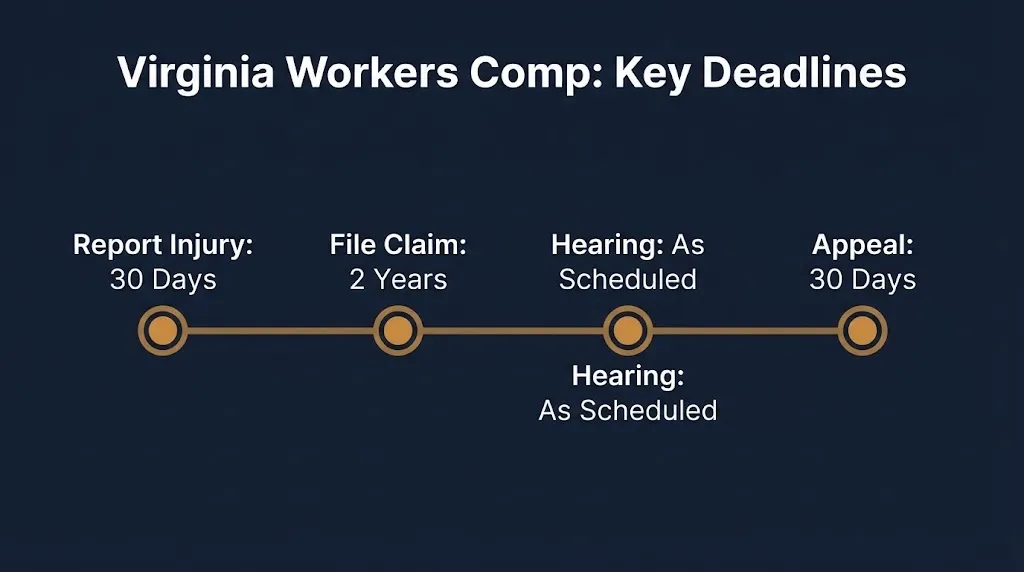
Step one: Report your injury to your employer within 30 days. Give written notice whenever possible.
Step two: Seek medical treatment. Your employer may direct you to a panel of physicians. Follow that process or risk having your care questioned.
Step three: Your employer or its insurer files a First Report of Accident with the Commission within 10 days of learning of the injury.
Step four: If your claim is denied or benefits stop, file a Claim for Benefits form with the Commission. This form is available on the Commission’s website.
Step five: The Commission assigns a file number and may schedule a hearing before a deputy commissioner.
Step six: Attend all hearings, mediations, and medical evaluations. Failure to appear can result in dismissal.
Step seven: If you disagree with the deputy commissioner’s decision, file a review request with the full Commission within 30 days.
| Step | Action | Deadline |
|---|---|---|
| 1 | Report injury to employer | 30 days from injury |
| 2 | Employer files First Report of Accident | 10 days after learning |
| 3 | File Claim for Benefits | 2 years from injury |
| 4 | Attend hearing | As scheduled |
| 5 | Appeal to full Commission | 30 days from decision |
How Long Do You Have to File a Workers Comp Claim in Virginia?
You have two years from the date of your injury to file a claim with the Virginia Workers Compensation Commission.
This two-year statute of limitations is strict. If you miss it, your claim is barred in nearly all cases.
There are narrow exceptions. If your employer paid benefits voluntarily, the two-year clock may start from the last payment date instead of the injury date. If you discover an occupational disease later, the clock may start from the diagnosis date.
Do not rely on exceptions without checking. The safest rule is to file as soon as you know you have an injury.
Reporting to your employer within 30 days is a separate requirement. Failing to report within 30 days can create an issue even if you file within two years.
What Happens at a Virginia Workers Compensation Hearing?
A hearing before a deputy commissioner is less formal than a civil trial but still carries legal weight.
Both sides present evidence. You testify about your injury, your job duties, and your medical treatment. Your employer or insurer may present witnesses and medical records.
The deputy commissioner issues a written opinion, usually within 60 to 90 days after the hearing. The opinion states whether your claim is awarded, denied, or partially awarded.
If you win, the insurer must begin payments according to the order. If you lose, you have 30 days to request review by the full Commission.
Think of the hearing like a store return without a receipt. The store wants proof you bought the item there. The Commission wants proof your injury arose out of and in the course of your employment.
Key Takeaway: Deadlines dominate workers’ compensation. The 30-day notice rule and 2-year filing rule are rigid, and missing either can end a valid claim.
Can You Settle a Virginia Workers Compensation Claim?
Yes. Workers in Virginia can settle their claims through a compromise settlement approved by the Commission.
A compromise settlement usually ends the insurer’s obligation to pay future wage benefits in exchange for a lump sum. Medical benefits may or may not be included depending on the agreement.
The Commission reviews every settlement. For workers without an attorney, a deputy commissioner or the full Commission must approve the settlement at a hearing. The hearing exists to make sure you understand what you are giving up.
Once approved, the settlement is final. You cannot reopen the claim later if your condition worsens.
Settlement amounts vary widely. A minor injury might settle for a few thousand dollars. A permanent total disability claim might settle for hundreds of thousands. Every case hinges on medical evidence and future care costs.
What Is the Role of the Virginia Workers Compensation Commission in Settlements?
The Commission acts as the gatekeeper for every compromise settlement.
It reviews the agreement terms, confirms the worker understands the consequences, and issues an order approving or rejecting the settlement. The approval process protects workers from signing away rights without full knowledge.
The Commission also maintains records of all approved settlements. These records are public and searchable through its online case information system.
For unrepresented workers, the Commission provides a more protective review. Deputy commissioners often question workers directly about their understanding of the settlement and whether anyone pressured them.
This is different from a class action settlement, where a single judge approves a fund for thousands of people. Workers’ compensation settlements are individual agreements, each one reviewed separately.
Are Virginia Workers Compensation Benefits Taxable?
No. Workers’ compensation benefits in Virginia are generally not subject to federal or state income tax.
This includes weekly wage replacement payments and lump sum compromise settlements for physical injuries.
The tax treatment changes only if you also receive Social Security Disability Insurance. In that case, an offset may reduce your Social Security benefit because your combined workers’ compensation and SSDI cannot exceed a certain percentage of your pre-injury earnings.
Do not confuse workers’ compensation with short-term disability insurance purchased through an employer. Those private insurance payments may be taxable if the employer paid the premiums.
| Payment Type | Taxable? |
|---|---|
| Weekly wage replacement | No |
| Permanent partial disability | No |
| Compromise settlement for physical injury | No |
| Private short-term disability | Possibly |
| Social Security Disability offset | Depends on combined income |
What Should You Do If Your Virginia Workers Comp Claim Is Denied?
A denial is not the end of the road.
First, read the denial letter. It must state the reason for denial and your appeal rights.
Second, file a Claim for Benefits with the Commission if the insurer denies liability or stops paying.
Third, gather evidence. Medical records, witness statements, and accident reports all matter.
Fourth, request a hearing. The Commission schedules the hearing, and both sides present their case.
Fifth, consider legal help. Attorneys who handle Virginia workers’ compensation cases typically work on contingency, taking a fee only if you win. The Commission must approve attorney fees.
A denial often comes down to one issue: whether the injury arose out of and in the course of employment. The insurer may argue a pre-existing condition caused your pain, or that your activity fell outside your job duties.
Key Takeaway: Denials are common and reversible. The hearing process exists precisely because insurers and workers often disagree on causation and disability.
How Does the Virginia Workers Compensation Commission Handle Medical Benefits?
Virginia law provides for lifetime medical benefits for injuries that require ongoing care.
The insurer must pay for all reasonable, necessary, and authorized medical treatment related to your work injury. This can include surgeries, physical therapy, prescriptions, and durable medical equipment.
There is no dollar cap on medical benefits, and they can continue for the rest of your life if your injury requires ongoing treatment.
The trade-off is control over providers. Your employer may direct you to a panel of physicians. You must choose from that panel for the initial treatment. Later referrals can expand your options.
Reality Check: No one from the Commission or any insurance company will text you asking for money to release your benefits. Filing a claim costs nothing. Third-party services that charge fees to “expedite” your claim are unnecessary and often unhelpful.
What Are the Most Common Mistakes in Virginia Workers Comp Claims?
The most common mistake is waiting too long to report the injury.
Workers sometimes assume the pain will go away or fear retaliation. Virginia law protects workers who file claims from discrimination, but the 30-day reporting rule still applies.
Another common mistake is missing the two-year filing deadline. The clock starts on the injury date, not the date you first consult a lawyer.
A third mistake is failing to follow medical advice. Insurers routinely stop payments when workers miss appointments or ignore treatment plans.
A fourth mistake is settling too early. Once you sign a compromise settlement, you cannot return for more money later. Future surgeries and complications belong to you.
A fifth mistake is going it alone at a hearing without understanding the burden of proof. The worker must prove the injury arose out of and in the course of employment.
What Is the Future of Virginia Workers Compensation in 2026?
The Commission continues to modernize its filing and hearing systems in 2026.
Electronic filing is now standard for most forms. Hearings may be held in person or by video conference depending on the region and the deputy commissioner’s preference.
The annual rate adjustment remains the most predictable change each year. The July 1, 2026 increase to $1,487 reflects the rising state average weekly wage.
No major legislative overhaul of Virginia workers’ compensation law took effect in 2026. The last significant changes involved COVID-19 presumptions for certain workers, which expired after the public health emergency ended.
If you are currently receiving benefits, your rate does not automatically increase each July. Your rate is locked to your injury date unless the Commission orders otherwise.
Key Takeaway: The Commission’s processes are stable in 2026. The biggest risk to most workers is not a changing law but missed deadlines and incomplete medical evidence.
What Happens Next
- Immediately: Report any new workplace injury to your employer in writing within 30 days.
- Within 2 years of injury: File a Claim for Benefits with the Commission if your claim is denied.
- Expected 2027: The Commission will announce the next annual rate adjustment effective July 1, 2027.
- Ongoing: The Commission continues to process hearings, mediations, and settlement approvals without a backlog crisis.
Frequently Asked Questions
Is the Virginia Workers Compensation Commission the same as a settlement fund?
No. The Commission is a state agency that resolves disputes and approves settlements. It is not a settlement fund open to all workers.
How much money can I get from a Virginia workers comp claim?
Your benefit is two-thirds of your pre-injury average weekly wage, capped at $1,487 per week for 2026 injuries.
How long does a Virginia workers comp case take?
A simple uncontested case may resolve in months. A disputed case with hearings and appeals can take a year or more.
Do I need a lawyer for a Virginia workers comp claim?
Not always, but lawyers help with denials, settlements, and permanent disability ratings. Most work on contingency.
What happens if I miss the 30-day reporting deadline?
Your claim may face additional scrutiny, but you may still file within the 2-year statute of limitations. Report anyway.
Can I reopen a settled workers comp claim in Virginia?
No. Approved compromise settlements are final. You cannot reopen a settled claim even if your condition worsens.
Are workers comp benefits in Virginia taxable?
No. Workers’ compensation benefits are generally not subject to federal or state income tax.
What does the Virginia Workers Compensation Commission do about uninsured employers?
The Commission enforces coverage requirements and maintains an uninsured employer fund to pay claims against non-compliant employers.
The most important date in your workers’ compensation case is your injury date. It controls your wage rate, your deadlines, and your benefit cap. Write it down and keep it with your medical records.
If you have a pending claim, check the Commission’s online case information system for hearing dates and orders. File your forms on time, attend your hearings, and get medical treatment consistently.