Ohio Workers’ Compensation 2026: Claims, Benefits, and BWC Rules Explained
Quick Answer:
- Ohio workers’ compensation is real and mandatory for most employers with one or more employees.
- Benefits cover medical costs and a portion of lost wages, not pain and suffering.
- Injured workers must report injuries within specific timeframes, often within one year for most claims.
The Ohio workers’ compensation system provides no-fault benefits to employees injured on the job. The Ohio Bureau of Workers’ Compensation (BWC) administers the state fund.
You may qualify for medical coverage, wage replacement, and vocational rehabilitation if your injury or illness arose from work. The system replaces lawsuits against employers in most cases.
This guide covers how Ohio workers’ compensation works, how much it pays, how to file, and what to expect in 2026. One surprising fact: Ohio is one of only four states with a monopolistic state-run system, meaning most employers cannot buy private coverage.
The Facts
| Case | Ohio workers’ compensation system, not a lawsuit |
| Status | Active state program administered by BWC |
| Fund Size | State insurance fund, multi-billion dollar reserve |
| Est. Per Person | Varies by average weekly wage and impairment rating |
| Claim Deadline | Generally one year from injury, but report immediately |
| Administrator | Ohio Bureau of Workers’ Compensation |
| Proof Needed | Medical records, incident report, employer notice |
Is the Ohio Bureau of Workers’ Compensation Real?
Yes, the Ohio Bureau of Workers’ Compensation is a real state agency that administers workers’ compensation claims for Ohio employees.
The BWC was created by state law and operates as the exclusive provider of workers’ compensation insurance for most Ohio employers. Self-insured employers exist, but they must meet strict financial standards.
The agency handles claims, pays medical bills, issues wage replacement checks, and manages the state insurance fund. Employers pay premiums into the fund.
If you were injured at work in Ohio, the BWC is the agency you deal with unless your employer is self-insured. Even then, the same state laws apply.
How Much Does Ohio Workers’ Compensation Pay?
Ohio workers’ compensation pays a portion of your lost wages and covers all reasonable and necessary medical treatment.
Wage replacement is typically 72 percent of your average weekly wage for the first 12 weeks of disability. After that, the rate shifts to 66.67 percent for temporary total disability.
Payments are subject to a statewide maximum. The maximum weekly benefit rate adjusts annually based on the statewide average weekly wage.
Medical benefits cover doctor visits, hospital stays, prescriptions, physical therapy, and durable medical equipment. There is no copay for approved treatment.
Ohio workers’ compensation wage benefits:
| Benefit Type | Rate | Duration |
|---|---|---|
| Temporary total disability | 72% for first 12 weeks, then 66.67% | Until maximum medical improvement |
| Permanent partial disability | Based on impairment rating | Varies by body part and percentage |
| Permanent total disability | 66.67% of average weekly wage | Ongoing if eligible |
| Death benefits | Varies by dependents | Ongoing for surviving spouse or children |
Key Takeaway: Wage replacement covers roughly two-thirds of your pay. Medical care is fully covered when approved.
How Do You File an Ohio Workers’ Compensation Claim?
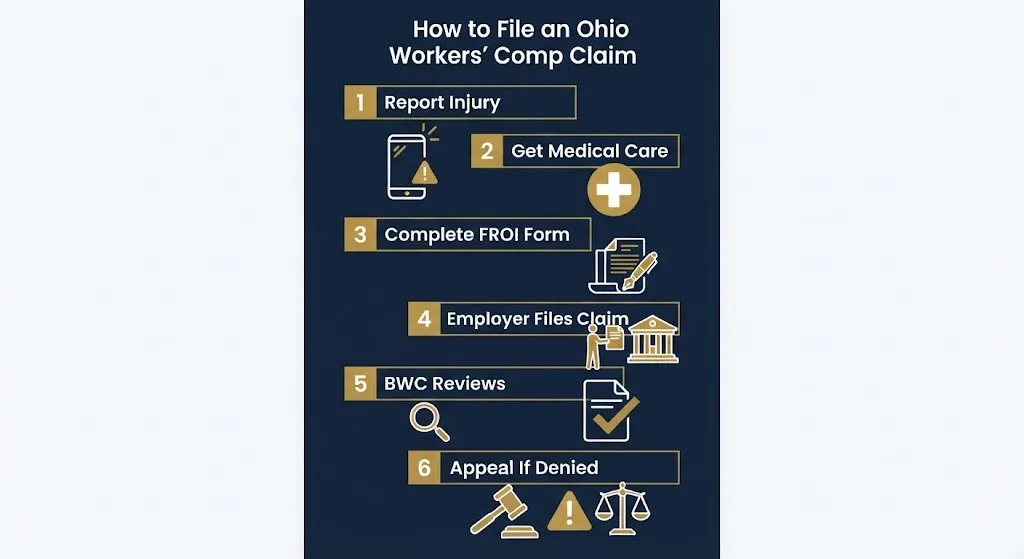
You file an Ohio workers’ compensation claim by reporting your injury to your employer and completing a First Report of Injury form.
Your employer must file the claim with the BWC or their self-insured administrator. You should also file your own claim to protect your rights.
The BWC assigns a claim number and investigates. A claims examiner reviews medical evidence and makes a decision on allowance or denial.
If your claim is denied, you can appeal to the Industrial Commission of Ohio. Deadlines for appeals are strict.
Steps to file a claim:
- Report the injury to your employer immediately, ideally in writing.
- Seek medical treatment and tell the provider it is work-related.
- Complete the First Report of Injury (FROI) form.
- Your employer files the FROI with the BWC or their administrator.
- The BWC assigns a claim number and begins review.
- A claims examiner approves or denies the claim.
- If denied, appeal to the Industrial Commission of Ohio.
Reality Check: You do not need to pay anyone to file a workers’ compensation claim. Filing is free through the BWC. Avoid third-party services that charge fees for forms you can complete yourself.
What Injuries Qualify for Ohio Workers’ Compensation?
Ohio workers’ compensation covers injuries and illnesses that arise out of and occur in the course of employment.
Physical injuries from accidents qualify. So do repetitive motion injuries, occupational diseases, and mental conditions caused by physical injury.
Pre-existing conditions that worsen due to work may qualify. You must show the work made the condition measurably worse.
Injuries from horseplay, intoxication, or intentional self-harm generally do not qualify. Off-duty injuries also do not qualify.
Qualifying injury examples:
- Falls from ladders or scaffolding
- Back injuries from lifting
- Repetitive strain injuries like carpal tunnel
- Occupational hearing loss
- Lung conditions from workplace exposure
- Burns from chemicals or equipment
Key Takeaway: The injury must be work-related. Your medical records and incident report must support the connection.
What Is the Ohio BWC Claim Deadline?
The general deadline to file an Ohio workers’ compensation claim is one year from the date of injury.
For occupational diseases, the deadline may run from the date you knew or should have known the condition was work-related. Some claims have shorter notice requirements.
You must report the injury to your employer immediately. Delays can hurt your claim even if you file within one year.
Missing the deadline bars your claim. Courts and the Industrial Commission rarely extend the filing window without extraordinary circumstances.
How Does Ohio Workers’ Compensation Insurance Work?
Ohio operates a monopolistic workers’ compensation system, meaning most employers must buy coverage through the BWC.
Private insurance companies do not sell workers’ compensation policies in Ohio. Employers pay premiums to the state fund.
Large employers can apply for self-insured status. They must prove financial stability and post security. Self-insured employers pay claims directly but follow the same state laws.
The system is designed to provide uniform benefits and reduce litigation. In exchange, employees give up the right to sue their employer for most work injuries.
Key Takeaway: You cannot buy a private workers’ compensation policy in Ohio. Coverage comes through the state fund or a self-insured employer.
Can You Sue Your Employer Instead of Filing a Workers’ Comp Claim?
Generally no. Ohio workers’ compensation is the exclusive remedy for work injuries, meaning you cannot sue your employer.
The tradeoff is built into the system. You get no-fault benefits without proving negligence, but you lose the right to sue for pain and suffering.
There are narrow exceptions. You may sue if your employer intentionally caused your injury. That standard is high and requires proof of deliberate intent to harm.
You can sue third parties. If a defective machine or a negligent contractor caused your injury, a separate liability claim may exist against that party.
What Is the Ohio BWC Settlement Process?
Ohio workers’ compensation claims can settle through a process called a settlement agreement or a BWC compromise.
Settlements typically resolve future benefits for a lump sum. The settlement must be approved by the Industrial Commission of Ohio.
Not all claims settle. The BWC and the injured worker must agree on the amount and scope. Settlements often include a resignation from employment.
Settlement amounts vary widely. They depend on the injury severity, future medical needs, and wage loss. No standard formula applies.
Settlement considerations:
- Current and future medical treatment costs
- Permanent impairment rating
- Age and life expectancy
- Ability to return to work
- Outstanding disputes over benefits
Key Takeaway: Settlements are case-specific and require Industrial Commission approval. No one can guarantee a settlement amount.
What Happens If Your Ohio Workers’ Comp Claim Is Denied?
If your Ohio workers’ compensation claim is denied, you can appeal to the Industrial Commission of Ohio.
The appeal process involves a hearing before a district hearing officer. You can present medical evidence, witness testimony, and legal argument.
Further appeals go to the staff hearing officer level, then the full Industrial Commission, and finally to state court.
Deadlines are strict. You generally have 14 days to appeal a decision to the next level. Missing a deadline can end your claim.
Appeal levels:
- District hearing officer
- Staff hearing officer
- Industrial Commission full board
- Court of Common Pleas
- Court of Appeals
How Do You Check Your Ohio Workers’ Comp Claim Status?
You can check your Ohio workers’ compensation claim status through the BWC online portal or by phone.
The BWC website allows registered users to view claim information, payment history, and hearing dates. You need your claim number and personal identification.
Your employer’s managed care organization (MCO) also tracks medical treatment and can answer questions about medical approvals.
For self-insured claims, contact your employer’s workers’ compensation administrator directly.
Steps to check status:
- Visit the BWC online portal.
- Log in with your claim number and credentials.
- View claim status, payments, and upcoming hearings.
- Call the BWC customer contact center for phone assistance.
- Contact your MCO for medical-specific questions.
What Happens Next in Ohio Workers’ Compensation in 2026?
Ohio workers’ compensation in 2026 faces potential changes in benefit rates, medical fee schedules, and employer premium rules.
The BWC typically adjusts the maximum weekly benefit rate each January based on the statewide average weekly wage. The 2026 rate has been published but varies by claim date.
Legislative proposals affecting workers’ compensation sometimes surface in the Ohio General Assembly. No major bill has been confirmed as passed for 2026.
The BWC continues to emphasize workplace safety programs and return-to-work initiatives. Employers with good safety records can earn premium discounts.
Expected developments:
| Date | Development |
|---|---|
| January 2026 | Annual maximum weekly benefit rate adjustment |
| 2026 | BWC premium rate-setting announcements |
| 2026 | Industrial Commission hearing schedule continues |
| TBD | Possible legislative changes to benefit rules |
| TBD | New managed care organization contracts |
Frequently Asked Questions
Is Ohio workers’ compensation mandatory?
Yes, Ohio workers’ compensation is mandatory for most employers with one or more employees.
The BWC is the exclusive state fund.
Self-insured employers must meet strict financial standards.
How much does Ohio workers’ comp pay per week?
Ohio workers’ comp pays 72 percent of your average weekly wage for the first 12 weeks.
After that, the rate drops to 66.67 percent.
Payments are capped at the statewide maximum weekly rate.
How long do you have to file a workers’ comp claim in Ohio?
You generally have one year from the injury date to file.
Occupational disease claims may have different deadlines.
Report injuries to your employer immediately.
Can you be fired for filing a workers’ comp claim in Ohio?
Ohio law prohibits retaliation for filing a workers’ compensation claim.
If your employer fires you for filing, you may have a separate claim.
Document everything and contact an attorney if retaliation occurs.
Does Ohio workers’ comp pay for pain and suffering?
No, Ohio workers’ compensation does not pay for pain and suffering.
It covers medical care and wage loss only.
Pain and suffering damages require a third-party lawsuit outside workers’ comp.
Can you work while receiving Ohio workers’ comp benefits?
You may work light duty and receive partial benefits.
Working full duty while receiving temporary total disability is prohibited.
Report all income to the BWC to avoid overpayment issues.
What is the maximum workers’ comp rate in Ohio for 2026?
The maximum weekly rate adjusts annually based on the statewide average weekly wage.
The exact 2026 figure is published by the BWC.
Check the BWC website for the current maximum rate.
Ohio workers’ compensation provides critical benefits but comes with strict deadlines and procedural rules. Report injuries immediately, file early, and track your claim status through the BWC.
The single most important deadline is the one-year filing window. Missing it bars your claim. Act the day you are injured.