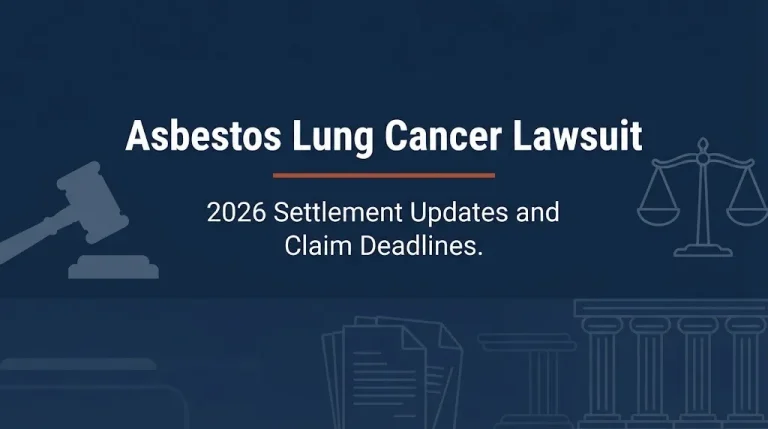
Asbestos Lawsuits 2026: Claim Types, Payout Ranges, and Filing Deadlines
Quick Answer:
- Asbestos lawsuits are real and ongoing, with over $30 billion in trust fund assets still available to claimants.
- Payouts vary widely, from a few thousand dollars to over $1 million depending on diagnosis and exposure history.
- Deadlines vary by state and trust fund, with many requiring filing within 1 to 3 years of diagnosis.
Asbestos lawsuits remain active in 2026, more than five decades after the first wave of litigation began. The claims process has evolved into a system of bankruptcy trusts and direct lawsuits against solvent companies.
If you or a family member received a mesothelioma, lung cancer, or asbestosis diagnosis, you may have legal options. The most important number to know: many asbestos trusts still hold billions in unpaid funds.
This article covers what is verified about claim types, payout ranges, filing deadlines, and how the system works today. One surprising detail: asbestos trusts have paid over $25 billion to date, and new claims are filed every month.
The Facts
| Case | Various asbestos personal injury and wrongful death claims |
| Status | Active, ongoing filings against trusts and solvent defendants |
| Fund Size | Over $30 billion across active trusts |
| Est. Per Person | Varies by diagnosis, exposure, and trust |
| Claim Deadline | Varies by state and trust |
| Administrator | Individual trust administrators |
| Proof Needed | Medical records, exposure history, employment records |
Is the Asbestos Lawsuit System Still Active in 2026?
The asbestos lawsuit system is still active in 2026, with thousands of new claims filed annually and billions in trust fund assets available.
Asbestos litigation is not one case. It is a collection of individual lawsuits and trust claims against companies that manufactured, sold, or used asbestos-containing products.
The system operates through two main channels. Bankruptcy trusts process claims against companies that have filed for Chapter 11 protection. Direct lawsuits target companies that remain solvent.
More than 60 asbestos bankruptcy trusts exist today. Each trust operates independently with its own claim forms, payment percentages, and deadlines.
The total remaining assets across active trusts exceed $30 billion. This money is set aside specifically to compensate current and future asbestos victims.
New mesothelioma diagnoses continue to occur. The latency period between asbestos exposure and disease development can span 20 to 50 years. Workers exposed in the 1970s and 1980s are still being diagnosed today.
The system faces ongoing challenges. Some trusts have reduced payment percentages due to high claim volumes. Others have faced fraud allegations that led to stricter documentation requirements.
Key Takeaway: The asbestos claim system is active, funded, and accepting new claims, but the process is complex and requires solid documentation.
How Much Are Asbestos Lawsuit Payouts?
Asbestos lawsuit payouts vary dramatically based on diagnosis type, exposure history, and the specific trust or defendant involved.
Mesothelioma cases typically produce the highest payouts. The disease is almost exclusively linked to asbestos exposure, making causation easier to prove. Individual settlements often exceed $100,000, and some cases reach $1 million or more when multiple defendants are involved.
Lung cancer claims with documented asbestos exposure and smoking history produce moderate payouts. The presence of smoking complicates causation. Trusts apply lower payment percentages to these claims.
Asbestosis claims produce lower payouts than cancer claims. Asbestosis is a scarring of the lungs that can impair breathing but is not fatal in most cases. Payouts often range from $10,000 to $100,000 depending on severity.
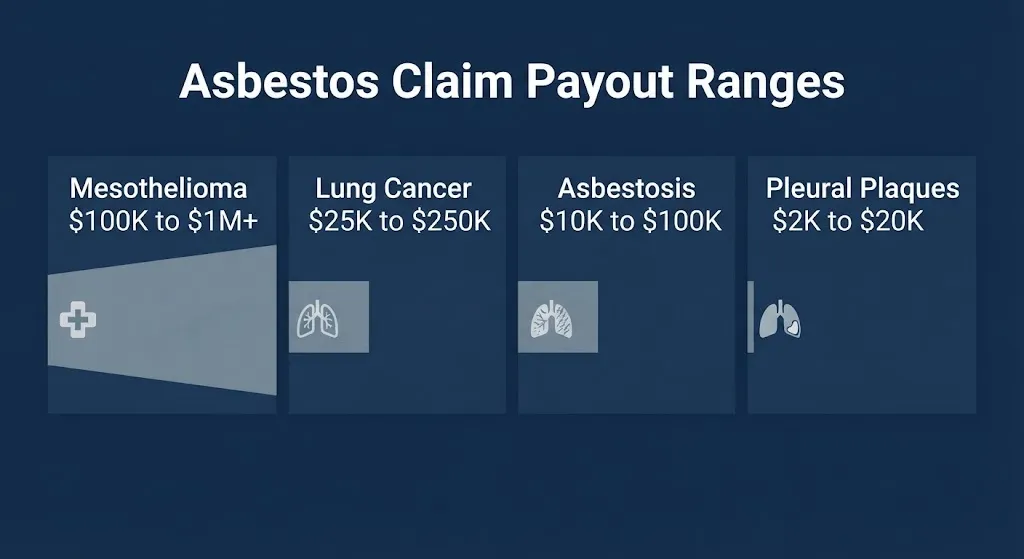
Here is the typical payout range table:
| Diagnosis | Typical Range |
| Mesothelioma | $100,000 to $1,000,000+ |
| Lung Cancer (with asbestos exposure) | $25,000 to $250,000 |
| Asbestosis | $10,000 to $100,000 |
| Pleural Plaques | $2,000 to $20,000 |
| Wrongful Death | Varies by diagnosis and state |
These ranges come from reported settlement data and trust payment schedules. They are not guarantees. Every case depends on specific facts.
Reality Check: No one can promise you a specific asbestos payout. Any service that guarantees a dollar amount before reviewing your medical records and exposure history is not credible. Legitimate asbestos attorneys work on contingency and only get paid if you recover money.
Who Qualifies to File an Asbestos Lawsuit?
You may qualify to file an asbestos lawsuit if you have a diagnosed asbestos-related disease and a documented history of asbestos exposure.
The diagnosis must be confirmed by medical testing. Mesothelioma requires biopsy confirmation. Lung cancer requires pathology reports. Asbestosis requires imaging studies and pulmonary function tests.
Exposure history matters. You must identify where and when you were exposed to asbestos. Common exposure sites include construction sites, shipyards, factories, power plants, and military service.
Occupations with high asbestos exposure risk include:
- Insulators and pipefitters
- Shipyard workers
- Construction workers
- Auto mechanics working with brake linings
- Power plant workers
- Factory workers in asbestos product manufacturing
- Military veterans, especially Navy personnel
The exposure does not need to be recent. The law recognizes that asbestos diseases develop decades after exposure. The relevant question is whether you can identify the source.
Secondary exposure counts in some cases. Spouses who washed work clothes covered in asbestos fibers have successfully filed claims.
Documentation is essential. Employment records, union records, military service records, and coworker testimony all support exposure claims.
Key Takeaway: A confirmed diagnosis plus a credible exposure history are the two essential qualification factors for any asbestos claim.
How to File an Asbestos Lawsuit or Trust Claim
Filing an asbestos lawsuit or trust claim involves multiple steps and typically requires an experienced attorney.
Here is the step-by-step process:
- Obtain your medical records confirming the asbestos-related diagnosis.
- Gather employment records, military records, or other documentation of exposure.
- Contact an asbestos litigation attorney for a free case evaluation.
- Provide all medical and exposure documentation to the attorney.
- The attorney identifies all potentially liable companies and available trusts.
- Claims are filed with each bankruptcy trust using the trust’s specific forms.
- Direct lawsuits are filed against solvent defendants where applicable.
- Trusts review claims and issue payment offers based on their schedules.
The process is similar to filing a complex insurance claim. You need documentation, patience, and professional help to navigate the system.
Do not attempt to file trust claims without legal representation. The forms are complex, the deadlines are strict, and the payment percentages vary by trust.
Most asbestos attorneys work on contingency. You pay nothing upfront. The attorney receives a percentage of any recovery, typically 25 to 40 percent depending on the state and case complexity.
Time matters. Some trusts require claims to be filed within 1 to 3 years of diagnosis. State statutes of limitations for direct lawsuits range from 1 to 6 years depending on the state.
What Is the Average Asbestos Settlement?
The average asbestos settlement varies by diagnosis type, but mesothelioma settlements average between $1 million and $1.4 million across multiple defendants.
This figure comes from reported settlement data across the asbestos litigation system. It represents the total recovery from all trusts and defendants combined, not a single payment.
Lung cancer settlements average lower, typically between $200,000 and $400,000 when asbestos exposure is documented. Smoking history reduces the average.
Asbestosis settlements average between $50,000 and $150,000 depending on severity and jurisdiction.
The settlement average masks wide variation. Some mesothelioma cases settle for less than $100,000 when exposure is weak or documentation is thin. Others exceed $5 million when multiple defendants are involved and the plaintiff is young.
The number of available defendants matters. Each defendant or trust contributes a portion of the total recovery. A claimant who can file against 10 trusts will typically recover more than one who can only file against one.
Settlement timing varies. Trust claims may resolve within months. Direct lawsuits can take one to three years to settle. Trials take longer.
The comparison to a home insurance claim fits here. The total payout depends on the damage, the policy limits, and the number of policies that apply.
Key Takeaway: Averages are useful reference points, but your specific recovery depends on your diagnosis, exposure, and available defendants.
What Is the Statute of Limitations for Asbestos Claims?
The statute of limitations for asbestos claims varies by state, typically ranging from 1 to 6 years from diagnosis or death.
The clock starts when the disease is discovered, not when the exposure occurred. This discovery rule is critical for asbestos cases because the latency period can span decades.
For personal injury claims, the deadline typically runs from the date of diagnosis. For wrongful death claims, it runs from the date of death.
Some states use different rules for different claim types. Trust claims have their own deadlines set by each trust’s distribution procedures.
Most asbestos trusts require filing within 2 to 3 years of diagnosis. Some allow longer. The exact deadline depends on the specific trust.
If you wait too long, you lose the right to file. This deadline applies to lawsuits and often to trust claims as well.
The safest approach is to contact an attorney immediately after diagnosis. Waiting to gather documentation while deadlines pass is the most common preventable mistake.
Do not assume you have plenty of time. Some states have statutes of repose that cut off claims after a certain number of years from exposure, regardless of diagnosis date. These are rare but can apply.
Are There Asbestos Class Action Lawsuits?
Asbestos class action lawsuits are rare in 2026. The asbestos litigation system operates primarily through individual claims and multidistrict litigation, not class actions.
The U.S. Supreme Court effectively ended most asbestos class actions in the 1990s. The Court ruled that asbestos victims are too diverse for class treatment because each person’s diagnosis, exposure, and damages differ.
What exists instead is a system of individual claims. Each claimant files separately, either through bankruptcy trusts or direct lawsuits.
Multidistrict litigation consolidates pretrial proceedings for efficiency. The federal asbestos multidistrict litigation, MDL 875, has operated since 1991 in the Eastern District of Pennsylvania. It consolidates cases for discovery and pretrial motions, but each case remains individual.
Some class actions still exist for specific narrow issues, such as property damage from asbestos in buildings. These are separate from personal injury claims.
If you see an advertisement for an “asbestos class action settlement,” approach it with skepticism. It may be referring to a specific trust distribution or a narrow property damage settlement, not a personal injury class action.
The individual claim structure benefits most victims. It allows for higher payouts tailored to specific circumstances rather than dividing a fixed fund among a large class.
Key Takeaway: Asbestos personal injury claims are individual, not class actions, and each case is evaluated on its own facts.
What Are Asbestos Bankruptcy Trusts?
Asbestos bankruptcy trusts are funds established by companies that filed for bankruptcy protection to compensate current and future asbestos victims.
The trust system began with the Johns Manville bankruptcy in 1982. Since then, more than 60 companies have established trusts through Chapter 11 reorganization.
Each trust operates under a Trust Distribution Procedures document approved by the bankruptcy court. This document sets payment percentages, claim categories, and filing deadlines.
The payment percentage is critical. Most trusts pay only a fraction of the claim’s full value. For example, a trust with a 25 percent payment percentage pays $25,000 on a $100,000 claim.
Here are some of the largest active trusts:
| Trust | Approximate Assets |
| Johns Manville | $2.5 billion |
| Owens Corning/Fibreboard | $2.0 billion |
| WR Grace | $1.5 billion |
| USG | $1.3 billion |
| Armstrong World Industries | $1.0 billion |
These figures are approximate and change as claims are paid and investments fluctuate.
Filing a trust claim requires specific documentation. Medical records must meet the trust’s diagnostic criteria. Exposure must be documented to the specific products manufactured by the company that established the trust.
Trust claims can resolve faster than lawsuits. Many trusts process claims within 6 to 12 months when documentation is complete.
What Companies Are Still Being Sued for Asbestos?
Companies still being sued for asbestos in 2026 include manufacturers, distributors, and premises owners that remain solvent.
The original asbestos manufacturers largely filed for bankruptcy decades ago. The companies that remain as defendants are typically those with asbestos liabilities that did not push them into insolvency.
Active defendants include:
- Industrial equipment manufacturers like Crane Co. and Flowserve
- Pump and valve manufacturers
- Gasket and packing manufacturers
- Brake manufacturers like Ford and General Motors in certain cases
- Premises owners like power utilities and refineries
- Talc suppliers facing asbestos contamination claims
The talc litigation is a distinct branch of asbestos claims. Some talc products contained trace asbestos that plaintiffs claim caused mesothelioma and ovarian cancer. Johnson & Johnson has faced thousands of such claims.
The specific defendants in your case depend on your exposure history. An attorney must trace your exposure to identify which companies’ products you encountered.
Some defendants have established their own trusts through bankruptcy. Others remain solvent and defend cases individually.
The solvent defendant pool has shrunk over time. This makes identifying every potential source of recovery more important than ever.
Key Takeaway: While the original asbestos companies are largely bankrupt, many solvent defendants remain, and identifying all of them maximizes recovery.
What Is Mesothelioma?
Mesothelioma is a rare and aggressive cancer affecting the lining of the lungs, abdomen, or heart, caused almost exclusively by asbestos exposure.
The disease develops decades after exposure. The average latency period is 30 to 40 years, though shorter periods occur with heavy exposure.
There are several types of mesothelioma. Pleural mesothelioma affects the lung lining and is most common. Peritoneal mesothelioma affects the abdominal lining. Pericardial mesothelioma affects the heart lining and is extremely rare.
There is no cure for mesothelioma. Treatment options include surgery, chemotherapy, radiation, and immunotherapy. The five-year survival rate remains below 10 percent.
Mesothelioma is the primary driver of asbestos litigation. The disease’s clear link to asbestos exposure makes causation relatively easy to prove compared to other asbestos-related conditions.
The prognosis is typically poor. Median survival after diagnosis ranges from 12 to 21 months depending on the type and stage.
If you receive a mesothelioma diagnosis, the legal system treats your claim with priority. Some courts and trusts expedite mesothelioma cases due to the shortened life expectancy.
The medical evidence requirements for mesothelioma claims are strict. Biopsy confirmation is typically required for trust claims and direct lawsuits.
What Is Asbestosis?
Asbestosis is a chronic lung disease caused by inhaling asbestos fibers that scar the lung tissue over time.
The scarring, called fibrosis, reduces lung elasticity. Breathing becomes progressively more difficult. The condition is not cancer but can be disabling.
Symptoms include shortness of breath, persistent cough, chest tightness, and finger clubbing in advanced cases. Symptoms typically develop 10 to 20 years after exposure.
Asbestosis is diagnosed through imaging studies, typically high-resolution CT scans, combined with pulmonary function tests and a documented exposure history.
The disease is progressive but not always fatal. Many people live with asbestosis for years. Others develop complications including respiratory failure or lung cancer.
In the legal system, asbestosis claims fall into a lower compensation tier than cancer claims. The payouts reflect the non-fatal nature of the condition and the greater difficulty proving causation.
The condition also increases the risk of developing lung cancer or mesothelioma later. Some claims include compensation for this increased risk.
If you have asbestosis, medical monitoring is essential. Regular chest imaging and pulmonary function testing track disease progression and detect cancer early.
Key Takeaway: Asbestosis is a serious but non-cancerous lung condition that qualifies for lower-tier asbestos compensation than cancer diagnoses.
What Is the Difference Between Mesothelioma and Asbestosis?
Mesothelioma is a cancer, while asbestosis is a scarring condition. Both result from asbestos exposure but differ in severity, treatment, and legal value.
The key differences:
| Feature | Mesothelioma | Asbestosis |
| Cause | Asbestos exposure | Asbestos exposure |
| Type | Cancer of organ linings | Lung tissue scarring |
| Latency | 30 to 40 years typical | 10 to 20 years typical |
| Treatment | Surgery, chemo, immunotherapy | Symptom management, oxygen |
| Prognosis | Median survival 12 to 21 months | Variable, often chronic |
| Legal Value | Highest tier | Lower tier |
Mesothelioma is almost exclusively linked to asbestos. This makes causation easier to prove in legal claims.
Asbestosis requires heavier or longer exposure typically. The condition reflects cumulative damage rather than a single exposure event.
The legal distinction matters for compensation. Mesothelioma claims receive priority in trust review queues and higher payment amounts. Asbestosis claims face more scrutiny and lower payouts.
Both conditions qualify for workers compensation in some cases. However, workers compensation payouts for asbestos conditions are typically far lower than civil lawsuit recoveries.
If you have either diagnosis, the legal clock is running. Contact an attorney promptly to preserve your rights.
How Long Does an Asbestos Lawsuit Take?
An asbestos lawsuit can take anywhere from a few months to several years, depending on the claim type and venue.
Bankruptcy trust claims resolve fastest. When documentation is complete, many trusts process claims within 6 to 12 months. Expedited review for mesothelioma claims can reduce this to weeks in some trusts.
Direct lawsuits against solvent defendants take longer. Settlements typically occur within one to three years. Trials can take three to five years or longer, especially with appeals.
The discovery phase drives much of the delay. Both sides exchange documents, take depositions, and develop expert testimony. Asbestos cases involve extensive historical research into product identification and exposure.
Some jurisdictions have special asbestos dockets designed to move cases faster. These courts schedule frequent status conferences and set firm trial dates.
The plaintiff’s health affects timing. Courts often expedite cases for plaintiffs with shortened life expectancies. Some jurisdictions allow preferential trial settings for terminally ill plaintiffs.
The comparison to a delayed tax refund fits here. The system eventually processes your claim, but the exact timeline depends on complexity, caseload, and whether anything gets flagged for review.
Key Takeaway: Trust claims resolve in months, but direct lawsuits against solvent defendants can take years.
What Happens Next for Asbestos Litigation in 2026?
Here is the expected timeline for asbestos litigation developments in 2026:
Throughout 2026: New mesothelioma and lung cancer claims continue to be filed with trusts and courts.
Early to Mid 2026: Several trusts may adjust payment percentages based on claim volumes and asset performance.
Mid 2026: Federal courts continue processing cases in MDL 875, with trial settings scheduled throughout the year.
Late 2026: Potential legislative activity on asbestos trust transparency requirements.
Ongoing: Medical advances in mesothelioma treatment may affect survival rates and claim values over time.
The system remains active and funded. No single deadline applies to all asbestos claims. Each trust and each state has its own rules.
The most important date for you is the one tied to your diagnosis. The clock starts when you learn you have an asbestos-related condition.
Frequently Asked Questions
Is there a class action lawsuit for asbestos?
No, asbestos personal injury claims are individual cases, not class actions.
How much can I get from an asbestos claim?
Payouts range from a few thousand dollars for minor conditions to over $1 million for mesothelioma.
What is the deadline to file an asbestos claim?
Deadlines vary by state and trust, typically 1 to 3 years from diagnosis or death.
Can family members file after someone dies from asbestos?
Yes, surviving family members can file wrongful death claims within the applicable deadline.
Do I need to prove where I was exposed to asbestos?
Yes, you must identify the source of exposure, typically through employment or military records.
Can I file an asbestos claim for a relative who died years ago?
Possibly, if the death was recent and the statute of limitations has not expired.
Is there money left in asbestos trust funds?
Yes, over $30 billion remains in active trusts as of 2026.
How long does an asbestos trust claim take?
Most trust claims resolve within 6 to 12 months when documentation is complete.
If you have an asbestos-related diagnosis, gather your medical records and exposure history now. Contact an experienced asbestos attorney for a free evaluation.
The most important deadline is the one tied to your diagnosis date. Do not wait. The clock is running.