Workers Compensation Lawyer 2026: What Workmen Compensation Attorneys Actually Cost and Do
Quick Answer
- A workers compensation lawyer works on contingency: no fee unless you recover benefits, capped at 25% in Colorado.
- Estimated payout is not one fixed number, it depends on your wage, impairment rating, and state.
- Colorado’s filing deadline is two years from your injury date for the WC-15 claim form.
If you got hurt on the job and started searching “workers compensation lawyer,” here’s the direct answer: you almost never pay anything upfront. Most workmen compensation attorneys, in Colorado and nationwide, work on contingency and only collect a fee if they win you benefits or a settlement.
This matters most to anyone whose claim was denied, whose checks stopped, or whose employer is pushing them back to work before a doctor clears it. Colorado workers have a hard two-year deadline to file the formal claim form, and missing early reporting windows can complicate a case even before a lawyer gets involved.
This article covers what these lawyers cost, what they actually do, how Colorado’s rules differ from other states, and what a recent 2026 push through the legislature changed about attorney fees. One detail that surprises a lot of injured workers: Colorado’s fee cap was 20% for years before lawmakers raised it to 25% in 2023.
The Facts
| Item | Detail |
|---|---|
| What this is | General guide to hiring a workers’ compensation attorney, not one specific case or lawsuit |
| Fee structure | Contingency, most states 10% to 25% of recovery |
| Colorado fee cap | 25% of contested benefits (raised from 20% by HB23-1076) |
| Colorado filing deadline | 2 years from date of injury (WC-15 form), 30 days for occupational disease from manifestation |
| Colorado injury reporting deadline | 10 working days, in writing to your employer |
| Upfront cost | Not yet determined by case, but standard practice is $0 upfront |
| Where Colorado claims go | Colorado Division of Workers’ Compensation, Department of Labor and Employment |
Never treat any dollar figure here as a promise. Your payout depends on your wage, your injury, your state, and facts a lawyer has not yet reviewed.
Is Hiring a Workers Compensation Lawyer Worth It?
Hiring a workers compensation lawyer is worth it when your claim is denied, delayed, or your benefits don’t match your injury. It is not always necessary for a clean, undisputed claim.
Simple cases with quick employer admission and full benefit payment often resolve without an attorney. The math changes fast once an insurer disputes your injury, cuts off medical care, or lowballs a settlement offer.
A denied claim is a lot like a denied insurance claim after a car accident: the first answer is rarely the final one, and appeals exist for a reason.
When to seriously consider a lawyer:
- Your claim was denied or contested.
- Your benefits stopped without explanation.
- You received a permanent impairment rating you disagree with.
- Your employer retaliated after you filed.
- You’re being pushed back to work before a doctor clears you.
Workmen Compensation Attorneys vs. Workers Compensation Lawyers: Is There a Difference?
There is no legal difference between a “workmen compensation attorney” and a “workers compensation lawyer.” Both terms describe the same type of licensed attorney who handles workplace injury claims.
“Workmen’s compensation” is the older, historical name for the same system most states now call “workers’ compensation.” You’ll still see the older phrase in search terms, older law firm names, and some state statute titles.
Key Takeaway: A workmen compensation attorney and a workers compensation lawyer are the same license, the same job, and the same fee rules, only the name has changed.
How Much Does a Workers Compensation Lawyer Cost?
A workers compensation lawyer typically costs nothing upfront. Most attorneys are paid on contingency, meaning the fee comes only out of benefits or a settlement they actually recover for you.
Contingency percentages nationally run roughly 10% to 25% of the recovery, though the exact figure depends on state law. Workers’ compensation fee rules are unusual because many states cap attorney fees or require approval by a workers’ compensation judge or board, and fees are commonly a percentage of the recovery rather than hourly billing. PEOPayGo
State examples verified in 2026 reporting:
- Colorado: capped at 25% of contested benefits.
- Kentucky: 20% of the first $25,000, 15% of the next $25,000, 10% after that, capped at $18,000 total.
- Alabama: fixed at 15%.
- California: commonly around 15%, with some cases as low as 10%.
If your lawyer doesn’t win benefits, you typically owe no fee at all.
What Percentage Do Workers Compensation Lawyers Take in Colorado?
In Colorado, workers compensation attorney fees are capped so a contingent fee over 25% of contested benefits is presumed unreasonable. That cap was raised in 2023 from the prior 20% limit.
The change came through HB23-1076, and it also expanded benefit duration for mental impairment claims and adjusted independent medical exam rules. A contingency fee cannot be charged against previously incurred medical benefits that are simply being paid, only against contested amounts.
Colorado fee snapshot:
| Rule | Detail |
|---|---|
| Presumed unreasonable above | 25% of contested benefits |
| Applies to | Contested benefits only, not routine medical payments |
| Review authority | Director of the Division of Workers’ Compensation |
| Recent change | Raised from 20% to 25% under HB23-1076 |
Key Takeaway: Colorado’s 25% fee cap only applies to benefits an attorney had to fight for, not to medical bills the insurer was already paying without dispute.
How Much Can a Workers Compensation Lawyer Get You?
There is no single national average payout, and any site giving you one exact number is guessing. Not yet determined is the honest answer until a lawyer reviews your wage history, injury severity, and impairment rating.
Amounts depend on:
- Your average weekly wage.
- Whether the injury caused permanent or temporary disability.
- Your permanent impairment rating once you reach maximum medical improvement (MMI).
- Your age and occupation.
- Whether liability was admitted or had to be contested.
Reality Check
No legitimate workers compensation lawyer asks for payment before your case resolves. Filing a claim through your state’s division is always free. If someone contacts you promising a fast payout for an upfront fee, that is not how contingency-based workers comp representation works.
How to Find Workers Compensation Lawyers in Colorado
You can find a Colorado workers compensation lawyer through the Colorado Bar Association referral service, state attorney directories, or a free consultation offered by most firms handling these cases.
- Confirm the attorney is licensed in Colorado and focuses on workers’ compensation, not general injury law only.
- Ask directly about the fee percentage and whether it matches the 25% cap.
- Ask whether you’ll owe anything if the case doesn’t result in benefits.
- Get the fee agreement in writing before signing.
- Ask how they handle communication and how often you’ll get case updates.
- Confirm they can appear before the Colorado Division of Workers’ Compensation if a hearing is needed.
How to File a Workers Compensation Claim in Colorado
You file a workers compensation claim in Colorado by first notifying your employer in writing, then submitting the WC-15 form to the Division of Workers’ Compensation within two years.
Step by step:
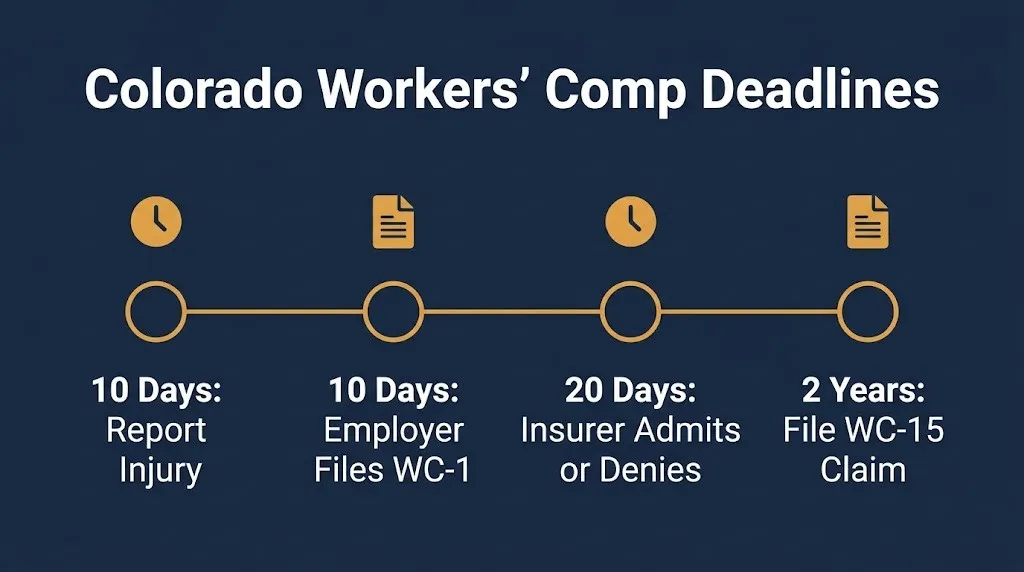
- Report the injury to your employer in writing within 10 working days.
- Request the panel of authorized treating physicians from your employer.
- Get evaluated and follow the treatment plan.
- Wait for your employer to file the First Report of Injury (WC-1) with the Division, typically within 10 days.
- The insurance carrier has 20 days after receiving the WC-1 to admit or deny liability.
- File your Worker’s Claim for Compensation (WC-15) within two years of the injury.
- If denied, request a hearing before an administrative law judge.
Filing this form is a lot like mailing a warranty claim before a deadline. Miss the window and you generally lose the right to the benefit, no matter how strong the underlying claim was.
What to Do If Your Workers Comp Claim Is Denied
If your Colorado workers compensation claim is denied, you can request a hearing before an administrative law judge through the Division of Workers’ Compensation. This step usually adds several months to your timeline.
A denial is not the end of the process. It’s the point where legal representation tends to matter most, since insurers frequently contest impairment ratings, causation, or average weekly wage calculations.
Key Takeaway: A denied claim in Colorado still has a path forward through an administrative hearing, but that path runs on its own clock and benefits from legal help.
What Is the Deadline to File a Workers Compensation Claim in Colorado?
The deadline to file a workers compensation claim in Colorado is two years from the date of injury, using the WC-15 form. Occupational disease claims get 30 days from when the disease is diagnosed or manifests.
Separately, you must report the injury itself to your employer in writing within 10 working days. That reporting deadline is different from the two-year filing deadline, and both matter.
| Deadline Type | Timeframe |
|---|---|
| Report injury to employer | 10 working days |
| Report occupational disease | 30 days from manifestation |
| File WC-15 claim form | 2 years from date of injury |
| Insurer admits/denies liability | 20 days after employer’s WC-1 filing |
How Long Does a Workers Compensation Case Take to Settle in Colorado?
A Colorado workers compensation case commonly takes many months to over a year to settle, and some industry estimates put the average closer to sixteen months from injury to settlement. Treat that figure as a rough range, not a promise for your case.
Settlement generally can’t happen until you reach maximum medical improvement, meaning your treating physician determines you’ve recovered as much as medical care will get you, or you receive a permanent impairment rating.
What Changed in Colorado Workers Comp Law in 2026?
Colorado’s biggest recent change to workers comp attorney fees came from HB23-1076, which raised the presumed-unreasonable fee threshold from 20% to 25% of contested benefits. The bill also extended mental impairment benefit duration from 12 to 36 weeks.
Separately, Colorado’s injury reporting deadline was extended in recent years from 4 days to 10 working days, giving injured workers more time to notify employers without risking their claim.
Who Qualifies for Workers Compensation?
Most employees injured on the job qualify for workers compensation, regardless of fault, as long as they are classified as an employee rather than an independent contractor. Misclassification disputes are common and often need legal review.
Coverage generally does not depend on who caused the accident. It does depend on your employment status and whether the injury or illness is connected to your job duties.
What Benefits Does Workers Compensation Cover?
Workers compensation generally covers medical treatment, a portion of lost wages, and compensation for permanent impairment if you don’t fully recover. Exact benefit types and amounts vary by state and by injury severity.
In Colorado, once liability is admitted and you reach maximum medical improvement, your case may resolve through a lump sum settlement or a structured payment plan, depending on the type and severity of disability involved.
What Happens Next
Ongoing: Colorado’s 25% contingency fee cap under HB23-1076 remains in effect through 2026.
Within 10 days of any new injury: Workers must report in writing to stay protected under current rules.
Within 2 years of injury: The WC-15 filing deadline continues to apply statewide.
Expected ongoing: State legislatures, including Colorado’s, continue to revisit fee caps and benefit durations most sessions, so rules can shift again.
Frequently Asked Questions
Do workmen compensation attorneys charge upfront fees?
No, most work on contingency and collect a fee only after recovering benefits.
This is standard across nearly every state, including Colorado.
What percentage do workers compensation lawyers take in Colorado?
Colorado caps the presumed-reasonable contingency fee at 25% of contested benefits.
That cap does not apply to medical bills the insurer is already paying without dispute.
How long do I have to file a workers comp claim in Colorado?
You generally have two years from the date of injury to file the WC-15 form.
Occupational disease claims have a separate 30-day window from diagnosis or manifestation.
Is it worth hiring a workers compensation lawyer for a small claim?
It depends on whether your claim is contested, denied, or your benefits seem too low.
Simple, undisputed claims often resolve without needing an attorney.
What happens if my Colorado workers comp claim gets denied?
You can request a hearing before an administrative law judge through the Division of Workers’ Compensation.
This process commonly adds several months to your case timeline.
How much does a workers compensation lawyer cost if I lose my case?
Under a standard contingency agreement, you typically owe nothing if no benefits are recovered.
Always confirm this in writing before signing a fee agreement.
How is a workmen compensation attorney different from a personal injury lawyer?
Workers compensation attorneys focus on the no-fault benefits system for job injuries, not third-party lawsuits.
Some injuries can involve both a workers comp claim and a separate personal injury claim, depending on the facts.
What is the injury reporting deadline in Colorado, separate from the filing deadline?
You must report a workplace injury to your employer in writing within 10 working days.
That’s different from the two-year deadline to file the formal WC-15 claim form.
If you were hurt on the job in Colorado, the two dates to write down are the 10-day injury report window and the two-year WC-15 filing deadline. Gather your medical records and wage information early, and get any fee agreement with an attorney in writing before you sign.
Sources & Verification
Sources checked July 14, 2026: Colorado Division of Workers’ Compensation (cdle.colorado.gov), Colorado Revised Statutes Title 8 Section 8-43-403, Colorado General Assembly HB23-1076 summary, and multiple 2026-dated law firm publications on Colorado and national contingency fee structures (Munley Law, Matlin Injury Law, Vasquez Law Firm, Law Offices of Miguel Martinez).
LawCompensate.com is an independent news publisher, not a law firm. This article is information, not legal advice. Verify current details on the official Colorado Division of Workers’ Compensation website before filing.