Structured Settlement Companies: How They Work and 2026 Consumer Protections
Quick Answer
- Structured settlement companies create or purchase periodic payment streams from lawsuit settlements.
- Selling your structured settlement payments requires court approval in most states.
- Discount rates on factoring transactions typically range from 6 to 29 percent, reducing the total you receive.
If you received a structured settlement from a lawsuit and are considering selling your payments, or if you are setting up a settlement and want to understand your options, you need to know how these companies work.
Structured settlement companies fall into two categories. Some help create structured settlements when a case resolves. Others purchase existing payment streams from people who want cash now.
One fact most people do not know: selling your structured settlement is not a simple transaction. Most states require court approval, and the discount rate can significantly reduce what you actually receive.
The Facts
| Case | Structured settlement industry, regulated financial practice |
| Status | Active, regulated by state and federal law |
| Fund Size | Industry-wide, no single fund |
| Est. Per Person | Discount rates reduce payments by 6 to 29 percent |
| Claim Deadline | Not applicable to ongoing transactions |
| Administrator | Court approval required for factoring in most states |
| Proof Needed | Settlement agreement, payment schedule, identification |
Are Structured Settlement Companies Legitimate?
Yes, structured settlement companies are legitimate financial services firms. The industry is regulated, and the products they offer are recognized by federal law.
The structured settlement industry emerged from a 1982 federal law that gave favorable tax treatment to periodic settlement payments in personal injury cases. The law encouraged structured settlements as an alternative to lump-sum payments.
Companies that create structured settlements work with plaintiffs, defendants, and insurers to design payment schedules that meet long-term financial needs. These companies purchase annuities from highly rated insurance carriers to fund the payments.
Companies that purchase structured settlement payments, called factoring companies, buy future payment rights in exchange for a lump sum. These transactions require court approval in most states under structured settlement protection acts.
Key Takeaway: Structured settlement companies are legitimate and regulated, but factoring companies that buy payments charge significant discounts.
What Is a Structured Settlement Annuity?
A structured settlement annuity is an insurance product that provides periodic payments to a settlement recipient over time. The annuity is purchased by the defendant or their insurer to fund the settlement.
The annuity is owned by the assignment company, not the recipient. The recipient receives payments according to the schedule established in the settlement agreement.
Structured settlement annuities are typically issued by highly rated life insurance companies. The payments are guaranteed by the issuing insurer, subject to state guaranty association limits.
The tax advantage is significant. Payments from a structured settlement annuity in a personal injury case are generally tax-free, including the interest component.
How Do Structured Settlement Companies Work?
Structured settlement companies work in two distinct ways. Some design and fund structured settlements. Others purchase existing payment streams from recipients.
Design companies work with all parties during settlement negotiations. They calculate the present value of future payments, select the annuity issuer, and document the payment schedule.
Factoring companies approach recipients after a settlement is in place. They offer a lump sum in exchange for the right to receive some or all of the future payments.
The factoring process requires court approval. The recipient must show that the transfer is in their best interest, considering their financial situation and the discount rate being charged.
| Company Type | Role | How They Earn |
|---|---|---|
| Design company | Creates payment schedule, buys annuity | Fee from settlement funds |
| Annuity issuer | Guarantees periodic payments | Investment income on reserves |
| Factoring company | Buys future payments for lump sum | Discount rate on purchase |
| Broker | Connects sellers with buyers | Commission on transaction |
How Much Do Structured Settlement Companies Pay?
Structured settlement factoring companies do not pay the full value of your future payments. They apply a discount rate that reduces the amount you receive.
The discount rate typically ranges from 6 to 29 percent, depending on the company, the length of the payment stream, and market conditions. A longer payment stream generally carries a higher discount rate.
For example, if you have 100,000 dollars in future payments over 10 years, a factoring company might offer you 70,000 to 85,000 dollars today. The difference is the discount, which represents the company’s profit and the time value of money.
The present value calculation is straightforward, but the discount rate applied by factoring companies is often much higher than the rate used by annuity issuers when the settlement was created.
Should You Sell Your Structured Settlement?
Selling your structured settlement is a major financial decision that requires careful thought. The answer depends on your specific circumstances.
You may consider selling if you face an emergency expense, a medical need, or a housing crisis that cannot be addressed another way. A lump sum can solve immediate problems that periodic payments cannot.
But selling means giving up guaranteed future income. Structured settlements are designed to provide long-term financial security. Selling undermines that purpose.
Most states require you to demonstrate that the sale is in your best interest before a court will approve it. The judge will consider the discount rate, your financial needs, and whether you have received independent professional advice.
Key Takeaway: Selling a structured settlement gives you cash now but costs you guaranteed future income, and courts must approve the transaction.
What Is the Process for Selling a Structured Settlement?
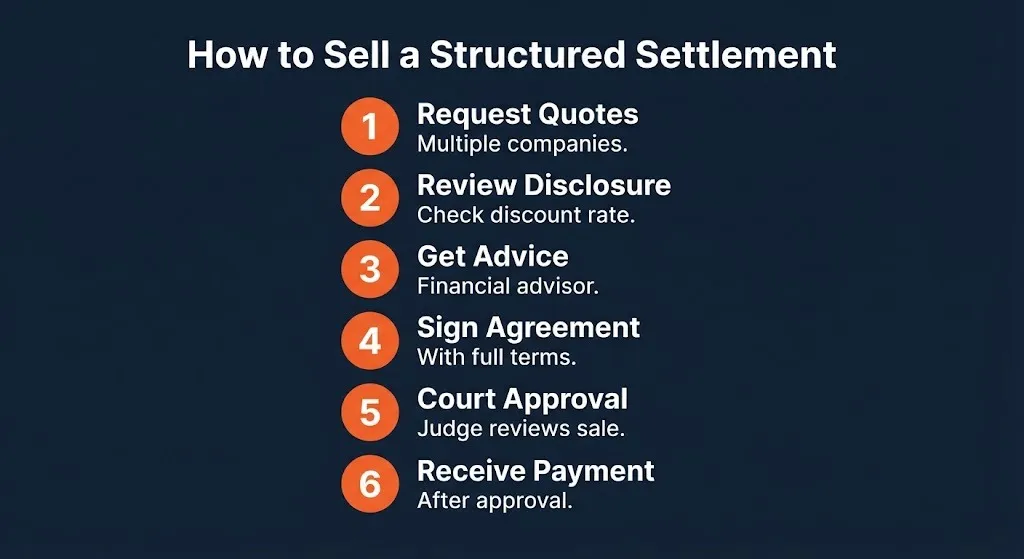
Selling a structured settlement is a multi-step process that requires court approval in most states. You cannot simply sign over your payments.
- Contact a factoring company and request a quote for your payment stream.
- Review the disclosure statement showing the discount rate and the present value.
- Obtain independent professional advice from a financial advisor or attorney.
- Sign a transfer agreement with the factoring company.
- The factoring company files a petition for court approval.
- Attend a court hearing where a judge reviews the transaction.
- If approved, the factoring company receives the future payments and you receive the lump sum.
Each state has its own structured settlement protection act. The specific requirements vary, but the core protections are similar across jurisdictions.
What Are the Risks of Using a Structured Settlement Company?
The primary risk of using a factoring company is the discount rate. You receive significantly less than the full value of your future payments.
Some companies use aggressive sales tactics to pressure recipients into selling. They may call repeatedly, send unsolicited offers, or make the transaction seem urgent.
There is also a risk of fraud. Unscrupulous companies may misrepresent the value of the payments, hide fees, or fail to disclose the full terms.
State structured settlement protection acts are designed to address these risks. The court approval requirement is the primary safeguard.
Reality Check
No legitimate factoring company will pressure you to sell your structured settlement immediately or charge you a fee upfront. Court approval exists specifically to protect you from bad deals. Any company that tells you court approval is not needed or that you can skip the process is not legitimate. Get independent professional advice before signing anything.
What Are the Largest Structured Settlement Companies?
Several large companies operate in the structured settlement industry. These include both design firms and factoring companies.
J.G. Wentworth is the most recognizable name in the factoring industry. The company has purchased billions of dollars in structured settlement payments.
Peachtree Settlement Funding, DRB Capital, and Oasis Legal Finance are other significant factoring companies. Each competes for the same pool of settlement recipients looking for liquidity.
On the design side, companies like Ringler Associates and Arcadia Settlements Group work with attorneys and insurers to create structured settlements.
These companies are legitimate businesses, but their interests are not always aligned with yours. A factoring company profits when you sell, regardless of whether selling is the right decision for you.
How Are Structured Settlement Payments Taxed?
Structured settlement payments from a personal injury case are generally tax-free. This includes both the principal and the interest component.
The tax advantage comes from the internal Revenue Code provision that excludes damages received for personal physical injuries from gross income. The periodic payments retain that character.
If you sell your structured settlement, the lump sum is also generally not taxable. The payment represents the value of tax-free future income.
However, if you invest the lump sum and earn income, that income is taxable. The tax-free treatment applies to the settlement payments, not to investment returns.
What Happens Next
Day 1 to 30: You research factoring companies and request quotes for your payment stream.
Month 1 to 3: You consult a financial advisor or attorney and review the disclosure documents.
Month 3 to 6: The factoring company files for court approval, and a hearing is scheduled.
TBD: The court approves or denies the transfer based on your best interest.
Frequently Asked Questions
Are structured settlement companies legitimate?
Yes, the industry is regulated and the products are recognized by federal law.
But factoring companies charge significant discounts when purchasing payments.
How much can I sell my structured settlement for?
The amount depends on the discount rate applied to your future payments.
Discount rates typically range from 6 to 29 percent.
Do I need court approval to sell my structured settlement?
Yes, most states require court approval under structured settlement protection acts.
The judge must find the sale is in your best interest.
Is a structured settlement taxable?
No, payments from a personal injury structured settlement are generally tax-free.
This includes the interest component of the payments.
What is the difference between a structured settlement and a lump sum?
A structured settlement pays periodic amounts over time.
A lump sum is a single payment of the full amount.
Can I sell part of my structured settlement?
Yes, you can sell some of your future payments rather than the entire stream.
The court approval process applies to partial sales as well.
How long does it take to sell a structured settlement?
The process typically takes 45 to 90 days from quote to court approval.
The timeline depends on the court’s schedule and the complexity of the transaction.
What should I do before selling my structured settlement?
Get independent professional advice from a financial advisor or attorney.
Compare quotes from multiple factoring companies.
Your next step is to get independent advice before making any decision. Compare quotes from multiple companies if you decide to sell. Read every disclosure document carefully.
The most important fact is this: court approval exists to protect you. If a company tells you the process is simple or unnecessary, walk away. Your structured settlement is guaranteed future income. Protect it.