Workers Comp Settlement Calculator 2026: How to Estimate Your Claim Value and Avoid Lowball Offers
Quick Answer
- Workers comp settlement calculators are free estimate tools, not official government or court resources.
- Your actual payout depends on state law, injury severity, wages, and future medical needs.
- No single calculator can give you a guaranteed number. Treat every result as a starting range.
If you searched for a workers comp settlement calculator, you probably just got hurt or your claim hit a wall. Maybe the adjuster called with an offer. Maybe your doctor said you reached maximum medical improvement and you are wondering what that means for money. You want a number. You want it now.
Here is the truth. No online calculator can tell you what your workers comp claim is worth. Not one backed by an algorithm, a chatbot, or a law firm marketing page. Workers comp settlements are not a formula. They are a negotiation. And that negotiation has rules, deadlines, and state-specific math that no website tool can fully capture.
This article covers how to estimate your claim yourself, what calculators can and cannot do, what maximum medical improvement really means, how the settlement formula actually works, and what mistakes cost injured workers the most money in 2026.
| The Facts | |
|---|---|
| Official Calculator | None exists from any state workers comp agency or federal body |
| Best Use of Online Calculators | Rough range only, not binding |
| Primary Settlement Drivers | State law, impairment rating, average weekly wage, future medical costs |
| Key Milestone | Maximum medical improvement, or MMI |
| Common Deadline | Varies by state, typically 1 to 3 years from injury or last benefit |
| Legal Requirement | Settlement must be approved by a workers comp judge or board |
| Administrator | Not applicable for individual claims |
Are workers comp settlement calculators accurate?
No, workers comp settlement calculators are not accurate in the sense of giving you a real dollar figure. They use broad averages and assumptions. They do not know your state’s impairment schedule, your exact wages, your doctor’s restrictions, or the insurance company’s settlement history.
Think of a workers comp calculator like a home value estimator. It can give you a ballpark based on comparable data. But it cannot see the cracked foundation or the new roof. The same is true for your injury claim.

A calculator might ask for your injury type, your weekly wage, and your impairment rating if you have one. Then it spits out a range. That range might be $10,000 to $40,000. The real settlement might be $7,500 or $95,000. The variables are too specific for a generic tool.
Here is what an online calculator cannot account for:
- Your state’s exact impairment schedule
- Whether your injury is to a scheduled member like a hand or an unscheduled area like your back
- Future surgery likelihood
- Your age and education level
- Whether you can return to your old job
- The insurance adjuster’s authority and settlement history
- Litigation risk for both sides
Use calculators for education, not decisions. The moment you treat a calculator result as a real offer, you have given the adjuster an advantage.
What is a workers comp settlement calculator?
A workers comp settlement calculator is an online tool that claims to estimate what your work injury claim might be worth. It typically asks for a few inputs and returns a dollar range. The tool is almost always hosted on a law firm’s website or a legal marketing site.
The calculator is a lead generation tool first. It is designed to get you to enter your name, email, and phone number. Then a law firm or referral service calls you. That does not make the calculator evil. It just means you should understand the business model.
No state workers compensation board offers an official settlement calculator. No federal agency does either. The math is too state-specific and fact-dependent.
A typical calculator asks for:
- Injury date
- Body part injured
- Whether you had surgery
- Your average weekly wage
- Your impairment rating if known
- Whether you have returned to work
It then applies a rough formula. But that formula is not the law. It is a marketing estimate.
How to calculate workers comp settlement
You calculate a workers comp settlement by working through your state’s formula, not a website’s. The core inputs are your average weekly wage, your impairment rating, your compensation rate, and your future medical needs.
Here is the basic method used in most states.
- Determine your average weekly wage before the injury.
- Apply your state’s compensation rate, often two-thirds of that wage.
- Find your impairment rating from your treating doctor.
- Multiply your impairment rating by the number of weeks your state assigns to that body part.
- Multiply those weeks by your compensation rate.
- Add estimated future medical costs.
- Subtract what the insurance company has already paid for temporary disability.
That gives you a rough settlement value. But every state changes the math.
For example, California uses the permanent disability rating schedule with a formula tied to your date of injury. New York has its own schedule. Texas allows settlements but the system works differently than California. Florida has specific impairment guidelines.
Here is a simplified example table using hypothetical numbers for illustration only.
| Input | Example Value |
|---|---|
| Average weekly wage | $900 |
| Compensation rate (two-thirds) | $600 |
| Impairment rating | 10% |
| Weeks assigned to body part | 30 weeks |
| Base permanent disability value | $18,000 |
| Estimated future medical | $15,000 |
| Rough settlement range | $25,000 to $40,000 |
These numbers are invented for illustration. Your numbers will differ.
What is the workers comp settlement formula?
The workers comp settlement formula is compensation rate times impairment weeks, plus future medical costs. But that is the skeleton. The flesh is negotiation.
Most states calculate permanent partial disability using a schedule. The schedule lists body parts and assigns a maximum number of weeks per body part. Your impairment rating, given as a percentage by a doctor, is multiplied against those weeks.
For example, if your state assigns 200 weeks for a back injury and your impairment rating is 10 percent, you get 20 weeks of benefits. Multiply those 20 weeks by your compensation rate. That is your base permanent disability amount.
But settlements are not just the base amount. Insurance companies pay to close the file. That means they may pay more than the base disability amount to avoid future medical exposure, litigation costs, and uncertainty.
Here is what a full settlement demand typically includes:
- Permanent partial disability value
- Future medical costs, discounted to present value
- Unpaid temporary disability if owed
- Vocational rehabilitation if applicable
- A premium for closing the case, often negotiated
The formula gives you a floor. It does not give you a ceiling.
Key Takeaway: Online calculators give you a range, not a result. The real number comes from your state’s schedule, your doctor’s rating, and negotiation leverage.
What is MMI and why does it matter for my settlement?
MMI stands for maximum medical improvement. It means your condition has stabilized and is not expected to improve significantly with more treatment. It does not mean you are healed. It means you are as good as you are going to get, medically speaking.
MMI matters because it triggers the permanent disability portion of your claim. Before MMI, you are in temporary disability territory. After MMI, the insurance company wants to settle.
Your doctor issues an MMI report. That report includes your impairment rating, work restrictions, and future medical needs. Those three items drive your settlement value.
If you settle before MMI, you are guessing at your future medical costs. You might guess low and lose money. You might guess high and the insurer rejects the demand. Most experienced workers comp attorneys recommend waiting until MMI before serious settlement talks.
MMI is like getting the final repair estimate on a car before you accept an insurance payout. You would not settle a car crash claim before the shop opened the hood. Do not settle your body claim before your doctor says you have reached the end of treatment.
What is an impairment rating and how does it affect settlement value?
An impairment rating is a percentage your doctor assigns to your injury to measure permanent damage. Ten percent means you have lost 10 percent of the function of that body part or your body as a whole. The higher the rating, the more weeks of benefits you receive.
The American Medical Association guides impairment ratings in most states. Your doctor follows the AMA Guides, usually the Fifth or Sixth Edition depending on your state. The rating is not a guess. It follows specific medical criteria.
But the rating is not the only number that matters. A 10 percent shoulder injury for a 28-year-old warehouse worker with a high school diploma may settle for a different amount than the same rating for a 60-year-old with no transferable skills. The rating is one input, not the whole value.
Some states use scheduled member ratings. A hand, arm, leg, foot, or eye gets a set number of weeks. Other states treat injuries to the spine, head, or body as a whole differently. You need to know which bucket your injury falls into.
How much is my workers comp claim worth?
Your workers comp claim is worth what the insurance company will pay to close it. That depends on your average weekly wage, your impairment rating, your future medical exposure, and your negotiation posture.
No calculator knows those variables. No adjuster will tell you the real number on the first call. The first offer is usually low. Sometimes insultingly low.
Here is a realistic table of settlement ranges by injury type based on published data and attorney surveys. These are illustrative ranges, not guarantees.
| Injury Type | Typical Settlement Range |
|---|---|
| Minor sprain or strain | $5,000 to $20,000 |
| Herniated disc, no surgery | $25,000 to $75,000 |
| Shoulder injury with surgery | $40,000 to $100,000 |
| Back injury with surgery | $50,000 to $150,000 |
| Multiple injuries or permanent restrictions | $100,000 to $300,000+ |
| Catastrophic injury | Varies widely, often structured settlement |
These ranges come from aggregated legal industry data, not from any official source. Your case may fall outside them.
The only way to know your claim’s value is to get your medical records, understand your state’s formula, and compare your facts to similar cases in your state.
What is a workers comp settlement calculator for MMI?
A workers comp settlement calculator for MMI is a tool that attempts to estimate your permanent disability payout once your doctor has placed you at maximum medical improvement. It asks for your MMI date and impairment rating. Then it runs a rough state formula.
The problem is that MMI calculators often use a generic schedule, not your state’s actual schedule. New York and California and Texas and Florida all differ. A calculator that does not ask for your state is not using your state’s law.
Even a calculator that asks for your state is incomplete. It cannot know your exact impairment report, your future surgery risk, or the insurance company’s settlement authority.
After MMI, here is the more reliable path.
- Get your MMI report and impairment rating in writing.
- Ask your doctor for work restrictions and future medical recommendations.
- Look up your state’s impairment schedule or ask a workers comp attorney.
- Calculate your compensation rate from your average weekly wage.
- Build a settlement demand with the base value plus future medical costs.
That is not a calculator. It is due diligence.
What is the average workers comp settlement?
The average workers comp settlement varies by state, injury, and data source. Published surveys put the overall average somewhere between $20,000 and $40,000 for a single injury. But averages hide more than they reveal.
A torn rotator cuff with surgery averages more than a wrist sprain. A back fusion averages more than physical therapy. Age, education, return-to-work status, and state law all move the number.
Here is a breakdown by common injury category using aggregated legal industry data. These are illustrative, not official.
| Injury Category | Average Settlement Range |
|---|---|
| Upper extremity, no surgery | $15,000 to $35,000 |
| Upper extremity, with surgery | $35,000 to $85,000 |
| Lower extremity, no surgery | $15,000 to $40,000 |
| Lower extremity, with surgery | $40,000 to $90,000 |
| Back injury, no surgery | $20,000 to $60,000 |
| Back injury, with surgery | $60,000 to $200,000 |
| Neck injury, no surgery | $20,000 to $50,000 |
| Neck injury, with surgery | $50,000 to $150,000 |
Do not walk into a settlement negotiation quoting these numbers as your entitlement. The adjuster will know your case better than a national average does.
Key Takeaway: Averages are directionally useful but factually weak. Your case is not an average.
Reality Check: No one can promise you a specific workers comp settlement before reviewing your medical records, wage history, and state law. If a website or a lawyer guarantees a number before seeing those documents, that is a sales pitch, not a legal opinion.
How does a work injury settlement calculator work?
A work injury settlement calculator works by collecting a few inputs and running them through a simplified formula. It might multiply your impairment weeks by a compensation rate. It might add a rough future medical estimate.
The formula inside the calculator is built by the website owner. It is not a government formula. It is not a court formula. It is a marketing estimate designed to generate leads and set expectations.
Here is what the calculator does not tell you.
- Whether your state caps permanent partial disability benefits
- Whether your injury falls under scheduled or unscheduled rules
- Whether the insurer disputes causation
- Whether you have a pre-existing condition that complicates the rating
- Whether your employer has a light-duty job available
- Whether you need vocational retraining
- Whether a structured settlement makes more sense than a lump sum
Each of those factors can move your settlement by tens of thousands of dollars. A calculator cannot see any of them.
How do I calculate my workers comp settlement by state?
You calculate your workers comp settlement by state by using that state’s impairment schedule, compensation rate formula, and procedural rules. There is no national formula.
Every state sets its own workers comp laws. Some states use a pure schedule. Some mix scheduled and unscheduled. Some allow settlements for future medical. Some do not.
Here is what you need for any state calculation.
- Your state’s average weekly wage calculation method.
- Your state’s compensation rate percentage.
- Your state’s impairment rating guide and schedule.
- Your state’s settlement approval process.
- Your state’s rules on future medical closure.
You can find most of this on your state workers compensation board or commission website. State sites are official. They are also dense. If reading statutory language is not your skill, a workers comp attorney in your state can calculate it in minutes.
What factors determine my workers comp settlement amount?
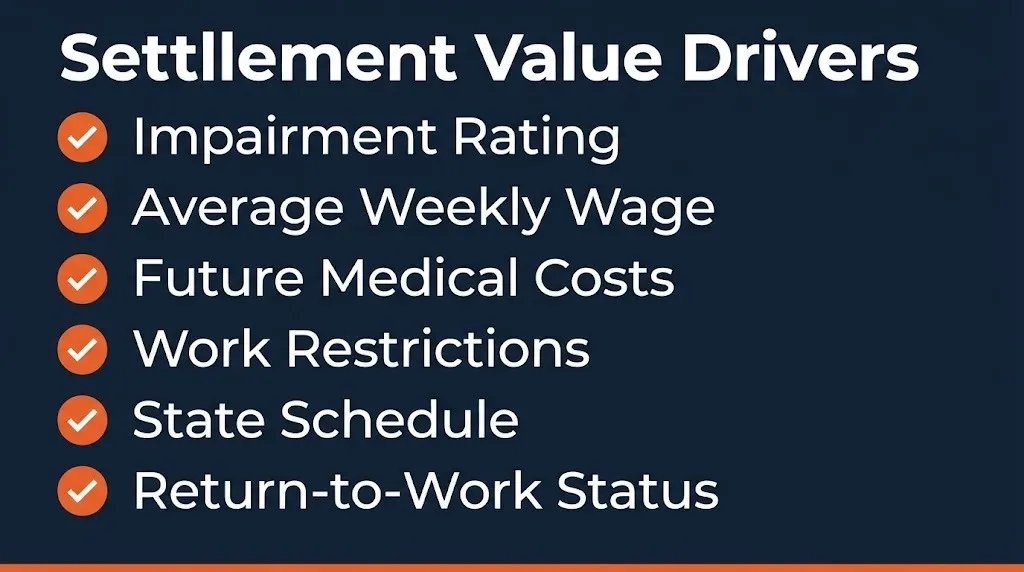
The factors that determine your workers comp settlement amount are your average weekly wage, your impairment rating, your body part injured, your future medical needs, your age, your education, and your return-to-work options.
Here is the full list in order of impact.
- Impairment rating and body part
- Average weekly wage and compensation rate
- Future medical treatment and surgery risk
- Whether you can return to your old job
- Your age and transferable skills
- Whether the insurer disputes liability
- Your state’s settlement rules
- Whether you have an attorney
A 10 percent back impairment for a 60-year-old with a ninth-grade education and a lifting restriction settles differently than the same rating for a 30-year-old software worker. The injury is the same. The consequences are not.
The adjuster knows this. You should too.
What is the workers comp settlement negotiation process?
The workers comp settlement negotiation process usually starts after MMI and ends with a signed settlement agreement approved by a workers comp judge. It is a back-and-forth, not a single conversation.
Here are the steps.
- Your doctor issues an MMI report with impairment rating and restrictions.
- The insurance company makes an initial settlement offer, usually low.
- You or your attorney respond with a demand package.
- The adjuster counters.
- You negotiate over permanent disability, future medical, and closure language.
- You reach a verbal agreement.
- The settlement is reduced to writing and submitted to the workers comp board.
- A judge approves or rejects the settlement at a hearing.
The judge’s job is to make sure the settlement is not grossly unfair. Most settlements get approved if both sides signed knowingly.
Treat the first offer like a store’s first price at a market. It is a starting point, not the final number.
Key Takeaway: Negotiation is normal. First offers are low. Patience and documentation are the strongest tools an injured worker has.
Can I settle my workers comp claim without a lawyer?
Yes, you can settle your workers comp claim without a lawyer. That does not mean you should. Small claims with no future medical exposure can sometimes be handled alone. Larger claims with permanent restrictions are riskier.
The insurance company has adjusters and lawyers. They do this every day. You do this once. That is not a fair fight.
Workers comp attorneys typically work on contingency. They get paid a percentage of your settlement, often 15 to 20 percent depending on the state. If you get nothing, they get nothing. That aligns their incentive with yours.
If you go alone, here is what you must do.
- Get your MMI report and impairment rating.
- Request your complete medical file.
- Verify your average weekly wage calculation.
- Check your state’s schedule for your body part.
- Estimate future medical costs.
- Prepare a written demand.
- Negotiate in writing, not just by phone.
- Have a workers comp judge review the final settlement.
You can do all of that. Many people do. Just know the adjuster will test whether you understand the process.
What is a structured settlement in workers comp?
A structured settlement in workers comp is a payout plan that gives you money over time instead of one lump sum. It is common in larger cases and cases with long-term medical needs.
The settlement agreement specifies a schedule of payments. You might get $50,000 up front and $2,000 a month for 10 years. Or a larger lump sum plus an annuity for life in catastrophic cases.
Structured settlements have tax advantages. Workers comp settlements are generally not taxable at the federal level. A structured settlement keeps that tax-free status while spreading income over time.
Some insurers prefer structures because they cost less than a single lump sum. Some injured workers prefer structures because they prevent a large sum from being spent too fast.
The choice is yours, but it should be informed. Ask for the present value comparison. That tells you what the structure is actually worth today compared to the lump sum offer.
What mistakes reduce workers comp settlement value?
The mistakes that reduce workers comp settlement value are settling before MMI, accepting the first offer, and failing to document restrictions. There are more.
Here are the most expensive mistakes, in order.
- Settling before MMI, when future medical costs are unknown.
- Accepting the first offer without a counter.
- Not getting work restrictions in writing.
- Returning to work against doctor’s orders and reinjuring yourself.
- Posting physical activity on social media that conflicts with restrictions.
- Missing a state deadline or hearing.
- Not calculating future medical costs.
- Treating the adjuster’s “final offer” as final.
Each of these is avoidable. Each costs money every year.
The adjuster is not your friend. The adjuster’s job is to close the file for as little as possible. That is not a conspiracy. It is the job description.
What is a workers comp settlement calculator for MMI settlement?
A workers comp settlement calculator for MMI settlement is an online tool that tries to estimate your permanent disability amount after maximum medical improvement. It is no more official than any other settlement calculator.
After MMI, your claim enters a new phase. Temporary benefits end. Permanent disability calculation begins. The adjuster’s posture shifts from paying ongoing benefits to closing the claim.
That is when settlement talks get serious. It is also when calculator searches spike. You want to know if the offer is fair. A calculator cannot tell you that.
The fair offer is the one that covers your permanent disability under your state schedule, plus your future medical needs, plus a premium to close the file. If the offer does not cover future surgery or lifetime medication, it is not fair.
How do future medical costs affect my settlement?
Future medical costs affect your settlement by adding a major expense to the value calculation. In many cases, future medical is worth more than the permanent disability amount.
If your doctor recommends a future surgery, that cost must be included. If you need pain management for years, that cost must be included. If you will take medication indefinitely, that cost must be included.
The insurance company will discount those future costs to present value. A $50,000 surgery in five years is worth less today. But it is not worth zero.
Here is a simple future medical cost checklist.
- Recommended future surgeries
- Physical therapy or chiropractic maintenance
- Pain management and injections
- Prescription medications
- Medical equipment like braces or TENS units
- Mileage to medical appointments
- Home modifications if needed
Ask your doctor to write future medical needs in the MMI report. If it is not in writing, it does not exist in the negotiation.
Key Takeaway: Future medical care is often the largest single factor in a workers comp settlement. Get it in writing before you negotiate.
What is the workers comp settlement approval process?
The workers comp settlement approval process requires a judge or board to review and approve the agreement. It is not a private contract. It is a court-sanctioned resolution.
Here is how it works in most states.
- Both sides sign the settlement agreement.
- The agreement is filed with the workers comp board or commission.
- A hearing is scheduled.
- The judge questions you to confirm you understand the terms.
- The judge confirms the settlement is in your best interest.
- The judge issues an order approving the settlement.
- Payment is issued according to the agreement terms.
The hearing is not a trial. It is usually short. But it matters. The judge is the backstop against unfair settlements.
If you settle without understanding a term, say so at the hearing. It is your last chance before the deal becomes final.
What happens after my workers comp settlement is approved?
After your workers comp settlement is approved, the insurance company issues payment according to the agreement. That may be a lump sum within 30 to 60 days or a structured payout over time.
Once approved, the settlement is final. You cannot reopen the claim if your condition worsens, unless the settlement specifically allows it. That is why future medical planning matters so much before you sign.
The settlement closes your claim. You receive your payment. The insurer closes its file. The medical providers get paid from the settlement if liens exist.
For most injured workers, the settlement is the end of the workers comp road. Make sure you arrive at that road with your eyes open.
What Happens Next
Now: Gather your medical records, MMI report, and wage history.
Within 30 days: Check your state workers comp board website for settlement rules and forms.
If you have an attorney: Ask for a written settlement valuation with future medical costs included.
If you do not have an attorney: Consider a consultation. Most workers comp lawyers offer free first visits.
Before you sign: Read every clause. Ask what happens if you need future surgery. Get the answer in writing.
The single most important thing you can do today is request your complete medical file and your MMI report if one exists. Every settlement number starts there.