New York Workers Compensation 2026: Benefit Rates, Deadlines, and How NYC Claims Actually Work
Quick Answer
- New York workers compensation is real and mandatory for nearly all employers in the state.
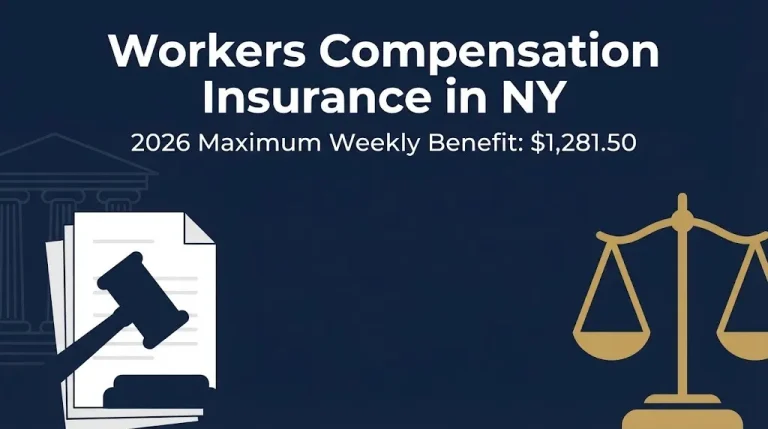
- The 2026 maximum weekly benefit is $1,261.04 for claims with dates of injury on or after July 1, 2026.
- You must report a work injury to your employer within 30 days to protect your right to benefits.
Workers compensation in New York State is not a lawsuit you file against your employer. It is a state-run insurance system that pays medical bills and a portion of lost wages when you get hurt or sick because of your job. The New York State Workers Compensation Board oversees the system. The board sets benefit rates, resolves disputes, and enforces employer compliance.
For workers in New York City, the rules are the same as the rest of the state. There is no separate New York City workers compensation program. The same state board handles claims from all five boroughs. That is a common point of confusion for workers searching for workers compensation in NYC.
This article covers the 2026 benefit rates, how to file a claim, what to do if your claim is denied, and how long the process takes. One fact that surprises many workers: you do not have to prove your employer was negligent to collect benefits. You only have to prove the injury happened at work.
The Facts
| Case | New York State Workers Compensation system, not a lawsuit |
| Status | Active, ongoing statutory program administered by the NYS Workers Compensation Board |
| Fund Size | Not a fixed settlement fund; benefits paid by employer insurance carriers |
| Est. Per Person | Varies by wage and disability level; 2026 max is $1,261.04 per week |
| Claim Deadline | 30 days to notify employer, 2 years to file a claim form |
| Administrator | New York State Workers Compensation Board |
| Proof Needed | Medical records, accident report, wage documentation |
Is workers compensation in NY real or a scam?
Workers compensation in New York is a legitimate, mandatory insurance system. Every employer in the state is required by law to carry workers compensation coverage. That includes businesses with one or more employees. It is not optional. It is not a government benefit you apply for through a federal agency.
The New York State Workers Compensation Board is the state agency that administers the program. The board is real. It has offices in Albany, Brooklyn, Manhattan, Queens, Buffalo, Rochester, Syracuse, and Binghamton. You can call the board, file forms online, or attend a hearing in person.

What is a scam: any person or service that charges you money to file a workers compensation claim. Filing is free. The board provides forms at no cost. You do not need a paid intermediary to start your claim. Some third-party services charge fees for help with paperwork. That is unnecessary for most claims.
The system is funded by employer-paid insurance premiums, not by worker contributions. There is no deduction from your paycheck for workers compensation in New York. Your employer cannot lawfully ask you to pay part of the premium or to cover your own medical bills out of pocket while a valid claim is pending.
Key Takeaway: Workers compensation in New York is a state-mandated insurance system, not a scam, and filing a claim costs you nothing out of pocket.
How much does New York workers compensation pay in 2026?
The maximum weekly benefit in New York for 2026 is $1,261.04. That rate applies to claims with dates of injury on or after July 1, 2026. For injuries between July 1, 2025 and June 30, 2026, the maximum was $1,242.78 per week.
The actual amount you receive depends on your average weekly wage before the injury. New York uses a formula based on two-thirds of your average weekly wage, subject to the maximum. Here is how the math works for common wage levels.
| Average Weekly Wage | Two-Thirds Rate | What You Actually Get |
|---|---|---|
| $600 | $400.00 | $400.00 |
| $900 | $600.00 | $600.00 |
| $1,200 | $800.00 | $800.00 |
| $1,500 | $1,000.00 | $1,000.00 |
| $2,000 | $1,333.33 | $1,261.04 (capped) |
| $3,000 | $2,000.00 | $1,261.04 (capped) |
There is also a minimum weekly benefit. For 2026, the minimum is $150 per week. If your calculated benefit falls below that, you get $150, provided you meet the disability threshold.
Wage replacement is not the only benefit. Workers compensation in New York also pays for all necessary medical care related to your injury. That includes doctor visits, surgery, physical therapy, prescriptions, and medical equipment. There is no copay and no deductible for approved care.
If your injury leaves you with a permanent partial disability, you may receive a separate award called a schedule loss of use award. That pays a lump sum or weekly benefit based on the body part injured and the degree of permanent impairment.
Reality Check: No one can guarantee you a specific workers compensation settlement amount. The formula is set by law, but your wage records and medical evidence control the final number. Be wary of anyone who promises a large payout before reviewing your file.
What is the New York State Workers Compensation Board?
The New York State Workers Compensation Board is the state agency that runs the workers compensation system. It is not a court, but it has the power to hold hearings, issue decisions, and order payments. The board handles disputes, approves settlements, and monitors insurance carriers.
The board operates under the New York Workers Compensation Law. That law has been on the books for over a century. It was created to give injured workers a faster, less adversarial alternative to lawsuits. In exchange for guaranteed benefits, workers give up the right to sue their employer for negligence in most cases.
The board maintains an online portal called eCase. Through eCase, you can check the status of your claim, view documents, and see hearing dates. You can also file certain forms electronically. eCase is free to use.
Hearings are held before workers compensation law judges. These judges are employees of the board. They do not work for your employer’s insurance company. If you disagree with a judge’s decision, you can appeal to a panel of board commissioners. Further appeals go to the state courts.
The board also enforces compliance. Employers who fail to carry coverage face penalties. Injured workers whose employers lacked coverage can file a claim with the Uninsured Employers Fund, which is administered by the board.
Key Takeaway: The New York State Workers Compensation Board is the state agency that resolves disputes and enforces the law, and its eCase portal is the main tool for tracking a claim.
How do I file a workers compensation claim in NYC?
Filing a workers compensation claim in New York City follows the same process as the rest of the state. The first step is not a form. It is telling your employer. Under New York law, you must notify your employer in writing within 30 days of the injury or the date you learned the injury was work-related.
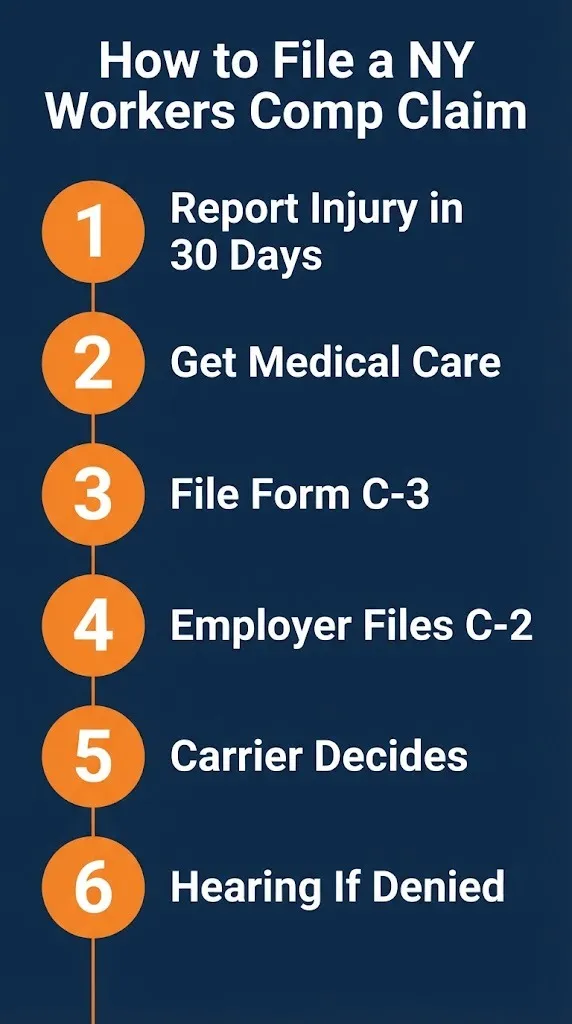
After you notify your employer, you must file an Employee Claim Form, also called Form C-3, with the Workers Compensation Board. Here is the sequence.
- Report the injury to your supervisor or HR department in writing within 30 days.
- Seek medical treatment and tell the doctor the injury is work-related.
- Complete Form C-3 and submit it to the Workers Compensation Board within 2 years of the injury date.
- Your employer files Form C-2, the Employer’s Report of Work-Related Injury or Illness.
- Your doctor files Form C-4, the Doctor’s Initial Report.
- The insurance carrier investigates and decides whether to accept or deny the claim.
- If approved, you begin receiving wage replacement and medical benefits.
The filing process is like submitting a warranty claim. The earlier you document everything, the smoother it goes. Delays create gaps in the record that insurers use to question whether the injury happened at work.
You can file Form C-3 online through the board’s website or by mail. The form asks for your employer’s name and address, the date and location of the injury, a description of what happened, and your medical provider’s information.
What is the deadline for filing a workers compensation claim in NY?
There are two deadlines. The first is 30 days to notify your employer. The second is 2 years to file a claim with the Workers Compensation Board. Missing either can cost you your benefits.
The 30-day notice requirement starts on the date of the accident or the date you knew the injury was related to your job. For occupational diseases, such as repetitive stress injuries or lung conditions from exposure, the clock starts when you first learn the condition is work-related.
The 2-year filing deadline is strict. If you file after 2 years, your claim may be barred entirely, even if your employer knew about the injury. There are narrow exceptions. If your employer continued to pay wages during your absence, the time may be extended. If you were a minor at the time of injury, different rules may apply.
Do not rely on your employer to file the necessary forms. Even though employers must file Form C-2, your own claim form is what protects your rights. File Form C-3 early, even if you are still gathering medical evidence.
The same deadlines apply in New York City. There is no separate city agency with different rules. Brooklyn, Queens, Manhattan, the Bronx, and Staten Island all follow the state board’s deadlines.
Key Takeaway: The 30-day notice to your employer and the 2-year claim filing deadline are both mandatory, and missing either can terminate your right to benefits.
How long does a workers compensation claim take in New York?
A straightforward accepted claim can begin paying wage replacement within a few weeks. New York law requires the insurance carrier to begin payments within 18 days after the employer learns of the injury, if the claim is not disputed. That is an unusually fast statutory requirement compared to other states.
If the carrier disputes the claim, the timeline stretches. A disputed claim goes to a hearing before a workers compensation law judge. The first hearing is typically scheduled within 30 to 60 days of the dispute. The judge then decides whether the medical evidence supports the claim.
From injury to first hearing, expect 2 to 4 months if the claim is disputed. From hearing to a decision, expect another 1 to 3 months. Appeals add 6 to 12 months. Settlement negotiations can happen at any stage after the carrier accepts the claim.
Here is a typical timeline for a disputed New York workers compensation claim.
| Stage | Typical Timeframe |
|---|---|
| Injury and notice to employer | Day 0 |
| Carrier decision to accept or deny | 18 days |
| First hearing if denied | 30 to 60 days |
| Judge’s decision | 2 to 4 months |
| Appeal to board panel | 6 to 12 months |
| Settlement or final award | 12 to 24 months for complex cases |
The timeline is comparable to a delayed tax refund. You know the money is owed, but the process has fixed steps that cannot be skipped.
What if my workers compensation claim is denied in NY?
A denial is not the end of the case. It is the beginning of the dispute process. In New York, roughly one in five workers compensation claims is initially disputed by the insurance carrier. Many of those disputes are resolved in favor of the worker at a hearing.
Common reasons for denial include the employer’s claim that the injury did not happen at work, the carrier’s medical expert saying the condition is not work-related, or a dispute over whether you were an employee or an independent contractor.
If you receive a denial, you can request a hearing before a workers compensation law judge. You do not need a lawyer to request a hearing, but a lawyer can help. Workers compensation attorneys in New York typically work on contingency. They get paid a percentage of your award, not upfront fees.
At the hearing, the judge reviews medical records, witness statements, and the accident report. The judge can order the carrier to pay benefits retroactively to the date of the injury. That retroactive payment is called an award.
You have the right to appeal an unfavorable judge decision to a board panel. The appeal must be filed within 30 days of the judge’s written decision. Missing that deadline can make the decision final.
Key Takeaway: A denial starts a hearing process where a judge reviews the medical evidence, and many initially denied claims are later awarded benefits.
What is the difference between workers compensation and a lawsuit in New York?
Workers compensation is not a lawsuit. It is an administrative claims system. You do not sue your employer. You file a claim, and a state agency decides whether you get benefits. The standard of proof is lower than in a civil lawsuit. You only have to show the injury arose out of and in the course of employment.
A lawsuit is different. In a personal injury lawsuit, you sue a person or company for negligence. You have to prove fault. In workers compensation, fault does not matter. Even if you made a mistake that caused your injury, you can still collect benefits. That is the trade-off: workers give up the right to sue their employer, and employers give up the right to argue fault.
There is one exception. If a third party, not your employer or a co-worker, caused your injury, you can file a separate personal injury lawsuit against that third party while also collecting workers compensation. Common examples include a car accident while driving for work caused by another driver, or an injury on a construction site caused by a subcontractor’s negligence.
In New York City, construction accident cases frequently involve both a workers compensation claim and a third-party lawsuit under the state’s labor laws. The workers compensation claim pays medical bills and wage replacement. The third-party lawsuit can pay pain and suffering, which workers compensation does not cover.
How much is a workers compensation settlement in New York?
Settlement amounts vary widely. There is no fixed average. A claim involving a minor injury with full recovery might settle for a few thousand dollars. A claim involving permanent disability can settle for hundreds of thousands of dollars.
New York uses two types of settlements. A Section 32 settlement is a full and final agreement that closes the case. It can include a lump sum for both wage replacement and future medical care. Once approved by the board, the case is closed. You cannot reopen it later.
The other type is a stipulation agreement. This resolves the wage replacement portion but leaves medical benefits open. You continue receiving medical care for the injury, but your weekly payments stop or are reduced.
Here are the factors that drive settlement value.
| Factor | Impact on Settlement |
|---|---|
| Severity of permanent impairment | Higher impairment means higher value |
| Average weekly wage | Higher wage means higher value |
| Age at time of injury | Younger workers with long future earning loss often get more |
| Need for future surgery | Future medical costs increase value |
| Strength of medical evidence | Stronger evidence supports a higher settlement |
| Carrier’s risk tolerance | Some carriers settle faster than others |
No lawyer, judge, or website can tell you what your specific case is worth without reviewing your medical records and wage documents. Any estimate offered before that review is a guess.
Key Takeaway: New York settlements are based on impairment, wages, and future medical needs, and a Section 32 agreement closes the case permanently.
Can I choose my own doctor for workers compensation in New York?
New York law allows you to choose your own authorized medical provider, subject to certain rules. The provider must be authorized by the Workers Compensation Board. Many doctors, physical therapists, and chiropractors in New York City are board-authorized.
Your employer’s insurance carrier may have a preferred provider network. But you are not required to use it. You can choose your own board-authorized doctor. That is different from some other states, where the employer controls the initial choice of physician.
The doctor must file Form C-4, the Doctor’s Initial Report, with the board. If the doctor does not file the form, your claim may be delayed. Always confirm that the provider is board-authorized before your first visit.
If you are unhappy with your doctor, you can change providers. The board does not require you to stay with one provider for the life of the claim. However, frequent changes can raise questions about the consistency of your treatment.
Do undocumented workers qualify for workers compensation in NY?
Yes. New York workers compensation law does not require proof of immigration status. If you are hurt on the job, you may be entitled to benefits regardless of your immigration status. The board has repeatedly affirmed this position.
Employers are required to carry coverage for all employees, including undocumented workers. The Workers Compensation Board does not report injured workers to immigration authorities. The board’s forms do not ask about immigration status.
Undocumented workers face unique pressures. Some employers threaten to call immigration authorities if the worker files a claim. That is unlawful. It is also a violation of the employer’s duty under New York law. Several legal aid organizations in New York City specialize in representing immigrant workers in workers compensation cases.
If your employer lacks coverage entirely, you may still have a path to benefits through the Uninsured Employers Fund. You can also file a lawsuit against the employer directly, which is not normally allowed against a covered employer.
Key Takeaway: Immigration status does not bar a workers compensation claim in New York, and the board does not inquire about status.
What is the role of the New York State Workers Compensation Board in disputes?
The board is the referee in every workers compensation dispute. When a carrier denies a claim, the board schedules a hearing. A workers compensation law judge presides. The judge can order the carrier to produce documents, approve or deny medical treatment, and issue awards.
The board is not automatically on your side. It is a neutral decision-maker. But it applies the law to the facts. The law in New York is generally considered worker-friendly. The burden of proof is lower than in civil court. Medical evidence from your treating doctor is given significant weight.
If the carrier refuses to pay for surgery recommended by your doctor, you can request an expedited hearing. The board can order the carrier to authorize the procedure. The board also resolves disputes over average weekly wage calculations, degree of disability, and the need for vocational rehabilitation.
The board’s decisions are public records. You can look up any decision through the board’s online systems. That transparency helps lawyers, carriers, and workers understand how similar cases are being decided.
What Should Injured Workers in NYC Do Right Now?
The most important actions happen in the first 48 hours after an injury. Do these steps in order.
- Report the injury in writing to your supervisor or HR department.
- Get medical treatment and tell the provider it is work-related.
- Take photos of the injury site and any visible injuries.
- Write down the names and contact information of any witnesses.
- File Form C-3 with the Workers Compensation Board as soon as possible.
- Keep a copy of every document you submit or receive.
- Do not sign anything from the insurance carrier before reading it fully.
Documentation is everything. The more you write down now, the harder it is for the carrier to dispute the facts later. Memories fade. Witnesses move. Photos get deleted. Capture it all while it is fresh.
What Happens Next
Immediately: You report the injury and seek medical care.
Within 18 days: The carrier must begin payments or file a dispute.
Within 30 to 60 days: If disputed, the first hearing is scheduled.
Within 2 years: You must file Form C-3 to preserve your claim.
After treatment: You may negotiate a settlement or accept a schedule loss of use award.
The system works best for workers who file early, keep records, and respond to board notices on time.
Frequently Asked Questions
Is workers compensation in New York mandatory?
Yes. Every employer in New York must carry workers compensation insurance for all employees, including part-time and undocumented workers.
Does workers compensation cover commuting to work in NYC?
Usually not. Injuries during a normal commute are not covered. But travel between job sites during work hours is covered.
Can I be fired for filing a workers compensation claim in New York?
No. Retaliation for filing a workers compensation claim is illegal under New York law. You may have a separate claim if you are terminated for filing.
How long do I have to report a work injury in NY?
You must notify your employer in writing within 30 days. You have 2 years to file Form C-3 with the Workers Compensation Board.
Does workers compensation pay full salary in New York?
No. It pays two-thirds of your average weekly wage, up to the 2026 maximum of $1,261.04 per week.
Can I sue my employer for a work injury in New York?
Usually not. Workers compensation is your exclusive remedy against your employer. Third-party claims against other responsible parties may be possible.
Is there a New York City workers compensation office?
Yes. The Workers Compensation Board has district offices in Manhattan, Brooklyn, and Queens. Hearings are also held virtually in many cases.
What is a schedule loss of use award in New York?
It is a separate payment for permanent impairment to a body part, such as a hand, arm, leg, or eye. The amount depends on the body part and the degree of impairment.
Workers compensation in New York is a system that rewards early reporting and good documentation. The 2026 benefit rates are set. The process is clear. The two numbers to remember are 30 days to notify your employer and 2 years to file your claim. File early. Keep records. Use the board’s free tools. Those steps are within your control.