Worker Compensation Insurance Quote 2026: Real Costs, Coverage Gaps, and Claim Risks
Quick Answer
- A workers compensation insurance quote is an estimate, not a binding price or a lawsuit payout.
- Most states require employers to carry coverage once they have one or more employees.
- No national class action settlement changes workers compensation insurance pricing in 2026.
If you searched for a worker compensation insurance quote, you probably own a small business or started a new job. You need coverage that satisfies state law without overpaying.
The quote process is not like buying car insurance. Your payroll, industry classification, and claims history drive the price more than any comparison site slider.
This guide explains how quotes actually work, what makes coverage affordable, and where insurers and employers get into legal trouble. One surprising fact: misclassifying workers as independent contractors is the most common reason employers face fines and denied claims.
| The Facts | |
|---|---|
| Case | No active workers compensation insurance class action in 2026 |
| Status | No settlement fund, coverage is state-regulated |
| Fund Size | Not applicable |
| Est. Per Person | Not determined, no consumer settlement exists |
| Claim Deadline | None, state filing deadlines apply to claims |
| Administrator | State insurance departments regulate carriers |
| Proof Needed | Payroll records, employee count, industry codes |
Is a Workers Compensation Insurance Quote Legit?
A workers compensation insurance quote is a standard business document. It is not a scam, and it is not a government benefit.
Insurers and brokers generate quotes based on your payroll, your state, and your employees’ job duties. The quote shows an estimated premium, usually annual.
The price can change after an audit. Workers compensation policies are auditable, meaning the insurer checks your actual payroll at year end and adjusts the premium up or down.
What Does a Workers Compensation Insurance Quote Include?
A quote includes the estimated annual premium, the class codes used, and the coverage limits. It may also list the experience modification factor if your business is large enough.
Class codes are numerical codes assigned to job types. A clerical worker has a different code and rate than a roofer. Misclassification changes the price and the risk.
The quote also shows the insurer name, policy period, and any fees or minimum premiums. Read every line before you bind coverage.
How Much Does Workers Compensation Insurance Cost in 2026?
Workers compensation premiums vary by state and industry. A small office with two employees might pay $500 to $2,000 a year. A roofing crew could pay $10,000 or more.
Rates are set per $100 of payroll. The National Council on Compensation Insurance, or NCCI, publishes advisory rates in many states. State regulators approve final rates.
Your actual cost depends on payroll, class codes, claims history, and any discounts. There is no single national price.
| Business Type | Estimated Annual Premium Range |
|---|---|
| Office or clerical | $500 to $2,000 |
| Retail store | $1,000 to $5,000 |
| Restaurant | $2,500 to $10,000 |
| Construction trades | $5,000 to $25,000+ |
| Trucking or logistics | $8,000 to $30,000+ |
What Is the Most Affordable Workers Compensation Insurance?
The most affordable workers compensation insurance is the policy that matches your actual risk without gaps. The cheapest quote is not always the best.
Small businesses can lower costs by using a professional employer organization, or PEO, which bundles workers compensation with payroll. State funds in monopolistic states like Ohio and Washington are the only option for many employers.
Some states offer assigned risk pools for businesses that cannot get coverage on the open market. Those policies cost more but provide required coverage.
Key Takeaway: A workers compensation quote is an estimate based on payroll and job class. The final premium can change after audit.
What Happens If You Do Not Have Workers Compensation Insurance?
If you are required to carry workers compensation and do not, you face fines, stop-work orders, and personal liability for injured workers.
Most states impose daily penalties. In New York, for example, the Workers Compensation Board can issue stop-work orders that shut down a business until coverage is in place.
An injured worker can sue an uninsured employer directly. That claim can include medical costs, lost wages, and pain and suffering. The business owner may have to pay out of pocket.
Can an Employee Sue Outside Workers Compensation?
Workers compensation is generally an exclusive remedy. That means an injured employee cannot sue the employer in most cases.
Exceptions exist for intentional harm, gross negligence, or third-party claims. If a defective machine caused the injury, the worker might sue the manufacturer.
The exclusive remedy rule is why employers buy coverage. It caps liability and provides no-fault benefits to workers.
What Is Workers Compensation Claim Denial and Settlement?
A workers compensation claim can be denied if the insurer disputes the injury, the cause, or the employment status. Denials are not the final word.
Injured workers can appeal through a state workers compensation board or commission. Many cases settle before a hearing.
A workers compensation settlement usually pays a lump sum or structured payments. The amount depends on medical needs, disability rating, and future wage loss.
Reality Check: A low workers compensation quote may signal misclassified employees or missing payroll. If the insurer audits and finds unreported payroll, you owe back premium. If an employee is hurt and misclassified, the claim can spiral into fines and personal liability.
How to Get a Workers Compensation Insurance Quote
Here is the step-by-step process for getting an accurate quote.
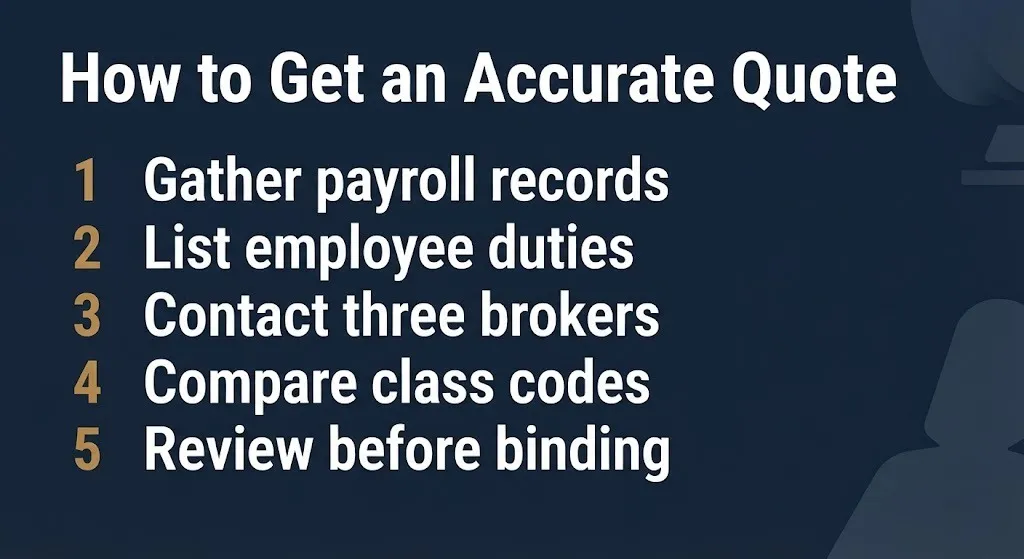
- Gather your payroll records for the last 12 months.
- List every employee and their actual job duties.
- Identify your state and whether it uses NCCI or state-specific rates.
- Contact three licensed agents or brokers.
- Compare class codes, coverage limits, and exclusions.
- Ask about audit procedures and payment plans.
- Review the quote in writing before binding.
- Keep the quote and final policy together for audit season.
What Are Class Codes and Why Do They Matter?
Class codes group employees by type of work. Each code has a rate per $100 of payroll.
Using the wrong code is a common mistake. A contractor who lists roofers as clerical staff will pay less now but face an audit adjustment later.
Misclassification is also a legal risk. State regulators and insurers treat it as premium fraud if done knowingly.
Does Workers Compensation Insurance Cover Remote Employees?
Workers compensation covers remote employees if the injury arises out of employment. The home office is treated as a worksite.
The challenge is proving the injury happened during work. Insurers look at the time, the activity, and whether the employer benefited.
Document remote work policies and report injuries promptly. Delayed reporting is a common reason claims get denied.
What Is an Experience Modification Factor?
An experience modification factor, or ex mod, compares your claims history to similar businesses. A score of 1.0 is average.
A lower score means lower premiums. A higher score means you pay more.
Small businesses with very low payroll may not have an ex mod. Larger employers should review theirs annually for errors.
Key Takeaway: Misclassification and missed payroll audits are the two biggest cost risks. Accurate records protect both your premium and your legal position.
Can a Workers Compensation Claim Affect Your Premium?
Yes. A single large claim or multiple small claims can raise your experience modification factor and your premium.
Insurers use claims history to predict future risk. A business with frequent injuries will pay more.
Prevention programs and prompt return-to-work policies can help keep premiums stable over time.
What States Have Different Workers Compensation Rules?
Every state has its own workers compensation system. Some states, like Ohio, North Dakota, Washington, and Wyoming, use monopolistic state funds.
California, New York, and Florida have competitive markets with many private carriers. Texas does not require private employers to carry workers compensation, but most do.
State differences affect pricing, claim deadlines, and settlement rules. Work with a local broker who knows your state.
How Long Does a Workers Compensation Claim Take?
A straightforward claim with prompt reporting and clear medical evidence may resolve in weeks. Disputed claims can take months or years.
The timeline depends on the injury, the treatment, and whether the insurer accepts the claim. Hearings and appeals add time.
Think of it like a delayed tax refund. The paperwork starts fast, but the final payment can lag.
What Happens Next
Mid-2026: State insurance departments continue rate reviews for 2027 policy years.
Late 2026: NCCI and state funds publish updated rate filings for the coming year.
If a class action over workers compensation pricing or claims practices is filed, affected employers would receive direct notice.
Frequently Asked Questions
Is a workers compensation insurance quote free?
Yes. Licensed agents and brokers provide quotes at no cost to you.
How fast can I get workers compensation insurance?
Most policies can be bound within one to three business days after you submit payroll records.
What is the cheapest workers compensation insurance?
The cheapest policy depends on your state and industry. Compare quotes from at least three brokers.
Can I get workers compensation insurance online?
Yes. Several carriers and brokers offer online quotes and same-day coverage in many states.
What happens if I misclassify employees?
You may owe back premiums, face fines, and risk personal liability for unpaid claims.
Does workers compensation cover part-time employees?
Yes. Most states require coverage for part-time workers, not just full-time staff.
What is an audit in workers compensation?
An audit is a year-end review of your actual payroll. The insurer adjusts your premium based on real numbers.
Can I shop for workers compensation after a claim?
Yes, but a recent claim may raise your premium with any new carrier.
The right workers compensation quote is the one that matches your actual payroll and job classifications. That protects you from audit surprises and claim denials.
Gather your records, compare three quotes, and verify every class code. That is the only way to buy coverage that actually works when someone gets hurt.