Personal Injury Lawsuits in 2026: How Much They Pay, How Long They Take, and How to File
Quick Answer
- Personal injury lawsuits are real, individual civil claims, not a shared settlement fund or class action program.
- Recent 2026 industry reports put average settlements anywhere from roughly $24,000 to $77,600, depending on injury type and legal representation.
- Filing deadlines vary by state, from as short as one year to as long as six years, so your specific state’s statute of limitations is what actually controls your case.
If you’re searching “personal injury lawsuits,” you’re likely trying to understand what your own case might be worth, not tracking a specific class action. That’s an important distinction, because unlike a mass settlement, there’s no single payout pool here.
Every personal injury lawsuit is its own case, decided by the facts of what happened to you specifically. The number that matters most isn’t a national average, it’s your state’s filing deadline, since missing it can end your case before it starts.
This article breaks down what the 2026 data actually shows about settlement amounts, legal fees, timelines, and deadlines, without pretending there’s one universal number that applies to everyone. One thing the data makes clear: the gap between what represented and unrepresented claimants recover is large enough that it changes the math on hiring a lawyer.
The Facts
| Topic | Personal injury lawsuits (individual civil negligence claims, not one shared case) |
| Status | Ongoing area of civil law, no single active settlement or deadline applies to the category itself |
| Fund Size | Not applicable, each personal injury lawsuit is an individual claim, not a shared fund |
| Est. Per Person | No single confirmed average, 2026 industry reports range from roughly $24,000 to $77,600 depending on injury severity, state, and representation |
| Claim Deadline | Varies by state, from 1 year to 6 years depending on jurisdiction, always confirm your specific state’s statute of limitations |
| Administrator | Not applicable, personal injury lawsuits are filed and resolved individually through the courts |
| Proof Needed | Medical records, accident documentation, evidence of fault, and documented damages, specific requirements vary by case type and state |
What Is a Personal Injury Lawsuit?
A personal injury lawsuit is a civil legal claim you file seeking financial compensation for harm caused by someone else’s negligence, carelessness, or wrongdoing.
This differs from an insurance claim, which is a request for payment made directly to an insurance company without involving a court. A lawsuit becomes necessary when a fair settlement can’t be reached, or when the injury and damages are serious enough to justify formal litigation.
Common categories include car accidents, slip and fall incidents, medical malpractice, product liability, workplace injuries outside the workers’ comp system, and wrongful death claims.
Key Takeaway: A personal injury lawsuit is a formal court claim, not a settlement program you apply to, and every case is decided on its own specific facts.
Do Most Personal Injury Lawsuits Go to Trial or Settle?
Most personal injury lawsuits settle before trial, with roughly 95 percent resolved through negotiation or mediation rather than a courtroom verdict.
Only about 4 to 5 percent of personal injury cases actually reach a trial verdict. Of the cases that do go to trial, plaintiffs win roughly 50 percent of the time, according to industry-compiled jury verdict data.
Trials are expensive and slow for both sides. Preparing a case for trial commonly costs each side tens of thousands of dollars and can take two to four years, which is a major reason both plaintiffs and defendants often prefer settling.
Key Takeaway: If you’re picturing a dramatic courtroom verdict, know that the overwhelming majority of personal injury cases never get there, they settle first.
How Much Do Personal Injury Lawsuits Pay?
There is no single confirmed national average payout, because settlement amounts depend heavily on injury severity, liability strength, and available insurance coverage.
2026 industry reports vary widely on this exact question. That variance itself is worth noting, since it shows how unreliable a single “average settlement” headline really is.
2026 Reported Average Settlement Figures (By Source)
| Reporting Source | Reported Average |
|---|---|
| Rev.com industry statistics | $52,900 |
| WorldMetrics fact-checked statistics | $42,000 |
| ConsumerShield law firm survey | $44,000 |
| Insurance Research Council (represented claimants) | $77,600 |
| Insurance Research Council (unrepresented claimants) | $17,600 |
Not yet determined for your case specifically: Your own settlement value depends on your documented medical costs, lost wages, injury severity, and the strength of the evidence showing fault, none of which a national average can predict.
What’s the Average Personal Injury Settlement Amount in 2026?
The honest answer is that reported 2026 averages range from about $17,600 to $77,600, and the number that applies to you depends almost entirely on whether you’re represented and how severe your injury is.
Averages can also be misleading on their own. In Texas, for example, jury verdict data shows an average personal injury verdict of $826,892, but the median verdict is only $12,281. A small number of very large verdicts pull the average far above what a typical case actually recovers.
Settlement Range by Injury Severity (Reported 2026 Estimates)
| Injury Type | Reported Range |
|---|---|
| Soft tissue or whiplash | Around $12,000 to $35,000 |
| Fractures requiring treatment | $15,000 to $100,000+ |
| Spinal cord injuries | Can exceed $1.1 million |
| Medical malpractice claims | Commonly $250,000 to over $1 million |
Reality Check: Be skeptical of any website that states one flat “average personal injury settlement” number as if it applies to your case. Multiple 2026 industry reports disagree with each other by tens of thousands of dollars, which means a single-number claim is a marketing simplification, not a verified fact about your specific situation.
How Much Does a Personal Injury Lawyer Cost?
Most personal injury lawyers work on contingency, meaning you pay nothing upfront and the fee comes out of your settlement only if you recover money.
The standard structure across most states runs 33 percent to 33.33 percent if your case settles before a lawsuit is filed, rising to 35 percent to 40 percent if a lawsuit is filed or the case goes to trial. This tiered structure reflects the added work of discovery, depositions, and trial preparation.
Typical Contingency Fee Structure
| Case Stage | Typical Fee |
|---|---|
| Settled before filing a lawsuit | 33% to 33.33% |
| Lawsuit filed or proceeds to litigation | 35% to 40% |
Some states cap contingency fees for specific case types. Illinois, for example, limits medical malpractice fees to 33⅓ percent of the first $150,000, 25 percent of the next $850,000, and 20 percent above $1 million under state law. California similarly restricts fees in medical malpractice cases under its MICRA statute.
How Does Having a Lawyer Change Your Settlement Amount?
Hiring a lawyer is associated with a significantly higher average recovery, based on Insurance Research Council data cited across multiple 2026 industry sources.
Represented claimants recovered an average of $77,600, compared to $17,600 for unrepresented claimants, a difference of roughly 340 percent. Even after paying a standard one-third contingency fee, represented claimants still net substantially more on average.
One reason for the gap: an estimated 73 percent of unrepresented claimants accept an insurance company’s first offer, which is typically 40 to 60 percent below fair value according to the same industry data.
Key Takeaway: The data consistently shows represented claimants net more money even after attorney fees, largely because insurers’ first offers are rarely their best offers.
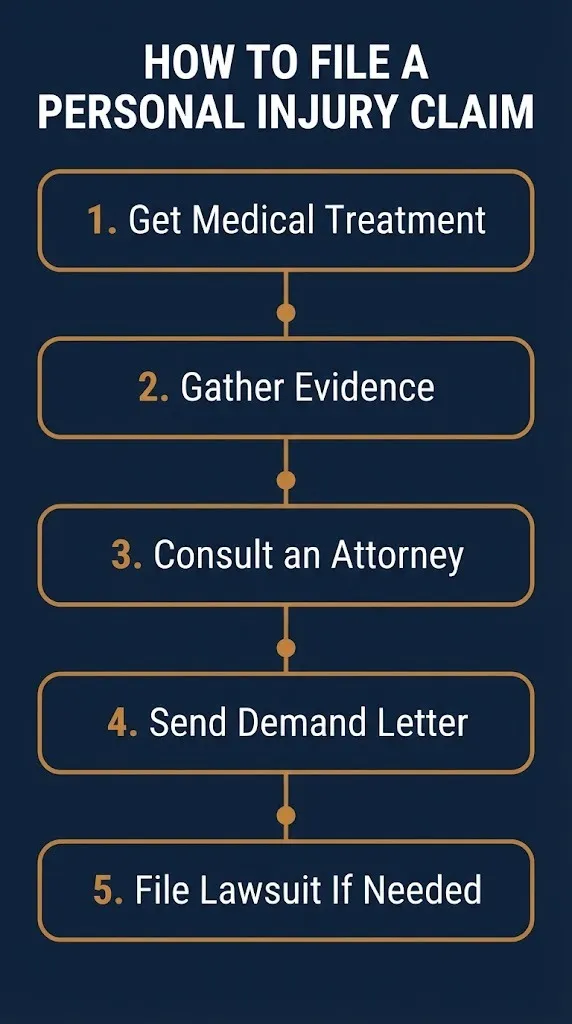
How Do You File a Personal Injury Lawsuit?
You file a personal injury lawsuit by first pursuing an insurance claim or demand, then filing formally in civil court if a fair settlement isn’t reached.
- Seek medical treatment immediately and get every injury properly documented.
- Gather evidence: photos, witness contact information, and incident reports.
- Consult a personal injury attorney, most offer free initial consultations.
- Send a demand letter to the at-fault party’s insurance company.
- Negotiate a settlement if the insurer offers a fair amount.
- File a formal lawsuit in civil court if negotiations stall or the offer is inadequate.
- Proceed through discovery, depositions, and possible mediation.
- Settle or proceed to trial if no agreement is reached.
What Evidence Do You Need for a Personal Injury Claim?
You need documented proof connecting the incident, the at-fault party’s negligence, and your specific damages to build a strong personal injury claim.
Core Evidence Checklist:
- Medical records and bills directly tied to the injury.
- Photos or video of the accident scene and visible injuries.
- Police or incident reports, where applicable.
- Witness names and contact information.
- Proof of lost wages, such as pay stubs or employer statements.
- Any communication with the at-fault party or their insurer.
Missing documentation is one of the most common reasons unrepresented claimants accept lower settlement offers, since insurers often dispute damages that aren’t clearly documented.
What Is the Statute of Limitations for a Personal Injury Lawsuit?
The statute of limitations for a personal injury lawsuit varies significantly by state, ranging from as short as one year to as long as six years.
This deadline is not something you can safely estimate or assume. Some states have recently changed their rules. Louisiana, for example, extended its prescriptive period from one year to two years under Act 423, for injuries occurring on or after July 1, 2024.
Deadline Factors That Can Shift Your Timeline:
- The discovery rule, which can delay the clock if an injury wasn’t immediately apparent.
- Minor plaintiff tolling, which can extend deadlines for injuries to minors.
- Government claim requirements, which often impose much shorter notice deadlines, sometimes 30 to 90 days, when suing a government entity.
- Fraudulent concealment by the at-fault party, which can pause the clock in some jurisdictions.
Key Takeaway: Never assume your filing deadline based on a general “personal injury statute of limitations” answer, confirm your specific state’s rule and any exceptions that might apply to your situation.
How Long Does a Personal Injury Lawsuit Take in 2026?
A personal injury claim typically takes around 11.4 months to resolve on average, though cases that proceed to a full lawsuit and trial generally take significantly longer.
Cases resolved through early settlement negotiations move fastest. Cases that require filing a lawsuit, going through discovery, and potentially reaching trial can take two to four years, according to industry timeline data.
Mediation has become a common middle path, allowing both sides to test their case assumptions in a structured setting without the full cost of a trial, which speeds up many 2026 case resolutions compared to litigating all the way to verdict.
What’s a Recent Example of a Major 2026 Personal Injury Settlement?
One of the largest reported 2026 personal injury settlements was a $182 million resolution in the Metro-North Valhalla train crash litigation in Westchester County, New York.
The case stemmed from a 2015 collision between a commuter train and an SUV at a railroad crossing that killed six people and injured others. A jury had previously found Metro-North primarily at fault, and the 2026 settlement resolved claims for the families of those killed and other injured victims.
This case illustrates why national averages can be so misleading. A single catastrophic-injury or wrongful-death case involving corporate or government liability can be worth hundreds of times more than a typical soft-tissue injury claim.
What Types of Cases Count as Personal Injury Lawsuits?
Personal injury lawsuits cover a wide range of incidents where someone else’s negligence caused physical or psychological harm.
Common Personal Injury Case Types:
- Car, truck, and motorcycle accidents.
- Slip and fall or other premises liability incidents.
- Medical malpractice, including surgical errors and misdiagnosis.
- Product liability, involving defective or dangerous products.
- Dog bites and animal attacks.
- Wrongful death claims filed by surviving family members.
Each category has different evidentiary standards, potential damages, and, in some states, different statutes of limitations, so the general term “personal injury lawsuit” covers meaningfully different legal processes depending on the case type.
What Damages Can You Recover in a Personal Injury Lawsuit?
You can potentially recover economic damages, non-economic damages, and, in rare cases, punitive damages in a personal injury lawsuit.
Damage Categories:
- Economic damages: medical bills, lost wages, and future medical costs, all backed by documentation.
- Non-economic damages: pain and suffering, emotional distress, and loss of enjoyment of life.
- Punitive damages: rare payments meant to punish the wrongdoer, typically reserved for gross negligence or intentional misconduct, such as drunk driving.
Punitive damages are the exception, not the rule, and many states cap them or require a higher legal standard of proof than ordinary negligence claims.
How Does Comparative Negligence Affect Your Payout?
Comparative negligence rules reduce your compensation based on your own percentage of fault in causing the accident.
Under a modified comparative negligence system, common across many states, you generally cannot recover damages if you’re found more than 50 percent at fault for the incident. Some states have recently tightened this rule further; one state’s 2026 update bars recovery entirely once claimant fault exceeds 50 percent for accidents occurring on or after January 1, 2026.
If you’re found 20 percent at fault for an accident, for example, your total compensation would typically be reduced by 20 percent under most states’ comparative negligence formulas, even if you’re still allowed to recover something.
What Happens Next If You’re Considering a Personal Injury Lawsuit
- First step, immediately after injury: Seek medical treatment and document everything, this protects both your health and your claim.
- Typically within days to weeks: Consult a personal injury attorney for a free case evaluation.
- Typically within weeks to months: Your attorney sends a demand letter and negotiates with the insurer.
- If negotiations stall: A formal lawsuit gets filed before your state’s statute of limitations expires.
- Most commonly, within about 11.4 months on average: Cases resolve through settlement, though litigated cases can extend to two to four years.
Frequently Asked Questions
What is the average personal injury lawsuit settlement?
There is no single confirmed average, 2026 industry reports range from roughly $17,600 to $77,600 depending on representation and injury severity.
Your specific case value depends on documented medical costs, lost wages, and the strength of fault evidence.
How long do I have to file a personal injury lawsuit?
The deadline varies by state, ranging from as short as one year to as long as six years.
Some states have recently changed their deadlines, so always confirm your specific state’s current statute of limitations.
Do personal injury lawsuits usually go to trial?
No, roughly 95 percent of personal injury lawsuits settle before ever reaching a trial verdict.
Only about 4 to 5 percent of cases proceed to trial, and plaintiffs win roughly half of those.
How much does a personal injury lawyer charge?
Most personal injury lawyers work on contingency, typically 33 to 33.33 percent if the case settles before a lawsuit, rising to 35 to 40 percent if litigation is required.
You generally pay nothing upfront, and the fee only applies if you recover compensation.
Is it worth hiring a lawyer for a personal injury claim?
Industry data shows represented claimants recovered an average of $77,600 compared to $17,600 for unrepresented claimants.
Even after paying a standard contingency fee, represented claimants generally net significantly more than those who negotiate alone.
What’s the difference between a personal injury claim and a lawsuit?
A claim is a request for compensation made directly to an insurance company, while a lawsuit is a formal court filing.
Most cases start as a claim and only become a lawsuit if a fair settlement can’t be reached through negotiation.
Can I still file if I was partly at fault for the accident?
It depends on your state’s comparative negligence rules, but many states reduce your compensation by your percentage of fault rather than barring recovery entirely.
Some states now bar recovery completely once your fault exceeds 50 percent, so this varies significantly by jurisdiction.
If you’re evaluating a potential personal injury claim, your very first priority should be confirming your state’s statute of limitations before anything else. After that, document your medical treatment and gather evidence early, since strong documentation is consistently linked to higher settlement outcomes.
The single most important fact from the 2026 data: represented claimants recovered an average of $77,600 versus $17,600 unrepresented, a gap that holds even after standard attorney fees.