Roundup Lawsuit Settlement Amounts 2026: Verified Payouts, Point System, and Claim Status
Quick Answer
- Roundup lawsuit settlements are real, not a scam. Bayer has paid billions to resolve over 100,000 claims.
- Individual payouts range from under $10,000 to over $200,000 depending on diagnosis, exposure, and the point system.
- No current claim deadline exists for new filers, but statutes of limitations in your state control your eligibility.
You used Roundup. You have non-Hodgkin lymphoma. You want to know if the lawsuit is real, how much you might get, and whether it is too late to file.
Here is the direct answer. The Roundup litigation is real. Bayer, which owns Monsanto, has paid billions of dollars to settle tens of thousands of claims. But the settlement process is complex, and not everyone gets the same amount.
This guide explains the verified settlement amounts, the point system that determines payouts, how to check your claim status, and whether new claims are still being accepted in 2026. One surprising verified fact: despite the massive settlements, Bayer has not admitted that Roundup causes cancer, and the company continues to sell the product without a cancer warning label in the United States.
The Facts
| Item | Detail |
|---|---|
| Defendant | Monsanto, now owned by Bayer |
| Product | Roundup weed killer, active ingredient glyphosate |
| Injury | Non-Hodgkin lymphoma and related cancers |
| Claims Resolved | Over 100,000 |
| Total Settlement Value | Over $10 billion |
| Per-Person Payout Range | Under $10,000 to over $200,000 |
| Point System | Used to rank claims by severity and exposure |
| New Claims Accepted | Yes, as of August 2026 |
Is the Roundup Lawsuit Real or a Scam?
The Roundup lawsuit is real. It is one of the largest mass tort litigations in U.S. history, with over 100,000 claims filed and billions of dollars in settlements paid.
The litigation began after the International Agency for Research on Cancer, part of the World Health Organization, classified glyphosate as a probable human carcinogen in 2015. That classification triggered a wave of lawsuits from agricultural workers, landscapers, and home gardeners who used Roundup and later developed non-Hodgkin lymphoma.
Bayer acquired Monsanto in 2018 and inherited the litigation. The company has settled multiple waves of claims. In 2020, Bayer announced a settlement framework that included $10.9 billion for existing and future Roundup claims.
The money is real. Tens of thousands of people have received payments. But the process is not simple, and not every claim results in a large payout.
How Much Are Roundup Lawsuit Settlement Amounts?
Roundup lawsuit settlement amounts vary widely. Individual payouts have ranged from under $10,000 to over $200,000 depending on the strength of the claim, the severity of the illness, and the settlement tier assigned.
The average settlement amount is difficult to verify because most settlements are confidential. Publicly reported figures suggest that the typical payout falls between $10,000 and $150,000, with some cases exceeding $250,000.
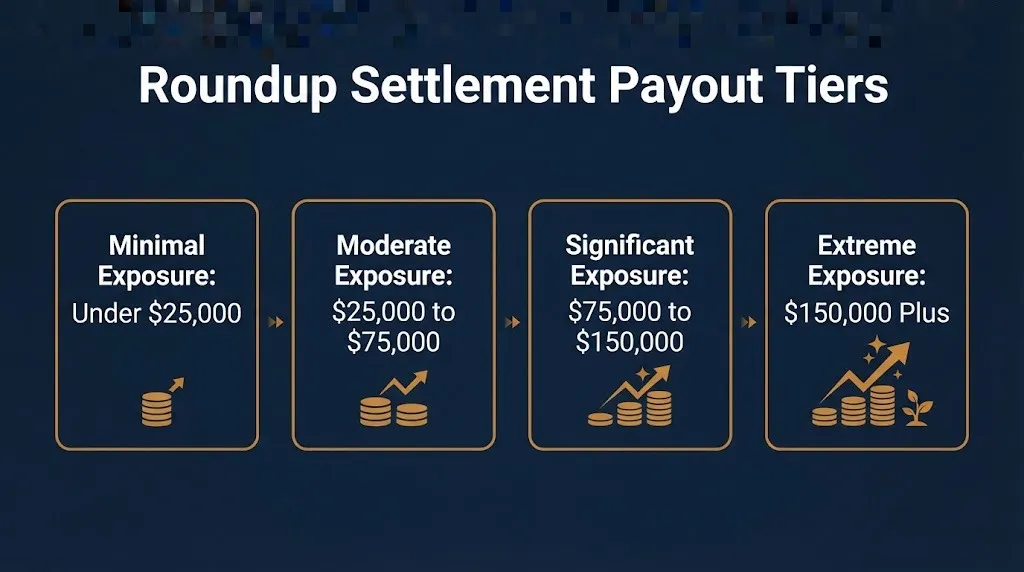
Here is a general range table based on reported data:
| Claim Category | Typical Payout Range |
|---|---|
| Minimal exposure, resolved illness | Under $10,000 to $25,000 |
| Moderate exposure, ongoing treatment | $25,000 to $75,000 |
| Significant exposure, severe illness | $75,000 to $150,000 |
| Extreme exposure, terminal diagnosis | $150,000 to $250,000+ |
These ranges are not guarantees. Your specific payout depends on factors unique to your claim.
Key Takeaway: Roundup payouts are not flat. The amount depends on your medical records, exposure history, and the point system ranking.
What Is the Roundup Settlement Point System?
The Roundup settlement point system is a formula used to rank claims and allocate settlement funds. Claims are assigned points based on factors like diagnosis, age, exposure duration, and disease severity.
The point system was developed as part of the 2020 settlement framework. It was designed to distribute money fairly among thousands of claimants without requiring individual trials.
Factors that influence your point total include:
- Type of non-Hodgkin lymphoma diagnosis
- Stage of cancer at diagnosis
- Duration of Roundup exposure
- Frequency of exposure
- Age at diagnosis
- Whether the claimant is still living
- Strength of medical evidence linking Roundup to the illness
Higher point totals correspond to larger settlement payouts. Lower point totals mean smaller payouts.
The exact formula is confidential and has not been publicly released. Claimants typically learn their point total and corresponding payout when they receive a settlement offer.
Has Anyone Received Money from the Roundup Lawsuit?
Yes, tens of thousands of people have received money from the Roundup lawsuit. Payments began flowing after the 2020 settlement framework and have continued through multiple settlement waves.
The payments are real and documented. Claimants have received checks, wire transfers, and structured settlements. Some have publicly shared their experiences, though many are bound by confidentiality agreements.
The timing of payments varies. Some claimants received money within months of accepting a settlement. Others waited over a year due to administrative processing, medical record review, and the sheer volume of claims.
If you filed a claim and accepted a settlement, the payment timeline depends on the settlement administrator and your specific claim. If you have not received a payment, you should contact your attorney for a status update.
Can You Still File a Roundup Lawsuit in 2026?
Yes, you can still file a Roundup lawsuit in 2026 if you have not previously filed and you meet the eligibility criteria. New claims are being accepted by law firms handling Roundup litigation.
The statute of limitations is the key deadline. Most states allow 2 to 3 years from the date of diagnosis or discovery to file a personal injury claim. Some states have longer windows. If you were diagnosed years ago, your deadline may have passed.
You may qualify if you used Roundup regularly and later developed non-Hodgkin lymphoma. The stronger your exposure history and the clearer the link between exposure and diagnosis, the more likely your claim will be accepted.
Contact a law firm with Roundup litigation experience for a free case evaluation. They will review your medical records and exposure history and tell you whether you have a viable claim.
What Is the Current Roundup Litigation Update?
The Roundup litigation remains active in 2026. Bayer has resolved most of the older claims through settlement, but new claims continue to be filed and negotiated.
Bayer has also pursued legal strategies to limit future liability. In 2021, the company announced it would replace glyphosate in residential lawn and garden products in the United States, though agricultural products still contain glyphosate.
The company has petitioned the U.S. Supreme Court on preemption grounds, arguing that federal pesticide labeling laws shield it from state failure-to-warn claims. The Supreme Court has not ruled in favor of Bayer, and litigation continues.
As of August 2026, no new nationwide settlement framework has been announced beyond the existing programs. Individual claims are being resolved through negotiation and, in some cases, trial.
Key Takeaway: The litigation is not over. Bayer continues to defend itself, and new claimants are still coming forward.
How Do I Check My Roundup Claim Status?
You can check your Roundup claim status by contacting the law firm that filed your claim or the settlement administrator assigned to your case.
Your attorney is the primary point of contact. They receive updates from the settlement administrator and can tell you where your claim stands in the review process.
If your claim was part of a specific settlement program, there may be a dedicated settlement website or portal. Those portals provide status updates based on your claim number and other identifying information.
Do not respond to unsolicited calls or emails claiming to have information about your Roundup settlement. Legitimate updates come through your attorney or the official administrator.
What Is the Monsanto Lawsuit About?
The Monsanto lawsuit, now against Bayer, alleges that Roundup weed killer causes non-Hodgkin lymphoma and that Monsanto failed to warn users about the cancer risk.
The core allegation is failure to warn. Plaintiffs argue that Monsanto knew or should have known that glyphosate was carcinogenic and that the company actively concealed the risk while marketing Roundup as safe.
Evidence in the litigation included internal Monsanto emails that plaintiffs argue showed the company manipulating scientific research and influencing regulatory agencies. Monsanto and Bayer deny these allegations.
The first three trials produced jury verdicts for the plaintiffs totaling over $2 billion, though those verdicts were later reduced on appeal. The jury outcomes pressured Bayer to settle most claims rather than risk continued trial losses.
Is There a Roundup Class Action Suit?
Roundup is not a traditional class action with a single settlement fund. It is a mass tort, which means individual claims are grouped together for efficiency but each claim is evaluated separately.
Mass torts differ from class actions. In a class action, all members receive similar treatment regardless of individual circumstances. In a mass tort, each plaintiff’s claim is valued based on their specific injuries and evidence.
This structure explains why payouts vary so widely. A class action might pay every member $5,000. A mass tort pays some claimants $10,000 and others $250,000 depending on their individual case strength.
What Proof Do I Need for a Roundup Claim?
You need medical records showing a non-Hodgkin lymphoma diagnosis and evidence of Roundup exposure to file a claim.
The medical evidence is critical. You must prove your diagnosis and the date of diagnosis. Pathology reports, oncology records, and treatment history are essential.
Exposure evidence varies by claimant. Farmers and agricultural workers may have employment records, purchase records, or witness statements. Home gardeners may have receipts, photos, or personal journals documenting Roundup use.
The stronger your exposure history and the more thoroughly documented your diagnosis, the higher your claim is likely to rank in the point system.
Key Takeaway: Medical records and exposure evidence determine both eligibility and payout amount.
Reality Check
No legitimate Roundup settlement will contact you by text message. No legitimate law firm will charge you upfront fees to evaluate your Roundup claim. No legitimate settlement administrator will ask for your bank account details over the phone. Roundup cases are handled through licensed attorneys and court-approved settlement programs. If someone offers to “fast track” your Roundup payout for a fee, it is a scam.
What Happens Next
Here is the expected path for Roundup litigation in 2026 and beyond:
- Ongoing: New claims accepted and reviewed by Roundup litigation firms.
- 2026: Individual settlements continue, with payments issued in waves.
- 2026 to 2027: Remaining trials may proceed in some jurisdictions.
- Future: Bayer may announce additional settlement frameworks or continue litigation.
- For claimants: If you have a diagnosis, file now. Do not wait for a new settlement announcement.
Frequently Asked Questions
Is it too late to file a Roundup lawsuit?
It may not be too late if you were diagnosed recently.
The statute of limitations varies by state, often 2 to 3 years from diagnosis.
Contact a Roundup attorney to determine your specific deadline.
How long does it take to get Roundup settlement money?
It typically takes 6 to 18 months from settlement acceptance to payment.
Administrative processing and claim volume cause delays.
Some claimants wait longer depending on their specific settlement tier.
Do I need a lawyer for a Roundup claim?
Yes, Roundup claims require legal representation.
These cases are complex and settlement negotiations require experienced counsel.
Most Roundup attorneys work on contingency with no upfront fees.
Can I file a Roundup claim for a deceased family member?
Yes, you may file a claim on behalf of a deceased family member.
The claim becomes part of the estate.
A surviving spouse, child, or estate representative can pursue it.
What if I used Roundup but do not have cancer?
You likely do not have a claim if you have not developed non-Hodgkin lymphoma or a related cancer.
Exposure alone is not enough.
A diagnosis is required.
How much did the average Roundup plaintiff receive?
The average is difficult to verify due to confidentiality.
Reported averages range from $10,000 to $150,000 depending on the settlement wave.
Your specific payout depends on your point system ranking.
Is Bayer still selling Roundup?
Yes, Bayer still sells Roundup in the United States.
The company replaced glyphosate in residential lawn and garden products but continues selling agricultural formulations.
The product does not carry a cancer warning label in the U.S.
File Now If You Have a Diagnosis and Exposure History
The Roundup litigation has already paid billions to claimants, but new cases are still being filed and resolved. If you used Roundup and developed non-Hodgkin lymphoma, the most important action is to contact a law firm with Roundup experience.
Your statute of limitations may be running. The longer you wait, the harder it becomes to gather evidence and file a valid claim.
The single most important fact to remember: your diagnosis date starts the clock. Contact a lawyer today to find out if you still have time.