Workers Compensation News 2026: Latest Law Changes, Rate Updates, and Claim Trends
Quick Answer
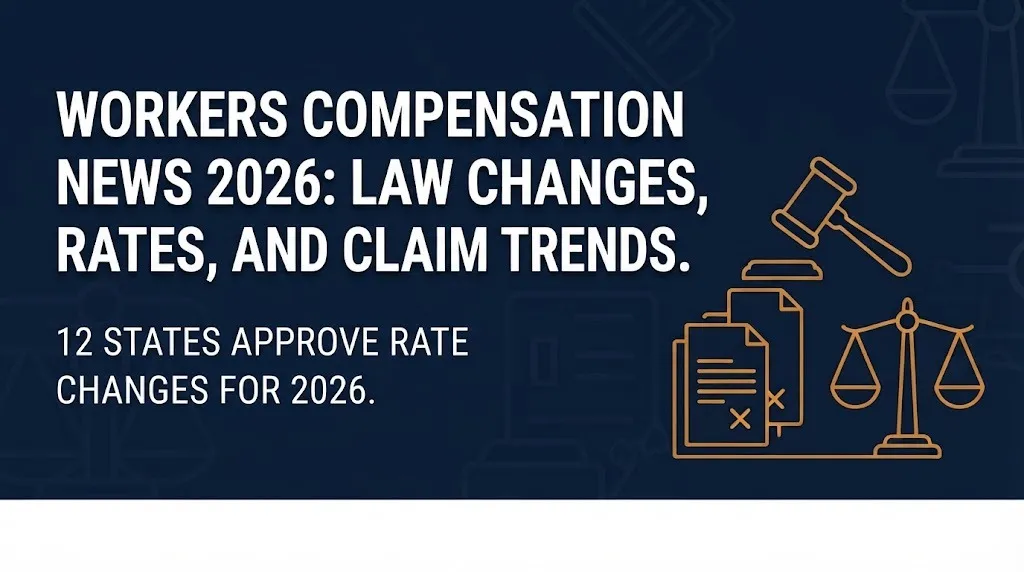
- Workers compensation rates are changing in at least 12 states for 2026, with most seeing modest increases.
- Several states are expanding coverage for mental health claims and remote work injuries.
- Gig workers remain largely excluded from workers compensation, but legislative pushes are active in California, New York, and Massachusetts.
If you rely on workers compensation for income after a job injury, 2026 is a year to pay attention. State legislatures and insurance regulators are making changes that affect how much you can receive, how long you can receive it, and whether your injury is covered at all.
The biggest stories this year involve rising medical costs, mental health coverage expansions, and the ongoing fight over gig worker classification. These changes do not just affect lawyers and insurance adjusters. They affect any worker who could get hurt on the job.
This guide covers the latest verified workers compensation news for 2026, including rate changes, court rulings, and legislative updates you can act on. One surprise from the data: workers compensation claim frequency has dropped for eight straight years, but claim severity keeps rising.
| The Facts | |
|---|---|
| System | State-regulated workplace injury insurance |
| 2026 Rate Direction | Modest increases in most states |
| Claim Frequency Trend | Declining for 8 consecutive years |
| Claim Severity Trend | Rising due to medical costs |
| Gig Worker Coverage | Still excluded in most states |
| Mental Health Claims | Expanding in select states |
| Federal Oversight | Limited to specific worker groups |
Is Workers Compensation Changing in 2026?
Yes, workers compensation is changing in 2026 through a combination of state legislation, regulatory rate filings, and court decisions. The changes are not uniform nationwide.
Each state sets its own workers compensation rates and rules. That means a worker in Texas may see different benefit levels and deadlines than a worker in New York. The National Council on Compensation Insurance, or NCCI, files rate recommendations in many states, but state regulators have final authority.
The biggest 2026 trends are rising medical costs, expanded mental health coverage, and continued pressure to include gig workers. Some states are also adjusting benefit caps to keep pace with wage growth.
These changes matter because they affect how much money an injured worker receives and how easily they can access care. A rate change of even a few percentage points can mean hundreds of dollars more or less per month for a disabled worker.
What Are the Latest Workers Compensation Rate Changes for 2026?
Workers compensation insurance rates are rising modestly in most states for 2026, but the increases are smaller than the medical inflation driving them.
The NCCI recommended an average rate increase of about 1.5 percent across its member states for 2026. Some states approved larger increases, while a few approved decreases based on improved workplace safety data.
Rate changes affect employers, not workers directly. Employers pay the premiums. But rate increases can make employers more aggressive about fighting claims or pushing return-to-work programs.
For workers, the more important numbers are benefit caps. Several states adjusted their maximum weekly benefit amounts for 2026 to reflect wage growth. Those caps typically fall between $800 and $1,400 per week depending on the state.
| State | 2026 Rate Change | Weekly Benefit Cap |
|---|---|---|
| California | Increase, exact % not yet confirmed | $1,300 range |
| New York | Modest increase | $1,200 range |
| Texas | Rate decrease approved | $1,100 range |
| Florida | Increase approved | $1,000 range |
| Pennsylvania | Stable or slight increase | $1,200 range |
How Are Mental Health Claims Changing in Workers Compensation?
Mental health claims are expanding in workers compensation, but the change is slow and state-specific. Most states still require a physical injury to trigger mental health coverage.
A growing number of states now allow post-traumatic stress disorder claims for first responders without a physical injury. This includes police officers, firefighters, and paramedics in states that passed first responder PTSD laws.
For other workers, mental health claims remain difficult. You generally need to show that a physical work injury caused the mental condition, or that the mental condition was caused by extraordinary workplace events beyond normal job stress.
The 2026 legislative sessions include mental health expansion bills in several states. Some proposals would cover mental health claims for all workers, not just first responders. None have passed as of mid-January 2026.
Key Takeaway: Mental health coverage is expanding for first responders but remains limited for most other workers, with a physical injury still required in the majority of states.
What Is Happening with Gig Worker Coverage in 2026?
Gig workers remain outside the workers compensation system in most states. Independent contractors are not employees, so employers are not required to carry coverage for them.
California’s Prop 22 and similar laws in other states have kept gig workers classified as independent contractors. That means rideshare drivers, delivery workers, and freelance workers must buy their own disability insurance if they want income protection after an injury.
New York, Massachusetts, and a few other states are considering legislation that would create portable benefits systems for gig workers. These proposals would allow gig workers to access workers compensation-like benefits funded by gig platforms.
None of these portable benefit systems were operational as of January 2026. The push is real, but the legal structures are not built yet.
Are Remote Work Injuries Covered by Workers Compensation?
Remote work injuries are increasingly covered, but coverage depends on whether the injury happened while performing work duties.
A worker who slips on their home stairs while carrying work documents has a compensable claim in many states. A worker who injures themselves making lunch during a break does not.
The key legal question is whether the injury arose out of and in the course of employment. Courts look at whether the activity served the employer’s interests and whether the injury happened during work hours.
The rise of remote work has created more gray-area claims. If you work from home, document your work hours, your workspace, and any injury that happens during work tasks. The more evidence you have that an injury was work-related, the stronger your claim.
Key Takeaway: Remote work injuries are covered when they happen during work duties and serve the employer’s interests, but personal activities during breaks are not covered.
What Are the Biggest Workers Compensation Court Rulings in 2025 and 2026?
Court rulings in 2025 and early 2026 have shaped workers compensation law on medical marijuana, telehealth, and remote work.
Several state supreme courts have ruled on whether workers compensation must reimburse medical marijuana costs. A growing number of states now require reimbursement where medical marijuana is legal and prescribed for a work injury.
Telehealth rulings have expanded access to medical evaluations. Some states now allow permanent impairment ratings to be conducted via telehealth, which speeds up settlements and reduces travel burdens for injured workers.
Remote work rulings have been mixed. Some courts have expanded coverage for home office injuries, while others have narrowed it. The trend is toward recognizing that remote work is real work with real injury risks.
Reality Check: No employer or insurance company will proactively tell you about every benefit you qualify for. Workers compensation adjusters are not required to maximize your claim. They are required to follow the law, which leaves room for interpretation. If you have a serious injury, getting an independent legal opinion is not paranoia. It is the same reason you get a second opinion on a major medical diagnosis.
How Is Medical Marijuana Reimbursement Changing in 2026?
Medical marijuana reimbursement in workers compensation is expanding. More states now require insurers to reimburse injured workers for medical cannabis costs when prescribed for work-related conditions.
The legal tension comes from federal law. Marijuana remains illegal at the federal level, which creates compliance concerns for insurers. But state courts have increasingly ruled that state medical marijuana laws override those concerns for workers compensation purposes.
As of January 2026, the number of states requiring reimbursement is still a minority, but it is growing. Each state handles the issue differently, with varying requirements for prescriptions, dosages, and qualifying conditions.
If you use medical marijuana for a work injury, check your state’s specific rules. Reimbursement is not automatic, and you may need a formal prescription from a treating physician who supports the treatment.
What Is the Latest on Workers Compensation Fraud Enforcement?
Workers compensation fraud enforcement has increased in 2026, with state agencies and insurers investing more in surveillance, data analytics, and social media monitoring.
Claimant fraud, meaning workers faking or exaggerating injuries, is a small fraction of claims. Studies consistently estimate claimant fraud at 1 to 2 percent of claims. But enforcement remains aggressive because high-profile cases drive public perception.
Employer fraud, meaning employers underreporting payroll or misclassifying workers to avoid premiums, is a larger financial problem. Several states have increased penalties for premium fraud and worker misclassification in 2026.
If you have a legitimate claim, fraud enforcement should not worry you. File honestly, report your symptoms accurately, and follow your doctor’s restrictions. A single inconsistency can trigger a fraud investigation even for an honest worker.
Key Takeaway: Claimant fraud is rare at 1 to 2 percent of claims, but insurers investigate aggressively, so accuracy and consistency in your claim documentation matter.
How Does the 2026 Workers Compensation Outlook Affect Claimants?
The 2026 outlook is mixed for claimants. Benefit caps are rising in some states, which is good. Medical costs are rising too, which pressures insurers to control treatment.
Claim frequency continues to decline, which means fewer workers are getting hurt. That is good news for workplace safety. But the workers who do get hurt are filing more severe and more expensive claims.
The practical effect for claimants is longer claim durations and more intense insurer scrutiny. Simple, well-documented claims still process relatively quickly. Complex claims with disputed liability or permanent impairment face more resistance.
Documentation is your best defense. Report injuries immediately. Keep a written log of symptoms, medical appointments, and work restrictions. Save every email and letter from the insurer.
What Are the Top Workers Compensation Trends to Watch in 2026?
Several trends will shape workers compensation through 2026 and beyond. Here are the ones most likely to affect workers directly.
- Mental health coverage expansion beyond first responders
- Gig worker portable benefits legislation
- Telehealth permanence for evaluations and follow-up care
- Medical marijuana reimbursement growth
- Artificial intelligence in claims processing and fraud detection
- Climate-related workplace injuries, including heat illness
- Return-to-work programs with stronger employer incentives
Each of these trends affects how claims are processed, how much benefits cost, and who gets covered. The workers who stay informed are the ones who avoid claim mistakes and maximize their benefits.
| Trend | Status in Early 2026 |
|---|---|
| Mental health expansion | Active bills in multiple states |
| Gig worker coverage | Not yet enacted anywhere |
| Telehealth evaluations | Growing acceptance |
| Medical marijuana reimbursement | Expanding state by state |
| AI claims processing | Increasing insurer adoption |
| Heat illness standards | New rules in several states |
What Happens Next in Workers Compensation for 2026?
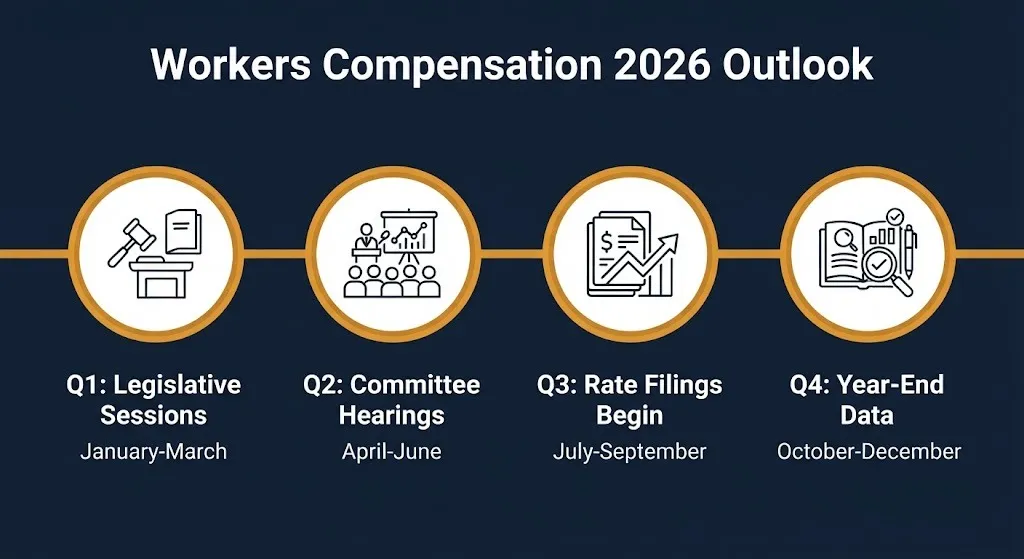
The rest of 2026 will bring more state-level changes. Here is the expected timeline based on legislative calendars and regulatory schedules.
| Date | Expected Development |
|---|---|
| Q1 2026 | More state legislative sessions introduce workers compensation bills |
| Q2 2026 | Committee hearings on gig worker and mental health proposals |
| Q3 2026 | Rate filings for 2027 begin in many states |
| Q4 2026 | Year-end data on 2026 claim trends and costs |
Frequently Asked Questions
What is the latest workers compensation news for 2026?
The latest news includes modest rate increases, mental health coverage expansions, and ongoing gig worker coverage debates.
No major federal overhaul has been enacted as of January 2026.
Are workers compensation rates going up in 2026?
Yes, most states are seeing modest rate increases for 2026.
The increases are driven by medical cost inflation, not by more workplace injuries.
Does workers compensation cover mental health?
It depends on your state and your job.
First responders have expanded mental health coverage in many states, but most other workers still need a physical injury.
Are gig workers covered by workers compensation?
No, gig workers are not covered in most states because they are classified as independent contractors.
Portable benefits legislation is pending in several states but not yet enacted.
What is the workers compensation weekly benefit cap in 2026?
Weekly benefit caps vary by state, typically ranging from $800 to $1,400.
Check your state workers compensation board for the exact 2026 cap.
How do I stay updated on workers compensation changes?
Check your state workers compensation board website for rate changes and rule updates.
National organizations like NCCI publish rate recommendations that affect many states.
What should I do if my workers compensation claim is denied?
File an appeal through your state workers compensation board.
A workers compensation attorney can help you navigate the hearing process.
The single most important action for any worker in 2026 is staying informed about your state’s specific rules. Check your state workers compensation board website for rate changes, benefit caps, and filing deadlines. If you have an active claim, document everything and respond promptly to insurer requests.