T+1 Settlement 2026: What the Faster Trade Cycle Means for Your Money
Quick Answer:
- T+1 settlement means securities trades finalize one business day after the trade date.
- It applies to stocks, bonds, ETFs, and municipal securities in U.S. markets.
- No new regulatory deadline is pending for 2026; the system is already active.
If you bought or sold a stock in 2026, your trade settled faster than it would have two years ago. T+1 settlement is real, it is active, and it changed how money moves after every securities transaction in the United States. The rule took effect on May 28, 2024, and by 2026, brokers, clearinghouses, and investors have fully adjusted to the new rhythm.
The people searching this term include new investors confused about why funds appear in their account sooner, and retirement account holders trying to time withdrawals. The single most important fact to know in 2026 is that T+1 is not a pending proposal. It is the law of the market, enforced by the Securities and Exchange Commission.
This article covers what T+1 means, how it compares to T+2, why the SEC made the change, and what it means for your cash flow, margin account, and settlement date calculations. One surprising detail: the shift to T+1 cut the time your money sits in limbo after a trade by half, but it also gave investors less time to fix funding errors.
| The Facts | |
|---|---|
| Rule | SEC Rule 15c6-1 amendment, T+1 settlement cycle |
| Effective Date | May 28, 2024 |
| Applies To | Stocks, bonds, ETFs, municipal securities |
| Regulator | U.S. Securities and Exchange Commission |
| Prior Standard | T+2 settlement |
| Current Status | Active and enforced |
| Consumer Deadline | None; ongoing operational rule |
Is T+1 Settlement Legitimate?
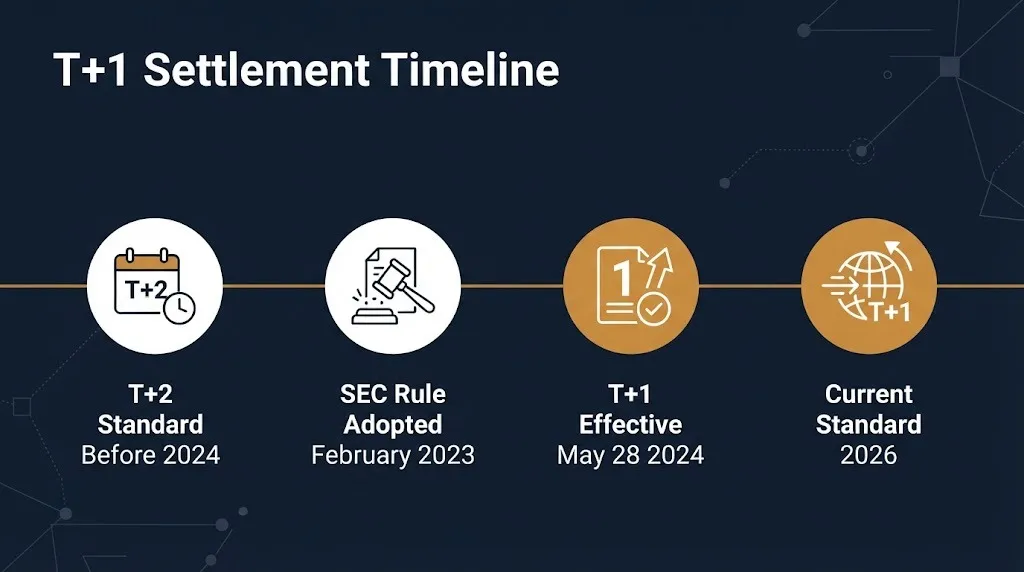
Yes, T+1 settlement is a legitimate regulatory standard. It is not a scam, not a broker policy, and not an optional feature. The Securities and Exchange Commission adopted the rule change in February 2023, and it became mandatory for U.S. securities transactions on May 28, 2024.
The rule amended SEC Rule 15c6-1, which sets the standard settlement cycle for most broker-dealer transactions. Before the change, the standard was T+2, meaning trades settled two business days after the trade date. The amendment shortened that to one business day.
Every registered broker-dealer in the United States must comply. The Depository Trust and Clearing Corporation, or DTCC, updated its systems to support the faster cycle. The National Securities Clearing Corporation, a DTCC subsidiary, now processes settlement obligations on the shorter timeline.
For ordinary investors, T+1 means the gap between clicking “sell” and seeing cash in your account shrank by one business day. That is a real operational change, not a marketing label.
What Does T+1 Settlement Mean for Your Money?
T+1 settlement means your securities transaction is final one business day after you place the trade. If you sell a stock on Monday, the cash settles in your account on Tuesday. If you buy on Friday, settlement occurs on Monday, assuming no market holiday.
This matters for three reasons. First, you can access sale proceeds faster. Second, you must fund purchases faster. Third, dividend and corporate action records update sooner.
| Trade Date | T+1 Settlement Date |
|---|---|
| Monday | Tuesday |
| Tuesday | Wednesday |
| Wednesday | Thursday |
| Thursday | Friday |
| Friday | Monday (next business day) |
The table assumes no market holidays. Weekends do not count as settlement days. A trade placed on the Friday before a Monday holiday settles on Tuesday, not Monday.
For retirement account withdrawals, the faster cycle means you can move proceeds from sold investments into your bank account sooner. That is useful for required minimum distributions or planned expenses. But it also means less float time if you are selling to cover a bill.
How Does T+1 Compare to T+2 Settlement?
T+1 settlement is one business day faster than the previous T+2 standard. Under T+2, a Monday trade settled on Wednesday. Under T+1, that same trade settles on Tuesday.
The difference sounds small, but it compounds. Institutional investors, market makers, and clearinghouses process millions of transactions daily. Cutting the settlement cycle in half reduces counterparty risk, the chance that one side of a trade fails before the other side delivers cash or securities.
For retail investors, the change is most visible in two places. Sale proceeds arrive one day earlier. Margin calls and funding deadlines arrive one day sooner. The second point catches some investors off guard.
| Comparison Point | T+2 (Old) | T+1 (Current) |
|---|---|---|
| Settlement time | 2 business days | 1 business day |
| Sale proceeds access | Day 2 | Day 1 |
| Funding deadline for buys | Day 2 | Day 1 |
| Counterparty risk window | Longer | Shorter |
The shift did not change how trades are placed, priced, or confirmed. It only changed when the backend settlement occurs. For most buy-and-hold investors, the adjustment was invisible within weeks.
Why Did the SEC Move to T+1 Settlement?
The SEC moved to T+1 settlement to reduce risk in the financial system. The longer a trade sits unsettled, the more exposure exists to a default, a market shock, or an operational failure at a clearinghouse.
The GameStop trading frenzy of early 2021 exposed settlement pressure points. Retail trading volume spiked, and clearinghouses faced billions in collateral demands. The SEC accelerated its settlement reform timeline in response. The final rule came in 2023 with an effective date in 2024.
A faster settlement cycle means less time for something to go wrong. It also means brokers and clearinghouses hold less capital against pending trades. That frees up liquidity but demands better back-office systems.
The SEC did not act alone. Canadian markets moved to T+1 on the same date. Mexico transitioned to T+1 the following day. The coordinated shift prevented cross-border settlement mismatches.
Key Takeaway: T+1 settlement is the current mandatory standard for U.S. securities, one business day faster than the old T+2 rule, and it applies to every stock and ETF trade you place in 2026.
What Is the Option Settlement Date Under T+1?
The option settlement date under T+1 is one business day after the trade date for most listed options. Options on equities, ETFs, and indexes follow the same T+1 standard that applies to the underlying securities.
Before May 2024, options settled on T+2 alongside their underlying stocks. The SEC’s rule change aligned the option settlement cycle with the equity settlement cycle. That was necessary because options exercise and assignment create underlying stock transactions.
If you exercise a call option on Tuesday, the underlying stock transaction settles on Wednesday. If you are assigned on a short put, the stock purchase settles one business day after assignment. The tighter timeline means option traders must have cash or margin available faster.
| Option Activity | Settlement Timing |
|---|---|
| Buy or sell an option | T+1 |
| Exercise a call | Underlying stock settles T+1 |
| Assignment on a short put | Underlying stock settles T+1 |
| Option expiration | Final settlement per exchange rules |
This is not a gray area. The Options Clearing Corporation, or OCC, updated its rules to match the SEC mandate. Every U.S. options exchange follows the same T+1 timeline in 2026.
How Do You Calculate a T+1 Settlement Date?
Calculating a T+1 settlement date is simple. Take the trade date, add one business day, and skip weekends and market holidays. That is your settlement date.
The trade date is the day your order executes, not the day you place it. If you enter a limit order on Saturday, the trade date is Monday when the order fills. Settlement is Tuesday.
Market holidays do not count. The U.S. securities markets observe fixed holidays. If the trade date is the day before a holiday, settlement moves to the next business day after the holiday.
Here is the quick calculation method:
- Identify the trade date when your order executed.
- Add one calendar day.
- If that day is a Saturday, Sunday, or market holiday, advance to the next business day.
- The resulting date is your T+1 settlement date.
Think of it like a library book due the next open day. You check out on Thursday, it is due Friday. You check out Friday, it is due Monday.
What Happens If You Sell a Stock on Friday Under T+1?
If you sell a stock on Friday under T+1, the trade settles on Monday, assuming Monday is a business day. Your sale proceeds become available on Monday, not over the weekend.
This is a common point of confusion. Investors sometimes assume Friday trades settle on Saturday or Sunday. Settlement systems only process on business days. The weekend adds no settlement progress.
If Monday is a market holiday, the Friday trade settles on Tuesday. That means a three-day gap between trade date and settlement date, even under T+1. The rule is one business day, not one calendar day.
For cash flow planning, Friday sellers should not expect weekend access to proceeds. If you need the money by Saturday, you must sell no later than Thursday for a Friday settlement, or use an alternative cash management strategy.
Reality Check: Faster Settlement Does Not Mean Faster Tax Reporting
Reality Check: T+1 settlement changed when trades finalize, not when brokers report them to the IRS. Your 1099-B still arrives on the same annual schedule. Some investors assume faster settlement means faster tax documents. That is false. The settlement cycle and the tax reporting cycle are separate processes with separate deadlines.
Does T+1 Settlement Affect Mutual Funds?
Most mutual funds do not settle on T+1. Mutual fund transactions typically settle on T+1 already, or on a separate schedule set by the fund company. The SEC’s T+1 rule targeted securities traded on exchanges and through broker-dealers, not the direct purchase and redemption of mutual fund shares.
Money market mutual funds operate on their own settlement conventions. Some settle same-day. Others settle next-day. The T+1 rule did not disrupt these existing structures.
| Investment Type | Settlement Standard in 2026 |
|---|---|
| Stocks | T+1 |
| ETFs | T+1 |
| Corporate bonds | T+1 |
| Municipal bonds | T+1 |
| Options | T+1 |
| Mutual funds | Fund-specific, often T+1 |
| Money market funds | Fund-specific, often same-day |
Exchange-traded funds settle on T+1 because they trade on exchanges like stocks. Traditional mutual funds do not trade intraday, so the settlement cycle is less visible to investors.
How Does T+1 Settlement Affect Margin Accounts?
T+1 settlement affects margin accounts by shortening the time you have to meet a margin call. If a trade or market move creates a margin deficiency, your broker now expects resolution one day sooner.
Under T+2, a margin call issued on Monday might require action by Wednesday. Under T+1, the same call typically requires action by Tuesday. This compressed timeline trips up investors who relied on the extra day to move cash.
Brokers have discretion to issue intraday margin calls. In volatile markets, a broker may demand same-day deposits. The T+1 standard compounds that pressure because the underlying settlement is already one day faster.
For investors using margin, the lesson is to keep a cash buffer. Relying on the full settlement timeline to fund a margin account is riskier under T+1 than it was under T+2.
Key Takeaway: T+1 cuts the settlement cycle from two business days to one, which means sale proceeds arrive faster but margin calls and funding deadlines also arrive faster.
What Are the Benefits of T+1 Settlement for Retail Investors?
The main benefit of T+1 settlement for retail investors is faster access to cash. When you sell a stock or ETF, the proceeds hit your account one business day sooner. That improves liquidity for everyday money management.
A second benefit is reduced systemic risk. The faster the market settles trades, the less exposure the financial system has to a default between trade date and settlement. That stability indirectly benefits every investor.
A third benefit is faster dividend eligibility updates. Under T+2, a stock purchase had to settle before you were officially a shareholder of record. Under T+1, that timeline compressed by a day, making record date calculations tighter.
| Benefit | What It Means for You |
|---|---|
| Faster cash access | Sale proceeds available one day sooner |
| Lower systemic risk | Less chance of a market-wide settlement failure |
| Quicker record updates | Dividend and corporate action changes post sooner |
| Simplified planning | Predictable one-day rhythm for most trades |
The benefits are modest for passive investors. The biggest winners are active traders and institutional desks that process high volumes daily.
What Are the Risks of T+1 Settlement?
The main risk of T+1 settlement is operational failure. A shorter settlement window leaves less time to fix errors in trade matching, funding, or securities delivery. When something breaks, it breaks faster.
The SEC acknowledged this risk when adopting the rule. It pointed to the need for better automation, real-time monitoring, and same-day affirmations from institutional counterparties. The industry spent 2023 and 2024 upgrading systems to meet those demands.
For retail investors, the practical risk is missing a funding deadline. If you place a buy order without sufficient cash, your broker may liquidate other holdings or impose trading restrictions. Under T+1, that consequence arrives sooner.
| Risk Factor | Impact Under T+1 |
|---|---|
| Funding shortfall | Less time to deposit cash before liquidation |
| Trade error correction | Smaller window to fix mistakes |
| Margin call | Faster due date for additional collateral |
| Settlement failure | Rare, but consequences hit sooner |
Brokerage platforms now display settlement dates on order confirmations. Review those dates before placing trades that require funding.
Does T+1 Settlement Apply to Cryptocurrency?
No, T+1 settlement does not apply to cryptocurrency. Crypto trades on exchanges settle according to each exchange’s own rules, not SEC Rule 15c6-1. Most crypto exchanges settle trades within minutes or hours, not business days.
The SEC’s settlement rule covers securities, and the regulatory status of most cryptocurrencies remains unsettled. Bitcoin and ether spot ETFs trade as securities on exchanges and settle T+1, but the underlying cryptocurrencies do not.
If you trade crypto on a centralized exchange, your settlement timeline depends on that platform. If you trade a crypto ETF through a brokerage account, that ETF follows T+1 like any other ETF.
How Does T+1 Settlement Affect Dividend Capture Strategies?
T+1 settlement changed dividend capture math. To receive a dividend, you must be a shareholder of record on the record date. The ex-dividend date is typically one business day before the record date.
Under T+2, you had to buy a stock two business days before the record date to settle in time. Under T+1, you can buy one business day before the record date. The shorter cycle moves the ex-dividend date calculation by one day.
| Action | T+2 Timeline | T+1 Timeline |
|---|---|---|
| Buy before record date | 2 business days prior | 1 business day prior |
| Sell after ex-dividend date | Standard | Standard |
| Capture dividend | Requires earlier purchase | Purchase window moved later |
This change does not make dividend capture more profitable. It just shifts the mechanics. The dividend amount is the same. The risk of price movement around the ex-date remains.
What Is the Settlement Date Meaning in Legal Documents?
In legal documents, the settlement date is the date on which ownership of a security officially transfers from seller to buyer, and payment transfers from buyer to seller. It is the completion date of the trade contract.
This meaning predates T+1. The settlement date has always been the contractual endpoint of a securities transaction. What changed in 2024 is the standard gap between trade date and settlement date.
The settlement date matters for tax purposes, dividend eligibility, voting rights, and corporate action deadlines. In 2026, that date is almost always one business day after the trade date for U.S. exchange-traded securities.
Key Takeaway: T+1 settlement benefits most investors through faster cash access and lower market risk, but it also compresses the time you have to fix funding errors and meet margin calls.
What Happens Next in Settlement Cycle Reform
| Expected Timing | Milestone |
|---|---|
| Already complete | T+1 implementation on May 28, 2024 |
| Ongoing through 2026 | Industry monitoring of settlement failure rates |
| Under discussion | Same-day settlement feasibility studies |
| No confirmed date | Potential future move to T+0 |
The SEC has not proposed a move to same-day settlement. Industry groups, including DTCC, have published research on the possibility. The focus in 2026 remains on measuring how well T+1 works.
Regulatory attention has shifted to operational resilience. The shorter settlement cycle exposes weaknesses in trade affirmation, funding, and error correction. Future rulemaking may target those areas rather than accelerating the cycle further.
Frequently Asked Questions
Is T+1 settlement the current standard?
Yes, T+1 settlement has been the U.S. standard since May 28, 2024.
It applies to stocks, bonds, ETFs, and options.
The SEC rule change replaced the older T+2 standard.
How does T+1 settlement affect when I get my money?
You receive sale proceeds one business day after the trade date.
A Monday sale settles on Tuesday.
A Friday sale settles on Monday, assuming no holiday.
Does T+1 settlement apply to all securities?
No, T+1 applies to most exchange-traded securities in the U.S.
Mutual funds and money market funds have their own settlement schedules.
Cryptocurrency trades on crypto exchanges are not covered by the rule.
What happens if I do not have enough cash for a T+1 trade?
Your broker may liquidate other holdings to cover the purchase.
You may face trading restrictions or fees.
Deposit funds before placing the trade to avoid this.
Why did the SEC change from T+2 to T+1?
The SEC wanted to reduce settlement risk in the financial system.
The GameStop volatility in 2021 exposed settlement pressure points.
A shorter cycle means less time for a counterparty default.
Does T+1 change my tax reporting?
No, T+1 does not change tax reporting deadlines.
Brokers still issue 1099 forms on the annual schedule.
The settlement cycle and tax cycle are separate processes.
Can I sell a stock and buy another on the same day under T+1?
Yes, same-day buying and selling is allowed.
The sale proceeds settle on T+1, and the purchase settles on T+1.
Your broker may apply its own cash management rules.
How do market holidays affect T+1 settlement?
Market holidays delay settlement by one business day.
A trade before a holiday settles after the holiday.
Weekends also do not count as settlement days.
T+1 settlement is the settled reality of U.S. markets in 2026. You will not find a pending deadline or a class action settlement tied to this term. You will find a faster trade cycle that gives you quicker access to sale proceeds and less time to fix funding mistakes. Check your broker’s settlement display before every trade. Confirm your cash is in place before you buy. The market moves faster now, and your money management should too. August 25, 2026 is the date this information was verified. The date that matters most to you is your next trade date, and its settlement is one business day later.