Lawyer for Lawsuit 2026: How to Find the Right Attorney and Avoid Scams
Quick Answer:
- A lawyer for a lawsuit is a licensed attorney who represents you in civil litigation.
- Attorney fees vary by case type, with personal injury lawyers typically charging contingency fees.
- The most important deadline is your state’s statute of limitations, which varies by claim type.
If you are searching for a lawyer for a lawsuit in 2026, you are probably facing a dispute you cannot resolve alone. Maybe you were injured, defrauded, or denied a settlement payout you believe you deserve. The first thing to know is that hiring a lawyer is not like filing a class action claim. You do not fill out one form and wait for a check. You hire a professional who advocates for you in court or in settlement negotiations.
The people searching this term include consumers with defective products, workers with denied injury claims, and investors who lost money to fraud. The single most important number you need is not a settlement amount. It is your state’s statute of limitations, the legal deadline for filing your lawsuit.
This article covers how to find a licensed lawyer, what fees to expect, how to avoid scams, and what questions to ask before signing anything. One surprising detail: in 2026, most legitimate personal injury and consumer fraud lawyers still work on contingency, meaning they only get paid if you win.
| The Facts | |
|---|---|
| Licensing | State bar associations regulate lawyers |
| Fee Types | Contingency, hourly, flat, retainer |
| Contingency Range | Commonly 33% to 40% of recovery |
| Deadline | Statute of limitations, state-specific |
| Verification | State bar license lookup |
| Scam Risk | Upfront fee demands from unlicensed operators |
| Consultation | Often free for personal injury and consumer cases |
Is Hiring a Lawyer for a Lawsuit Legitimate?
Yes, hiring a lawyer for a lawsuit is a legitimate and regulated process. Lawyers in the United States must pass a state bar exam, maintain a license, and follow ethical rules enforced by their state bar association. The process is not a scam when you work with a verified licensed attorney.
Every state has a bar association or state supreme court that licenses attorneys. You can verify any lawyer’s license status online through the state bar directory. A legitimate lawyer will never object to you checking their credentials.

The problem is not the legal profession. The problem is the people who pretend to be lawyers or claim they can “process” your lawsuit for a fee. Unlicensed operators target people searching for lawsuit representation, especially those looking for class action payouts or mass tort settlements.
Legitimate lawyers do not cold-call you promising a settlement. They do not ask for payment before reviewing your case. They do not guarantee results. If someone does any of those things, you are not talking to a real lawyer.
How Much Does a Lawyer for a Lawsuit Cost in 2026?
Lawyer costs depend on the type of case and the fee arrangement. Personal injury, consumer fraud, and employment lawyers often work on contingency. That means you pay nothing upfront, and the lawyer takes a percentage of your settlement or verdict.
Contingency fees typically range from 33% to 40% of the recovery. If you settle for $100,000 and your agreement says 33%, your lawyer receives $33,000. You receive the remainder, minus any case expenses.
| Fee Type | How It Works | Common Case Types |
|---|---|---|
| Contingency | Percentage of recovery, no upfront fee | Personal injury, consumer class actions |
| Hourly | Set rate per hour worked | Business disputes, family law |
| Flat fee | One fixed price for a defined service | Simple contracts, uncontested matters |
| Retainer | Upfront deposit against hourly billing | Ongoing legal counsel |
Hourly rates vary widely by location and experience. A small-town lawyer may charge $200 per hour. A big-city specialist may charge $800 or more. Always ask for the fee agreement in writing before you commit.
Case expenses are separate from fees. Court filing fees, expert witness costs, and deposition transcripts come out of your recovery or your pocket. Clarify who pays expenses if you lose.
How Do I Find a Lawyer for a Lawsuit?
Finding a lawyer for a lawsuit starts with your state bar association. Every state offers a free lawyer referral service or an online directory of licensed attorneys. That is the safest starting point because it filters out unlicensed operators.
The next step is narrowing by practice area. A lawyer who handles divorce cases is the wrong choice for a defective product claim. Look for someone who specializes in the exact type of lawsuit you are considering.
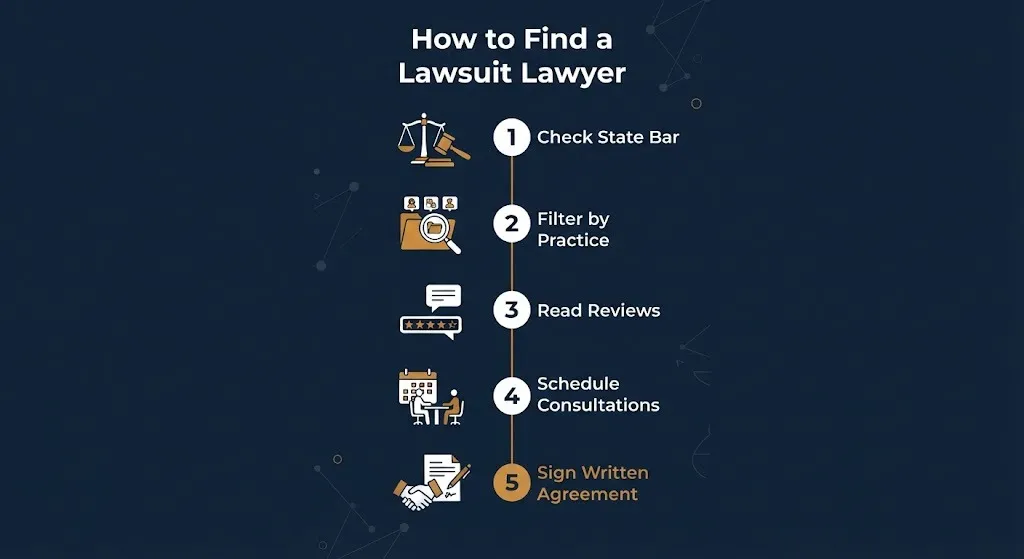
Here is a practical search process:
- Visit your state bar association’s lawyer directory.
- Filter by practice area and location.
- Read client reviews and disciplinary records.
- Shortlist three to five lawyers.
- Schedule consultations, which are often free.
- Ask about experience with your specific type of case.
- Compare fee structures and communication styles.
- Sign a written retainer or engagement agreement.
Referrals from friends or family work too, but verify the license yourself. A good recommendation does not replace a state bar check.
What Questions Should You Ask Before Hiring a Lawyer?
The right questions reveal whether a lawyer has real experience with your type of case. You are hiring someone to handle a serious matter, so treat the first meeting like a job interview.
The first question is about experience. Ask how many cases like yours the lawyer has handled. Ask about outcomes, not just years in practice. A lawyer with 20 years of experience but no trials in your claim type is less useful than a specialist with five years and 50 settlements.
The second question is about communication. Ask who will handle your case day to day. In larger firms, a junior associate may do most of the work while the senior partner supervises. Ask how quickly they return calls and emails.
The third question is about fees. Ask for the fee agreement in writing. Ask what percentage they take, what expenses you owe, and what happens if you lose. A lawyer who dodges this question is not ready for your business.
Key Takeaway: Lawyers are licensed by state bar associations, and legitimate attorneys never demand upfront payment for contingency cases or guarantee a specific outcome.
What Is the Difference Between a Lawyer and a Settlement Claims Service?
A lawyer is a licensed professional who represents you in litigation. A settlement claims service is a business that helps people file claims in class actions or mass tort settlements. The two are not the same.
Claims services often charge fees for something you can do yourself for free. Class action settlements have official claim forms on the settlement administrator’s website. Filing is almost always free. A claims service that charges $50 to file a form you could file in 10 minutes is selling convenience, not legal representation.
Lawyers add value when your case requires litigation, negotiation, or complex evidence. If you are just filing a claim in an existing settlement, you do not need a lawyer. You need the official claim form and your documentation.
| Factor | Lawyer | Claims Service |
|---|---|---|
| Licensed | Yes, by state bar | Often not licensed |
| Represents you in court | Yes | No |
| Fees | Contingency or hourly | Flat fee or percentage |
| Class action claims | Can represent you | Often unnecessary |
| Risk | Low if verified | High if unlicensed |
How Do You Know If a Lawyer Is Licensed?
You verify a lawyer’s license through your state bar association. Every state maintains an online directory of active attorneys. The lookup is free and takes less than a minute.
The directory shows the lawyer’s license status, admission date, and any disciplinary history. If a lawyer is not in the directory, they are not licensed in that state. If the directory shows a suspension or disbarment, walk away.
Some lawyers are licensed in multiple states. That is common for mass tort cases that span jurisdictions. Verify the license in the state where your case will be filed, not just any state.
Do not rely on a website’s claim that someone is a lawyer. Do not rely on a LinkedIn profile or a business card. The state bar directory is the only authoritative source.
What Types of Lawsuits Do Lawyers Handle in 2026?
Lawyers handle nearly every type of civil dispute. In 2026, the highest-volume categories include personal injury, consumer class actions, employment discrimination, data breach claims, and product liability.
Personal injury lawyers handle car accidents, slip and falls, and medical malpractice. These are contingency fee cases, meaning the lawyer gets paid only if you recover money.
Consumer protection lawyers handle deceptive practices, false advertising, and defective products. Many of these cases become class actions where one law firm represents thousands of plaintiffs.
| Lawsuit Type | Common Claims |
|---|---|
| Personal injury | Car accidents, medical malpractice, premises liability |
| Consumer fraud | False advertising, data breaches, defective products |
| Employment | Discrimination, wage theft, retaliation |
| Product liability | Defective drugs, faulty medical devices, dangerous products |
| Contract disputes | Breach of contract, nonpayment, partnership conflicts |
The right lawyer for your lawsuit is one who spends most of their time in your specific category, not a generalist who handles everything.
What Is a Contingency Fee Agreement?
A contingency fee agreement is a contract that says the lawyer only gets paid if you win or settle. If you recover nothing, the lawyer receives no fee. That aligns the lawyer’s incentive with yours.
The agreement must be in writing. It must state the percentage the lawyer takes and how expenses are handled. Most states cap contingency fees in certain case types or require court approval for fees over a certain percentage.
Contingency fees are common in personal injury and consumer cases because injured people often cannot afford hourly billing. The arrangement gives access to legal representation without upfront costs.
The tradeoff is the percentage. A 40% contingency fee on a large settlement can exceed what an hourly arrangement would have cost. But if you lose, the hourly arrangement leaves you with a bill. Contingency leaves you with nothing owed.
Key Takeaway: A free consultation, a written fee agreement, and a verified state bar license are the three signs you are dealing with a legitimate lawyer, not a scammer.
How Do Statutes of Limitations Affect Your Lawsuit?
The statute of limitations is the legal deadline for filing a lawsuit. Every state sets its own time limits, and the limits vary by claim type. A personal injury claim might have a two-year window. A breach of contract claim might have four years.
The clock starts on the date you knew or should have known about the harm. The discovery rule applies in many states. If you did not discover the injury until years later, your filing window may start then.
Missing the deadline usually means losing the right to sue. Courts rarely extend statutes of limitations except in narrow circumstances like fraud, minority, or mental incapacity. Once the clock runs out, your case is dead.
| Claim Type | Typical Limitation Range |
|---|---|
| Personal injury | 1 to 6 years, varies by state |
| Breach of written contract | 3 to 10 years, varies by state |
| Fraud | 2 to 6 years, varies by state |
| Product liability | 2 to 4 years, varies by state |
| Medical malpractice | 1 to 3 years, varies by state |
Do not guess your deadline. A lawyer can calculate it. If you wait too long to ask, the answer may already be too late.
Reality Check: Upfront Fees for a Lawsuit Lawyer Are a Red Flag
Reality Check: Legitimate contingency fee lawyers do not ask for money before reviewing your case. If someone demands a “processing fee,” a “filing deposit,” or a “retainer” before they have even looked at your documents, they are likely not a real lawyer. Verify the license through the state bar directory before sharing anything. Real lawyers have nothing to hide.
How Do Mass Tort Lawyers Work?
Mass tort lawyers handle cases where many people suffered similar injuries from the same product or drug. Gardasil litigation, talcum powder claims, and hernia mesh cases are examples. These cases are not class actions. Each plaintiff files an individual lawsuit that gets grouped for efficiency.
Mass tort lawyers often work on contingency. They advertise heavily because they need many clients to make the litigation economically viable. Some of these advertisements are legitimate. Some are lead generators that sell your information to law firms.
A real mass tort lawyer will review your medical records and vaccination history before accepting your case. A lead generator will ask for your phone number and sell it to the highest bidder. Know the difference.
Mass tort cases take years. A lawyer who promises quick money is lying. The Gardasil MDL has been active since 2022 and still has no settlement. That is the realistic timeline for complex litigation.
How Do You Check a Lawyer’s Disciplinary Record?
Every state bar association publishes disciplinary records online. The record shows formal complaints, suspensions, disbarments, and reprimands. It is public information, and checking it is free.
A clean disciplinary record is the baseline, not a gold star. Most lawyers never face formal discipline. A record with a minor reprimand from 20 years ago may be irrelevant. A record with a recent suspension for mishandling client funds is a dealbreaker.
Look for patterns. Multiple complaints about the same issue, even if not formally disciplined, suggest a problem. The bar directory may not show informal complaints, but consumer review sites and court records can fill the gap.
What Happens After You Hire a Lawyer?
After you hire a lawyer, the work shifts to case development. Your lawyer gathers evidence, interviews witnesses, and drafts the complaint that starts the lawsuit. The defendant responds, and discovery begins.
Discovery is the information exchange phase. Both sides request documents, answer written questions, and take depositions. This is where cases are won or lost, not in dramatic courtroom moments. Most cases settle during or after discovery.
If settlement fails, the case proceeds to trial. Trials are expensive and unpredictable. A good lawyer prepares for trial from day one, because the credible threat of trial drives better settlement offers.
Your job after hiring is to communicate. Respond to your lawyer’s requests promptly. Do not hide facts. Do not discuss the case on social media. The lawyer handles the strategy. You handle the honesty.
Key Takeaway: Statutes of limitations are the silent deadline in every lawsuit, and the only way to know your specific deadline is to ask a licensed lawyer in your state.
What Happens Next If You Need a Lawyer
| Expected Timing | Milestone |
|---|---|
| Immediately | Check your state bar directory for licensed lawyers |
| This week | Schedule free consultations with two or three candidates |
| At the consultation | Ask about experience, fees, and your statute of limitations |
| After signing | Your lawyer drafts and files the complaint |
| Months later | Discovery and settlement negotiations |
| If no settlement | Trial or arbitration |
The timeline is predictable. The outcome is not. The single biggest mistake people make is waiting too long to call a lawyer. The second biggest mistake is calling the wrong kind of lawyer. The third is paying someone who is not a lawyer at all.
The right move is to start today. Verify licenses. Ask questions. Compare fee structures. Your lawsuit will not file itself, and the clock is already running.
Frequently Asked Questions
How do I find a lawyer for a lawsuit near me?
Use your state bar association’s online lawyer directory.
Filter by practice area and location.
Schedule consultations with at least two lawyers before deciding.
Do I need a lawyer to file a lawsuit?
You can file some lawsuits yourself, a practice called pro se litigation.
Complex cases almost always require a licensed lawyer.
Courts hold pro se litigants to the same rules as lawyers.
How much does a lawyer charge for a lawsuit?
Personal injury lawyers typically charge 33% to 40% on contingency.
Hourly lawyers charge anywhere from $200 to $800 per hour.
Flat fees apply to simple, defined legal tasks.
What is the difference between a lawyer and an attorney?
There is no practical difference in the United States.
Both terms refer to someone licensed to practice law.
The words are used interchangeably.
How do I know if a lawyer is legitimate?
Verify the lawyer’s license through your state bar directory.
Check for disciplinary actions on the public record.
A legitimate lawyer will never object to a license check.
Can I fire my lawyer and hire a new one?
Yes, you can change lawyers at any time.
Your former lawyer may have a lien on the case file for unpaid fees.
The new lawyer will handle the transition with the court’s approval.
What should I bring to a lawyer consultation?
Bring every document related to your dispute.
Contracts, medical records, emails, and photos are all useful.
A written timeline of events helps the lawyer evaluate your case.
How long do I have to file a lawsuit?
The deadline depends on your state’s statute of limitations.
Most states give one to six years, depending on the claim type.
Contact a lawyer immediately to calculate your specific deadline.
Finding a lawyer for a lawsuit in 2026 is straightforward if you start with the state bar directory and ask the right questions. Verify the license. Demand a written fee agreement. Ask about experience with your specific claim type. Never pay upfront for a contingency case. The statute of limitations is already running, so the best time to call a lawyer was the day you learned something was wrong. The second best time is today. August 25, 2026 is the date this information was verified. The date that matters most to you is your filing deadline, and only a licensed lawyer can tell you what that is.