Compensation and Benefits 2026: Legal Claims, Employee Rights, and Dispute Deadlines
Quick Answer:
- Compensation and benefits are the wages, salaries, bonuses, insurance, and retirement plans employers provide.
- Unpaid wage claims can recover back pay, liquidated damages, and attorney fees.
- Deadlines vary by claim type, from 180 days for some discrimination claims to 3 years for FLSA violations.
If you are searching for compensation and benefits in 2026, you are probably wondering whether your employer is paying you correctly or whether you are entitled to something you have not received. The term covers a wide legal landscape: wages, overtime, health insurance, retirement plans, stock options, severance, and more. It is not a single lawsuit or settlement. It is a category of rights and disputes.
The people searching this term include workers who suspect wage theft, employees who lost benefits after a layoff, and retirees whose pensions changed unexpectedly. The single most important deadline depends on your specific claim, but for many wage cases, the federal Fair Labor Standards Act gives you up to three years to recover unpaid overtime or minimum wage.
This article covers the legal framework for compensation and benefits, common disputes, how to file claims, and what deadlines apply. One surprising detail: many workers are misclassified as independent contractors and never realize they may be owed overtime, benefits, and back pay.
| The Facts | |
|---|---|
| Governing Laws | FLSA, ERISA, state wage laws |
| Common Claims | Unpaid wages, denied overtime, benefit denial |
| FLSA Deadline | 2 years, or 3 years for willful violations |
| ERISA Deadline | Plan-specific, often 1 to 3 years |
| Discrimination Deadline | 180 days to file with EEOC |
| State Wage Deadlines | Vary by state, often 1 to 3 years |
| Recovery Potential | Back pay, liquidated damages, attorney fees |
Is a Compensation and Benefits Claim Legitimate?
Yes, compensation and benefits claims are legitimate legal disputes. They are not a class action settlement you join by filling out one form. They are individual or collective claims against employers who violate wage, hour, or benefits laws.
Federal law protects your right to minimum wage, overtime pay, and certain benefits. The Fair Labor Standards Act, or FLSA, sets the federal minimum wage and overtime rules. The Employee Retirement Income Security Act, or ERISA, governs pension and health benefit plans. State laws often go further than federal law.
When an employer violates these laws, you have a legal claim. The violation could be unpaid overtime, misclassification as exempt or as an independent contractor, failure to pay final wages, or denial of a benefit you earned. These claims are enforced through the Department of Labor, private lawsuits, and sometimes class actions.
The legitimacy of your claim depends on the facts. Not every compensation dispute is a legal violation. A lawyer or the Department of Labor can evaluate your situation.
How Much Can You Recover in a Compensation Claim?
The amount you can recover in a compensation claim depends on the violation. Unpaid wage claims can recover the back pay you should have received. Many laws add liquidated damages, which double the recovery.
For FLSA overtime violations, you can recover the unpaid overtime plus an equal amount in liquidated damages. If you are owed $10,000 in overtime, a successful claim could recover $20,000. You can also recover attorney fees and court costs.
| Claim Type | Recovery Potential |
|---|---|
| Unpaid minimum wage | Back pay plus liquidated damages |
| Unpaid overtime | Back pay plus liquidated damages |
| Misclassification | Back pay, benefits value, penalties |
| ERISA benefit denial | Benefit value, possible attorney fees |
| Discrimination | Back pay, front pay, compensatory damages |
State laws sometimes offer more. California, for example, imposes waiting time penalties when an employer fails to pay final wages on time. The penalty can equal up to 30 days of wages.
The practical recovery depends on the employer’s ability to pay. A solvent company with deep pockets is a better defendant than a bankrupt one. Most wage claims settle before trial because the employer wants to avoid attorney fee awards.
What Are the Most Common Compensation and Benefits Violations?
The most common compensation and benefits violations in 2026 mirror the claims the Department of Labor files every year. Misclassification tops the list. Employers call workers independent contractors to avoid paying overtime, benefits, and payroll taxes.
Unpaid overtime is the second major category. Employers misclassify workers as exempt from overtime or fail to track hours accurately. Off-the-clock work, where employees answer emails or take calls after hours without pay, generates thousands of claims annually.
| Violation Type | What It Looks Like |
|---|---|
| Misclassification | Employee labeled as contractor or exempt |
| Unpaid overtime | Off-the-clock work, no overtime rate |
| Minimum wage violations | Tipped workers paid below minimum |
| Benefit denial | ERISA plan denies valid claim |
| Final paycheck violations | Employer withholds last paycheck |
| Wage theft | Deductions for uniforms, tools, or breakage |
Benefit denial cases under ERISA are a separate category. These involve health insurance claims denied, pension benefits miscalculated, or disability benefits terminated. ERISA sets strict deadlines and procedures for appealing a denial.
How Do You File a Wage Claim?
Filing a wage claim starts with identifying the right forum. You can file with the Department of Labor for FLSA violations, with your state labor agency for state wage law violations, or file a private lawsuit. Some claims require you to exhaust administrative remedies first.
Here is the general process for a federal wage claim:
- Gather your pay stubs, time records, and job description.
- Calculate the wages you believe you are owed.
- File a complaint with the Department of Labor’s Wage and Hour Division.
- Provide all supporting documents and respond to follow-up questions.
- The agency investigates and may seek back pay on your behalf.
- Alternatively, consult an employment lawyer about a private lawsuit.
- File within the statute of limitations, which is 2 or 3 years for FLSA claims.
The Department of Labor can investigate and recover wages for you. You do not need a lawyer to file a wage claim with the agency. For a private lawsuit, a lawyer is strongly recommended.
What Is the Deadline to File a Compensation Claim?
The deadline to file a compensation claim depends on the law you are using. FLSA wage claims have a two-year statute of limitations, extended to three years for willful violations. Willful means the employer knew or showed reckless disregard for the law.
ERISA benefit claims have plan-specific deadlines. You must exhaust the plan’s internal appeals process before filing a lawsuit. The lawsuit deadline is often one to three years, but the plan document controls.
| Claim Type | Deadline |
|---|---|
| FLSA minimum wage or overtime | 2 or 3 years |
| State wage claim | 1 to 3 years, varies by state |
| ERISA benefit denial | Plan-specific, often 1 to 3 years |
| EEOC discrimination charge | 180 days, extended to 300 in some states |
| Workers’ compensation | 1 to 3 years, varies by state |
Do not guess your deadline. A missed deadline bars your claim permanently. The Equal Employment Opportunity Commission deadline is particularly short at 180 days. Many workers lose valid discrimination claims because they wait too long.
Key Takeaway: Compensation and benefits claims are legitimate legal disputes, and the FLSA allows recovery of back pay plus liquidated damages for unpaid wage violations.
What Is the Difference Between Wages and Benefits?
Wages are the cash compensation you earn for your work. Benefits are the non-cash compensation your employer provides, like health insurance, retirement contributions, and paid time off. Both are protected by law, but the legal frameworks differ.
Wage claims fall under the FLSA and state wage laws. These laws set minimum pay, overtime rules, and payment timing. If your employer fails to pay you correctly, you can file a wage claim.
Benefit claims fall under ERISA and state insurance laws. ERISA sets fiduciary duties, disclosure requirements, and appeals procedures for employer-sponsored benefit plans. If your health insurer denies a valid claim or your pension is miscalculated, ERISA provides the remedy.
| Compensation Type | Examples | Governing Law |
|---|---|---|
| Wages | Salary, hourly pay, commissions | FLSA, state wage laws |
| Overtime | Time-and-a-half for hours over 40 | FLSA, state overtime laws |
| Bonuses | Signing, performance, retention | Contract law, state wage laws |
| Health benefits | Medical, dental, vision | ERISA, state insurance laws |
| Retirement | 401(k), pension | ERISA, IRS rules |
Some forms of compensation blur the line. A bonus that is guaranteed may be treated as wages under state law. A bonus that is discretionary may not be protected. The specific facts of your arrangement matter.
What Is ERISA and How Does It Protect Benefits?
ERISA is the Employee Retirement Income Security Act, a federal law that sets minimum standards for employer-sponsored benefit plans. It covers health insurance, pension plans, disability benefits, and life insurance provided through work.
ERISA requires plan administrators to provide plan documents, act in the interest of plan participants, and follow a claims procedure. When a plan denies a claim, you have the right to a written explanation and an appeal.
The appeal process is critical. You must exhaust the plan’s internal appeals before you can file a lawsuit. The deadlines for appeals are set by the plan document, often 60 to 180 days. Missing an appeal deadline can bar your lawsuit.
ERISA lawsuits can recover the value of the denied benefit. In some cases, you can also recover attorney fees. But ERISA does not allow punitive damages or pain and suffering. The remedies are narrower than in other types of lawsuits.
Reality Check: A “Free Benefits Check” Is Not a Legal Service
Reality Check: Many companies advertise “free benefits checks” or “wage audits” that turn out to be lead generators for paid services. A legitimate evaluation of your compensation claim comes from a licensed employment lawyer or the Department of Labor. No legitimate lawyer charges upfront for a wage claim consultation. If someone asks for a fee before reviewing your case, walk away.
How Does Misclassification Affect Compensation and Benefits?
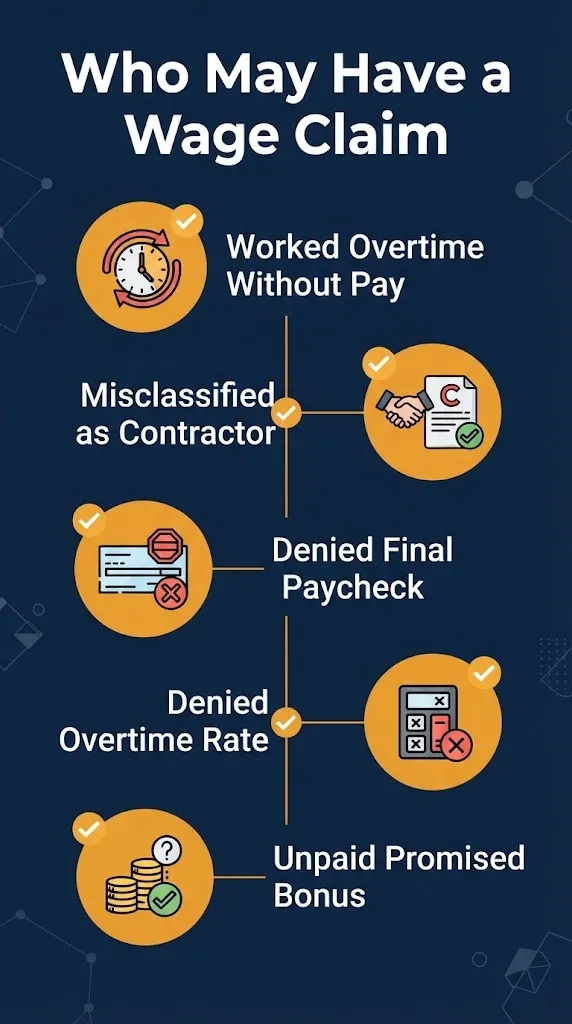
Misclassification happens when an employer treats a worker as an independent contractor or as an exempt employee when the law says otherwise. The consequence is that the worker loses rights to overtime, minimum wage protections, benefits, and unemployment insurance.
The misclassification test varies by law. The FLSA uses an economic realities test that looks at control, opportunity for profit, and permanence. The IRS uses a different test for tax purposes. State laws often have their own standards.
Misclassified workers may recover back pay for unpaid overtime, the value of lost benefits, and penalties. The Department of Labor has prioritized misclassification enforcement in 2026. Many states have passed stricter laws making misclassification harder for employers.
| Worker Type | Rights |
|---|---|
| Employee | Overtime, minimum wage, benefits, unemployment |
| Independent contractor | No overtime, no benefits, self-employment tax |
| Exempt employee | No overtime, but salary and benefits |
| Non-exempt employee | Overtime, minimum wage protections |
If you are called a contractor but the employer sets your hours, provides your tools, and controls your work, you may be misclassified. That misclassification may entitle you to years of back pay.
What Happens When an Employer Fails to Pay Final Wages?
When an employer fails to pay final wages, state law usually imposes penalties. The specific rules vary by state. Some states require immediate payment on termination. Others allow a few days. Some states require immediate payment if you are fired and the next regular payday if you quit.
The penalty for failure to pay final wages can be significant. California imposes waiting time penalties equal to your daily wage for each day the employer delays, up to 30 days. Other states impose smaller penalties or interest.
| State Category | Final Paycheck Rule |
|---|---|
| Immediate payment states | Pay due on last day |
| Next payday states | Pay due by next regular payday |
| Penalty states | Daily penalties for late payment |
| No penalty states | Interest only, less deterrent |
Your final paycheck should include all earned wages, unused vacation if your state requires payout, and any commissions or bonuses due. If the employer withholds part of your check for uniforms, equipment, or training, that may be an illegal deduction.
Key Takeaway: The FLSA gives you up to three years to recover unpaid overtime, and misclassification as a contractor or exempt employee is one of the most common violations in 2026.
How Are Bonuses and Commissions Treated Under Wage Laws?
Bonuses and commissions are treated as wages under many state laws if they are earned and determinable. A discretionary bonus is not protected. A promised bonus based on a formula is protected.
Commissions are earned when you complete the sale or satisfy the conditions of the commission agreement. An employer cannot change the commission structure retroactively to avoid paying you. State laws often require written commission agreements.
| Compensation Type | Legal Protection |
|---|---|
| Discretionary bonus | Not protected, employer decides |
| Formula bonus | Protected, earned when conditions met |
| Commission | Protected, earned on completed sales |
| Signing bonus | Protected, contract terms control |
If your employer failed to pay a promised bonus or commission, you may have a wage claim. The amount at stake can be substantial, especially for sales professionals. A lawyer can review your compensation agreement and determine if the failure is actionable.
What Are the Rules for Overtime Pay in 2026?
The federal overtime rule requires employers to pay time-and-a-half for hours worked over 40 in a workweek. The rule applies to non-exempt employees. Exempt employees, who meet salary and duties tests, are not entitled to overtime.
In 2026, the salary threshold for exempt employees remains a point of legal dispute. The Department of Labor raised the threshold in 2024, but a federal court in Texas struck down the rule. The litigation has continued, and the current threshold depends on pending appeals.
| Employee Category | Overtime Rule |
|---|---|
| Non-exempt hourly | Time-and-a-half over 40 hours |
| Non-exempt salaried | Time-and-a-half over 40 hours |
| Exempt executive | No overtime |
| Exempt professional | No overtime |
| Exempt administrative | No overtime |
The exempt classification requires more than a salary. The employee must also perform exempt duties. An assistant manager who spends most of the day doing the same work as hourly employees may be misclassified as exempt.
What Happens Next If You Have a Compensation Claim
| Expected Timing | Milestone |
|---|---|
| Immediately | Gather pay stubs, time records, and benefit documents |
| This week | Consult an employment lawyer or file with the Department of Labor |
| Within months | Agency investigation or lawsuit filing |
| During litigation | Discovery and settlement negotiations |
| Resolution | Settlement or judgment, typically 6 to 24 months |
The timeline depends on the claim type and the forum. Department of Labor investigations can take months. Private lawsuits can take a year or more. The key is to start early because the statute of limitations is running.
Preserve every document. Pay stubs, time cards, emails about your pay, benefit plan documents, and termination letters are all evidence. The more you keep, the stronger your claim.
Frequently Asked Questions
What counts as compensation and benefits?
Compensation includes wages, salary, bonuses, and commissions.
Benefits include health insurance, retirement plans, and paid time off.
Both are protected by state and federal laws.
Can I sue my employer for unpaid wages?
Yes, you can sue for unpaid wages under the FLSA or state law.
You may also file a complaint with the Department of Labor.
A lawyer can help you choose the right forum.
How long do I have to file a wage claim?
FLSA claims have a two or three year deadline.
State wage claim deadlines vary from one to three years.
Do not wait, the clock is running now.
What is the difference between exempt and non-exempt?
Non-exempt employees are entitled to overtime pay.
Exempt employees are not entitled to overtime.
The classification depends on salary and job duties.
Can I recover attorney fees in a wage claim?
Yes, successful FLSA claims can recover attorney fees.
Many state wage laws also allow fee awards.
This makes contingency representation possible.
What if my employer misclassified me as a contractor?
You may be entitled to overtime, benefits, and back pay.
The misclassification test looks at control and independence.
A lawyer or the Department of Labor can evaluate your situation.
How does ERISA protect my benefits?
ERISA requires plan administrators to act in your interest.
You have the right to appeal a denied benefit claim.
ERISA lawsuits can recover the value of the denied benefit.
What should I do if my employer does not pay my final check?
Contact your employer in writing requesting the check.
File a complaint with your state labor agency.
State penalties may apply for each day of delay.
Compensation and benefits disputes are not a single settlement. They are individual legal claims with real deadlines and real recoveries. The fastest path to understanding your rights is to gather your documents and consult an employment lawyer or the Department of Labor. August 25, 2026 is the date this information was verified. The date that matters most to you is your claim deadline, and for FLSA wage cases, that deadline may be as long as three years but starts running the day you were underpaid.