Mounjaro Lawsuit 2026: Status, Allegations, and Eligibility
Quick Answer:
- The Mounjaro lawsuit is real, with plaintiffs alleging severe gastrointestinal injuries from the drug.
- No settlement exists, so payout amounts are not determined and no claim form is available.
- The litigation is in early procedural stages, with no certified class or consolidated MDL yet.
If you took Mounjaro and suffered severe stomach problems, you are probably searching for whether you can sue. The Mounjaro lawsuit is real, and it is growing. Plaintiffs allege that the diabetes and weight-loss drug caused gastroparesis, intestinal blockages, and other serious gastrointestinal injuries. But no settlement exists, and no one is cutting checks.
The people searching this term include patients who were prescribed Mounjaro for type 2 diabetes or off-label for weight loss and later experienced vomiting, severe constipation, or stomach paralysis. The single most important fact is that the litigation is still in its earliest stages. There is no claim form, no deadline, and no payout.
This article covers the verified allegations, where the cases stand, who may eventually qualify, and what you should do with your medical records if you believe you were harmed. One surprising detail: Mounjaro’s FDA label already warns about severe gastrointestinal events, which may complicate the plaintiffs’ failure-to-warn claims.
| The Facts | |
|---|---|
| Drug | Mounjaro (tirzepatide), Eli Lilly |
| Litigation Status | Active, early stages, no MDL yet |
| Alleged Injuries | Gastroparesis, intestinal blockages |
| Fund Size | None established |
| Est. Per Person | Not determined |
| Claim Deadline | None set |
| Administrator | None appointed |
| Proof Needed | Medical records, prescription history |
Is the Mounjaro Lawsuit Legitimate?
Yes, the Mounjaro lawsuit is legitimate. Multiple individual lawsuits have been filed against Eli Lilly, the manufacturer of Mounjaro. The cases are real, filed in federal courts, and moving through the legal system.
Mounjaro, known generically as tirzepatide, is a GLP-1 receptor agonist approved for type 2 diabetes. Many patients also use it off-label for weight loss. The lawsuits allege that Eli Lilly failed to adequately warn about the risk of severe gastrointestinal injuries.
The litigation has not yet been consolidated into a multidistrict litigation, or MDL. Plaintiffs’ attorneys have petitioned the Judicial Panel on Multidistrict Litigation to create an MDL for efficiency. That ruling has not been issued as of August 2026.
This is not a class action settlement. It is a growing mass tort. Each plaintiff files an individual lawsuit, and the cases may eventually be grouped for pretrial proceedings.
What Are the Mounjaro Lawsuit Allegations?
The core allegation in the Mounjaro lawsuits is that the drug causes severe gastrointestinal injuries that were not adequately disclosed. The most serious claimed injury is gastroparesis, a condition where the stomach cannot empty properly.
Gastroparesis causes persistent nausea, vomiting, severe abdominal pain, and malnutrition. Some patients require feeding tubes or surgery. The lawsuits allege that Mounjaro slows gastric emptying to a dangerous degree in some patients.
Other alleged injuries include intestinal blockages, bowel obstructions, and persistent vomiting requiring hospitalization. Plaintiffs claim these injuries occurred after starting Mounjaro and resolved or improved after stopping the drug.
| Alleged Injury | What Plaintiffs Claim |
|---|---|
| Gastroparesis | Stomach paralysis, persistent vomiting |
| Intestinal blockage | Bowel obstruction requiring surgery |
| Severe dehydration | From persistent vomiting |
| Malnutrition | From inability to eat normally |
| Gallbladder disease | Some cases allege gallbladder injury |
The allegations focus on failure to warn. Plaintiffs do not claim Mounjaro is defective for all users. They claim Eli Lilly knew or should have known about the risks and failed to provide adequate warnings to patients and doctors.
How Much Could the Mounjaro Lawsuit Pay?
No payout amount has been determined. There is no settlement fund, no settlement agreement, and no jury verdict. Any number you see online is speculation.
If the litigation matures into an MDL and eventually settles, the per-person payout would depend on injury severity, medical documentation, and the settlement structure. Mass tort settlements often use tiered systems based on injury type and permanence.
| Potential Factor | Effect on Payout |
|---|---|
| Documented gastroparesis | Higher tier |
| Hospitalization | Higher tier |
| Surgery required | Higher tier |
| Complete recovery | Lower tier |
| No medical records | Low or no recovery |
Mass tort settlements take years. The litigation is not even consolidated yet. A realistic timeline for any settlement is three to five years away, assuming the plaintiffs’ cases survive dismissal and the science supports their claims.
Do not expect quick money. The process is slow, and the outcome is uncertain.
Who May Qualify for the Mounjaro Lawsuit?
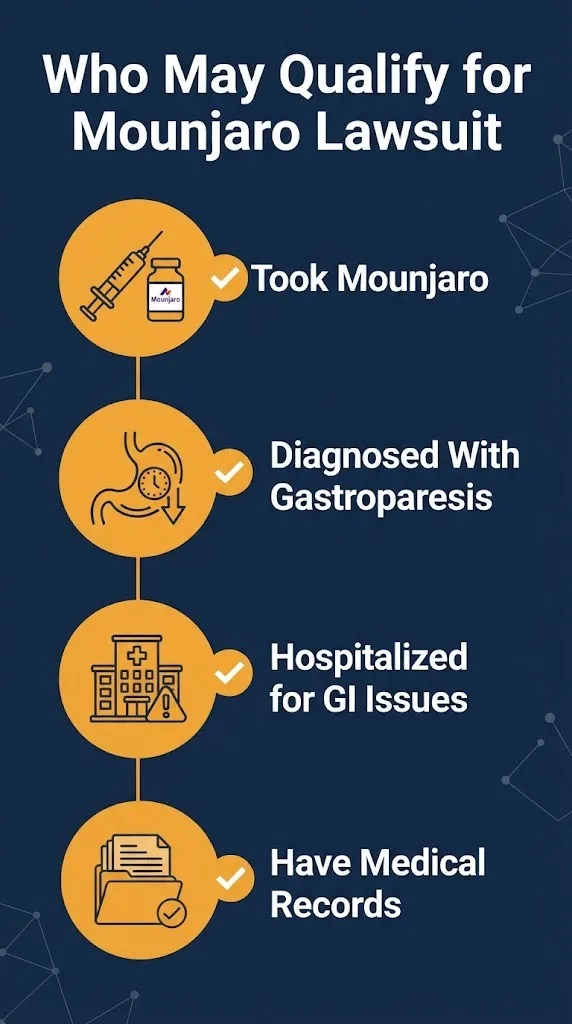
You may qualify for the Mounjaro lawsuit if you took Mounjaro, experienced severe gastrointestinal injuries, and have medical records documenting the connection. Qualification is not automatic.
The strongest cases involve patients with a documented diagnosis of gastroparesis or intestinal blockage after starting Mounjaro. Hospital records, endoscopy results, and gastric emptying studies are critical evidence.
| Potential Claimant | Likely Covered |
|---|---|
| Took Mounjaro | Yes, if injured |
| Diagnosed with gastroparesis | Yes, documented |
| Hospitalized for GI issues | Yes, documented |
| Mild nausea only | No, insufficient injury |
| No medical records | Harder to prove |
The temporal link matters. Plaintiffs who developed symptoms within weeks or months of starting Mounjaro have stronger cases than those who developed problems years later.
Key Takeaway: The Mounjaro litigation is real and growing, but no settlement, no MDL consolidation, and no payout amount exist as of August 2026.
What Should You Do If You Were Harmed by Mounjaro?
If you believe Mounjaro caused your gastrointestinal injury, you should act now to preserve your medical records and consult a lawyer. The litigation is early, but the evidence you preserve today will matter later.
Here are the verified steps to take:
- Gather all medical records related to your Mounjaro prescription and GI symptoms.
- Obtain your prescription history showing when you started and stopped Mounjaro.
- Document your symptoms with dates and severity.
- Save any hospital discharge summaries or endoscopy reports.
- Take photos of visible symptoms if applicable.
- Consult a product liability lawyer with pharmaceutical litigation experience.
- Do not stop taking prescribed medication without discussing with your doctor.
The medical records are the foundation of your claim. Without documentation, a lawyer cannot evaluate your case. With documentation, the lawyer can assess whether you fit the profile of the emerging litigation.
Is the Mounjaro Lawsuit a Class Action?
No, the Mounjaro litigation is not a class action. It is a mass tort, meaning individual lawsuits filed by individual plaintiffs. The cases may be consolidated into an MDL for pretrial efficiency, but each plaintiff retains their own case.
In a class action, one plaintiff represents a group, and any settlement binds everyone. In a mass tort, each plaintiff has their own lawsuit with their own evidence and their own outcome.
The distinction matters for how the case will resolve. A mass tort settlement may use a points system or tiered structure, but each plaintiff must submit individual medical records and prove individual injury.
| Structure | How It Works |
|---|---|
| Class action | One case, one settlement for all |
| Mass tort | Many cases, individual outcomes |
| MDL consolidation | Grouped for pretrial, separate trials |
The Mounjaro litigation is on the mass tort path. If an MDL is created, the cases will be coordinated but not merged.
What Is the Current Status of the Mounjaro Lawsuit Update?
The current status of the Mounjaro litigation is early-stage. Multiple lawsuits have been filed across federal courts. Plaintiffs’ attorneys have requested MDL consolidation. The Judicial Panel on Multidistrict Litigation has not yet ruled.
No bellwether trials have been scheduled. No settlement negotiations have been confirmed. The litigation is in the initial pleading and motion practice phase.
| Litigation Milestone | Status |
|---|---|
| Lawsuits filed | Yes, multiple |
| MDL consolidation | Pending |
| Discovery | Not yet underway |
| Bellwether selection | Not scheduled |
| Settlement talks | None confirmed |
The next significant milestone is the MDL ruling. If the panel creates an MDL, the cases will be transferred to a single judge for coordinated proceedings. If the panel declines, the cases proceed individually.
Reality Check: No One Is Signing You Up for a Mounjaro Settlement
Reality Check: If you see a social media ad or text message saying you can “sign up” for a Mounjaro settlement, it is a lead-generation scheme, not a settlement. No settlement exists. No claim form exists. No one is mailing checks. Legitimate law firms evaluate cases through individual consultations, not through online sign-up forms that ask for your medical history. Never provide sensitive information to an unknown website.
How Does Mounjaro Compare to Ozempic Litigation?
Mounjaro litigation is often compared to Ozempic litigation because both drugs are GLP-1 receptor agonists used for diabetes and weight loss. The Ozempic litigation is further along and may provide a roadmap for Mounjaro cases.
Ozempic, made by Novo Nordisk, faces similar allegations of gastroparesis and intestinal injuries. The Ozempic cases have been consolidated into an MDL. Plaintiffs in the Mounjaro cases point to the Ozempic litigation as evidence that the GLP-1 class carries underappreciated risks.
| Comparison | Mounjaro | Ozempic |
|---|---|---|
| Manufacturer | Eli Lilly | Novo Nordisk |
| Drug class | GLP-1 receptor agonist | GLP-1 receptor agonist |
| Alleged injury | Gastroparesis, blockages | Gastroparesis, blockages |
| Litigation stage | Early, no MDL yet | MDL established |
| Settlement | None | None |
The Ozempic litigation’s progress does not guarantee a similar outcome for Mounjaro. Each drug has a different formulation and different clinical trial history. But the legal theories overlap significantly.
What Does the FDA Say About Mounjaro and Stomach Problems?
The FDA-approved Mounjaro label already includes warnings about gastrointestinal adverse reactions. The label notes that severe gastrointestinal events have been reported in patients taking Mounjaro.
This creates a legal complication for plaintiffs. If the label already warns about the risk, the failure-to-warn claim becomes harder to prove. Plaintiffs must argue that the warning was inadequate or that Eli Lilly knew the risk was more severe than the label suggests.
| FDA Label Element | What It States |
|---|---|
| Common GI reactions | Nausea, vomiting, diarrhea |
| Severe GI events | Reported in clinical trials |
| Gastroparesis warning | Not specifically listed |
| Postmarketing reports | GI events reported |
The absence of a specific gastroparesis warning is central to the litigation. Plaintiffs argue that Eli Lilly should have added one based on postmarketing adverse event reports. Eli Lilly argues the existing warnings are sufficient.
What Are the Long-Term Implications of the Mounjaro Litigation?
The Mounjaro litigation could have broad implications for the entire GLP-1 drug class. If plaintiffs succeed, manufacturers may face pressure to strengthen warnings and conduct additional postmarketing surveillance.
For patients, the litigation highlights the importance of monitoring for gastrointestinal symptoms. Persistent vomiting, severe constipation, or abdominal pain after starting Mounjaro should be reported to a doctor immediately.
| Stakeholder | Potential Impact |
|---|---|
| Eli Lilly | Financial exposure, label changes |
| Other GLP-1 manufacturers | Precedent risk |
| Patients | Better warnings, more informed consent |
| Doctors | Prescribing considerations |
The litigation is not about banning Mounjaro. For many patients, the drug provides significant benefits. The lawsuits focus on whether the risks were adequately disclosed.
Key Takeaway: The Mounjaro litigation is a mass tort, not a class action, and the FDA label already warns about gastrointestinal events, which may complicate the plaintiffs’ failure-to-warn claims.
What Happens Next in the Mounjaro Litigation
| Expected Timing | Milestone |
|---|---|
| Late 2026 | MDL panel ruling on consolidation |
| 2027 | Discovery begins if MDL created |
| 2028 | Bellwether selection possible |
| 2029 | First bellwether trials possible |
| Unknown | Settlement negotiations, if any |
These dates are estimates based on the pace of similar pharmaceutical mass torts. The litigation is still in its infancy.
The most important thing you can do now is preserve your medical records. If you took Mounjaro and suffered gastrointestinal injuries, the records are your evidence. Without them, no lawyer can evaluate your claim.
Frequently Asked Questions
Is the Mounjaro lawsuit real or a scam?
The Mounjaro lawsuit is real, with multiple cases filed against Eli Lilly.
No settlement exists and no claims are being accepted.
Online sign-up forms are lead generators, not official claims.
How do I join the Mounjaro lawsuit?
You cannot join through an online form.
Consult a product liability lawyer for individual evaluation.
The lawyer will review your medical records and advise whether you have a case.
How much money can I get from the Mounjaro lawsuit?
No payout amount has been determined.
There is no settlement fund in 2026.
Any specific dollar figure is speculation.
What proof do I need for a Mounjaro lawsuit?
You need medical records documenting your Mounjaro prescription.
You need records showing your gastrointestinal diagnosis.
Gastric emptying studies and hospitalization records strengthen your case.
Can I still file if I stopped taking Mounjaro?
Yes, you may still have a claim if you were injured.
The statute of limitations varies by state.
Contact a lawyer soon to protect your rights.
What is the difference between Mounjaro and Ozempic lawsuits?
Both are GLP-1 drugs with similar allegations.
The Ozempic litigation is further along with an established MDL.
The Mounjaro cases are still in early stages.
How long will the Mounjaro lawsuit take?
Mass tort litigation typically takes three to five years.
The Mounjaro cases are not yet consolidated.
A settlement, if any, is years away.
Should I stop taking Mounjaro if I am worried?
Do not stop prescribed medication without consulting your doctor.
Discuss your concerns with your healthcare provider.
Your doctor can assess your individual risk.
The Mounjaro litigation is real, but it is not a settlement. No money is waiting. No claim form exists. No deadline has been set. If you were harmed, the action now is documentation and legal consultation, not online sign-ups. August 25, 2026 is the date this information was verified. The date that matters most to you is your state’s statute of limitations, and only a lawyer can tell you what that is.