Wisconsin Workers Compensation 2026: Rates, Filing Rules and Deadlines
Quick Answer
- Wisconsin workers compensation is a real, state-mandated insurance system run by the DWD Worker’s Compensation Division, not a lawsuit or settlement fund.
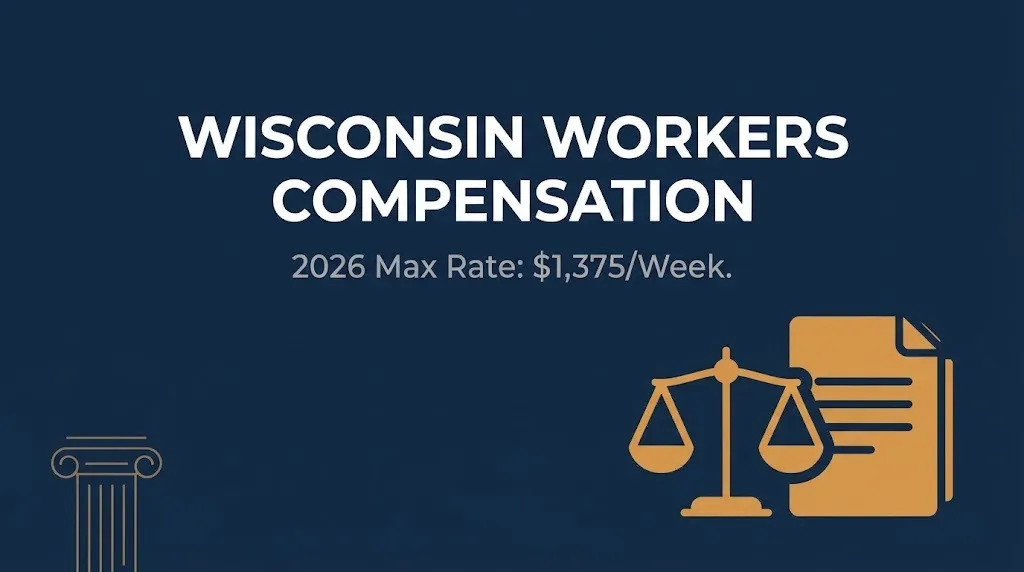
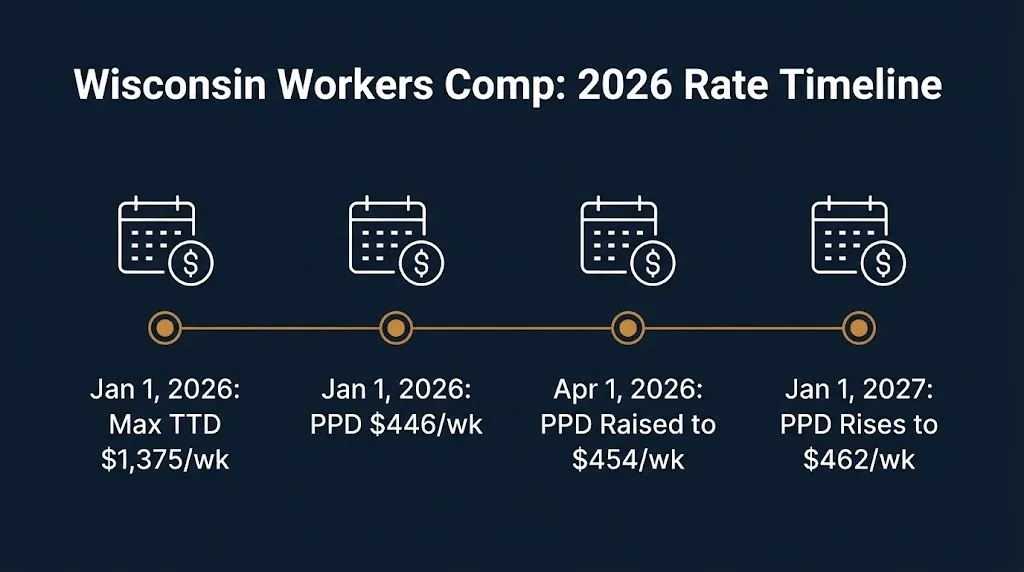
- The 2026 maximum weekly benefit is $1,375 for TTD, PTD, and death benefits; the PPD maximum is $454 a week as of April 1, 2026.
- Most claims must be reported to your employer within 30 days and filed within 6 years (12 years for occupational disease) or the claim can be time-barred.
Wisconsin workers compensation is not a class action or a one-time settlement fund. It’s an ongoing, state-run insurance system that pays wage replacement and medical benefits when you’re hurt on the job.
If you were injured at work in Wisconsin, the amount you can collect depends on your wage, the type of injury, and the date you got hurt, since the state’s maximum rates change every year and sometimes mid-year. The single most important number right now is the $1,375 weekly maximum for total disability, set for injuries occurring on or after January 1, 2026.
This article breaks down what the system actually pays, who’s required to carry coverage, how long you have to file, and what happens if your employer doesn’t have insurance at all. One detail most guides skip: Wisconsin’s PPD rate went up twice in 2026, once in January and again in April, because of a new law.
The Facts
| Category | Detail |
|---|---|
| Program | Wisconsin Worker’s Compensation Act, Chapter 102, Wis. Stats. |
| Administering Agency | DWD Worker’s Compensation Division (WCD) |
| 2026 Max TTD/PTD Rate | $1,375 per week (injuries on or after Jan. 1, 2026) |
| 2026 Max PPD Rate | $446 per week (Jan. 1, 2026); $454 per week (April 1, 2026) |
| Death Benefit Cap | $412,500 aggregate; up to $5,958.33 per month to surviving spouse |
| Filing Deadline | 6 years for traumatic injury (after March 2, 2016); 12 years for occupational disease |
| Report to Employer | Within 30 days recommended; 2-year hard limit in most cases |
| Employer Insurance Threshold | 3+ employees, or 1+ employee with $500+ gross wages in a calendar quarter |
Is Wisconsin Workers Compensation a Real Program or a Scam Text?
Wisconsin workers compensation is a legitimate, state-administered insurance system, not a scam or a marketing scheme. It’s created and enforced under Wisconsin Statutes Chapter 102 and run by the DWD Worker’s Compensation Division.
Nearly every employer in the state is legally required to carry it. This isn’t a program you sign up for online after seeing an ad. It’s coverage that already exists if you’re an employee hurt on the job.
If you received a text or email promising a “workers comp settlement” out of nowhere, without you ever filing a claim, treat it with suspicion. Real Wisconsin workers comp benefits come through your employer’s insurer or the state, not an unsolicited link.
Key Takeaway: Wisconsin workers compensation is a mandatory state insurance system administered by the DWD, and legitimate benefits never start with an unsolicited text message.
How Much Does Wisconsin Workers Compensation Pay in 2026?
Wisconsin workers compensation pays two-thirds of your average weekly wage, capped at a state maximum that changes based on your injury date. For 2026, that maximum reached $1,375 a week for the most severe categories.
Amounts depend on the type of benefit you qualify for. There’s no single flat payout; the state runs several distinct benefit categories with separate caps.
| Benefit Type | 2026 Maximum | Basis |
|---|---|---|
| Temporary Total Disability (TTD) | $1,375/week | Two-thirds of average weekly wage, capped |
| Permanent Partial Disability (PPD) | $454/week (as of April 1, 2026) | Set by statutory schedule, not wage-based |
| Permanent Total Disability (PTD) | $1,375/week | Same cap as TTD |
| Death Benefit | $412,500 aggregate; $5,958.33/month max | 4x average annual wage |
| Burial Expenses | $10,000 maximum | Actual cost, up to cap |
| Minor Dependent’s Fund | $132.60/week | Per surviving minor dependent |
Your actual payout depends on your wage history, the severity of your injury, and whether your disability is temporary or permanent. Amounts are not yet determined until a doctor rates your impairment and your average weekly wage is calculated.
How to File a Workers Compensation Claim in Wisconsin
Filing a claim starts with reporting your injury, not with paperwork to the state. Wisconsin puts the initial burden on you to notify your employer, then on your employer to notify their insurer.
- See a doctor immediately; you have the right to choose your own physician in Wisconsin.
- Report the injury to your employer in writing, ideally within 30 days.
- Ask your employer to confirm they’ve submitted the claim to their insurance carrier.
- If your employer fails to report it, file a complaint directly with the DWD Worker’s Compensation Division.
- Keep copies of every medical record, wage statement, and correspondence.
- If your claim is denied or disputed, file a Hearing Application (WKC-12) with the Division.
- Attend any scheduled hearing before an administrative law judge if the dispute isn’t resolved.
- If you disagree with the judge’s ruling, appeal to the Labor and Industry Review Commission within 21 days.
This is like a warranty claim on a major appliance: you have to report the defect to the seller first, or the manufacturer never even hears about it.
What Proof Do You Need for a Wisconsin Workers Comp Claim?
You need documentation connecting your injury directly to your job, your wage records, and a written report of the incident. Missing documentation is the most common reason claims stall.
Wisconsin doesn’t require a formal application form to start receiving benefits in an accepted claim; your employer’s insurer processes it once notified. But if your claim is disputed, you’ll need more.
- Written injury report given to your employer, dated at the time
- Medical records connecting the injury to your job duties
- Wage records for the 52 weeks before your injury, used to calculate your average weekly wage
- Any denial letter or dispute notice from the insurer
- A Hearing Application (WKC-12) if you need to formally dispute a denial
Key Takeaway: Most accepted Wisconsin claims don’t require you to file a form yourself; disputes are where documentation becomes critical.
Wisconsin Workers Compensation Filing Deadlines in 2026
Wisconsin’s filing deadline depends on your injury type, and missing it can bar your claim permanently. The general rule is six years for a traumatic injury and twelve years for an occupational disease.
For injuries occurring on or after March 2, 2016, the statute of limitations for a hearing application is 6 years from the date of injury or the date of your last indemnity payment, whichever is later. For occupational diseases, that window stays at 12 years.
There’s a shorter, separate clock too. Wisconsin law generally requires notice to your employer within 30 days, and no claim can be maintained at all if notice wasn’t given within 2 years of the injury, with exceptions if the employer already knew.
Reality Check: No legitimate Wisconsin workers comp claim requires you to pay an upfront fee to a “claims specialist” to file. Reporting your injury to your employer and, if needed, filing a Hearing Application with the DWD costs nothing.
Which Wisconsin Employers Must Carry Workers Compensation Insurance?
Most Wisconsin employers with three or more workers must carry workers compensation insurance, and the threshold drops even lower for smaller payrolls. This is a strict legal requirement, not optional coverage.
You’re a “subject employer” required to carry insurance if any of the following apply:
- You employ 3 or more full-time or part-time employees; coverage is required the day you hire the third person.
- You employ 1 or more employees and paid $500 or more in gross combined wages in any calendar quarter.
- You’re a farmer employing 6 or more workers on the same day for 20 or more days in a calendar year.
Out-of-state employers with any Wisconsin-based employees must also carry coverage. Closely held corporations with two or fewer officers and no other employees can opt out by filing a Corporate Officer Option Notice.
What Happens If Your Wisconsin Employer Has No Workers Comp Insurance?
If your employer is illegally uninsured, you can still collect benefits through the Uninsured Employers Fund (UEF), a state-run backstop that pays claims as if the employer had coverage. This applies to injuries occurring on or after July 1, 1996.
The UEF pays your benefits directly, then pursues the uninsured employer for reimbursement, using aggressive collection including warrants, levies, and garnishment. Within 14 days of receiving your completed claim form, the department must mail your first payment, deny the claim, or explain why it’s still under review.
Employers face steep penalties for going uninsured, separate from any benefits owed:
| Violation | Penalty |
|---|---|
| Lapse in coverage | 2x unpaid premium or $750, whichever is greater |
| First-time lapse of 7 days or less | $100 per uninsured day |
| Failure to report injury in bad faith | Up to 200% of compensation due, capped at $30,000 |
Key Takeaway: Being employed by an uninsured company doesn’t block your benefits; the Uninsured Employers Fund exists specifically to cover you while the state penalizes your employer separately.
How Long Does It Take to Get Wisconsin Workers Comp Benefits?
Medical benefits typically begin once your claim is accepted, generally within about 14 days of reporting your injury. Wage replacement benefits work on a different, delayed schedule.
Wisconsin has a mandatory 3-day waiting period. The first 3 days of lost time aren’t compensable unless your disability lasts more than 7 calendar days, in which case those first 3 days get paid retroactively.
- Days 1 to 3: unpaid, unless disability extends past 7 days
- Day 4 onward: TTD payments begin at two-thirds of your average weekly wage
- If disability exceeds 7 days: days 1 to 3 are paid retroactively
- Medical treatment: covered from day one regardless of the waiting period
This works something like a delayed tax refund: the money is owed to you, but the calendar has to run before the check actually arrives.
What Is the Wisconsin Uninsured Employers Fund and Who Qualifies?
The Uninsured Employers Fund pays workers compensation benefits to employees hurt while working for an illegally uninsured Wisconsin employer. It’s funded entirely by penalties collected from noncompliant businesses, not general tax revenue.
You may qualify if your injury occurred on or after July 1, 1996, and your employer was legally required to carry insurance but didn’t. The UEF steps in and pays as though your employer had been properly covered.
- Your employer met the 3-employee or $500 quarterly wage threshold
- No active workers compensation policy existed on your date of injury
- You file a completed UEF claim form with the DWD
- The department confirms your employer’s uninsured status through payroll and tax records
What Happens If Your Wisconsin Workers Comp Claim Is Disputed?
If your employer’s insurer denies or disputes your claim, you can request a formal hearing before an administrative law judge at the DWD. This is a structured legal process with clear appeal rights.
You start by filing a Hearing Application (WKC-12). Litigation formally begins only once that application is actually filed; simply hiring an attorney doesn’t put your claim into dispute status. If you disagree with the judge’s decision, you can appeal to the Labor and Industry Review Commission (LIRC) within 21 days.
- Insurer denies or disputes part of your claim.
- You file a WKC-12 Hearing Application with the DWD.
- An administrative law judge holds a hearing and issues a decision.
- Either party appeals to LIRC within 21 days, if unsatisfied.
- After LIRC’s decision, either party may file in circuit court within 30 days.
- Further appeals can go to the Court of Appeals and, rarely, the Wisconsin Supreme Court.
Key Takeaway: Most disputed Wisconsin workers comp cases resolve before reaching circuit court, but the formal appeal chain runs from a DWD judge to LIRC to the courts.
Do Most Wisconsin Workers Comp Claims End in a Settlement?
Many disputed or long-running Wisconsin workers comp claims do end in a negotiated lump-sum settlement, but it’s not automatic or guaranteed for every claim. A settlement requires agreement from the worker, employer, and insurer.
Settlement amounts may cover past or future medical costs, wage-loss compensation, and sometimes penalties for delayed payment or bad faith conduct by the insurer. Every settlement agreement must be in writing, signed by all parties, and filed with the DWD for approval by an administrative judge before it’s final.
For larger settlements, federal Medicare rules can also apply. If you’re a Medicare beneficiary and your settlement exceeds $25,000, or you have a “reasonable expectation” of Medicare eligibility within 30 months and your settlement exceeds $250,000, a Medicare Set-Aside review may be required.
What Recent Changes to Wisconsin Workers Comp Law Took Effect in 2026?
2025 Wisconsin Act 145 made several changes to the Worker’s Compensation Act, effective April 1, 2026. The most direct impact on injured workers is the PPD rate increase.
The maximum weekly PPD rate rose to $454 for injuries occurring on or after April 1, 2026, and is scheduled to rise again to $462 for injuries on or after January 1, 2027. The same law also expanded criminal fraud provisions to cover employers who misclassify employees to lower insurance premiums, and it prohibits “stacking” PPD ratings for a repeat surgical procedure on the same limb.
The law also changed how insurers request reimbursement for supplemental benefits from the Second Injury Fund, now requiring electronic submission through the state’s updated Insurer Portal.
How Do Wisconsin’s Rates Compare to Prior Years?
Wisconsin’s maximum weekly benefit has climbed steadily, tied to the statewide average weekly wage, which reached $2,062.50 for 2026. That’s up from $1,989 in 2025 and $1,870.50 in 2023.
| Year | Average Weekly Wage | Max TTD/PTD Rate |
|---|---|---|
| 2023 | $1,870.50 | $1,247/week |
| 2025 | $1,989.00 | $1,326/week |
| 2026 | $2,062.50 | $1,375/week |
The maximum rate is recalculated every January 1 based on 110 percent of the prior year’s statewide average weekly wage. PPD rates don’t follow that same annual formula; they’re set separately by statute and adjusted less predictably, which is why 2026 saw two different PPD increases.
What Happens Next
January 1, 2026 (completed): New maximum TTD/PTD rate of $1,375/week and initial PPD rate of $446/week took effect for new injuries.
April 1, 2026 (completed): 2025 Wisconsin Act 145 took effect, raising the PPD maximum to $454/week and adding new fraud and reporting provisions.
Expected January 1, 2027: PPD maximum rate is scheduled to rise again to $462/week under the same 2026 law.
Ongoing: DWD continues processing disputed claims through hearings, LIRC appeals, and Uninsured Employers Fund cases as they arise.
Frequently Asked Questions
Is Wisconsin workers compensation mandatory for employers?
Yes, most employers with 3 or more employees, or 1 or more employees paid $500+ in a calendar quarter, must carry it.
Farmers face a separate threshold of 6 or more workers on 20 days in a year.
Very small closely held corporations can opt out under specific conditions.
How much does Wisconsin workers comp pay per week in 2026?
The maximum is $1,375 a week for temporary and permanent total disability for injuries on or after January 1, 2026.
The PPD maximum is $454 a week as of April 1, 2026.
Your actual payment is two-thirds of your average weekly wage, capped at these limits.
How long do I have to file a workers comp claim in Wisconsin?
Generally 6 years from the injury date or last benefit payment for traumatic injuries after March 2, 2016.
Occupational disease claims have a 12-year window.
You must also notify your employer, generally within 30 days, and no later than 2 years in most cases.
What if my employer doesn’t have workers comp insurance?
You can still file a claim through the Uninsured Employers Fund, which pays benefits directly.
The state then pursues your employer for reimbursement and penalties.
This applies to injuries occurring on or after July 1, 1996.
Do I get paid for the first few days after a work injury?
No, Wisconsin has a 3-day waiting period before wage-loss benefits start.
If your disability lasts more than 7 calendar days, those first 3 days are paid retroactively.
Medical treatment is covered from day one, regardless of the waiting period.
Can I choose my own doctor for a Wisconsin workers comp injury?
Yes, Wisconsin is an employee-choice state, meaning you can see any licensed physician.
This differs from states that require using an employer-approved provider list.
Document your treatment carefully regardless of which doctor you choose.
What happens if my Wisconsin workers comp claim is denied?
You can file a Hearing Application (WKC-12) to request a formal hearing before a DWD administrative law judge.
If you disagree with that ruling, you can appeal to LIRC within 21 days.
Further appeal to circuit court is possible within 30 days of a LIRC decision.
Do most Wisconsin workers comp claims end in a settlement?
Many disputed or long-running claims do end in a negotiated lump-sum settlement.
Settlements must be signed by all parties and approved by a DWD judge before they’re final.
Not every claim settles; some resolve through standard ongoing benefit payments instead.
Check the DWD Worker’s Compensation Division directly if you’re unsure whether your injury or employer qualifies under current rules. Calendar your reporting deadline the moment you’re hurt, since Wisconsin’s 30-day notice window moves fast.
The number to remember for 2026: $1,375 a week is the current maximum for total disability and death benefits under Wisconsin law.