South Carolina Workers Compensation Claims in 2026: What Workers Need to Know
Quick Answer
- South Carolina workers’ compensation is a state-mandated insurance system, not a lawsuit in most cases.
- Average weekly wage benefits equal 66.67% of your pre-injury wage, subject to state maximums updated annually.
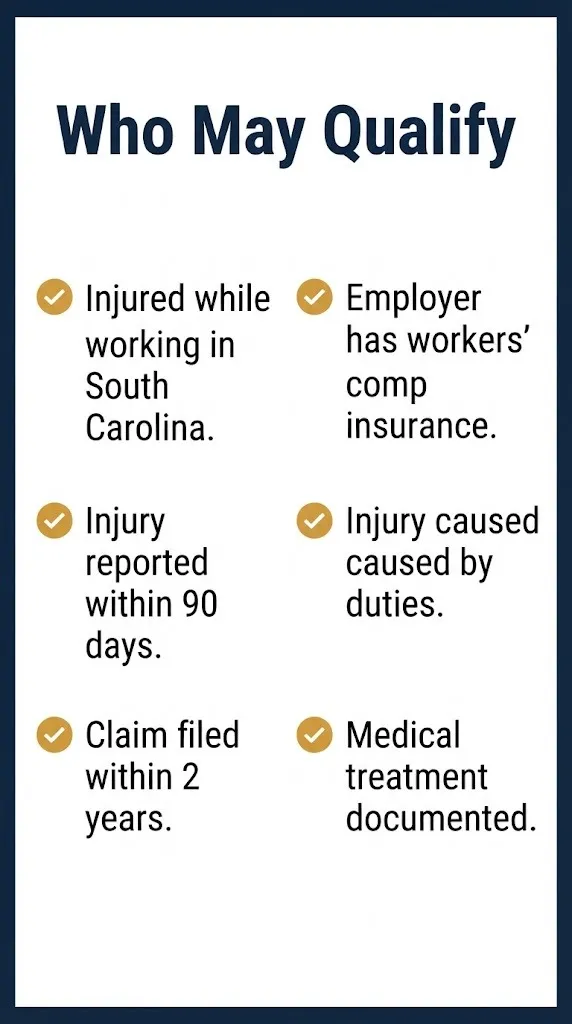
- Injured workers must report injuries to employers within 90 days, but filing immediately protects your claim.
South Carolina workers’ compensation is not a class action settlement. It is a state-run insurance system that pays medical bills and partial wage replacement when you get hurt on the job.
The South Carolina Workers’ Compensation Commission oversees every claim filed in the state. That commission sets the rules, hears disputes, and approves or denies settlements.
If you were injured at work in South Carolina, you may qualify for weekly benefits, medical care coverage, and possibly a lump sum settlement. The clock starts the day you report the injury.
This article covers the 2026 benefit rates, how the commission works, what you can expect to receive, filing deadlines, and the questions real workers ask most.
The Facts
| Item | Details |
|---|---|
| Governing Body | South Carolina Workers’ Compensation Commission |
| Benefit Rate | 66.67% of average weekly wage |
| 2026 Maximum Weekly Benefit | $1,065.00 (pending confirmation) |
| Minimum Weekly Benefit | $75.00 (pending confirmation) |
| Injury Reporting Deadline | 90 days from injury date |
| Claim Filing Deadline | 2 years from injury date |
| Mileage Reimbursement | Updated annually by commission |
| Legal Representation | Optional, fees capped by commission |
Is the South Carolina Workers Compensation Commission a Real Government Agency?
The South Carolina Workers’ Compensation Commission is a real state agency created by the South Carolina General Assembly. It operates under Title 42 of the South Carolina Code of Laws.
The commission has seven members appointed by the Governor. These commissioners hear disputed claims, approve settlements, and review appeals from single commissioner decisions.

The agency maintains offices in Columbia and regional hearing locations across the state. You can verify any commission communication by calling the main office directly.
Unlike some states where workers’ compensation runs through a court system, South Carolina uses this administrative commission. That means most claims never see a traditional courtroom.
Workers often ask if the commission is legitimate because scammers sometimes pose as government agencies. The real commission never asks you to pay a filing fee upfront or wire money to process a claim.
How Much Does South Carolina Workers Compensation Pay in 2026?
South Carolina pays injured workers 66.67% of their average weekly wage, up to the state maximum. The exact maximum adjusts annually.
For 2026, the state maximum weekly benefit is expected to increase from the 2025 rate, though the commission had not posted the final figure as of this writing. Check the commission’s official website for the current published rate.
The minimum weekly benefit for total disability remains well below the maximum. Workers earning minimum wage or part-time wages may receive the state minimum.
Here is how the calculation works for a worker earning $800 per week before injury:
| Calculation Step | Amount |
|---|---|
| Pre-injury average weekly wage | $800.00 |
| Compensation rate (66.67%) | $533.36 |
| 2026 state maximum cap | Applied if above cap |
| Weekly benefit paid | $533.36 |
Key Takeaway: Your weekly benefit equals roughly two-thirds of your gross pre-injury wage, capped at the state maximum, and is not taxed as income.
What Is the South Carolina Workers Compensation Commission Claims Process?
The claims process starts with reporting your injury. South Carolina law requires you to notify your employer within 90 days of the accident.
Your employer or their insurance carrier then files a First Report of Injury with the commission. The insurer has 14 days to accept or deny the claim after receiving notice.
If the claim is accepted, you start receiving weekly benefits and medical treatment. If denied, you can request a hearing before a commissioner.
The process resembles filing a warranty claim, except the timeline is set by law, not company policy. Miss a step and the claim can stall.
Here are the basic steps:
- Report the injury to your supervisor immediately.
- Seek medical treatment from an authorized provider.
- Your employer files the First Report of Injury.
- The insurer accepts or denies within 14 days.
- If accepted, you receive a Notice of Benefits.
- Weekly checks begin after a 7-day waiting period.
- If denied, file a Form 50 to request a hearing.
How Do I File a South Carolina Workers Compensation Claim?
Filing starts with verbal notice to your employer. Written notice is better and creates a record.
Your employer has a legal duty to report the injury to their insurance carrier. The carrier then reports to the commission.
If your employer refuses to report the injury, you can file a Form 50 directly with the commission. This form requests a hearing and formally opens your case.
Here is the direct filing process:
- Send written notice of injury to your employer by certified mail.
- Keep a copy of that letter and the mailing receipt.
- Ask your employer for the name of their workers’ compensation insurer.
- Contact the insurer directly to confirm a claim number exists.
- If no claim number exists within 10 days, file Form 50 with the commission.
- Include the date, time, location, and description of the injury.
- List every body part affected, even minor ones.
- Keep all medical records and work restrictions.
Key Takeaway: Never assume your employer filed the claim. Confirm a claim number exists within two weeks of reporting the injury.
What Are the South Carolina Workers Compensation Commission Settlement Amounts?
Settlements in South Carolina workers’ compensation are not automatic. They require negotiation between you, the insurer, and approval from a commissioner.
A lump sum settlement typically closes the claim permanently. The insurer pays one amount, and you give up the right to future benefits for that injury.
The settlement value depends on several factors:
| Factor | How It Affects Value |
|---|---|
| Average weekly wage | Higher wage means higher settlement |
| Body part injured | Back, neck, and brain injuries settle higher |
| Permanent impairment rating | Higher rating increases value |
| Future medical needs | Ongoing treatment adds value |
| Whether you returned to work | Returning reduces future wage loss claims |
| Litigation risk | Weak insurer defenses push settlements up |
Reality Check: No attorney, website, or commission employee can tell you an exact settlement amount before reviewing your medical records and wage history. Anyone promising a specific dollar figure before seeing those documents is guessing.
What Is the South Carolina Workers Compensation Commission Statute of Limitations?
South Carolina gives you two years from the date of injury to file a claim with the commission. For occupational diseases, the clock starts when you discovered or should have discovered the condition.
The 90-day reporting rule is separate from the two-year filing deadline. You can miss the 90-day report window but still file within two years, though your claim may face additional scrutiny.
For death claims, dependents have two years from the date of death to file.
Missing the two-year deadline almost always kills the claim. The commission has no authority to extend it for hardship, confusion, or bad legal advice.
Can I See My Own Doctor for a South Carolina Workers Compensation Injury?
South Carolina gives your employer the right to direct your initial medical care. That means you generally must see the doctor your employer or their insurer selects.
If your employer does not provide a doctor or fails to offer treatment, you can seek care on your own and ask the commission to order reimbursement.
After the initial authorized treatment, you can petition the commission to change doctors if you have a good reason. The commission does not grant these requests automatically.
Emergency care is the exception. If you need immediate treatment, go to the nearest emergency room. The insurer must pay for emergency care regardless of whether the doctor was preauthorized.
What Happens If My South Carolina Workers Compensation Claim Is Denied?
A denial is not the end of the road. It is the beginning of the dispute process.
Insurers deny claims for many reasons: they dispute whether the injury happened at work, whether it is a pre-existing condition, or whether you reported it on time.
You can challenge a denial by filing a Form 50 with the commission. That form requests a hearing before a single commissioner.
At the hearing, both sides present evidence and witnesses. The commissioner issues a written decision.
If you disagree with that decision, you can appeal to the full commission. If you still disagree, you can appeal to the South Carolina Court of Appeals and eventually the state Supreme Court.
Most disputes settle before hearing. The mere act of filing a Form 50 often moves the insurer back to the table.
Key Takeaway: A denial letter is an invitation to fight back through the commission’s hearing process, not a final answer.
What Is the South Carolina Workers Compensation Commission Hearing Process?
Hearings are less formal than courtroom trials but still follow legal rules. A single commissioner presides, hears testimony, and reviews medical evidence.
You can represent yourself, but insurers almost always have attorneys. That imbalance leads most injured workers to hire a lawyer whose fee the commission must approve.
Hearings typically last one to two hours. The commissioner may rule from the bench or issue a written order weeks later.
The hearing timeline from filing to decision often takes three to six months, depending on the commission’s docket and whether the parties settle first.
Are South Carolina Workers Compensation Benefits Taxable?
No. South Carolina workers’ compensation benefits are not subject to federal or state income tax.
This differs from unemployment benefits, which are taxable. It also differs from Social Security disability, which may be taxable depending on your total income.
Lump sum settlements retain that tax-free status, but there is a catch. If you also receive Social Security Disability Insurance, a lump sum may reduce those benefits. Consult a benefits specialist before accepting any large settlement.
What Are the South Carolina Workers Compensation Commission Rules on Permanent Disability?
Permanent disability benefits kick in after you reach maximum medical improvement. That is the point where your doctor says your condition will not improve further with treatment.
The doctor assigns a permanent impairment rating. That rating translates to a number of weeks of benefits under the commission’s schedule.
Here is a partial schedule for common injuries:
| Injury Type | Weeks of Benefits |
|---|---|
| Hand | 160 weeks |
| Arm | 220 weeks |
| Leg | 195 weeks |
| Foot | 140 weeks |
| Back (total disability) | 500 weeks |
| Brain (total disability) | 500 weeks |
The schedule is specific and strict. The number of weeks is fixed by law, not negotiation.
What Happens Next
Expected March 2026: Commission publishes confirmed 2026 average weekly wage and maximum benefit rates.
Expected April 2026: General Assembly committee hearings on any pending workers’ compensation reform bills.
Mid-2026: Commission updates mileage reimbursement and medical fee schedules.
Ongoing: Injured workers continue filing claims under existing law unless the legislature passes changes.
Workers with pending claims should check the commission’s official website monthly for updated rates and forms. Deadlines do not pause for legislative sessions or website updates.
Frequently Asked Questions
Is the South Carolina Workers Compensation Commission a real government agency?
Yes, it is a legitimate state agency created by the South Carolina General Assembly.
It oversees all workers’ compensation claims filed in the state.
You can verify its existence through the South Carolina government directory.
How much does South Carolina workers compensation pay per week?
You receive 66.67% of your average weekly wage, up to a state maximum.
The maximum adjusts annually based on the state’s average weekly wage.
Benefits are tax-free and continue during your period of disability.
How long does a South Carolina workers compensation case take?
Most accepted claims pay weekly benefits within 30 days of injury.
Disputed claims that go to hearing take three to six months or longer.
Settlements require commission approval, which adds several weeks after agreement.
What is the deadline to file a South Carolina workers compensation claim?
You have two years from the date of injury to file a claim.
You should report the injury to your employer within 90 days.
Missing the two-year deadline almost always bars the claim permanently.
Can I settle my South Carolina workers compensation case?
Yes, most cases settle for a lump sum at some point.
The commission must approve every settlement at a hearing.
Settlement amounts vary widely based on injury type, wages, and medical needs.
Do I need a lawyer for a South Carolina workers compensation claim?
You are not required to hire a lawyer.
Complex or denied claims usually benefit from representation.
Attorneys’ fees are capped and must be approved by the commission.
What does the South Carolina Workers Compensation Commission do?
The commission administers the state’s workers’ compensation system.
It hears disputes, approves settlements, and sets medical fee schedules.
It is not a court, but its decisions carry the force of law.
Where is the South Carolina Workers Compensation Commission located?
The main office is in Columbia, South Carolina.
The commission also holds hearings in regional locations.
Contact information is available on the official state government website.
South Carolina workers’ compensation exists to protect you after a work injury. The system pays medical bills and partial wages while you recover.
Your job is to report the injury, seek treatment, and follow through. The commission provides the process, but you must start it.
The two-year filing deadline is the one date you cannot miss. Report now, file if needed, and document everything.