Premises Liability Lawsuit 2026: Claim Deadlines, Payout Estimates, and What Plaintiffs Need to Know
Quick Answer
- Premises liability lawsuits are real legal claims against property owners for injuries caused by unsafe conditions.
- Payouts vary widely, from $15,000 for minor injuries to $1 million or more for catastrophic harm.
- Most states require filing within 2 to 3 years of the injury, but some deadlines are far shorter.
If you were injured on someone else’s property, whether a store, apartment complex, parking lot, or private home, you may have a premises liability claim. The legal theory is straightforward: property owners and occupiers have a duty to keep their premises reasonably safe. When they fail, and someone gets hurt, the law allows financial recovery for medical bills, lost wages, and pain and suffering.
This article covers what a premises liability lawsuit actually involves in 2026, the categories of injuries that qualify, how settlements are calculated, the filing deadlines by state, and what recent cases reveal about how much these claims are really worth. One surprising verified fact: slip and fall claims alone account for over one million emergency room visits in the United States each year, and a significant share of those become formal legal claims.
The Facts
| Case | Premises liability claims, including slip and fall, negligent security, and structural hazard lawsuits |
| Status | Active litigation across all 50 states, with several national class actions pending |
| Fund Size | Varies by case; individual settlements typically range from $15,000 to $150,000 |
| Est. Per Person | $15,000 to $1 million plus depending on injury severity and liability evidence |
| Claim Deadline | Varies by state; most are 2 to 3 years from the injury date |
| Administrator | Court-appointed administrators for class actions; individual claims handled by plaintiff counsel |
| Proof Needed | Medical records, incident reports, photographs, witness statements, and proof of financial losses |
Is a Premises Liability Lawsuit Legit or Just Another Legal Scam?
A premises liability lawsuit is a legitimate legal action, not a scam. It is a formal civil claim filed in state or federal court against a property owner, business operator, landlord, or government entity.
The legal basis is well established. Under common law and state statutes, property owners owe a duty of care to lawful visitors. That duty requires owners to inspect for hazards, fix dangerous conditions, or at minimum warn visitors about them.
When property owners ignore known dangers, like a broken staircase, a wet floor without signage, or inadequate security in a high-crime area, courts consistently hold them accountable.
In 2026, these lawsuits are being filed at a higher rate than any point in the past decade. The reasons are straightforward.
First, jury verdicts in premises cases have climbed. Second, more law firms are investing in premises litigation because the returns are predictable. Third, surveillance video and digital evidence now make it easier to prove what happened.
Key Takeaway: Premises liability is not a fringe legal theory. It is a well-settled area of law with billions of dollars paid out through verdicts and settlements every year.
What Types of Accidents Fall Under a Premises Liability Lawsuit?
A premises liability lawsuit can cover a wide range of accidents, but the legal test is the same in every case. The injured person must show that the property owner knew or should have known about a dangerous condition and failed to fix it or warn about it.
The most common categories of premises liability claims include:
- Slip and fall accidents from wet floors, icy walkways, loose rugs, or uneven pavement
- Trip and fall incidents from broken stairs, torn carpeting, exposed cords, or cluttered walkways
- Negligent security claims from assaults, robberies, or shootings in parking lots, apartment complexes, or hotels
- Swimming pool accidents from missing fencing, broken gates, or lack of lifeguards
- Dog attacks on property where the owner knew the animal was dangerous
- Elevator and escalator accidents from maintenance failures
- Ceiling collapses, falling merchandise, and structural defects
- Toxic exposure from mold, lead paint, or carbon monoxide leaks
- Fires from missing smoke detectors or blocked exits
Each of these categories requires different evidence. But the underlying principle is consistent. The property owner had a duty. The owner breached that duty. The breach caused real injury.
Key Takeaway: If your injury happened because a property was unsafe, and the owner knew or should have known about the hazard, you likely have a premises liability claim.
How Much Is a Premises Liability Settlement Worth in 2026?
This is the question every injured person asks first, and the honest answer is that settlement amounts depend heavily on the facts of your case. No two premises liability claims are identical.
That said, recent data from jury verdicts and settlement reports gives a realistic picture.
For minor injuries that resolve with limited medical treatment, settlements typically land between $15,000 and $50,000. These cases usually involve soft tissue injuries, sprains, or small fractures with no surgery.
Moderate injuries, including broken bones requiring surgery, herniated discs, or injuries with lasting physical limitations, commonly settle for $50,000 to $250,000.
Severe injuries, including traumatic brain injuries, spinal cord damage, amputations, or wrongful death, can produce settlements from $500,000 to over $5 million.
Here is a breakdown by injury category:
| Injury Severity | Typical Settlement Range | Key Factors |
|---|---|---|
| Minor (sprains, bruises, small fractures) | $15,000 to $50,000 | Limited medical bills, quick recovery |
| Moderate (surgery, herniated discs, lasting pain) | $50,000 to $250,000 | Higher medical costs, lost work time |
| Severe (brain injury, spinal damage, wrongful death) | $500,000 to $5 million plus | Lifelong care needs, lost earning capacity |
These ranges are not guarantees. A strong liability case with clear video evidence and a sympathetic plaintiff can push a minor injury into a six-figure settlement. A weak case with poor documentation can settle for far less than the numbers above.
Reality Check: No legitimate lawyer will promise you a specific settlement amount before reviewing your evidence. Anyone who guarantees a payout, especially a stranger who contacts you first, is running a scam. Filing a claim costs you nothing upfront in a standard contingency fee arrangement.
How Do Premises Liability Settlements Get Calculated?
Premises liability settlements are calculated by adding up your economic damages, multiplying or adding non-economic damages, and adjusting for the strength of your liability evidence.
The starting point is always your hard costs. Medical bills, rehabilitation expenses, lost wages, and future medical care needs form the base of any settlement demand.
Then comes pain and suffering. In most states, this is calculated as a multiple of your medical bills. For moderate injuries, lawyers often demand two to three times the medical bill total. For severe injuries, that multiple can reach five times or more.
Liability strength is the wild card. If you have video showing the hazard existed for hours before your fall, your case value jumps. If there are no witnesses and no documentation, the value drops.
Property owner conduct also matters. If the owner ignored previous complaints about the same hazard, punitive damages may be available in some states. Punitive damages punish reckless conduct and can dramatically increase a verdict.
Here is a simplified calculation for a typical slip and fall with a broken ankle:
| Damage Category | Amount |
|---|---|
| Medical bills (surgery, physical therapy) | $45,000 |
| Lost wages (3 months) | $18,000 |
| Pain and suffering (2x medical bills) | $90,000 |
| Estimated settlement range | $150,000 to $175,000 |
Your actual case will differ based on the facts. This is an example, not a promise.
Key Takeaway: Your settlement value depends on three things: how badly you were hurt, how much it cost you, and how clearly you can prove the property owner was at fault.
What Is the Premises Liability Lawsuit Filing Deadline by State?
Every state has a statute of limitations for premises liability claims. This is the legal deadline for filing your lawsuit. Miss the deadline and your case is almost certainly dismissed, no matter how strong the evidence.
Most states set the deadline at two or three years from the date of the injury. Some states allow less. A few allow more under specific circumstances.
Here are the deadlines for the most populated states:
| State | Filing Deadline | Special Notes |
|---|---|---|
| California | 2 years | 6 months if suing a government entity |
| Texas | 2 years | Shorter notice deadlines for government claims |
| Florida | 2 years | 4 years for some negligence claims |
| New York | 3 years | 90-day notice for public property claims |
| Illinois | 2 years | 1-year notice for government defendants |
| Pennsylvania | 2 years | 6-month notice for local government claims |
| Georgia | 2 years | No government notice for local claims |
| Ohio | 2 years | No special government notice period |
Government claims almost always have shorter deadlines. If you were injured on public property, like a courthouse, public school, or city sidewalk, you may need to file a formal notice within 30 to 180 days.
The deadline may be extended if you did not discover the injury immediately. This is common in toxic exposure cases where symptoms appear years later. The clock starts when you knew or reasonably should have known about the harm.
Key Takeaway: Check your state’s deadline immediately after any injury. Waiting even a few weeks can cost you the right to recover anything.
How Do You File a Premises Liability Lawsuit?
Filing a premises liability lawsuit is a process, not a single event. It starts the day you are injured and ends only when your case settles or a jury returns a verdict.
Here are the steps, in order:
- Seek medical care immediately and follow every treatment recommendation.
- Report the incident to the property owner, manager, or landlord in writing.
- Photograph the hazard, your injuries, and the surrounding area before anything changes.
- Collect witness names and contact information while memories are fresh.
- Request any incident report the property owner prepared.
- Preserve your clothing and shoes from the day of the injury.
- Contact a premises liability attorney for a free case evaluation.
- Let your attorney file the complaint before the statute of limitations expires.
The attorney handles the legal heavy lifting after step eight. Discovery follows, where both sides exchange evidence. Depositions happen next. Most cases settle during discovery or mediation. Only a small percentage go to trial.
The process typically takes 12 to 24 months from filing to settlement. Cases with severe injuries or contested liability can take longer.
Key Takeaway: The strongest cases are built in the first 48 hours after the injury. Documentation you gather immediately is often the difference between a win and a loss.
What Proof Do You Need for a Premises Liability Claim?
Proof is everything in a premises liability lawsuit. The burden is on you, the injured person, to show that the property owner was negligent.
Four elements must be proven. First, the owner owed you a duty of care. Second, the owner breached that duty. Third, the breach caused your injury. Fourth, you suffered actual damages.
The evidence you need falls into clear categories.
Medical records are the foundation. They prove your injuries and connect them to the accident. Emergency room notes, diagnostic imaging, surgical reports, and physical therapy records all matter.
Incident evidence proves the hazard existed. Photographs, video surveillance, maintenance logs, and inspection records are gold. If you can show the hazard existed for hours or days before your fall, the owner’s negligence becomes hard to dispute.
Witness testimony supports your version of events. Independent witnesses carry more weight than family members or friends.
Financial documentation proves your losses. Pay stubs, tax returns, and medical bills establish economic damages.
Here is a quick evidence checklist:
- Photographs of the hazard from multiple angles
- Photographs of your injuries over time
- Surveillance video, if the property has cameras
- Incident report or accident report
- Witness statements and contact information
- All medical records and bills
- Pay stubs and proof of lost income
- A journal documenting your pain and recovery
Key Takeaway: More evidence means a stronger case and a larger settlement. Less evidence means an uphill fight.
What Are the Most Common Defenses in Premises Liability Lawsuits?
Property owners and their insurance companies do not simply write checks. They fight back with well-established legal defenses.
The most common defense is comparative negligence. The owner argues that you were partly or mostly at fault for your own injury. In most states, your recovery is reduced by your percentage of fault. In a few states, any fault above 50 percent bars recovery entirely.
The open and obvious defense is also frequent. The owner claims the hazard was so obvious that any reasonable person would have seen and avoided it. This defense often succeeds when the injured person was distracted by a phone or ignored warning signs.
The no notice defense argues that the owner did not know about the hazard and had no reasonable opportunity to discover it. If a customer spills a drink and you slip 30 seconds later, the store may have a valid no-notice defense.
The trespasser defense applies when the injured person had no legal right to be on the property. Trespassers generally cannot recover for unsafe conditions, with limited exceptions for children.
Insurance companies also argue that your injuries pre-existed the accident or were caused by something else entirely. Medical records showing prior treatment for the same body part can seriously damage a claim.
Key Takeaway: Expect the property owner to blame you, at least partially. Your evidence must anticipate and answer these defenses.
Are There Premises Liability Class Action Lawsuits in 2026?
Yes. Premises liability class actions are active in 2026, though they work differently from individual injury claims.
Class actions arise when many people suffer the same type of harm from the same property condition or policy. Common examples include:
- Apartment complexes with widespread mold or carbon monoxide problems
- Hotel chains with recurring bed bug infestations
- Retail chains with structural defects causing repeated injuries
- Stadiums or arenas with known safety violations
Class actions do not produce large individual payouts for physical injuries. That is because serious injury claims require individual proof that cannot be resolved on a class-wide basis. Class actions are better suited to claims for refunds, property damage, or minor economic losses.
If you suffered a serious physical injury, your case will almost certainly proceed as an individual premises liability lawsuit, not a class action.
That said, class actions can be a valuable tool for addressing systemic safety violations. They force property owners to fix hazards and compensate affected tenants or visitors for smaller losses.
Key Takeaway: If you were seriously hurt, do not wait for a class action settlement. File your own claim and protect your individual right to full compensation.
How Long Does a Premises Liability Lawsuit Take to Settle?
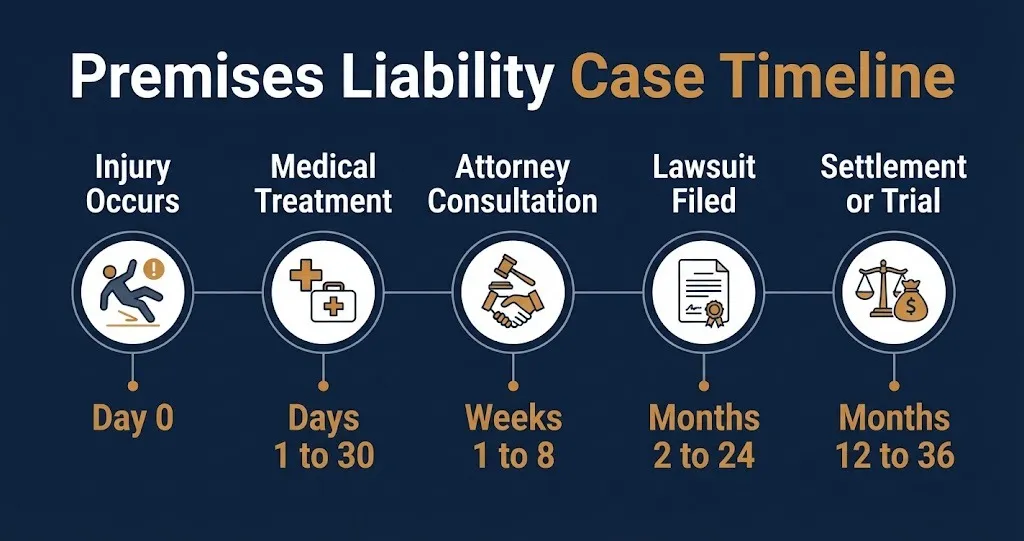
Most premises liability lawsuits settle in 12 to 24 months from the date of filing. Some resolve faster. Others take years.
The timeline depends on several factors. The complexity of your injuries matters. Cases with disputed liability take longer than cases where fault is clear. Insurance company tactics also play a role. Some carriers delay aggressively, hoping financial pressure forces a cheap settlement.
The typical timeline looks like this:
| Stage | Expected Timing |
|---|---|
| Injury to attorney consultation | Immediately to 2 months |
| Investigation and demand letter | 2 to 6 months |
| Filing complaint and discovery | 6 to 12 months |
| Depositions and expert reports | 9 to 18 months |
| Mediation or settlement negotiations | 12 to 24 months |
| Trial, if no settlement | 18 to 36 months |
Your case may move faster if liability is clear and the insurance company wants to limit legal fees. It may move slower if your injuries are still being treated and your future medical needs are uncertain.
Key Takeaway: Settling too fast often means leaving money on the table. A rushed settlement before you understand your full medical picture is a common mistake.
What Happens Next in a Premises Liability Lawsuit?
Once your lawsuit is filed, the process follows a predictable path. Understanding what comes next reduces anxiety and helps you make informed decisions.
Here is the expected sequence for a typical premises liability case filed in late 2026:
September to November 2026: The complaint is filed and served on the property owner and their insurance company.
December 2026 to March 2027: The defendant files an answer, and both sides exchange initial disclosures listing witnesses and evidence.
April to September 2027: Discovery continues with document requests, interrogatories, and depositions.
October 2027 to January 2028: Expert witnesses are retained to address liability and damages. Settlement negotiations intensify.
February to June 2028: Mediation occurs in most jurisdictions. If mediation fails, the case proceeds to trial preparation.
This timeline is an estimate. Your case may move faster or slower depending on the court’s docket and the complexity of your claim.
Key Takeaway: Patience matters in premises litigation. The process is designed to force both sides to reveal their evidence before trial, which is why most cases settle.
Frequently Asked Questions
What is a premises liability lawsuit?
A premises liability lawsuit is a legal claim against a property owner or occupier for injuries caused by an unsafe condition on the property.
The claim argues that the owner failed to maintain safe premises or warn visitors about known hazards.
How much can I get from a premises liability settlement?
Settlements range from $15,000 for minor injuries to over $1 million for catastrophic harm.
Your actual amount depends on injury severity, medical costs, lost wages, and the strength of your liability evidence.
How long do I have to file a premises liability claim?
Most states give you two to three years from the date of the injury to file.
Government claims often have much shorter deadlines, sometimes as little as 30 to 180 days for a required notice.
Do I need a lawyer for a premises liability lawsuit?
Yes, in almost every case, a lawyer is essential.
Premises liability cases involve complex legal standards, aggressive insurance companies, and significant evidence requirements.
What if I was partly at fault for my accident?
You may still recover compensation under comparative negligence rules in most states.
Your recovery is reduced by your percentage of fault, and in some states you recover nothing if you are more than 50 percent at fault.
Are premises liability lawsuits expensive to file?
Most premises liability lawyers work on contingency, meaning you pay nothing upfront.
The lawyer receives a percentage of your settlement, typically 33 to 40 percent, only if you win.
Can I sue for emotional distress from a premises accident?
Yes, emotional distress damages are available in most premises liability cases.
These damages are usually calculated as part of your pain and suffering and are tied to the severity of your physical injuries.
What if the property owner has no insurance?
You can still sue, but collecting a judgment may be difficult.
Most commercial property owners carry liability insurance, but private homeowners may have limited or no coverage.
The Bottom Line
If you were injured on someone else’s property in 2026, the clock is already running. Your state’s statute of limitations is the single most important date in your case.
Document everything. Photograph the hazard. Get medical care. Write down what happened while your memory is fresh. Then contact a premises liability attorney who can evaluate your claim before evidence disappears and deadlines expire.