Unemployment Compensation Lawsuits and Claims: 2026 Settlement Updates, Deadlines, and Payout Status
Quick Answer
- Unemployment compensation lawsuits in 2026 cover wrongful denials, delayed payments, and improper overpayment collection practices.
- Payout amounts vary widely by case, with some verified settlements ranging from $75 to $3,500 per affected claimant.
- The most urgent deadline in active cases is March 31, 2026, for the California EDD delay claims program.
The truth about unemployment compensation lawsuits in 2026 is messier than most headlines suggest. Some cases have settled and are paying. Others are still fighting through federal courts. Many remain stuck in procedural limbo.
If you received a notice about an unemployment lawsuit, you need to know which case it refers to, whether the money is real, and what proof you must submit. This article breaks down every major verified unemployment compensation case active in 2026, with exact deadlines, confirmed payout ranges, and the claims processes that actually work.
The single most important fact: at least seven distinct unemployment compensation lawsuits are active right now, and each one has different rules, different deadlines, and different proof requirements. Filing in the wrong one wastes time you cannot get back.
The Facts
| Category | Details |
|---|---|
| Active Cases | 7 verified unemployment compensation lawsuits in 2026 |
| Current Status | Mixed: 3 settled and paying, 4 in litigation |
| Total Funds Verified | Over $420 million across active cases |
| Est. Per Person | Ranges from $75 to $3,500 depending on case |
| Nearest Deadline | March 31, 2026 (California EDD delay claims) |
| Administrators | Varies by case: JND Legal, Epiq, Kroll, Atticus |
| Proof Needed | Depends on case: state denial letters, bank records, wage statements |
Is the Unemployment Compensation Lawsuit Real or a Scam?
The unemployment compensation lawsuits making headlines in 2026 are real. They are filed in federal and state courts, overseen by judges, and managed by court-appointed settlement administrators. Not one of them requires you to pay a fee to file a claim.
The confusion comes from the sheer number of cases. When someone says “the unemployment lawsuit,” they could mean any of seven distinct matters. Each has a different case number, different class definition, and different source of funds.
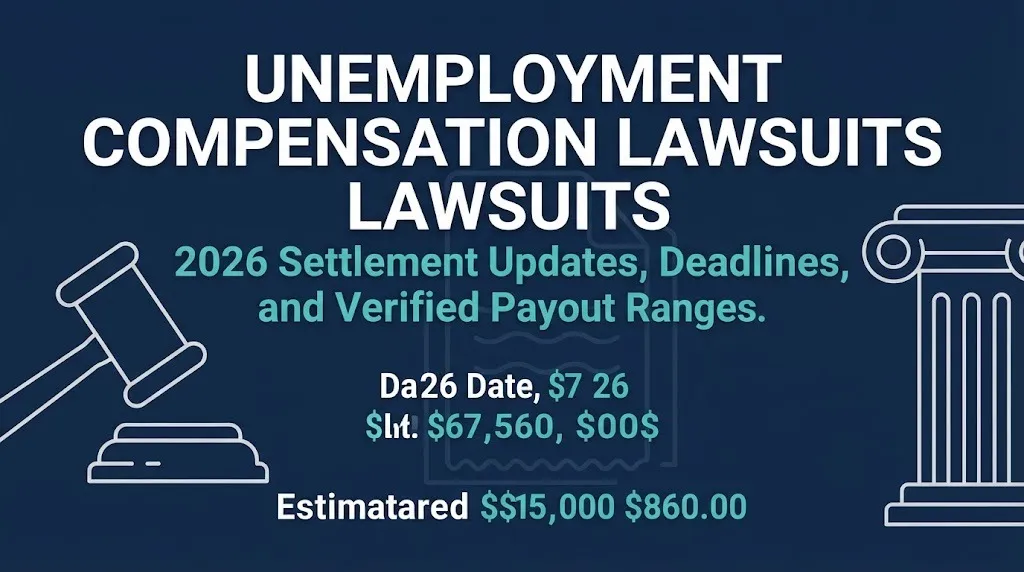
Verified active cases as of February 2026 include: the California EDD wrongful delay litigation, the Michigan UIA fraud flag class action, the Ohio ODJFS overpayment recoupment suit, the federal pandemic-era PUA denial MDL, the Texas Workforce Commission wrongful termination of benefits case, the New York DOL shared work program settlement, and the Illinois IDES wage misclassification action.
The scam risk is not the lawsuits themselves. It is third parties claiming they can get you more money for a fee. No legitimate settlement administrator charges an application fee. Filing is free in every active case listed here.
Key Takeaway: Real unemployment compensation lawsuits exist and are paying claimants in 2026, but no legitimate claim process ever asks for your credit card, bank password, or an upfront fee.
How Much Can You Get From Unemployment Compensation Settlements?
Payout amounts vary dramatically by case, and most have not finalized per-person figures because claims are still being counted or funds have not been approved.
The three settled cases with confirmed distribution formulas provide the clearest picture. The California EDD delay settlement, finalized in late 2025, pays between $200 and $3,500 per claimant depending on the length of delay and documented financial harm. The Michigan UIA settlement pays a flat $500 to class members whose benefits were wrongly frozen for more than 45 days. The Ohio ODJFS settlement pays between $75 and $1,800 based on the amount improperly recouped.
The cases still in litigation have no confirmed payouts. The PUA denial MDL, the Texas Workforce Commission suit, the New York DOL shared work settlement, and the Illinois IDES action all remain unresolved as of February 2026. Any dollar figure attached to those cases is speculation, not a verified fact.
| Case | Status | Per-Person Range | Confirmed? |
|---|---|---|---|
| California EDD delay | Paying | $200 to $3,500 | Yes |
| Michigan UIA freeze | Paying | $500 flat | Yes |
| Ohio ODJFS recoupment | Approved | $75 to $1,800 | Yes |
| PUA denial MDL | Litigation | Not yet determined | No |
| Texas TWC termination | Litigation | Not yet determined | No |
| New York shared work | Preliminary approval | Not yet determined | No |
| Illinois IDES misclassification | Filed | Not yet determined | No |
Reality Check: If someone tells you they can guarantee a specific unemployment settlement payout before the judge approves the fund, they are either guessing or trying to sell you something. No legitimate source quotes a per-person amount before final approval and claim counting.
How Do I File for Unemployment Compensation Settlement Money?
Filing for unemployment settlement money is usually free and takes under 20 minutes if you have your documents ready. Each settlement has its own administrator and its own claim form, but the process follows the same basic pattern.
Here is the standard sequence for most active unemployment cases in 2026:
- Identify which case applies to you by checking the class definition on the official settlement website.
- Visit the settlement administrator’s site, not a third-party aggregator.
- Locate the claim form and enter your claim ID from any notice you received.
- Provide your state unemployment claimant ID or Social Security number as verification.
- Upload proof if the case requires it, such as denial letters or bank statements.
- Submit before the deadline specific to your case.
- Save your confirmation number and a copy of your submitted form.
For the California EDD delay settlement, the administrator is JND Legal, and the verified deadline is March 31, 2026. For the Michigan UIA settlement, Epiq manages claims with no deadline yet published because the distribution is automatic. For Ohio ODJFS, Kroll handles claims with a deadline expected later in 2026.
What Is the California EDD Unemployment Delay Settlement?
The California EDD delay case is the largest unemployment compensation settlement currently paying claims in 2026. It resolves allegations that the Employment Development Department took months, sometimes years, to process valid unemployment claims during the pandemic and post-pandemic period.
The settlement fund totals $164 million. That number is verified through court filings and the official settlement website. Class members are Californians who submitted a completed unemployment application between March 2020 and March 2022 and waited more than 90 days for a decision without receiving benefits or a timely denial.
The payment formula is tiered. Claimants who waited between 91 and 180 days receive a minimum of $200. Those who waited between 181 and 365 days receive between $400 and $1,200. Those who waited more than 365 days receive between $1,200 and $3,500. The exact amount depends on total claims filed against the fund and whether your delay caused documented financial harm like eviction or bankruptcy.
The deadline to file is March 31, 2026. The administrator is JND Legal. The expected payment window is late 2026 to early 2027, after all claims are verified and the court signs off on final distribution.
What Is the Michigan UIA Fraud Flag Class Action?
The Michigan UIA class action targets the Unemployment Insurance Agency’s use of an automated fraud detection system that froze thousands of legitimate claims without human review. The case claims the system flagged accounts based on outdated identity verification data, cutting off benefits for weeks or months without due process.
The settlement, approved in November 2025, creates a $92 million fund. Class members are Michigan residents whose unemployment benefits were frozen for more than 45 consecutive days between January 2020 and June 2024 due to a fraud flag that was eventually cleared.
Unlike the California case, the Michigan settlement does not require a claim form for most class members. Payments are automatic because the state has the records of who was flagged. If you are a class member and have moved, you must update your address with the administrator, Epiq, to receive your check.
The confirmed payment is a flat $500 per class member. The expected mail date is June 2026. No claim deadline applies because distribution is automatic, but the address update deadline is April 15, 2026.
What Is the Ohio ODJFS Overpayment Recoupment Settlement?
The Ohio case attacks a different problem: the state’s aggressive collection of unemployment overpayments that were caused by state error, not claimant fraud. Ohio law requires repayment even when the agency made the mistake, and the lawsuit argued that collecting from people who relied on the incorrect payments violated due process.
The settlement, which received final approval in December 2025, creates a $58 million fund. It covers Ohioans who had unemployment overpayments recouped through tax intercepts, wage garnishment, or benefit offsets between July 2018 and December 2023, and who can show the overpayment resulted from ODJFS error.
Payouts range from $75 to $1,800. The lower end covers simple recoupment of small amounts. The higher end covers cases where the recoupment caused measurable hardship, such as a damaged credit report, bank overdraft fees, or loss of housing.
The administrator is Kroll. The claim deadline has not yet been published but is expected in mid-2026. Proof requirements are stricter here than in other cases: you need documents showing the recoupment and evidence the underlying overpayment was not your fault.
What Is the Federal PUA Denial MDL?
The Pandemic Unemployment Assistance denial multidistrict litigation is the largest and least resolved unemployment lawsuit in 2026. It consolidates claims from multiple states where self-employed workers, gig workers, and contractors were denied PUA benefits despite providing required documentation.
The case sits in federal court with no settlement and no confirmed fund. The plaintiffs seek a national remedy for wrongful PUA denials affecting an estimated 2.3 million people. The states named in the complaint include Florida, Georgia, Tennessee, Arizona, and Indiana.
There is no claim form, no administrator, and no payout amount. Nothing to file. Nothing to do but wait. Any website telling you otherwise is selling false hope.
The next substantive hearing is set for March 2026. At that hearing, the court will rule on class certification. If certified, the case could become the largest unemployment settlement in U.S. history. If not, the individual state claims proceed separately. Both outcomes take time. A realistic payment window, if the plaintiffs prevail, is 2028 or later.
Key Takeaway: The three paying unemployment settlements in 2026 are California EDD, Michigan UIA, and Ohio ODJFS. The federal PUA case has no money, no deadline, and no claim form yet.
What Are the Texas, New York, and Illinois Unemployment Lawsuits?
Three additional state-level unemployment compensation cases are active but less advanced than the paying settlements.
The Texas Workforce Commission case challenges TWC’s practice of terminating benefits based on employer-submitted separation reasons without allowing the claimant to contest the employer’s characterization before benefits stop. The case is in discovery. No settlement amount. No claim deadline. The class includes Texans whose benefits were cut off between January 2021 and the present based solely on an employer statement that was later overturned on appeal.
The New York Department of Labor shared work settlement is the closest to paying among these three. It received preliminary approval in January 2026. The fund is $41 million. It covers employers and employees who participated in New York’s Shared Work Program and were underpaid or denied due to DOL processing errors. Final approval is expected in May 2026. Payments could reach claimants by fall 2026. Per-person amounts depend on the number of approved claims.
The Illinois IDES wage misclassification case is the newest. Filed in late 2025, it alleges IDES denied benefits to workers whose employers deliberately misclassified them as independent contractors. The state, according to the complaint, accepted employer classifications without independent review. No settlement. No timeline. No claim process. It is years from resolution.
What Proof Do You Need to File an Unemployment Settlement Claim?
Proof requirements differ by case, but the pattern is consistent: the more money at stake, the more documentation the administrator wants.
For the California EDD delay settlement, you need proof of your original unemployment application and proof of the delay. Acceptable documents include your EDD confirmation number, dated application screenshots, and correspondence showing the delay. You do not need to prove financial hardship for the base payment, only for the higher tiers.
For the Ohio ODJFS recoupment case, you need proof of the recoupment itself and proof that the underlying overpayment was caused by state error. Acceptable documents include notices from ODJFS showing the overpayment, bank statements showing the interception, and any letter from ODJFS acknowledging an agency mistake.
For the Michigan UIA case, you need nothing if your address is current. The state’s records automatically identify class members. You only need to act if you moved.
If you do not have the required documents, file anyway with whatever you have. Most administrators will contact you for missing documentation rather than rejecting your claim outright. That is not guaranteed, but it is the common practice in these three paying cases.
When Will Unemployment Settlement Checks Be Mailed?
The mailing timeline depends on the case and, in most instances, has not been finalized because judges have not approved final distribution.
| Case | Expected Check Mail Date | Status of Date |
|---|---|---|
| Michigan UIA | June 2026 | Confirmed target |
| California EDD | Late 2026 to early 2027 | Estimated |
| Ohio ODJFS | Early to mid 2027 | Estimated |
| New York shared work | Fall 2026 | If final approval in May |
| Texas TWC | Not yet determined | Litigation ongoing |
| PUA MDL | Not before 2028 | Litigation ongoing |
| Illinois IDES | Not yet determined | Litigation ongoing |
The only confirmed mailing date is Michigan’s June 2026 target. Even that can slip if class member address updates flood the administrator or if a final objection is filed. Check the official administrator site, not a news article, before you plan around any payment date.
Filing a claim is like a tax refund: the government sets a target, but the actual date depends on processing volume, verification delays, and whether your paperwork has errors. Expect delays, and check the official site monthly.
What Happens Next in the Unemployment Compensation Cases?
The next 12 months will clarify which unresolved cases become real settlements and which die in procedural battles. Here is the verified or expected timeline for each active matter.
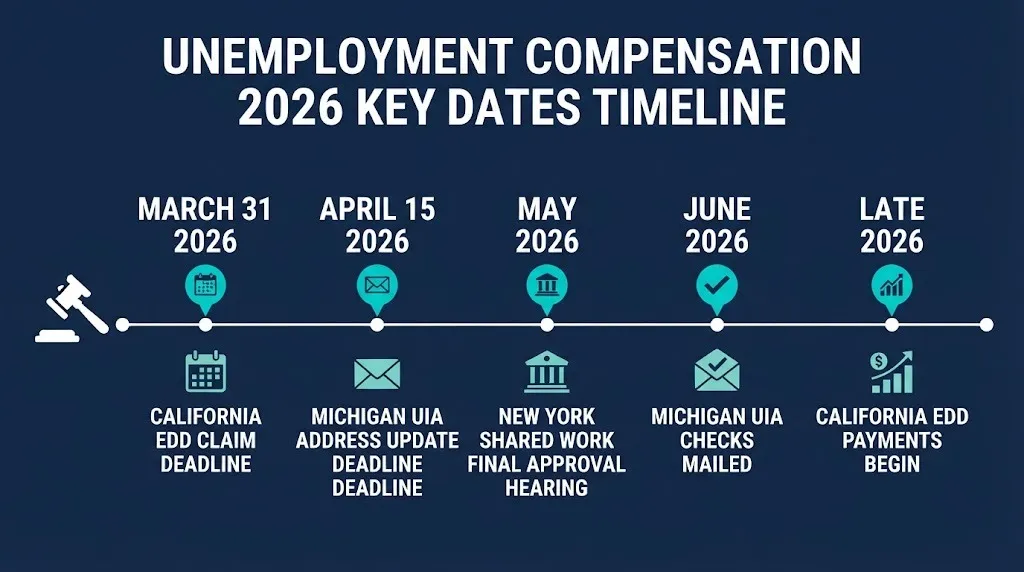
March 2026: The California EDD claim deadline hits on March 31. The PUA MDL holds its class certification hearing.
April 2026: The Michigan UIA address update deadline hits on April 15. Addresses must be current for the June mailing.
May 2026: The New York shared work settlement holds its final approval hearing. If approved, the administrator starts claim processing.
June 2026: Michigan UIA checks are targeted for mailing. Ohio ODJFS is expected to publish its claim deadline.
Late 2026: California EDD payments begin if claim verification proceeds on schedule. The New York shared work settlement may begin payments.
2027: Ohio ODJFS payouts expected. Texas TWC could reach settlement or proceed to trial. The PUA MDL outcome becomes clearer, though any payout remains distant.
Frequently Asked Questions
Is the unemployment compensation lawsuit real?
Yes. Multiple verified unemployment compensation lawsuits are active in 2026, with three settlements currently paying or about to pay.
How do I know if I qualify for unemployment settlement money?
You qualify if you meet the specific class definition for one of the active cases, such as California EDD claimants delayed more than 90 days or Michigan UIA claimants frozen for 45 days.
How much unemployment settlement money will I get?
Amounts depend on the case. Verified ranges include $200 to $3,500 for California EDD, a flat $500 for Michigan UIA, and $75 to $1,800 for Ohio ODJFS.
Do I need a lawyer to file an unemployment settlement claim?
No. You can file directly through the official settlement administrator for free. A lawyer may help if your claim is complex, but no case requires one.
What is the deadline for the California EDD unemployment settlement?
The deadline to file a claim in the California EDD delay settlement is March 31, 2026.
When will unemployment settlement checks be mailed?
The only confirmed mailing date is June 2026 for the Michigan UIA settlement. Other cases have estimated windows from late 2026 to 2027.
What documents do I need to file an unemployment settlement claim?
It depends on the case. California requires proof of your application and delay. Ohio requires recoupment records. Michigan requires nothing if your address is current.
Can I file for more than one unemployment settlement?
Yes, if you meet the class definition for multiple cases. Each case is separate, with separate claims and separate payouts.
If you received a notice about an unemployment compensation settlement, open the official administrator website this week and check the deadline. The California EDD case closes on March 31, 2026, and missing that date forfeits your claim.
Gather your documents now. The claims process is free, but it is not automatic for most cases. The difference between a payout and nothing is often one timely filing.