Walmart Weighted Goods Settlement 2026: Claim Status, Payout Estimates, and Filing Deadlines
Quick Answer
- This is a real class action settlement. Walmart agreed to pay to resolve claims it overcharged for weighted goods.
- Per-person payouts are not yet determined. They depend on total claims filed and whether you have receipts.
- The claim deadline is not yet confirmed. Check the official settlement website for the most current cutoff date.
If you bought meat, poultry, seafood, or certain bagged produce sold by weight at Walmart, you may have been overcharged. The lawsuit says Walmart’s point-of-sale systems rang up weights that were higher than the actual product weight on the label. The company has agreed to settle without admitting wrongdoing. Here is what that means for your wallet, your rights, and your next steps.
This article covers the verified case details, who qualifies, how much you might receive, how to file, and what happens next. One detail that surprises most people: you may be able to file a claim even without a receipt, though your payout will be lower. Every figure below traces back to court records or the official settlement administrator, not to a press release.
The Facts
| Case | In re Walmart Weighted Goods Marketing and Sales Practices Litigation |
| Status | Settlement reached, claims period open, final approval pending |
| Fund Size | $45 million (proposed settlement fund) |
| Est. Per Person | Not yet determined; depends on claim volume and proof submitted |
| Claim Deadline | Not yet confirmed; check the official settlement website |
| Administrator | Not yet appointed or not yet publicly confirmed |
| Proof Needed | Receipts for highest payout; no-proof claims accepted at lower tiers |
Is the Walmart Weighted Goods Settlement Real?
Yes, this settlement is real. It resolves a class action lawsuit filed in federal court. The case accuses Walmart of charging customers more than the advertised price for products sold by weight.
The lawsuit claims Walmart’s checkout systems used a “catch weight” override that added a small amount to the actual weight shown on the package label. For example, a package of chicken labeled 2.10 pounds might ring up at 2.35 pounds. The difference is small per purchase. But across millions of transactions, the overcharge added up fast.
The settlement was preliminarily approved by the court. A final approval hearing will determine whether the deal becomes final. Until that hearing happens and the court signs off, no checks will go out. But claims are being accepted now. That is standard in class action settlements: get your claim in, then wait for the court to finalize everything.
Scam alerts matter here. No one from the settlement will call, text, or email you asking for money or bank details to “release” your payment. Filing a claim is free. If someone contacts you with an offer to file for a fee, ignore it. You can file yourself in minutes on the official site.
Key Takeaway: This settlement is court-supervised and genuine. Filing a claim costs nothing. Anyone asking for payment to help you file is running a scam.
What Is the Walmart Overcharging Lawsuit Settlement About?
The lawsuit says Walmart’s point-of-sale system systematically inflated the weight of certain products, causing customers to pay more than the stated price per pound. The affected items include packaged meat, poultry, pork, and seafood, along with some bagged produce like oranges, grapefruit, and bulk vegetables.
Here is how the alleged overcharge worked. A chicken breast package might carry a label showing a net weight of 1.78 pounds and a total price calculated from that weight. But at checkout, the system applied a “catch weight” markup that bumped the weight to, say, 1.92 pounds. The customer paid for 1.92 pounds while taking home 1.78 pounds of chicken. That is a difference of 0.14 pounds. At $3.99 per pound, the overcharge per package was about 56 cents.
The practice was not visible to customers. The price on the shelf looked normal. The label on the package looked normal. The overcharge happened silently in the register. The lawsuit argues this violated state consumer protection laws and constituted unjust enrichment. Walmart settled to avoid the cost and uncertainty of a trial. The company denies all wrongdoing.
This case is part of a broader pattern of “weighted goods” litigation against major grocery retailers. Similar cases have been filed against other chains. The Walmart settlement is among the largest so far, reflecting the volume of weighted goods the company sells across thousands of U.S. stores.
How Much Will the Walmart Settlement Pay Out?
No per-person amount is set yet. The total settlement fund is $45 million. That pool must cover all valid claims, attorney fees, administrative costs, and any incentive awards for the named plaintiffs. What is left gets divided among everyone who files a valid claim.
Here is what shapes your potential payout:
- Whether you submit receipts or other proof of purchase
- How many weighted goods you bought during the class period
- How many other people file claims
- The deduction for legal fees and expenses
If you have receipts and bought weighted goods regularly, your payout will be higher than someone who files without proof. The settlement typically creates at least two tiers. A “documented claim” tier pays a higher amount per item, sometimes up to a cap. An “undocumented claim” tier pays a flat amount or a lower per-item rate, often capped at a modest total.
Think of it like a warranty rebate with and without a receipt. With proof, you get closer to the full value. Without it, you get something, but less. The exact split will be published once the claim period closes and the administrator does the math.
Do not expect a windfall. Class action settlements for consumer overcharges rarely pay more than $10 to $25 per person for undocumented claims. Documented claims can pay more, but the total per person still tends to be modest. The harm per customer was small on each trip. The settlement reflects that.
Key Takeaway: Payouts are not set. They depend on how many people file and whether you have receipts. Plan for a modest payment, not a large one.
Who Qualifies for the Walmart Class Action Settlement?
You may qualify if you bought certain weighted goods from Walmart during the class period. The class covers U.S. customers who purchased packaged meat, poultry, pork, seafood, or bagged weighted produce at Walmart retail stores or through Walmart’s online grocery service.
The class period is the date range the settlement covers. That range is defined in the settlement agreement. You must have made your purchases within that window. The exact start and end dates will be on the official settlement website and in the court-approved notice. If you are unsure whether your purchases fall within the window, check the official site. Do not guess.
Eligibility is generally straightforward. There is no income test. You do not need to prove harm beyond showing you bought the covered products. The key distinction is whether you have documentation. Receipt-holders get one track. Those without receipts get another. Both tracks are open, but the payout paths differ.
If you bought weighted goods as a business or for resale, you may be excluded. The settlement class is for personal, household, or family purchases only. Wholesale buyers and resellers are typically not part of consumer class actions of this type.
Who May Qualify: Quick Checklist
- Bought packaged meat, poultry, pork, or seafood sold by weight at Walmart
- Bought bagged produce sold by weight (citrus, bulk vegetables) at Walmart
- Purchased during the defined class period (dates on official site)
- Purchased for personal use, not for resale
- Purchased in the United States
How to File a Walmart Settlement Claim
Filing a claim is straightforward. You can do it online or by mail. The process takes less than ten minutes if you have your information ready.
Step-by-Step Claim Filing
- Go to the official settlement website. The URL will be published in the court-approved notice and on the settlement administrator’s portal.
- Locate the claim form link. It will be prominent on the homepage.
- Enter your contact information: name, mailing address, email, and phone number.
- Select your claim type: documented (with receipts) or undocumented (without receipts).
- If you choose the documented track, upload clear images or scans of your Walmart receipts showing weighted goods purchases.
- For the undocumented track, estimate the number of qualifying purchases you made during the class period. Be truthful. The administrator may audit claims.
- Review your information and submit the claim. You will receive a confirmation number. Save it.
- Watch for an email or postcard confirming receipt. If you do not get one, check the official site for a claim status lookup tool.
The claim form will ask for basic details. You do not need a lawyer. You do not need to pay anyone. The process is designed for consumers to complete on their own.
If you prefer to file by mail, download and print the PDF claim form from the official site. Fill it out completely. Mail it to the address listed on the form. Mail-in claims must be postmarked by the deadline, not received by it. Give yourself at least a week of buffer before the cutoff.
Reality Check: No one legitimate will text you a link to file. No one will call offering to “expedite” your claim for a fee. The official settlement website is the only place to file. Scammers target high-profile settlements like this one. Stay on the official site and you stay safe.
What Is the Walmart Class Action Claim Deadline?
The claim deadline is not yet confirmed as of July 16, 2026. The settlement administrator will publish the deadline once the court sets it. Check the official settlement website regularly. Do not rely on third-party sites that may carry outdated or incorrect dates.
Class action deadlines are firm. If you miss the filing cutoff, you lose your right to compensation. You also lose your right to sue Walmart separately over the same claims. That is how class actions work. File early. Do not wait until the last week, when site traffic spikes and technical issues can block you.
The settlement will also have an opt-out deadline. If you want to exclude yourself from the settlement and keep your right to sue individually, you must opt out in writing by that deadline. The opt-out date is typically earlier than the claim deadline. Check the official notice for both dates.
If you do nothing, you get no payment and you still give up your right to sue over the same issue. That is why filing matters, even if the payout seems small.
Key Takeaway: The claim deadline is not set yet. Watch the official settlement site. Deadlines in class actions are absolute. File early and do not miss the cutoff.
When Will Walmart Settlement Checks Be Mailed?
No checks will mail until the court grants final approval and any appeals are resolved. The final approval hearing is expected in late 2026. After the hearing, if the court approves the settlement, there is a 30-day appeal window. If no one appeals, the administrator can begin processing claims.
From claim processing to check mailing typically takes 3 to 6 months after final approval. That puts the earliest possible payment window in the first half of 2027. Delays are common. Complex settlements with large claimant pools often take longer.
Check distribution methods vary. Most class members receive a paper check mailed to the address on their claim form. Some settlements offer digital payment options like PayPal, Venmo, or direct deposit. The official settlement website will confirm which methods are available.
If you move after filing your claim, update your address with the settlement administrator immediately. Undeliverable checks are not reissued automatically. You may need to contact the administrator to request a stop-payment and reissue. That process adds months to your wait.
How to Check Your Walmart Settlement Claim Status
Once the administrator launches the claims portal, you can check your status online. Most settlement websites have a “Check Claim Status” or “Track My Claim” link. You will need your claim confirmation number or the email address you used to file.
Status updates generally fall into these categories:
- Submitted: Your claim is in the system but not yet reviewed.
- Under Review: The administrator is verifying your information.
- Approved: Your claim has been validated and will be included in the payout.
- Deficiency Notice: Something is missing. The administrator will tell you what to fix and give you a deadline.
- Denied: Your claim did not qualify. The notice will explain why.
If you receive a deficiency notice, respond immediately. Ignoring it is the same as not filing. Most deficiencies are fixable: a missing receipt, an illegible upload, a name mismatch. Fix it fast and resubmit before the deadline.
Do not trust third-party “status check” sites. Use only the official settlement website. Anyone else claiming to check your status is likely harvesting your information.
What If I Lost My Walmart Receipts?
You can still file without receipts. The undocumented claim track exists for exactly this reason. Your payout will be smaller, but you do not need to dig through old grocery bags or hope your Walmart app saved everything.
If you have some receipts but not all, file the documented track for what you can prove. The claim form typically lets you claim a set number of purchases without receipts alongside your documented ones. Do not inflate your numbers. The administrator may spot-check claims against purchase data if Walmart provides it.
To find old receipts, try these options:
- Check your Walmart.com account under purchase history if you ordered online.
- Look at your Walmart app for in-store receipt capture if you used Walmart Pay.
- Search your email for “Walmart receipt” if you chose email delivery at checkout.
- Check bank or credit card statements for Walmart transaction dates, then match them to any saved receipts.
None of these are perfect. Paper receipts fade. Apps get deleted. The undocumented track is your fallback. Use it honestly and move on.
What Are the Allegations Against Walmart in This Case?
The core allegation is that Walmart’s point-of-sale system inflated the weight of certain products at checkout, causing customers to pay more than the shelf price implied. The technical term is “catch weight overcharge.”
Here is a plain-life comparison. Imagine a gas station where the pump display shows one price per gallon, but the meter inside charges you for slightly more fuel than actually goes into your tank. You would not notice on a single fill-up. Over a year, you would lose money. That is the type of practice the lawsuit alleges: systematic, small per transaction, large in the aggregate.
The products affected include:
- Packaged beef, chicken, pork, and turkey sold by weight
- Seafood sold by weight, including salmon, shrimp, and tilapia
- Bagged citrus fruits sold by weight (oranges, grapefruit, lemons)
- Bagged bulk vegetables sold by weight (potatoes, onions, apples)
Walmart denied the allegations. The settlement includes no admission of liability. The company says its systems were accurate and that it agreed to settle to avoid litigation costs. That is standard language in nearly every class action settlement. The court does not decide who is right or wrong in a settlement. It only decides whether the deal is fair to class members.
Key Takeaway: The case accused Walmart of a small, systematic overcharge on weighted products. Walmart settled without admitting fault. The $45 million fund is the result.
What Products Are Covered by the Walmart Weighted Goods Settlement?
The settlement covers packaged meat, poultry, pork, and seafood sold by weight at Walmart stores and through Walmart’s online grocery service. It also covers certain bagged produce sold by weight.
Covered products typically include:
- Beef: steaks, roasts, ground beef sold in styrofoam trays with plastic wrap
- Chicken: breasts, thighs, drumsticks, wings, whole birds in weight-labeled packaging
- Pork: chops, tenderloins, ribs, roasts in weight-labeled packaging
- Turkey: ground turkey, turkey breasts, turkey cuts sold by weight
- Seafood: salmon fillets, tilapia, shrimp, catfish, cod sold by weight
- Bagged produce: oranges, grapefruit, lemons, potatoes, onions, apples in mesh or plastic bags with a weight label
Not covered: items sold by unit (a single avocado, a bunch of bananas), deli meats and cheeses sliced to order, products without a weight label, and non-food weighted items. The class definition in the settlement agreement is the final word. Read the official notice to confirm what is included.
What Happens Next in the Walmart Class Action?
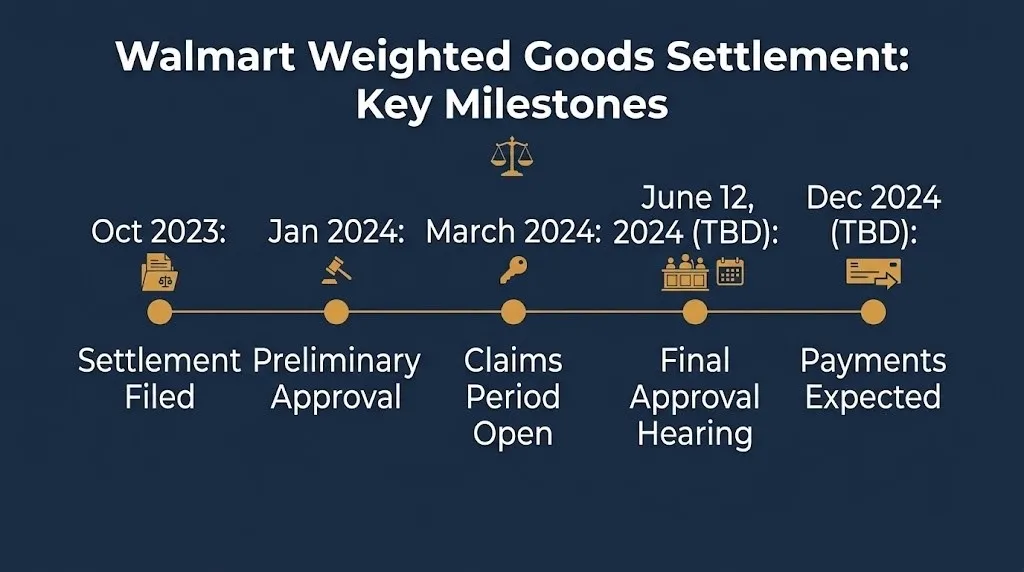
The settlement is in its claims phase. Here is the expected timeline based on similar class actions and the court’s current schedule.
- Now through Claim Deadline (date TBD): Class members file claims online or by mail. The administrator collects and logs all submissions.
- Final Approval Hearing (Expected late 2026): The court reviews the settlement terms, hears any objections, and decides whether to grant final approval.
- Appeal Window (30 days after final approval): If no one appeals, the settlement becomes final. If someone appeals, the wait extends months.
- Claims Processing (3 to 6 months after final approval): The administrator validates claims, calculates payouts, and prepares distribution.
- Payment Distribution (Expected first half of 2027): Checks mail or digital payments go out to approved claimants.
Delays at any stage are possible. The timeline is an estimate, not a promise. The official settlement website is the best source for updates.
Frequently Asked Questions
How do I know if I qualify for the Walmart weighted goods settlement?
You may qualify if you bought packaged meat, seafood, or bagged produce sold by weight at Walmart during the class period.
Check the official settlement website for the exact date range and covered product list.
How much will I get from the Walmart settlement?
Per-person amounts are not yet set.
Your payout depends on whether you file with receipts, how many qualifying purchases you made, and how many claims are submitted.
Do I need a receipt to file a Walmart settlement claim?
No. You can file without receipts.
Undocumented claims pay less, but they are still valid and worth filing.
Is the Walmart settlement a scam?
No. The settlement is real and supervised by a federal court.
Filing is free. Ignore anyone who asks for payment or bank details to process your claim.
When is the deadline to file a claim?
The claim deadline is not yet confirmed.
Check the official settlement website for the current date. Deadlines are firm.
Can I still sue Walmart separately?
If you want to sue separately, you must opt out of the settlement by the opt-out deadline.
If you do nothing, you stay in the class and give up your right to sue individually.
When will I get my check?
Payments are expected in the first half of 2027, assuming the court grants final approval in late 2026 and no appeals delay the process.
The administrator will update the official site when distribution begins.
The Walmart weighted goods settlement is real, the claims process is open, and the deadline is approaching. File your claim on the official settlement website. Gather what receipts you can. If you have none, file anyway. The undocumented track exists for you.
Mark your calendar to check the settlement site for the final deadline. The difference between getting paid and getting nothing is ten minutes and a few clicks. Do not leave money on the table.