Litigation Support Services 2026: What They Do, What They Cost, and How to Choose
Quick Answer
- Litigation support services help law firms manage documents, evidence, e-discovery, and trial preparation.
- Costs vary widely, from a few hundred dollars for small projects to hundreds of thousands for complex cases.
- No government agency licenses litigation support providers, so due diligence before hiring is essential.
If you are a lawyer, a paralegal, or a business involved in a lawsuit, you have likely encountered litigation support services. They promise to handle the technical and logistical burdens of modern litigation. Some deliver. Others overcharge and underperform.
Litigation support is not a single service. It is a category that includes e-discovery, document review, trial graphics, deposition services, and expert witness coordination. The industry has grown rapidly as cases have become more data-heavy.
This article explains what litigation support services actually do, what they cost in 2026, and how to avoid overpaying for services you may not need.
The Facts
| Detail | Verified Information |
|---|---|
| Industry | Litigation support and e-discovery |
| Regulation | No single licensing body |
| Common Services | E-discovery, document review, trial graphics |
| Cost Range | $50 to $500 per hour depending on service |
| E-Discovery Cost | $5 to $15 per gigabyte processed |
| Contract Review | Essential before hiring |
| Professional Associations | ACEDS, The Sedona Conference |
What Are Litigation Support Services?
Litigation support services are professional services that help legal teams manage the technical, logistical, and presentation aspects of litigation. They are not lawyers and do not give legal advice.
The most common services include e-discovery, which is the process of identifying, collecting, and producing electronically stored information. Document review services use contract attorneys or technology to review large volumes of documents for relevance and privilege.
Trial support services prepare exhibits, create timelines, and design visual presentations for the courtroom. Deposition services handle transcripts, video, and scheduling. Expert witness services help locate and manage expert testimony.
Law firms of all sizes use these services. Solo practitioners use them too. The question is not whether they are useful. The question is whether you are paying for the right ones.
Key Takeaway: Litigation support services handle the technical work of lawsuits, not the legal strategy.
How Much Do Litigation Support Services Cost?
Litigation support services cost anywhere from a few hundred dollars to hundreds of thousands of dollars, depending on the scope.
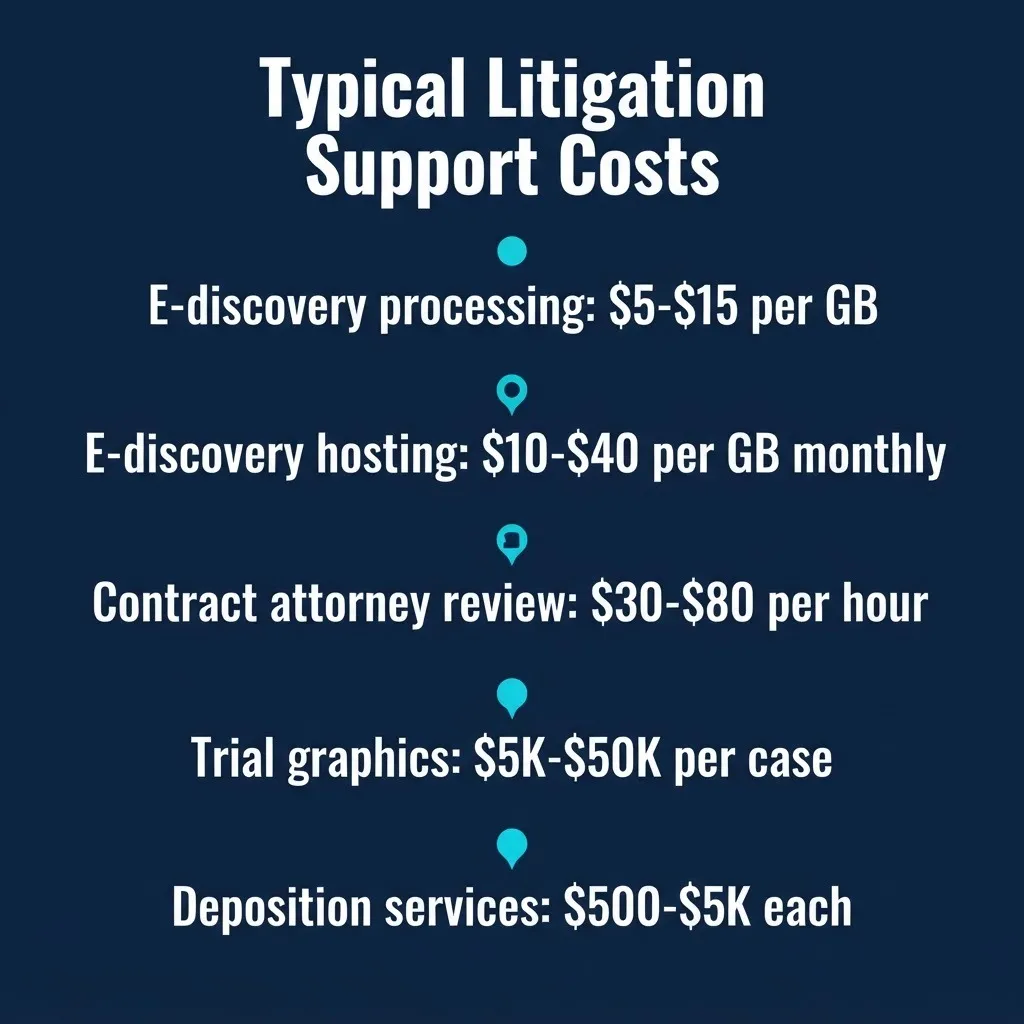
E-discovery processing often costs $5 to $15 per gigabyte. Hosting costs another $10 to $40 per gigabyte per month. A case with one terabyte of data can cost $15,000 to $55,000 just for processing and hosting.
Document review by contract attorneys costs $30 to $80 per hour. Technology-assisted review, which uses machine learning, can reduce that cost but adds software licensing fees.
Trial graphics and presentation support may cost $5,000 to $50,000 for a complex case. Deposition services run $500 to $5,000 per deposition depending on location and complexity.
Typical Litigation Support Cost Ranges
| Service | Typical Cost |
|---|---|
| E-discovery processing | $5 to $15 per gigabyte |
| E-discovery hosting | $10 to $40 per gigabyte monthly |
| Contract attorney review | $30 to $80 per hour |
| Trial graphics | $5,000 to $50,000 per case |
| Deposition services | $500 to $5,000 per deposition |
| Expert witness coordination | $200 to $500 per hour |
These ranges are estimates based on industry data, not fixed prices. Your case may differ.
Key Takeaway: Litigation support costs scale with data volume and case complexity. Small cases cost hundreds. Large cases cost hundreds of thousands.
What Does an E-Discovery Service Do?
An e-discovery service manages electronically stored information for litigation. This is often the largest and most expensive part of litigation support.
The process begins with identification. The service helps locate relevant data sources, including email, documents, databases, and mobile devices. Next comes preservation. A legal hold is issued to prevent data deletion.
Collection follows. The service extracts data in a defensible manner that preserves metadata. Processing then converts files into searchable formats and removes duplicates. Review is where attorneys or technology assess documents for relevance and privilege. Production is the final step, delivering responsive documents to the other side.
Each step has technical standards. Courts expect defensible processes. A mistake in collection or processing can lead to sanctions.
Key Takeaway: E-discovery is the largest litigation support cost and requires defensible processes at every stage.
What Are Trial Support Services?
Trial support services handle the presentation side of litigation. They help lawyers communicate complex evidence to judges and juries.
The work includes creating trial exhibits, building timelines, designing graphics, and managing courtroom technology. A trial support professional may run the presentation software during trial while the attorney focuses on argument.
For complex cases, trial graphics can make or break the presentation. A clear timeline, a well-designed chart, or an animation of an accident scene can help a jury understand what happened.
Trial support also includes war room setup, witness preparation tools, and real-time transcription. These services are concentrated in the weeks before and during trial.
Key Takeaway: Trial support services handle exhibits, graphics, and courtroom technology, concentrated near trial.
What Is Document Review in Litigation Support?
Document review is the process of examining documents to determine relevance and privilege. It is often the most labor-intensive part of litigation.
Traditionally, teams of contract attorneys reviewed documents one by one. Each document was coded for relevance, privilege, and issue. That process is slow and expensive.
In 2026, technology-assisted review is common. Predictive coding uses machine learning to prioritize documents likely to be relevant. The software learns from attorney decisions and surfaces the most important documents first.
Technology-assisted review reduces cost and increases consistency. But it requires setup, validation, and attorney oversight. It is not a set-it-and-forget-it tool.
Key Takeaway: Document review is labor-intensive, but technology-assisted review is reducing costs and improving consistency.
Reality Check: Litigation Support Is Not Regulated
Litigation support is not a regulated profession. No state bar licenses e-discovery vendors. No federal agency certifies trial graphics providers. Anyone can hang a shingle and call themselves a litigation support company. That means quality varies wildly. Some vendors are excellent. Others are incompetent or worse. The burden is on you to verify experience, check references, and insist on a written contract with clear deliverables. Cheap vendors can cost more in the long run when their work fails in court.
How Do You Choose a Litigation Support Provider?
Choosing a litigation support provider requires more than comparing prices. The cheapest vendor can be the most expensive if the work is not defensible.
Here are the steps to choose a provider.
- Define the scope of work precisely before contacting vendors.
- Ask for references from cases similar to yours.
- Verify the vendor’s experience with your court or jurisdiction.
- Request a sample or demonstration of their work product.
- Ask about their data security protocols and certifications.
- Get a written estimate with clear line items.
- Review the contract for limitations of liability and termination rights.
Do not skip the reference check. A vendor who cannot produce satisfied clients is a red flag.
Key Takeaway: Due diligence is essential because litigation support is unregulated and quality varies widely.
What Certifications Should a Litigation Support Provider Have?
Certifications in litigation support are voluntary, not required. But they signal a baseline of knowledge.
The Association of Certified E-Discovery Specialists offers the CEDS certification. It covers e-discovery principles, project management, and ethics. Passing the exam requires study and experience.
The Sedona Conference publishes influential guidelines on e-discovery and document production. Vendors who follow Sedona principles understand defensible processes.
For data security, look for SOC 2 Type II certification. This indicates the vendor has controls for data protection and has been audited.
No certification guarantees quality. But the absence of all certifications is a warning.
Key Takeaway: Voluntary certifications like CEDS and SOC 2 signal competence, but they are not a substitute for references.
How Do Litigation Support Services Work with Law Firms?
Litigation support services work as vendors to law firms. The law firm remains responsible for the legal strategy and the final work product.
The relationship is governed by a contract. The contract should specify deliverables, deadlines, and fees. It should also address data security, confidentiality, and the vendor’s obligation to comply with court orders.
The law firm supervises the vendor. If the vendor’s work is deficient, the law firm is accountable to the client and the court. Delegating work does not delegate responsibility.
Some law firms have in-house litigation support departments. Others outsource everything. The trend in 2026 is toward hybrid models, with in-house project managers overseeing external vendors.
Key Takeaway: Law firms remain responsible for work done by litigation support vendors. Delegation does not transfer accountability.
What Are the Risks of Using Litigation Support Services?
Using litigation support services carries real risks. The biggest is a data breach. Litigation often involves sensitive information, including trade secrets, personal data, and privileged communications.
A vendor with weak security can expose that data. The law firm and the client may face liability. In some cases, a breach can waive privilege.
Another risk is spoliation. If a vendor fails to preserve data properly, the court may impose sanctions. Those sanctions can include adverse inferences or even dismissal of claims.
Quality risk is also real. A vendor that produces inaccurate work can undermine the case. A botched e-discovery production can lead to motions to compel or sanctions.
Key Takeaway: Data breaches, spoliation, and quality failures are the biggest risks, and the law firm bears ultimate responsibility.
How Is Artificial Intelligence Changing Litigation Support?
Artificial intelligence is changing litigation support in significant ways. The changes are real, not hypothetical.
Predictive coding in document review is now standard in large cases. Machine learning models rank documents by relevance, reducing the number of documents attorneys must review manually.
Generative AI is beginning to assist with summarization, deposition preparation, and legal research. Some vendors offer AI tools that draft timelines from deposition transcripts or identify key documents from a review set.
But AI is not a replacement for attorney judgment. Courts still require attorney oversight of e-discovery. AI output must be validated. The lawyer who signs the discovery responses is responsible for what the AI produced.
Key Takeaway: AI is reducing costs and improving efficiency, but attorney oversight remains legally required.
What Is the Future of Litigation Support in 2026 and Beyond?
The future of litigation support is consolidation and automation. The industry is maturing, and smaller vendors are being acquired by larger ones.
E-discovery costs are falling as technology improves. Cloud-based platforms are replacing on-premises software. Subscription pricing is becoming more common.
Generative AI will continue to reshape document review and case analysis. Vendors that do not integrate AI will struggle to compete.
For consumers of litigation support, the trend is positive. More competition means better pricing and better tools. But due diligence remains essential because the industry is still unregulated.
Key Takeaway: Consolidation and AI adoption are driving costs down, but due diligence remains the consumer’s responsibility.
What Happens Next When You Hire a Litigation Support Provider
After you hire a litigation support provider, the engagement follows a predictable path.
Week 1: Contract signed, project kickoff meeting held.
Week 2 to 4: Data collection and processing begin for e-discovery projects.
Month 1 to 3: Document review underway. Trial support work begins if trial is near.
Month 3 to 12: Production completed, review updated, trial preparation intensifies.
Post-trial: Final invoices, data return or destruction, and case closeout.
These timelines vary. A small project may finish in weeks. A large e-discovery project can run for a year or more.
Frequently Asked Questions
What do litigation support services do?
They handle e-discovery, document review, trial graphics, depositions, and expert witness coordination.
How much does e-discovery cost?
Processing costs $5 to $15 per gigabyte. Hosting costs $10 to $40 per gigabyte monthly.
Are litigation support providers regulated?
No. There is no licensing body. Certifications are voluntary.
What is technology-assisted review?
It is machine learning software that prioritizes documents for attorney review, reducing cost and time.
Do I need litigation support for a small case?
Maybe. Even small cases involve electronic evidence. But scope the services carefully to avoid overpaying.
What is a CEDS certification?
It is a voluntary certification for e-discovery specialists offered by the Association of Certified E-Discovery Specialists.
Who is responsible if a vendor makes a mistake?
The law firm is responsible to the client and the court. Vendors may have contractual liability, but the firm remains accountable.
How do I avoid overpaying for litigation support?
Define the scope, compare estimates, check references, and avoid services you do not need.
The most important fact about litigation support services is that they are unregulated. Quality varies. Prices vary. The burden of due diligence is on you. Check references. Verify certifications. Get a written contract. And remember that the law firm remains responsible for the work, no matter who performs it. Choose carefully, because the cheapest vendor can become the most expensive mistake.