Wrongful Termination Lawsuit Payout 2026: Average Settlements, What Drives Value, and How to File
Quick Answer
- Wrongful termination settlements are confidential in most cases, so no official average exists.
- Payouts typically range from $5,000 to $250,000, with discrimination and retaliation cases paying more.
- Filing deadlines vary by state and claim type, often 180 to 300 days for agency charges.
If you were fired and believe it was illegal, the first question is usually about money. What is this worth? The honest answer is that no official average exists. Wrongful termination settlements are almost always confidential. The parties sign non-disclosure agreements. The numbers never become public record.
What can be said with confidence is this: the value of your case depends on lost wages, emotional distress, the strength of your evidence, and whether the employer violated a specific law like Title VII or the Family and Medical Leave Act. A weak case might settle for a few thousand dollars. A strong case with a high earner and clear discrimination can exceed six figures.
Here is what’s verified for 2026: the typical ranges, what drives settlement value, the filing deadlines, and the steps to protect your claim.
The Facts
| Item | Detail |
|---|---|
| Claim Type | Individual employment dispute, not class action |
| Average Settlement | No official average, most are confidential |
| Typical Range | $5,000 to $250,000 |
| Key Factor | Lost wages, evidence strength, legal violation type |
| Filing Deadline | 180 to 300 days for EEOC charges, varies by state |
| Administrator | None, negotiated between parties |
| Proof Needed | Termination letter, performance reviews, witness statements |
Is a Wrongful Termination Lawsuit Payout Real?
A wrongful termination lawsuit payout is real money, not a scam. When an employer illegally fires you, the law allows you to seek damages. Those damages include lost wages, emotional distress, and sometimes punitive damages. If the case settles, the employer pays money. If it goes to trial and you win, a jury awards money.
The scam risk comes from companies that promise guaranteed payouts for an upfront fee. No legitimate employment attorney charges upfront fees for wrongful termination cases. They work on contingency, meaning they take a percentage only if you recover. Anyone asking for payment before you receive a settlement is running a scam.
Legitimate settlements are negotiated between your attorney and the employer’s counsel. They are documented in a written agreement. The money is paid by check or wire transfer. None of that requires you to pay anything upfront.
Key Takeaway: Wrongful termination payouts are real, but legitimate attorneys never charge upfront fees. Contingency is the standard.
What Is the Average Wrongful Termination Settlement?
There is no verified official average for wrongful termination settlements. Most are confidential and never reported. The numbers you see online are estimates based on surveys, attorney self-reporting, and published case results. Treat every figure as a range, not a guarantee.
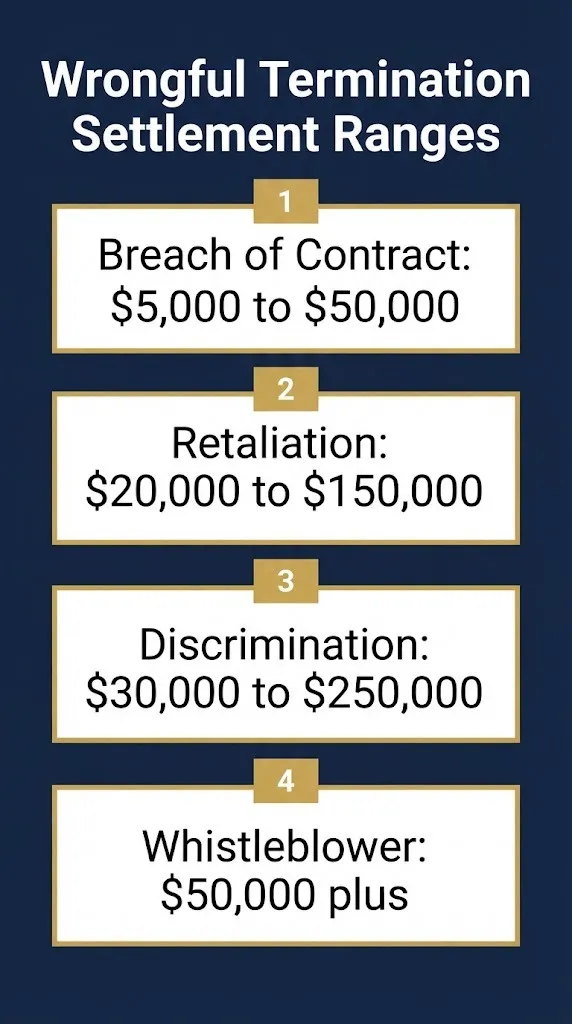
That said, employment law sources consistently report that most settlements fall between $5,000 and $80,000. Cases involving discrimination, retaliation, or whistleblower claims settle higher. Cases involving high earners with strong evidence can exceed $250,000.
Here is how case type drives settlement potential:
| Case Type | Typical Range | Key Factors |
|---|---|---|
| Breach of contract | $5,000 to $50,000 | Contract terms, remaining pay owed |
| Retaliation | $20,000 to $150,000 | Protected activity, timing, damages |
| Discrimination | $30,000 to $250,000 | Evidence strength, lost wages, emotional distress |
| Whistleblower | $50,000 to $500,000 plus | Statutory penalties, government involvement |
| High earner with strong evidence | $100,000 to $1 million plus | Significant lost compensation, punitive damages |
These ranges reflect patterns from published employment law data, not guaranteed outcomes.
What Factors Determine a Wrongful Termination Settlement Amount?
Several factors determine a wrongful termination settlement amount. The most important is lost wages. How much were you earning? How long were you out of work? The longer the unemployment and the higher the salary, the bigger the claim.
Evidence strength matters next. Do you have emails, texts, or witnesses that show the real reason for termination? Weak evidence means a smaller settlement. Strong evidence forces employers to pay more to avoid trial risk.
Here are the key drivers:
- Annual salary and benefits lost
- Length of unemployment after termination
- Emotional distress and documented mental health impact
- Strength of direct evidence of discrimination or retaliation
- Whether the employer has a history of similar claims
- State law and available damages
- Whether punitive damages are available
Key Takeaway: Lost wages and evidence strength are the two biggest drivers of settlement value.
What Is Compensation for Wrongful Termination?
Compensation for wrongful termination includes several categories of damages. Back pay covers wages lost from termination to settlement or judgment. Front pay covers future lost earnings if reinstatement is not feasible. Emotional distress damages compensate for mental anguish. Punitive damages punish egregious conduct.
Not every case includes every category. Emotional distress damages require proof, usually through medical records or testimony. Punitive damages require showing the employer acted with malice or reckless disregard.
Here is the breakdown:
| Damage Type | What It Covers | Proof Required |
|---|---|---|
| Back pay | Wages from termination to resolution | Pay stubs, tax returns |
| Front pay | Future lost earnings | Expert testimony, job search records |
| Emotional distress | Mental anguish from termination | Medical records, therapy notes |
| Punitive damages | Punishment for egregious conduct | Clear evidence of malice or recklessness |
| Attorney fees | Cost of legal representation | Fee agreement, court order |
How Do You File a Wrongful Termination Lawsuit?
Filing a wrongful termination lawsuit follows a defined sequence. Here are the steps:
- Document everything: termination letter, emails, performance reviews, witness names.
- Determine which law was violated: discrimination, retaliation, contract breach, or public policy.
- File a charge with the Equal Employment Opportunity Commission or your state agency if discrimination is involved.
- Obtain a right-to-sue letter from the agency.
- Contact an employment attorney for a case evaluation.
- Your attorney sends a demand letter to the employer.
- If no settlement is reached, your attorney files a lawsuit in state or federal court.
- Litigation proceeds through discovery, depositions, and possible trial.
Agency filing deadlines are short. For federal discrimination claims, you have 180 days from termination to file with the EEOC, extended to 300 days in some states. State deadlines vary.
Key Takeaway: The EEOC filing deadline of 180 to 300 days is the most urgent date in any discrimination-based wrongful termination claim.
What Are Wrongful Termination Settlement Amounts by State?
Wrongful termination settlement amounts vary by state because state laws differ. California, New York, and Illinois tend to produce higher settlements due to stronger employee protections and higher salaries. States with weaker worker protections produce lower averages.
California’s Fair Employment and Housing Act allows for emotional distress damages and attorney fees. New York’s Human Rights Law is similarly broad. Texas and Florida, by contrast, have fewer state-level protections beyond federal law.
Here is how settlement potential varies:
| State | Key Factor | Settlement Potential |
|---|---|---|
| California | Strong state law, high salaries | Higher |
| New York | Broad human rights law | Higher |
| Illinois | State anti-discrimination law | Higher |
| Texas | Federal law primarily | Lower |
| Florida | Federal law primarily | Lower |
These patterns reflect general legal landscapes, not guaranteed outcomes in any specific case.
What Is the Average Settlement for Wrongful Termination in 2026?
The average settlement for wrongful termination in 2026 remains elusive for the same reason it always has been: confidentiality. No government agency publishes a database of settlement amounts. No industry group collects comprehensive data. The figures that circulate are approximations.
Attorney surveys suggest most cases settle in the $10,000 to $75,000 range. Jury verdicts, when they happen, can be higher. A 2024 analysis of published employment verdicts found median jury awards around $200,000 for discrimination cases. But settlements and verdicts are different animals.
If you are trying to estimate your own case value, do not rely on averages. Focus on your lost wages, evidence strength, and the specific law you are claiming was violated.
Key Takeaway: Averages are unhelpful for individual cases. Your lost wages and evidence strength matter more.
Reality Check: No legitimate wrongful termination settlement requires an upfront fee. Employment attorneys work on contingency. If someone asks you to pay to “process” a settlement, it is a scam. Legitimate settlements are negotiated through your attorney and documented in writing. You never pay to receive money that is already yours.
How Long Does a Wrongful Termination Lawsuit Take?
A wrongful termination lawsuit typically takes 12 to 24 months to resolve. Straightforward cases with clear evidence may settle in under a year. Complex cases with multiple claims or a trial can take three years or more.
The timeline depends on several factors: agency investigation time, court backlogs, discovery disputes, and whether the employer is willing to settle early. Many employers prefer to settle before trial to avoid publicity and legal costs.
Here is a typical timeline:
| Stage | Timeframe |
|---|---|
| Agency charge filing | Month 1 |
| Agency investigation | Months 2 to 10 |
| Right-to-sue letter | Months 6 to 12 |
| Lawsuit filing | Months 10 to 14 |
| Discovery | Months 14 to 24 |
| Settlement or trial | Months 18 to 36 |
These are estimates based on typical employment litigation timelines. Your case may move faster or slower.
What Evidence Do You Need for a Wrongful Termination Claim?
You need evidence that shows the employer’s stated reason for termination was false or illegal. The strongest evidence is direct: an email saying you are being fired because of your race, age, or pregnancy. Direct evidence is rare. Most cases rely on circumstantial evidence.
Circumstantial evidence includes timing, inconsistent explanations, and differential treatment. Were you fired shortly after complaining about harassment? That timing supports retaliation. Were you replaced by someone outside your protected class? That supports discrimination.
Here is a checklist:
- Termination letter or email
- Performance reviews showing good standing
- Emails or texts about the termination
- Witness statements from coworkers
- Timelines showing protected activity and termination proximity
- Medical records if emotional distress is claimed
- Pay stubs and tax returns for lost wage calculation
Key Takeaway: The best evidence shows the stated reason was false. Gather documents before they disappear.
Can You Be Fired for Any Reason?
Most states follow at-will employment, meaning you can be fired for any reason that is not illegal. That is the background rule. The illegal reasons are the exceptions. You cannot be fired because of race, sex, religion, national origin, age, disability, pregnancy, or protected activity like whistleblowing.
If your termination was unfair but not illegal, you may not have a claim. For example, being fired for a personality conflict is generally legal. Being fired for reporting sexual harassment is illegal retaliation.
The distinction matters. Not every bad termination is a wrongful termination. An attorney can evaluate whether your situation fits a legal claim.
What Happens Next?
If you believe you were wrongfully terminated, time is critical. Here is the expected path:
- Week 1: Gather all termination documents and write a detailed timeline.
- Week 2: Consult an employment attorney for a free case evaluation.
- Month 1: File an agency charge if discrimination or retaliation is involved.
- Months 2 to 10: Agency investigation proceeds.
- Months 6 to 14: Right-to-sue letter issued, lawsuit filed.
- Months 14 to 24: Discovery and settlement negotiations.
- Year 2 to 3: Trial, if no settlement is reached.
These timelines are estimates. Your state and claim type may differ.
Frequently Asked Questions
What is the average wrongful termination settlement?
No official average exists. Most settlements are confidential. Typical ranges are $5,000 to $250,000, with discrimination cases paying more.
How much compensation do you get for wrongful termination?
Compensation includes back pay, front pay, emotional distress, and sometimes punitive damages. Amounts depend on lost wages and evidence strength.
How long do you have to file a wrongful termination claim?
For discrimination claims, you have 180 to 300 days to file with the EEOC. State deadlines vary. Contract and tort claims have longer windows.
Do you need a lawyer for wrongful termination?
You do not legally need one, but practically you do. Employment attorneys work on contingency and know how to build a case.
Can you get punitive damages for wrongful termination?
Yes, if the employer acted with malice or reckless disregard. Punitive damages are rare but can significantly increase a payout.
Is wrongful termination hard to prove?
Yes. Most cases rely on circumstantial evidence. The burden shifts between you and the employer. Strong documentation helps.
What is the difference between unfair and illegal termination?
Unfair termination is legal in most at-will states. Illegal termination violates a specific law, like discrimination or retaliation laws.
How are wrongful termination settlements paid?
Settlements are paid by check or wire transfer through your attorney. The attorney deducts the agreed contingency fee and expenses.