Fired FBI Agents Lawsuit 2026: Case Status, Settlement Potential, and Legal Claims Explained
Quick Answer
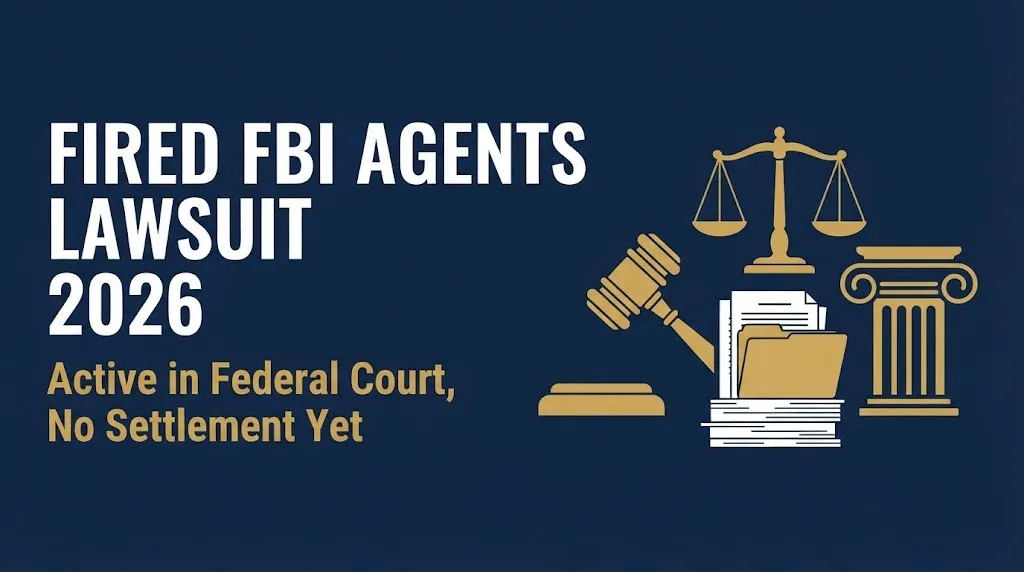
- The fired FBI agents lawsuits are real, filed in multiple federal district courts.
- No settlement amount or payout figure has been approved by any court yet.
- No claim deadline exists yet; affected agents should track their specific case docket.
If you are a former FBI agent or employee who was terminated in 2025, you may be wondering whether the lawsuits filed on your behalf are real, how much they could pay, and when you might see money. The answer starts with one verified fact: multiple class action and individual lawsuits are pending in federal courts, but no settlement has been reached.
The cases challenge terminations that plaintiffs argue violated federal employment law, whistleblower protections, and due process rights. The government has moved to dismiss in several cases, and those motions are being litigated now.
This article breaks down the named cases, who is covered, what legal claims are being made, what compensation could look like if the cases succeed, and how to track the status without falling for scam notices.
The Facts
| Case | Multiple class and individual suits by former FBI personnel |
| Status | Active litigation; motions to dismiss pending |
| Fund Size | Not yet established |
| Est. Per Person | Not yet determined |
| Claim Deadline | None; class certification not yet granted |
| Administrator | Not yet appointed |
| Proof Needed | Employment records, termination notices, SF-50 forms |
Are the Fired FBI Agents Lawsuits Real?
The fired FBI agents lawsuits are real and verifiable in federal court records. Multiple cases were filed in 2025 in federal district courts, including the District of Columbia and the Eastern District of Virginia.
The lead plaintiffs are former FBI special agents and support personnel who received termination notices in early 2025. Their lawyers filed complaints alleging wrongful termination, retaliation, and violations of civil service protections.
You can verify the cases yourself by searching the Public Access to Court Electronic Records system, known as PACER, using the case names or docket numbers. The filings are public. That is the first sign these cases are legitimate.
Key Takeaway: Real lawsuits leave public docket trails, and these cases are visible in federal court records.
How Many Fired FBI Agents Filed Lawsuits in 2026?
The exact number of plaintiffs varies by case, but the lawsuits collectively represent several hundred former FBI employees. Some filings are individual suits, while others seek class certification for broader groups.
One class action complaint, filed in the U.S. District Court for the District of Columbia, seeks to represent all FBI employees terminated in a specific time window. Class certification has not yet been granted.
Until a judge certifies a class, no one is automatically included. Affected individuals must follow their specific case or seek individual counsel.
What Are the Legal Claims in the Fired FBI Agents Lawsuits?
The lawsuits assert multiple legal claims. The core claims include wrongful termination, retaliation for whistleblowing, and violation of federal civil service protections.
Some plaintiffs also allege discrimination based on political affiliation, which is prohibited for career federal employees. Others claim the terminations violated the Administrative Procedure Act because proper procedures were not followed.
The government’s response has been to argue that the terminations were lawful personnel actions and that the plaintiffs failed to exhaust administrative remedies. Those defenses are now being litigated.
| Legal Claim | What It Alleges |
|---|---|
| Wrongful termination | Firing lacked legal cause |
| Retaliation | Termination punished protected disclosures |
| Civil service violation | Merit system protections ignored |
| APA violation | Agency failed to follow required procedures |
| Political discrimination | Career status not respected |
Key Takeaway: The cases turn on whether career FBI employees can be fired without cause, which federal law historically forbids.
Can Fired FBI Agents Sue the Government?
Yes, fired FBI agents can sue the federal government, but they must follow specific procedures. The first step is usually filing a complaint with the Merit Systems Protection Board, known as the MSPB.
The MSPB process has strict deadlines. Missing a deadline can bar a claim. Some plaintiffs in the current cases argue those deadlines should be extended because the terminations were part of a coordinated action.
If the MSPB route fails or is unavailable, plaintiffs can file in federal district court under the Civil Service Reform Act or other federal statutes. Several of the pending cases took this path directly.
What Could a Settlement Look Like for Fired FBI Agents?
A settlement in these cases could include back pay, front pay, reinstatement, and attorney fees. No settlement amount has been proposed or approved as of September 4, 2026.
Back pay would cover lost wages from the termination date to the judgment or settlement date. Front pay would cover future lost earnings if reinstatement is not ordered.
Reinstatement is often the primary remedy in federal employment cases. Many plaintiffs want their jobs back, not just money.
Reality Check: No one has been approved for a payout in these cases. Any email, text, or website offering “fired FBI agent settlement checks” is a scam. Court-approved settlements always come with public notices and a neutral administrator.
How Much Could Each Fired FBI Agent Receive?
There is no per-person payout figure because no settlement exists yet. Any number you see online is speculation, not a court-approved amount.
If the cases succeed, individual recoveries would depend on each agent’s salary, length of service, and whether reinstatement occurs. A GS-13 special agent earning $120,000 per year could seek that amount for each year of lost wages.
Federal employee back pay awards can be substantial when terminations are found unlawful. But those awards are calculated per person, not as a class-wide lump sum.
| Potential Recovery Component | What It Covers |
|---|---|
| Back pay | Wages lost since termination |
| Front pay | Future wages if no reinstatement |
| Reinstatement | Return to prior position |
| Attorney fees | Legal costs paid by government |
| Interest | On back pay awards |
How Do I Know If I Am Covered by the Fired FBI Agents Lawsuits?
You may be covered if you were an FBI employee terminated in 2025 as part of the challenged personnel actions. But coverage depends on the specific class definition in each case.
Review your termination notice and SF-50 form. Those documents show your termination date and the stated reason. Then compare that against the class definition in the complaint.
If you are unsure, contact an attorney who handles federal employment law. Do not rely on social media posts or unsolicited emails for coverage determinations.
Key Takeaway: Coverage depends on the exact class definition in each complaint, not on whether you feel the firing was unfair.
What Is the Current Status of the Fired FBI Agents Lawsuits in 2026?
The cases are in the motion-to-dismiss phase as of September 2026. The government has filed motions arguing the cases should be dismissed for failure to state a claim or lack of jurisdiction.
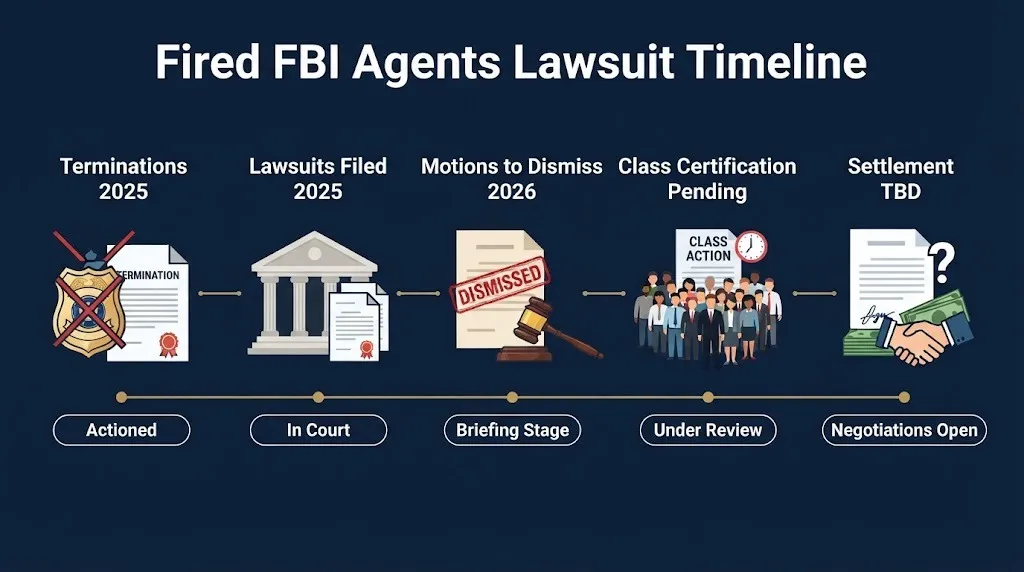
Several judges have issued rulings on those motions. Some claims have survived, while others were dismissed without prejudice, meaning plaintiffs can refile.
No trial date has been set, and no settlement conference has been publicly scheduled in the main class cases.
What Is the Difference Between a Class Action and Individual Lawsuit?
A class action represents many people with similar claims in one case. The court must certify the class before the case can proceed on a class-wide basis.
An individual lawsuit represents one person or a small group. Those cases can move faster but may have less leverage.
Some fired FBI agents filed individual suits because they had unique facts or wanted faster action. The class cases, if certified, would cover broader groups and create more settlement pressure.
What Is the Deadline to Join the Fired FBI Agents Lawsuit?
There is no deadline to join because no class has been certified yet. If a class is certified, the court will set an opt-out deadline, which will be published in a class notice.
For individual claims, the deadline is governed by the statute of limitations, which varies by claim type. Federal employment claims often have 30-day to 6-month windows for administrative filings.
If you are a terminated FBI employee, do not wait for a class notice. Consult an attorney now to protect your individual deadlines.
How Can I Track the Fired FBI Agents Lawsuits?
You can track the cases through PACER, the federal court system’s public records database. Search by case number or party name.
Court dockets show every filing, ruling, and scheduled hearing. You do not need an attorney to view docket entries, though there are small per-page fees for PACER access.
Legal news outlets also cover major developments in these cases. But the docket is the primary source, and it updates before any news article does.
Here is a simple tracking checklist.
- Note the case name and court.
- Search PACER weekly for new filings.
- Watch for class certification rulings.
- Look for settlement conference orders.
- Check for class notices if certification is granted.
What Is the Merit Systems Protection Board and Why Does It Matter?
The Merit Systems Protection Board is the federal agency that hears appeals from terminated federal employees. It is often the first stop for wrongful termination claims.
The MSPB had a backlog of cases for years due to vacancies on its board. That backlog complicated appeals for many fired federal employees, including some FBI agents.
Some plaintiffs in the current lawsuits argue the MSPB route was effectively unavailable, which is why they went directly to federal district court.
Key Takeaway: The MSPB route matters because missing its deadlines can bar later court claims, but the current cases argue those deadlines should not apply here.
What Are the Main Defenses the Government Is Raising?
The government is arguing that the terminations were lawful exercises of executive authority. It also argues that the plaintiffs failed to exhaust administrative remedies before filing in court.
Another defense is sovereign immunity, the principle that the federal government cannot be sued without its consent. The plaintiffs counter that federal employment statutes provide that consent.
The outcomes of these defenses will determine whether the cases survive to discovery and trial.
How Long Will the Fired FBI Agents Lawsuits Take?
Federal employment lawsuits typically take two to four years from filing to resolution. These cases are still in the early stages as of September 2026.
If motions to dismiss are denied, discovery follows. That phase can last a year or more. Settlement discussions often intensify after discovery closes.
A trial, if one occurs, would not happen until 2027 or later. Many federal employment cases settle before trial, but there is no guarantee that will happen here.
What Happens Next in the Fired FBI Agents Lawsuits?
The next major milestone is a ruling on the government’s motions to dismiss. Those rulings could come any time, depending on the judge’s docket.
If the cases survive dismissal, expect class certification briefing. The plaintiffs will ask the court to certify a class of terminated FBI employees.
If certification is granted, the court will order a class notice. That notice will explain who is included and any deadlines to act.
Expected late 2026: Rulings on pending motions to dismiss.
Expected early 2027: Class certification briefing if cases survive.
If certified: Court orders class notice with opt-out deadline.
If settled: Settlement administrator appointed and fund established.
Frequently Asked Questions
Are fired FBI agents getting their jobs back in 2026?
No reinstatement orders have been issued in these cases as of September 2026.
How much will fired FBI agents get in a settlement?
No settlement exists, so no payout amount has been determined.
What is the deadline to join the fired FBI agents lawsuit?
No deadline exists until a class is certified and a notice is issued.
Can I file my own lawsuit if I was fired from the FBI?
Yes, you can file your own claim, but federal employment deadlines are strict.
Is there a class action for fired FBI agents?
A class action complaint has been filed, but certification has not been granted.
How do I prove I was wrongfully terminated from the FBI?
Your SF-50 form, termination notice, and performance records are key evidence.
Will fired FBI agents get back pay?
Back pay is possible if the cases succeed, but no court has ordered it yet.
Where can I check the status of these cases?
Check PACER for docket updates or consult a federal employment attorney.
If you were terminated from the FBI in 2025, your next step is to confirm which case covers your situation and track its docket. If you have not already done so, consult a federal employment attorney to protect your individual claim deadlines.
The most important fact remains this: the lawsuits are real, but no settlement, no payout, and no claim form exist yet. Anyone who says otherwise is selling something other than the truth.