Wrongful Death Compensation: 2026 Payout Ranges, Eligibility Rules, and Filing Deadlines
Quick Answer
- Wrongful death compensation is a real legal claim for families after a preventable death caused by negligence or misconduct.
- Average settlements range from $250,000 to $2 million; court verdicts can exceed $10 million in egregious cases.
- Each state sets its own filing deadline, typically 1 to 3 years from the date of death.
Wrongful death compensation is money awarded to surviving family members when someone dies due to another party’s negligence, recklessness, or intentional act. It is a civil claim, separate from any criminal charges.
This affects spouses, children, parents, and sometimes other dependents of the deceased. The claim seeks to replace financial support and account for emotional loss.
This article covers who can file, how payouts are calculated, what deadlines apply by state, and what documentation families need to pursue a claim in 2026.
The Facts
| Field | Verified Detail |
|---|---|
| Case Type | Civil wrongful death claim |
| Governing Law | State wrongful death statutes |
| Average Settlement | $250,000 to $2 million |
| Filing Deadline | 1 to 3 years depending on state |
| Who Can File | Immediate family members or estate representative |
| Administrator | Not applicable; individual civil cases |
| Proof Required | Death certificate, financial records, proof of negligence |
Wrongful death claims arise from many situations. Car crashes, medical malpractice, workplace accidents, defective products, and criminal acts all produce wrongful death litigation.
The claim is filed by the estate or surviving family members against the party whose actions caused the death. Insurance companies often pay settlements in these cases.
No single national settlement exists. Wrongful death compensation is a state-by-state legal process with widely varying rules.
Is Wrongful Death Compensation Real?
Wrongful death compensation is real and established in every state. Each state has a wrongful death statute that defines who can sue and what damages are available.
It is not a government program or a class action. It is a private civil lawsuit filed by family members or the estate of the deceased.
If you received a letter, call, or message about wrongful death compensation, verify its source. Legitimate attorneys may contact families after a death. Scammers also pose as attorneys or settlement administrators.
The key difference: a legitimate attorney identifies the specific case, the deceased person, and the responsible party. A scammer asks for money upfront or makes vague promises without details.
How Much Is a Wrongful Death Claim Worth?
A wrongful death claim is worth anywhere from $250,000 to over $2 million on average. The exact amount depends on the deceased person’s income, age, dependents, and the circumstances of the death.
Settlement values vary by case type. Medical malpractice wrongful death settlements average around $500,000. Truck accident wrongful death settlements often exceed $1 million.
A payout table based on common case types:
| Case Type | Typical Settlement Range |
|---|---|
| Car accident | $250,000 to $1 million |
| Medical malpractice | $400,000 to $1.5 million |
| Truck accident | $750,000 to $3 million |
| Product liability | $500,000 to $5 million |
| Workplace fatality | $300,000 to $1.5 million |
These are not guaranteed amounts. Every case depends on its facts, the available insurance coverage, and the defendant’s assets.
Reality Check: No legitimate wrongful death attorney will guarantee a specific payout. Be skeptical of anyone promising a large settlement before reviewing case details and insurance limits.
Who Can File a Wrongful Death Claim?
Who can file a wrongful death claim depends on state law. Each state defines the eligible survivors differently.
In most states, the priority order is:
- Surviving spouse
- Children
- Parents of a deceased minor child
- Personal representative of the estate
Some states allow domestic partners to file. Others limit claims to legal spouses and blood relatives. A few states allow siblings or other dependents who relied on the deceased for support.
The estate representative usually files on behalf of all eligible survivors. Any recovery is then distributed according to state law or a court-approved plan.
If multiple family members disagree about the claim, courts can resolve disputes. The estate representative has a duty to act in the interest of all beneficiaries.
What Damages Are Available in a Wrongful Death Claim?
Wrongful death damages fall into two categories: economic and non-economic.
Economic damages include:
- Medical bills from the final injury or illness
- Funeral and burial expenses
- Lost income the deceased would have earned
- Lost benefits like health insurance or pension
- Value of household services the deceased provided
Non-economic damages include:
- Loss of companionship and guidance
- Mental anguish for surviving family
- Loss of consortium for a surviving spouse
- Pain and suffering of the deceased before death
Some states also allow punitive damages in cases of egregious misconduct like drunk driving or intentional violence. Punitive damages punish the wrongdoer rather than compensate the family.
How Are Wrongful Death Settlements Calculated?
Wrongful death settlements are calculated using the deceased person’s earning history, age, life expectancy, and the financial dependency of survivors.
Insurance companies and attorneys often use a formula. The base is the deceased’s annual income multiplied by remaining working years. Non-economic damages are added on top.
A simplified example: a 40-year-old earning $60,000 per year with 25 working years remaining has a lost income value of $1.5 million. Adding medical and funeral costs, plus non-economic damages for a spouse and children, pushes the total higher.
The calculation is not exact. Settlement negotiations account for the strength of evidence, the defendant’s insurance limits, and the jurisdiction’s history of verdicts.
What Is the Deadline to File a Wrongful Death Claim?
The deadline to file a wrongful death claim is set by state statute of limitations. Most states allow 1 to 3 years from the date of death.
State-by-state deadlines:
| State | Filing Deadline |
|---|---|
| California | 2 years |
| Florida | 2 years |
| Texas | 2 years |
| New York | 2 years |
| Tennessee | 1 year |
| Louisiana | 1 year |
| Missouri | 3 years |
| Maine | 6 years |
Some states have exceptions. If the death was not immediately discovered as wrongful, the clock may start later. Claims against government entities often have much shorter deadlines, sometimes 6 months.
Missing the deadline means losing the right to sue. This is the single most important reason to consult an attorney promptly after a death.
Key Takeaway: Wrongful death deadlines are strict. Most states allow 1 to 3 years, but government claims can have 6-month windows.
Do I Need a Lawyer for a Wrongful Death Claim?
You do not legally need a lawyer to file a wrongful death claim, but pursuing one without legal representation is almost always a mistake.
Insurance companies assign adjusters and defense attorneys to minimize payouts. They have handled thousands of these claims. Families navigating the process alone are at a severe disadvantage.
Wrongful death attorneys work on contingency. You pay nothing upfront. The attorney receives a percentage of the recovery, typically 30 to 40 percent, only if you win or settle.
Studies consistently show that represented claimants recover more than unrepresented claimants, even after attorney fees are subtracted.
What Documents Do I Need for a Wrongful Death Claim?
You need specific documents to support a wrongful death claim.
The essential documents include:
- Death certificate
- Autopsy report if one was performed
- Police report or accident report
- Medical records from the final injury or illness
- Pay stubs, tax returns, or employer verification of income
- Marriage certificate if the claim involves a spouse
- Birth certificates of dependent children
- Funeral and burial receipts
Financial documents are critical. The claim’s value depends heavily on the deceased’s income and support role. Gather tax returns, pay stubs, and benefits statements as early as possible.
What Is the Difference Between Wrongful Death and Survival Action?
Wrongful death and survival actions are two distinct legal claims that can arise from the same death.
A wrongful death claim compensates surviving family members for their own losses: lost support, companionship, and emotional suffering.
A survival action compensates the deceased person’s estate for damages the deceased experienced before death: pain and suffering, medical costs, and lost wages between injury and death.
Many states allow both claims to be filed together. The damages are separate. Wrongful death damages go to survivors. Survival action damages go to the estate and are distributed according to the will or state intestacy law.
What Types of Accidents Lead to Wrongful Death Claims?
Wrongful death claims arise from many types of accidents and incidents.
The most common causes include:
- Motor vehicle crashes
- Medical malpractice
- Workplace accidents
- Defective products
- Slip and fall incidents
- Nursing home neglect
- Criminal acts like assault
Each type has different legal standards. Medical malpractice wrongful death requires proving the provider deviated from the standard of care. Product liability claims require showing a defect caused the death.
Motor vehicle crashes are the most common source of wrongful death claims in the United States. The National Highway Traffic Safety Administration reported over 40,000 traffic fatalities annually in recent years.
How Long Does a Wrongful Death Lawsuit Take?
A wrongful death lawsuit takes 1 to 3 years on average. Simple cases with clear liability and adequate insurance may settle in 6 to 12 months.
Complex cases take longer. Medical malpractice claims require expert review and often face aggressive defense. Product liability cases involve extensive discovery.
The timeline breaks down like this:
| Stage | Typical Duration |
|---|---|
| Investigation and evidence gathering | 1 to 6 months |
| Demand letter and negotiations | 2 to 6 months |
| Lawsuit filing if no settlement | 6 to 18 months |
| Discovery and depositions | 6 to 18 months |
| Trial if necessary | 12 to 24 months |
| Appeal if filed | 6 to 24 months |
The quickest settlements happen when liability is clear and insurance limits are adequate. Cases with disputed fault or multiple defendants take longer.
Key Takeaway: Wrongful death claims take 1 to 3 years on average, and the quality of evidence matters more than speed.
Can a Wrongful Death Settlement Be Taxed?
Wrongful death settlements are generally not subject to federal income tax. The IRS treats compensation for personal injury or illness as non-taxable.
This includes wrongful death proceeds. The settlement is compensation for a personal injury, the death, rather than taxable income.
There are exceptions. Punitive damages are taxable. Interest earned on a settlement award before payment is taxable. Portions of a settlement allocated to lost wages may be taxable in some circumstances.
A tax professional can help structure the settlement correctly and allocate damages to minimize tax exposure.
What Is the Average Wrongful Death Settlement for a Family?
The average wrongful death settlement for a family is approximately $500,000 to $1 million. Averages are misleading because cases vary so widely.
Low-value cases with minimum insurance limits may settle for $100,000 or less. High-value cases with egregious facts and substantial insurance can settle for $5 million or more.
Jury verdicts tend to be higher than settlements. Many families settle because trials are risky, expensive, and emotionally draining. A settlement provides certainty.
The insurance policy limit is often the practical cap on recovery. If the at-fault driver carried $250,000 in liability coverage, that may be the maximum available absent other insurance.
What Happens Next After a Wrongful Death?
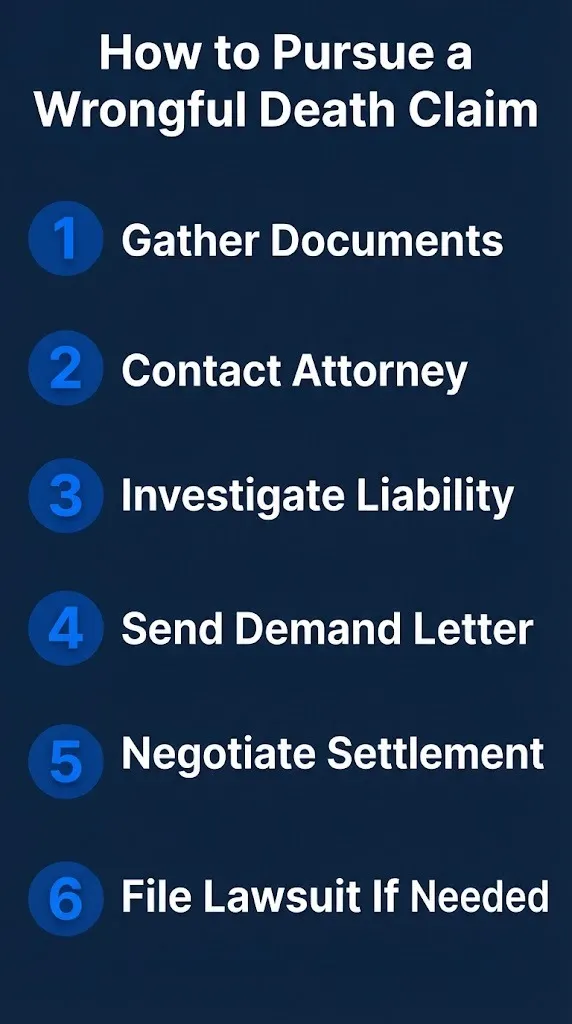
After a wrongful death, the legal process moves through predictable stages.
Weeks 1 to 4: Gather death certificate, police report, medical records, and financial documents.
Months 1 to 3: Attorney investigates liability and identifies insurance coverage.
Months 3 to 6: Demand letter sent to insurance company or defendant.
Months 6 to 12: Negotiations or lawsuit filing.
Years 1 to 3: Discovery, settlement, or trial.
The most important action is securing evidence early. Witness memories fade. Surveillance footage is overwritten. Physical evidence degrades.
Frequently Asked Questions
What is wrongful death compensation?
Wrongful death compensation is money awarded to surviving family members after a preventable death caused by negligence.
It covers financial losses, funeral costs, and emotional suffering.
Who qualifies for wrongful death compensation?
Immediate family members like spouses, children, and sometimes parents may qualify.
State law determines the exact list of eligible survivors.
How much is a wrongful death claim worth?
Average settlements range from $250,000 to over $2 million depending on income, dependents, and circumstances.
Every case value depends on its specific facts.
What is the deadline to file a wrongful death claim?
Most states allow 1 to 3 years from the date of death.
Some government claims have much shorter deadlines.
Can I file a wrongful death claim without a lawyer?
You can, but it is rarely advisable.
Insurance companies have lawyers and routinely underpay unrepresented families.
Are wrongful death settlements taxable?
Most wrongful death settlements are not taxable as income.
Punitive damages and interest on awards are exceptions.
What documents do I need for a wrongful death claim?
You need a death certificate, police or accident report, medical records, and financial documents.
Funeral receipts and marriage or birth certificates also help.
How long does a wrongful death lawsuit take?
Most wrongful death lawsuits resolve in 1 to 3 years.
Simple cases settle faster; complex cases take longer.
The most important step after a preventable death is securing evidence and understanding your state’s deadline. Wrongful death compensation can replace financial support, but it cannot replace the person you lost.
If you are considering a claim, gather the death certificate, accident report, and financial records this week. Contact an attorney before the statute of limitations expires.