Total Compensation Calculator 2026: How to Calculate Your Full Pay Package, Including Settlements and Benefits
Quick Answer:
- A total compensation calculator adds salary, bonuses, equity, benefits, and other cash value into one annual figure.
- For lawsuit settlements, total compensation means the gross settlement amount minus attorney fees, liens, and taxes.
- No single calculator covers every scenario. The right tool depends on whether you are evaluating employment pay or settlement proceeds.
A total compensation calculator is a tool that converts your full pay package, including non-salary items, into a single number.
For employees, that number includes base salary, bonuses, stock, health benefits, retirement contributions, and paid time off.
For lawsuit plaintiffs, total compensation means the gross settlement amount minus attorney fees, medical liens, and taxes.
This article covers both uses, with verified 2026 figures for tax rates, benefit valuations, and settlement deductions.
The Facts
| Item | Detail |
|---|---|
| Tool Type | Online calculator or manual formula |
| Key Inputs | Salary, bonus, equity, benefits, tax bracket, deductions |
| 2026 401(k) Limit | $23,500 ($31,000 if age 50+) |
| 2026 HSA Limit | $4,300 individual, $8,550 family |
| Settlement Tax Rate | Varies, ordinary income or capital gains |
| Attorney Fee Range | 25% to 40% typical in contingency cases |
Is a Total Compensation Calculator Reliable?
Yes, a total compensation calculator is reliable when it uses current tax tables and benefit formulas.
The accuracy depends on the data you enter and the calculator’s underlying assumptions.
Most major platforms, including those from payroll providers and financial software companies, update their calculators annually.
The 2026 updates reflect IRS cost-of-living adjustments released in late 2025.
The 401(k) contribution limit rose to $23,500 for 2026, up from $23,000 in 2025.
The catch-up contribution for workers age 50 and older remains at $7,500, making the total $31,000.
These figures are confirmed by IRS Revenue Procedure 2025-40, which sets 2026 pension plan limitations.
If a calculator still shows 2025 limits, it is outdated and will understate your total compensation.
Reliability also depends on how the calculator values non-cash benefits.
Employer health insurance contributions vary widely, from $3,000 per year for single coverage at small employers to $12,000 or more at large companies.
Use your actual benefits statement, not a national average, for the most accurate result.
Key Takeaway: A total compensation calculator is only as good as the tax year data behind it. Use one updated for 2026 IRS limits.
How Do You Calculate Total Compensation for a Job Offer?
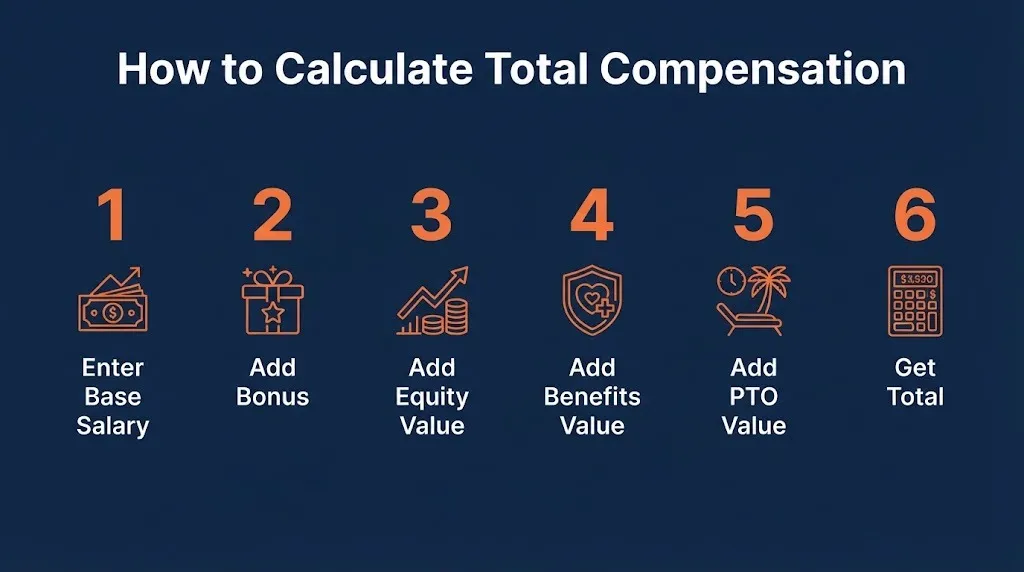
Total compensation for a job offer equals base salary plus bonus potential plus equity value plus benefits cash value.
Here is the formula:
- Base salary: the guaranteed annual pay
- Annual bonus: target percentage multiplied by salary, if guaranteed or highly likely
- Equity: the annualized value of stock options, restricted stock units, or other grants
- Retirement match: employer 401(k) match, typically 3% to 6% of salary
- Health benefits: the employer-paid portion of medical, dental, and vision premiums
- Paid time off: salary converted to a daily rate multiplied by PTO days
- Other cash: commuter benefits, tuition reimbursement, wellness stipends, cell phone allowances
Here is a sample calculation for a $120,000 base salary with typical benefits:
| Component | Value |
|---|---|
| Base salary | $120,000 |
| Target bonus (10%) | $12,000 |
| Equity (RSUs) | $18,000 |
| 401(k) match (4%) | $4,800 |
| Health benefits | $8,400 |
| PTO value (15 days) | $6,923 |
| Total compensation | $170,123 |
This shows why total compensation matters.
A job with a $110,000 salary but generous benefits may beat a $120,000 salary with no match and minimal health coverage.
Key Takeaway: Always compare total compensation, not just base salary, when evaluating competing job offers.
How Do You Calculate Total Compensation From a Lawsuit Settlement?
Total compensation from a lawsuit settlement means the amount that actually reaches your bank account after deductions.
The calculation works like this:
- Start with the gross settlement amount
- Subtract attorney fees, typically 25% to 40% in contingency cases
- Subtract case costs and expenses
- Subtract any medical liens, insurance subrogation claims, or government liens
- Subtract taxes, depending on the type of settlement
- The remainder is your net total compensation
Here is a sample calculation for a $100,000 personal injury settlement:
| Item | Amount |
|---|---|
| Gross settlement | $100,000 |
| Attorney fees (33%) | -$33,000 |
| Case costs | -$4,500 |
| Medical lien | -$12,000 |
| Subtotal | $50,500 |
| Taxable portion (lost wages) | Depends on allocation |
| Net total compensation | Approximately $45,000 to $50,000 |
The exact number depends on how the settlement is structured.
Physical injury settlements are generally not taxable under IRS rules, but lost wages, emotional distress not tied to physical injury, and punitive damages may be taxable.
Always ask your attorney for a settlement distribution statement before you sign anything.
Key Takeaway: Your settlement total compensation is not the headline number. It is what remains after fees, liens, and taxes.
What Is Included in Total Compensation in 2026?
Total compensation includes every item of value an employer provides in exchange for your work.
The 2026 list includes:
- Base salary or hourly wages
- Overtime and shift differentials
- Annual bonus and incentive pay
- Commission
- Equity compensation, including stock options and restricted stock units
- Employer 401(k) match
- Profit-sharing contributions
- Health insurance employer contributions
- Dental and vision insurance
- Life insurance and disability insurance premiums paid by employer
- Paid time off, including vacation, sick leave, and holidays
- Parental leave pay
- Tuition reimbursement
- Student loan repayment assistance
- Commuter and parking benefits
- Wellness stipends
- Relocation assistance
- Signing bonus
The IRS defines taxable compensation differently from total compensation.
Items like employer health contributions and 401(k) matches are part of total compensation but may not appear in Box 1 of your W-2.
This is why total compensation figures can exceed taxable income by $15,000 to $40,000 per year.
Key Takeaway: Total compensation is broader than taxable income. It includes items that never show up on a paycheck.
How Do You Calculate Equity Compensation in 2026?
Equity compensation valuation depends on the type of award.
For restricted stock units, the value is straightforward: the number of RSUs multiplied by the current stock price.
For stock options, the value depends on the strike price and current market price.
Here is the RSU formula:
- Annual equity value = (RSUs vesting this year) x (stock price on vesting date)
For example, if 500 RSUs vest at $180 per share, that is $90,000 in equity compensation for the year.
For stock options, the value is the spread between the strike price and market price.
If you have options with a $50 strike price and the stock trades at $150, each option is worth $100.
However, options have time vesting and expiration dates that affect their real-world value.
Private company equity is harder to value.
Startups often provide a 409A valuation that estimates the fair market value of common stock.
That valuation may differ from the price investors pay for preferred shares.
For total compensation purposes, use the most recent 409A valuation for private company stock.
Key Takeaway: RSUs are easy to value. Options and private stock require more careful analysis, but both belong in your total compensation figure.
How Do You Calculate PTO and Benefits Value?
Paid time off and benefits have cash value that belongs in your total compensation calculation.
The PTO formula:
- Daily rate = annual salary divided by 260 workdays
- PTO value = daily rate multiplied by number of PTO days
For a $100,000 salary, the daily rate is approximately $385.
Twenty days of PTO is therefore worth $7,692.
Here is how common benefits translate to cash value in 2026:
| Benefit | Typical Annual Value |
|---|---|
| Health insurance (employer portion) | $4,000 to $12,000 |
| 401(k) match (4% of $100,000) | $4,000 |
| Dental and vision | $500 to $1,500 |
| Life insurance | $100 to $300 |
| Disability insurance | $200 to $600 |
| Tuition reimbursement | $2,000 to $5,250 |
| Commuter benefits | $1,200 to $3,600 |
| Wellness stipend | $300 to $1,500 |
The exact numbers come from your benefits summary, not a generic table.
Your employer’s open enrollment documents list the employer contribution for each plan.
Use those figures for the most accurate total compensation calculation.
Key Takeaway: Benefits and PTO often add 20 to 35 percent to base salary. Ignoring them understates your true compensation.
What Is the Difference Between Total Compensation and Base Salary?
Total compensation includes base salary plus every other item of value.
Base salary is just the fixed annual pay before bonuses, benefits, or equity.
The difference is often substantial.
Here is a comparison for two hypothetical job offers:
| Component | Offer A | Offer B |
|---|---|---|
| Base salary | $100,000 | $115,000 |
| Bonus | $10,000 | $0 |
| Equity | $15,000 | $0 |
| 401(k) match | $5,000 | $2,000 |
| Health benefits | $9,000 | $4,000 |
| PTO value | $5,769 | $4,423 |
| Total compensation | $144,769 | $125,423 |
Offer A has a lower base salary but higher total compensation.
If you only compare base salary, you would choose Offer B and leave nearly $20,000 per year on the table.
This is the core reason total compensation calculators exist.
They prevent you from making decisions based on one number when the full package matters more.
Key Takeaway: Base salary is one line item. Total compensation is the whole picture. Compare offers on the full picture.
How Are Lawsuit Settlements Taxed in 2026?
Lawsuit settlement taxation depends on the nature of the claim.
Physical injury and physical sickness settlements are generally excluded from taxable income under IRS Section 104(a)(2).
This applies to compensatory damages for medical expenses, pain and suffering, and lost wages tied to physical injury.
Non-physical settlements, including employment discrimination, emotional distress without physical injury, and breach of contract, are generally taxable as ordinary income.
Here is the 2026 tax treatment by settlement type:
| Settlement Type | Tax Treatment |
|---|---|
| Physical injury compensatory | Not taxable |
| Medical malpractice | Not taxable if for physical injury |
| Employment discrimination | Taxable as ordinary income |
| Wrongful termination | Taxable as ordinary income |
| Emotional distress only | Taxable as ordinary income |
| Punitive damages | Always taxable |
| Interest on settlement | Taxable as interest income |
Attorney fees complicate the calculation.
In most cases, the full settlement amount is taxable income, even the portion paid to your attorney.
Some exceptions exist for physical injury settlements and certain employment claims.
The IRS rules changed in 2004 to require reporting of contingent attorney fees in some cases.
Your attorney or tax professional can determine the exact tax treatment for your settlement.
Key Takeaway: Physical injury settlements usually avoid taxes. Other settlements do not. Structure matters.
How Do Attorney Fees and Liens Reduce Settlement Compensation?
Attorney fees and liens come out of your gross settlement before you see any money.
This is the most misunderstood part of settlement compensation.
Attorney fees in contingency cases typically run 33% to 40% of the gross settlement.
Some cases use a sliding scale based on how far the case progresses.
Court costs and litigation expenses are subtracted separately.
Medical liens arise when health insurance, Medicare, Medicaid, or hospitals have paid for treatment related to your injury.
These payers have legal rights to reimbursement from your settlement.
The lien amount depends on what they paid, not what you were billed.
Negotiating liens can reduce them, but you cannot ignore them.
Here is a typical deduction stack for a $100,000 settlement:
| Deduction | Typical Range |
|---|---|
| Attorney fees | $25,000 to $40,000 |
| Case costs | $2,000 to $8,000 |
| Medical liens | $5,000 to $30,000 |
| Tax withholding | Varies |
| Net to client | $30,000 to $60,000 |
Your attorney must provide a written settlement statement itemizing every deduction.
Review it carefully before signing the release.
Reality Check: No one receives the full settlement amount. The gross number is a starting point, not a bank deposit. Ask for the net figure before you agree to settle.
What Is the Best Total Compensation Calculator in 2026?
The best total compensation calculator depends on your specific need.
For job offer comparisons, calculators from major payroll providers and financial software companies offer the most current data.
These include tools that integrate 2026 IRS limits and typical employer benefit costs.
For lawsuit settlement calculations, no single online calculator handles every variable.
The calculation requires your specific attorney fee agreement, lien amounts, and tax situation.
A spreadsheet you build yourself may be more accurate than a generic online tool.
Here is what to look for in any total compensation calculator:
- Updated for 2026 IRS limits
- Allows custom benefit values
- Includes equity valuation
- Shows tax implications
- Provides a side-by-side comparison
If a calculator does not ask for your specific benefits data, it is using national averages.
That is fine for rough estimates but not for decision-making.
Key Takeaway: Use a 2026-updated calculator for employment comparisons. For settlement math, build your own with your attorney’s numbers.
What Happens Next With Total Compensation Trends in 2026?
Several compensation trends affect total compensation calculations in 2026.
Employer health insurance costs continue rising, increasing the benefits portion of total compensation.
The IRS 2026 limits reflect inflation adjustments across retirement accounts and health plans.
State-level pay transparency laws now require employers in several states to disclose salary ranges.
Some states are expanding those laws to require total compensation disclosure.
Remote work continues to complicate total compensation comparisons.
A remote worker in a low-cost state may receive lower base salary but similar total compensation when benefits and equity are included.
Settlement tax rules have not changed for 2026.
No major federal legislation altering settlement taxation passed in 2025.
The trend toward larger punitive damage awards continues, which increases the taxable portion of some settlements.
For anyone evaluating compensation or settlement proceeds, the core lesson remains: look at the full number, not the headline.
Frequently Asked Questions
What is a total compensation calculator?
A total compensation calculator is a tool that adds salary, bonuses, equity, benefits, and other pay items into one annual figure.
How do I calculate my total compensation?
Add base salary, bonus, equity value, employer retirement match, health benefit value, and PTO cash value.
Is settlement money part of total compensation?
Settlement money is separate from employment compensation, but your net settlement after fees and liens is your total financial recovery.
Are lawsuit settlements taxable in 2026?
Physical injury settlements are generally not taxable, while employment and emotional distress settlements are taxable as income.
How much do attorneys take from settlements?
Attorneys typically take 25% to 40% of the gross settlement in contingency fee cases.
What are typical total compensation percentages above salary?
Benefits and bonuses typically add 20% to 35% above base salary, depending on the employer and role.
The most important number in any compensation calculation is the net figure: what actually reaches your account.
For job offers, that means base salary plus the cash value of every benefit and bonus.
For settlements, that means the gross amount minus fees, liens, and taxes.
Calculate both before you make a decision.