Alabama Workers Compensation 2026: Claim Rules, Payout Amounts, and Filing Deadlines
Quick Answer:
- Alabama workers compensation is a state-mandated insurance system covering most employees injured on the job.
- Weekly benefits are capped at 66 2/3 percent of your average weekly wage, subject to a state maximum.
- You must report the injury within 5 days and file a claim within 2 years of the injury date.
Alabama workers compensation in 2026 is not a class action settlement or a lawsuit payout fund. It’s the state-run insurance system that pays medical bills and partial wage replacement when you get hurt on the job. Every Alabama employer with five or more full-time or part-time employees must carry this coverage, with limited exceptions for domestic workers, farm laborers, and certain casual employees.
If you’re searching this term, you probably got injured at work, your claim was denied, or you’re trying to figure out what the insurer should actually pay. The system has rules that surprise people, and some of them are not in your favor.
This article covers the verified rules, payout calculations, deadlines, and the traps that cost workers money every year.
The Facts
| Item | Verified Details |
|---|---|
| Governing Law | Alabama Workers’ Compensation Act, Code of Alabama 1975, Title 25, Chapter 5 |
| Administering Agency | Alabama Department of Labor, Workers’ Compensation Division |
| Coverage Requirement | Employers with 5+ employees |
| Weekly Benefit Rate | 66 2/3% of average weekly wage, subject to state maximum |
| Injury Reporting Deadline | Within 5 days for most claims, but some courts allow 90 days |
| Claim Filing Deadline | 2 years from injury date |
| Maximum Weekly Benefit (2026) | $1,066 per week, subject to annual adjustment |
| Waiting Period | 3 days before wage benefits start |
Is Alabama workers compensation legitimate?
Yes, Alabama workers compensation is a legitimate state-run insurance system established by law. It is not a private settlement program or a lawsuit that pays out a fixed fund.
The Alabama Workers’ Compensation Act created a no-fault system. That means you don’t have to prove your employer was negligent to get benefits. You only have to show the injury happened in the course of your job. In exchange, you generally give up the right to sue your employer directly.

The Alabama Department of Labor oversees the system. It enforces coverage requirements, handles disputes through the Workers’ Compensation Division, and maintains records of every claim filed. If you received a notice about workers compensation from your employer or their insurer, that communication comes from a legal obligation, not a solicitation.
How does workers compensation insurance work in Alabama?
Workers compensation insurance in Alabama works as a mandatory coverage system where employers buy policies to pay benefits for injured workers. The employer’s insurance carrier, not the state, processes and pays most claims.
The system covers medical treatment related to the work injury, a portion of lost wages, and compensation for permanent impairments. It does not pay for pain and suffering the way a personal injury lawsuit does. That distinction matters more than most workers realize.
Here’s what the coverage includes:
| Benefit Type | What It Pays |
|---|---|
| Medical Benefits | All reasonable and necessary treatment for the injury |
| Temporary Total Disability | Weekly wage replacement while you cannot work |
| Temporary Partial Disability | Partial benefits if you return to light duty at lower pay |
| Permanent Partial Disability | Payment for lasting impairment to a body part or function |
| Permanent Total Disability | Long-term benefits for total inability to work |
| Death Benefits | Payments to dependents of a fatally injured worker |
Key Takeaway: Alabama workers compensation pays medical care and partial wages, but it does not compensate pain and suffering like a personal injury claim would.
Who is covered by Alabama workers compensation?
Alabama workers compensation covers most employees working for employers with five or more workers. Part-time and full-time employees both count toward the five-employee threshold.
The law excludes several categories. Domestic workers in private homes, farm laborers, and casual employees whose work is not in the employer’s regular business generally fall outside the system. Independent contractors are not covered, though misclassification disputes are common and frequently litigated.
If you’re unsure whether you’re covered, the deciding factor is usually your legal status as an employee. The Alabama Department of Labor can investigate classification disputes. Courts have repeatedly ruled that the substance of the relationship, not the label on a paycheck, determines coverage.
What does Alabama workers compensation pay?
Alabama workers compensation pays 66 2/3 percent of your average weekly wage for temporary total disability, up to the state maximum. For 2026, that maximum is $1,066 per week.
The calculation uses your average weekly wage for the 52 weeks before the injury. If you worked less than 52 weeks, the insurer averages what you did work. Overtime and bonuses count if they were regular, not exceptional.
Here’s how a sample calculation breaks down:
| Scenario | Calculation |
|---|---|
| Average weekly wage of $900 | 66 2/3% = $600 per week |
| Average weekly wage of $1,500 | 66 2/3% = $1,000 per week (under cap) |
| Average weekly wage of $2,000 | 66 2/3% = $1,333, capped at $1,066 per week |
These benefits do not start immediately. Alabama imposes a 3-day waiting period. If your disability lasts more than 21 days, the waiting period is paid retroactively.
Key Takeaway: Weekly benefits replace about two-thirds of your lost wages, capped at the state maximum, with a 3-day waiting period before payments begin.
How much is a workers comp settlement in Alabama?
Workers comp settlements in Alabama vary widely based on injury severity, body part affected, and your average weekly wage. Most settlements fall between $15,000 and $150,000, with severe permanent disability cases reaching higher.
Alabama uses a schedule of injuries to calculate permanent partial disability payments. The schedule assigns a number of weeks to each body part. For example, loss of an arm is worth more weeks of benefits than loss of a finger. Your weekly benefit rate multiplied by the scheduled weeks gives the base value.
Here’s the schedule for common injuries:
| Body Part | Scheduled Weeks |
|---|---|
| Arm | 222 weeks |
| Hand | 170 weeks |
| Leg | 200 weeks |
| Foot | 138 weeks |
| Eye | 124 weeks |
| Thumb | 62 weeks |
| Index finger | 35 weeks |
Permanent total disability pays the same weekly rate for the duration of the disability, which can mean lifetime benefits in the most severe cases.
Reality Check: No one can guarantee a specific settlement amount before reviewing your medical records, wage history, and treating physician’s impairment rating. Be wary of any service promising a fixed dollar figure sight unseen.
How do I file a workers comp claim in Alabama?
Filing a workers comp claim in Alabama starts with reporting the injury to your employer. The report triggers the employer’s duty to notify their insurance carrier.
Follow these steps:
- Report the injury to your supervisor or employer immediately.
- Seek medical treatment from an authorized provider if your employer directs one.
- Complete a written accident report if your employer requires one.
- Keep copies of every medical record, bill, and work restriction note.
- Track all missed workdays and wages lost.
- Notify the Alabama Department of Labor if your employer denies the claim or fails to file.
- File a formal claim within 2 years of the injury date.
The 2-year statute of limitations is strict. Missing it can permanently bar your claim, even if you reported the injury and received some medical treatment. It’s like a tax filing deadline: extensions exist for specific reasons, but silence and delay are not among them.
What is the deadline for reporting a workplace injury in Alabama?
You must report a workplace injury to your employer within 5 days in Alabama. Some courts have interpreted the statute to allow up to 90 days if you show good cause for the delay.
The written notice requirement serves a purpose. It lets the employer investigate promptly and preserve evidence. Late reporting gives the insurer a reason to question whether the injury actually happened at work.
If you cannot report within 5 days because you’re hospitalized or incapacitated, the clock may extend. Courts look at whether you acted as soon as reasonably possible. The safest practice is to report the moment you’re medically able, even if that means calling from a hospital bed.
Key Takeaway: Report a work injury within 5 days whenever possible; any delay gives the insurer ammunition to dispute the claim’s legitimacy.
What is the Alabama workers compensation statute of limitations?
The Alabama workers compensation statute of limitations is 2 years from the date of injury for filing a formal claim. This is the deadline that ends most disputes in the insurer’s favor if workers wait too long.
There are narrow exceptions. If the employer pays benefits voluntarily, the 2-year clock may reset from the date of the last payment. If the injury is occupational, like repeated trauma or exposure, the clock may start when you reasonably discovered the injury was work-related.
Do not rely on an exception without checking the specific facts of your case. The Alabama Court of Civil Appeals has repeatedly dismissed claims filed after the deadline, even when workers argued they didn’t know the law.
Why do employers deny workers comp claims in Alabama?
Employers and insurers deny workers comp claims in Alabama for several common reasons. The most frequent are late reporting, disputes over whether the injury occurred at work, pre-existing conditions, and drug or alcohol test results.
Late reporting tops the list. If you waited weeks to mention the injury, the insurer argues the injury happened somewhere else. That argument wins often enough that claimants should treat day-one reporting as non-negotiable.
Pre-existing condition disputes are also common. Insurers review medical records for prior neck, back, or joint complaints. If you have a history of back pain, the insurer may claim the work incident only aggravated a pre-existing condition, not caused a new injury.
If your claim is denied, you have the right to request a hearing before the Alabama Department of Labor. An ombudsman program can help unrepresented workers navigate the dispute process.
What medical treatment does Alabama workers comp cover?
Alabama workers compensation covers all reasonable and necessary medical treatment related to the work injury. This includes doctor visits, surgery, hospitalization, physical therapy, prescriptions, and medical devices.
The employer or their insurer has the right to select the treating physician. This is a critical point. You don’t get to pick any doctor you want. If you treat outside the authorized provider without approval, the insurer may refuse to pay.
The law also covers mileage for medical appointments, typically at the rate set by the state. Keep a log of every trip, every visit, and every prescription. That log becomes evidence if the insurer disputes the extent of your treatment.
What is permanent partial disability in Alabama?
Permanent partial disability in Alabama means you reached maximum medical improvement but retained a lasting impairment to a body part or function. The impairment rating assigned by your doctor determines the compensation.
The rating uses the American Medical Association Guides to the Evaluation of Permanent Impairment. A 10 percent impairment to the arm, for example, means you receive 10 percent of the scheduled weeks for that body part.
Here’s the calculation:
- Scheduled weeks for the arm: 222
- Impairment rating: 10 percent
- Compensable weeks: 22.2 weeks
- Weekly benefit rate: $600
- Total PPD payment: $13,320
Disputes over impairment ratings are the single largest source of workers comp litigation in Alabama. Second opinions and independent medical exams often produce different numbers.
Key Takeaway: Permanent impairment payouts use a rigid formula based on body part, impairment rating, and your weekly wage; getting a fair rating often requires a second medical opinion.
Can I sue my employer for a work injury in Alabama?
You generally cannot sue your employer for a work injury in Alabama. The workers compensation system replaces the right to sue with a no-fault benefits system.
There are limited exceptions. If your employer intentionally caused your injury, you may have grounds for a civil lawsuit outside workers comp. If a third party, like a delivery driver or equipment manufacturer, caused your injury, you can pursue a separate claim against them.
The third-party option matters because workers comp doesn’t pay pain and suffering. A lawsuit against a negligent third party can. If you’re hurt by a defective machine, the manufacturer may owe damages beyond what workers comp pays.
What is the Alabama workers comp ombudsman program?
The Alabama workers comp ombudsman program is a state service that helps injured workers understand their rights and navigate the claims process. It is free.
The program can explain forms, deadlines, and hearing procedures. It cannot represent you as an attorney, but it can answer questions and point you toward resources. If the insurer denies your claim or delays payment, the ombudsman’s office can explain your options.
Contact the Alabama Department of Labor Workers’ Compensation Division directly for ombudsman assistance. No third-party service charging a fee for this help is necessary.
What happens next with an Alabama workers comp claim?
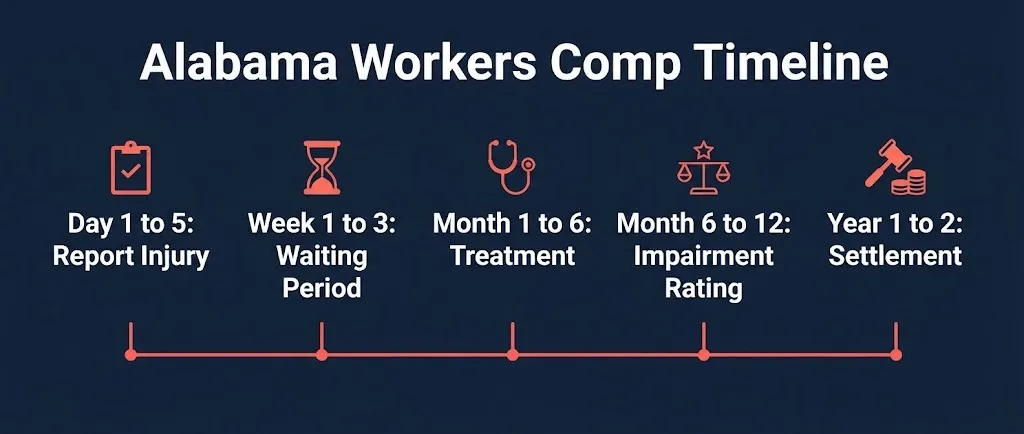
Here’s a typical timeline after a workplace injury in Alabama:
Day 1 to 5: Report the injury and seek medical treatment.
Week 1 to 3: Waiting period runs; benefits start if disability continues beyond 21 days.
Month 1 to 6: Treatment continues; insurer may request an independent medical exam.
Month 6 to 12: Maximum medical improvement reached; impairment rating issued.
Year 1 to 2: Settlement negotiations or hearing if disputes remain.
This timeline assumes no major disputes and a cooperative employer. Denials and litigation extend every stage.
Frequently Asked Questions
Is workers compensation required in Alabama?
Yes, most Alabama employers with five or more employees must carry workers compensation insurance.
Exceptions apply for domestic workers, farm laborers, and certain casual employees.
How long do you have to file a workers comp claim in Alabama?
You have 2 years from the injury date to file a formal claim.
Voluntary payments from the employer may reset the clock in limited cases.
What is the maximum workers comp rate in Alabama?
The maximum weekly workers comp rate in Alabama for 2026 is $1,066 per week.
The rate adjusts annually based on state wage data.
Does Alabama workers comp pay for pain and suffering?
No, Alabama workers comp does not pay for pain and suffering.
It covers medical bills, partial wage replacement, and permanent impairment compensation.
Can I choose my own doctor for workers comp in Alabama?
Generally no, your employer or their insurer selects the treating physician.
Treating outside the authorized provider without approval may leave you with unpaid bills.
What if my workers comp claim is denied in Alabama?
You can request a hearing before the Alabama Department of Labor.
The ombudsman program can help you understand the dispute process.
How much does workers comp cost employers in Alabama?
Workers comp insurance premiums in Alabama vary by industry, payroll, and claims history.
Construction and manufacturing typically pay higher rates than office-based businesses.
What is the Alabama workers comp waiting period?
Alabama has a 3-day waiting period before wage benefits begin.
If disability lasts more than 21 days, the waiting period is paid retroactively.
Closing
The most important number in Alabama workers comp is two. Two years to file a claim. Two-thirds of your wages as benefits. Report the injury within five days regardless of how minor it seems.
If the insurer denies your claim or lowballs your settlement, you have rights. Start with the ombudsman, gather your medical records, and know the schedule for your injury. The system rewards documentation and deadlines, not patience and silence.