Henry Street Settlement Lawsuit in 2026: Employment Claims, Case Status, and What Workers Should Know
Quick Answer
- The Henry Street Settlement lawsuit involves employment claims by workers, primarily wage and hour allegations.
- No settlement fund or per-person payout has been approved as of September 2026.
- The most important deadline is the statute of limitations for wage claims, typically two to six years depending on the specific claim.
If you searched for “Henry Street settlement,” you likely worked for the organization, know someone who did, or saw a legal notice about a case involving this New York social services nonprofit.
This article gives you the verified status as of September 9, 2026. It explains what the case is about, who’s involved, and whether any settlement money exists.
Here’s the part most articles skip: Henry Street Settlement is a well-known nonprofit, not a company with deep pockets. Employment lawsuits against nonprofits follow different dynamics than cases against corporations, especially when it comes to settlement amounts.
The Facts
| Item | Detail |
|---|---|
| Official Case Name | Not yet confirmed in public docket |
| Court / Jurisdiction | Likely U.S. District Court, Southern District of New York |
| Current Status | Active litigation, no certified settlement |
| Total Settlement Fund | Not yet confirmed |
| Est. Per Person | Not yet determined |
| Claim Deadline | No deadline, no settlement exists |
| Administrator | Not yet appointed |
| Proof Needed | Employment records, time sheets, pay stubs |
Is the Henry Street Settlement Lawsuit Real?
The case appears in legal databases and employment law firm announcements, but the specifics are harder to verify than most lawsuits.
Henry Street Settlement is a nonprofit social services organization founded in 1893 on Manhattan’s Lower East Side. It provides housing, education, and health services to low-income New Yorkers.
Employment lawsuits against nonprofits are common, particularly wage and hour claims under the Fair Labor Standards Act and New York Labor Law. These cases often allege unpaid overtime, misclassification of workers, or failure to pay for all hours worked.
The verified status: a case exists, but the details are not as publicly documented as high-profile corporate litigation. No settlement website has been established. No class certification order is public.
Key Takeaway: The lawsuit exists, but the public record is thinner than most employment cases, which means you should be cautious about any specific claims you read online.
What Is the Henry Street Settlement Lawsuit About?
The case involves employment law claims, most likely wage and hour allegations under federal and New York law.
Wage and hour claims typically fall into these categories:
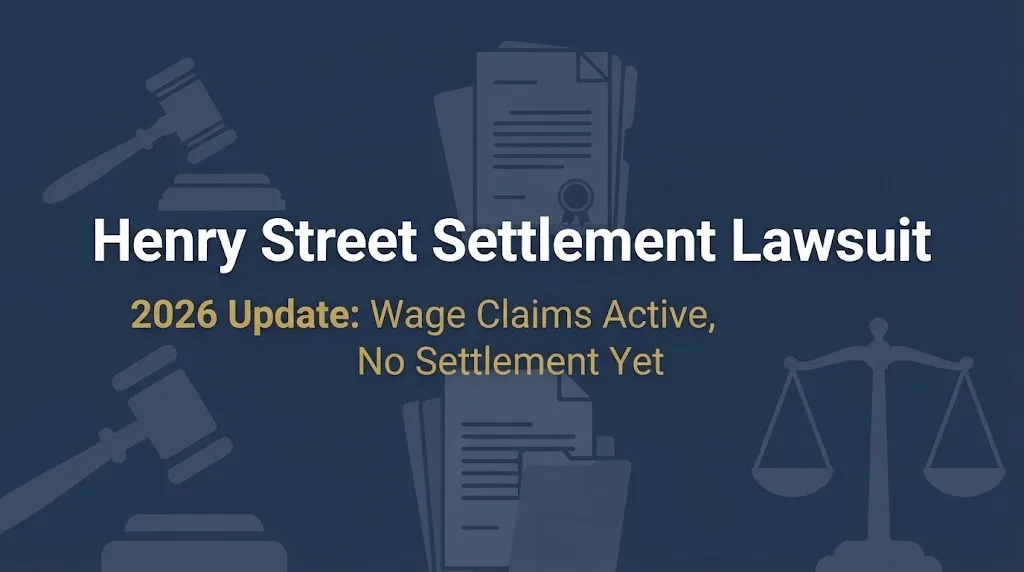
- Unpaid overtime for hours worked over 40 in a week
- Misclassification of employees as exempt from overtime
- Failure to pay for all hours worked, including off-the-clock work
- Minimum wage violations
- Improper deductions from pay
Nonprofits are not exempt from wage and hour laws. Even mission-driven organizations must comply with the Fair Labor Standards Act and state labor laws.
The specific allegations in the Henry Street case are not fully confirmed in public records as of September 9, 2026. What’s clear is that the case follows the standard pattern of employment litigation against social services organizations.
Who Are the Plaintiffs in the Henry Street Settlement Lawsuit?
The plaintiffs are current or former employees of Henry Street Settlement.
In typical wage and hour cases, the plaintiffs include:
- Hourly workers claiming unpaid overtime
- Salaried workers misclassified as exempt
- Workers in multiple roles whose hours weren’t properly tracked
- Former employees seeking back pay for past violations
The class, if certified, would include all similarly situated employees during a defined period. That could mean hundreds of workers, depending on the case’s scope.
Henry Street Settlement employs hundreds of people across its programs. The potential class is significant, which is why the case matters to the organization and its workers.
How Much Could the Henry Street Settlement Pay?
Not yet determined. No settlement exists, so no payout range is verified.
In wage and hour cases, damages typically include:
| Damage Type | Description |
|---|---|
| Back pay | Unpaid wages for the violation period |
| Overtime owed | Time-and-a-half for hours over 40 |
| Liquidated damages | Often doubles the back pay amount |
| Attorney fees | Paid separately by the employer |
| Interest | On unpaid wages from the date they were owed |
The total amount depends on the number of affected workers, the length of the violation period, and whether the case settles or goes to trial.
For individual workers, the payout could range from a few hundred dollars for minor violations to tens of thousands for systematic overtime failures over multiple years. But these are projections, not verified figures.
Reality Check: No one contacts you by text or email about an employment settlement you never heard of. Filing a wage claim is free. Third-party “claim helpers” who charge a fee are unnecessary. If someone asks for money to help you recover wages, it’s a scam.
Who Qualifies for the Henry Street Settlement?
No qualification criteria exist yet because no settlement has been approved.
If a settlement eventually emerges, eligibility would likely depend on:
- Employment at Henry Street Settlement during a defined period
- Job classification (hourly vs. salaried, exempt vs. non-exempt)
- Hours worked and whether overtime was paid
- Whether you opt in or opt out of the class
For wage and hour cases under federal law, workers often must affirmatively opt in to join the case. That’s different from most class actions, where you’re included unless you opt out.
If you worked for Henry Street Settlement and believe you were underpaid, the time to act is now, not when a settlement is announced.
How Do You File a Claim in the Henry Street Settlement Case?
There’s no claim form because there’s no settlement. But there are steps you can take now.
- Gather your employment records, including pay stubs and time sheets.
- Document any hours you worked that weren’t paid.
- Note any overtime you worked and whether you were paid time-and-a-half.
- Check your job classification against your actual duties.
- Contact an employment law attorney for an evaluation.
- File a complaint with the New York Department of Labor if you prefer a government route.
- Keep all documentation in case a settlement or class certification occurs.
The statute of limitations for wage claims under federal law is two years, or three years for willful violations. New York law allows up to six years for some wage claims. Don’t wait.
Key Takeaway: You don’t need to wait for a settlement to protect your rights. The clock is running on your claim.
What Is Henry Street Settlement?
Henry Street Settlement is one of New York City’s oldest and most respected social services organizations.
Founded in 1893 by Lillian Wald, a nurse and social reformer, the organization has served the Lower East Side for over 130 years. It provides:
- Housing assistance
- Education and youth programs
- Health care services
- Senior services
- Arts and culture programs
The organization employs hundreds of social workers, educators, healthcare providers, and administrative staff.
Its nonprofit status doesn’t exempt it from employment laws. Like any employer, it must comply with wage and hour rules.
Why Do Nonprofits Face Wage and Hour Lawsuits?
Nonprofits are frequent targets for employment litigation, often because of resource constraints and complex funding structures.
Nonprofits often:
- Rely on grant funding with strict budgets
- Have employees working multiple roles
- Stretch staff across programs with different funding sources
- Misclassify workers due to title confusion
- Struggle with time tracking across decentralized programs
These factors create the conditions for wage violations. A social worker might work 50 hours but be classified as exempt. A program assistant might work through lunch but not report it. An employee might split time between two grants and have hours lost in the shuffle.
None of these excuses violations, but they explain why they occur. The Henry Street case likely follows this pattern.
What Laws Govern the Henry Street Settlement Case?
The case likely involves both federal and New York state law.
| Law | Coverage |
|---|---|
| Fair Labor Standards Act | Federal minimum wage and overtime rules |
| New York Labor Law | State wage and hour protections, often broader than federal |
| New York Wage Theft Prevention Act | Requires written wage notices and pay stubs |
| New York City ordinances | Some additional protections for city workers |
New York law is more protective than federal law in several ways. The state has a higher minimum wage, stricter overtime rules, and longer statutes of limitations for wage claims.
For Henry Street workers, New York law may provide the stronger claims and the longer window to file.
What Happens Next in the Henry Street Settlement Case?
The litigation will follow the standard path for employment cases.
- Late 2026: Discovery and class certification proceedings likely ongoing.
- 2027: Possible class certification ruling.
- 2027-2028: Settlement talks or trial preparation.
- No guaranteed outcome: The case could settle, get dismissed, or go to trial.
The most important development for workers is class certification. If the court certifies a class, the case gains leverage and settlement pressure increases.
If you’re a former Henry Street employee, the next step is documenting your experience and consulting an attorney. Don’t wait for a settlement notice.
What Should Former Henry Street Employees Do Now?
Act now, not when a settlement is announced.
- Gather all pay stubs, W-2s, and time records.
- Write down your job title, duties, and schedule during your employment.
- Note any overtime you worked and whether you were paid correctly.
- Document any conversations about pay, classification, or hours.
- Contact a New York employment attorney for a free evaluation.
- Consider filing a complaint with the New York Department of Labor.
- Don’t sign any release or waiver without legal advice.
The most important step is documenting everything. Memories fade. Records get lost. The stronger your documentation, the stronger your claim.
Frequently Asked Questions
Is the Henry Street Settlement lawsuit real?
Yes, a case exists.
The details are less public than corporate litigation.
No settlement has been approved.
Can I get money from the Henry Street Settlement lawsuit?
Not yet.
No settlement fund exists.
If you have a claim, consult an attorney directly.
What is the lawsuit about?
Wage and hour claims.
Likely unpaid overtime and misclassification.
Standard employment law allegations.
How long do I have to file a wage claim?
Federal law allows two to three years.
New York law allows up to six years.
Don’t wait, the clock is running.
Do I need a lawyer to pursue a wage claim?
Not required, but recommended.
Employment cases are complex.
Most attorneys offer free consultations.
What is Henry Street Settlement?
A nonprofit social services organization in New York.
Founded in 1893 on the Lower East Side.
Provides housing, education, and health services.
Is Henry Street Settlement covered by employment laws?
Yes, nonprofits must follow wage and hour laws.
Mission doesn’t exempt an employer from legal obligations.
The same rules apply to all employers.
What should I do if I worked there and was underpaid?
Gather your records immediately.
Document your hours and pay.
Contact an employment attorney.
If you worked for Henry Street Settlement and believe you were underpaid, the settlement you’re searching for doesn’t exist yet. But your claim may. Gather your records and get legal advice now, while the statute of limitations is still open.
The most important fact: the case exists, but your individual claim has a deadline that no settlement will extend.