Settlement Tax Calculator 2026: How Much You Actually Owe the IRS
Quick Answer
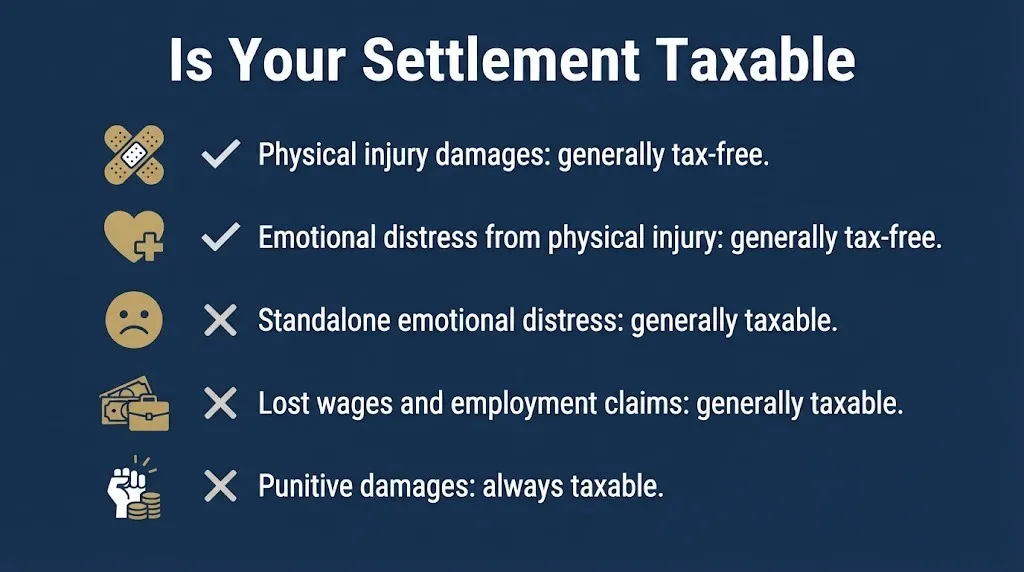
- Physical injury and physical sickness settlements are generally tax-free under IRC Section 104(a)(2).
- Emotional distress (standalone), lost wages, employment claims, and punitive damages are generally taxable as ordinary income.
- For 2026, you can no longer itemize-deduct attorney fees on a taxable settlement; that deduction was permanently eliminated by the One Big Beautiful Bill Act.
You searched “settlement tax calculator” because a check is coming, or already came, and you don’t know how much of it is really yours. The honest answer is: it depends entirely on what the money was paid to replace, not on the total dollar amount or what the lawsuit was called.
This matters most if you’re trying to figure out taxes on a $10,000 settlement, since smaller settlements often get miscalculated the same way big ones do. People assume a flat percentage applies. It doesn’t. The IRS looks at the character of each dollar, not the size of the check.
This article breaks down exactly how the IRS classifies settlement money in 2026, walks through a $10,000 example step by step, and flags the two rule changes that took effect this year and that most online calculators still don’t account for. One detail that surprises people: two settlements of the same size, for the same total injury, can have completely different tax bills depending on how the settlement agreement is worded.
The Facts
| Governing law | IRC Section 104(a)(2), personal physical injury and sickness exclusion |
| Default IRS position | All income is taxable unless a specific exclusion applies |
| Physical injury/sickness damages | Generally tax-free, including related medical costs and lost wages |
| Emotional distress (standalone) | Generally taxable as ordinary income |
| Punitive damages | Always taxable, regardless of the underlying injury |
| Attorney fee deduction (2026) | Itemized deduction permanently eliminated; above-the-line deduction still available for certain claims (employment discrimination, whistleblower, civil rights) |
| 1099 reporting threshold (2026) | Raised from $600 to $2,000 under the One Big Beautiful Bill Act |
Is a settlement tax calculator accurate for figuring what you owe?
A settlement tax calculator gives you an estimate, not a filing-ready number. Every calculator has to make assumptions about what percentage of your settlement is taxable, and that percentage depends entirely on the wording of your settlement agreement.
Most free calculators online run on a flat assumption, often that 70 to 100 percent of a settlement is taxable unless you specify otherwise. That works fine for a rough estimate. It falls apart the moment your settlement mixes categories, like a car accident case that includes both physical injury damages and a separate claim for lost income.

The IRS itself does not publish an official calculator. Its authority is IRS Publication 4345 and Publication 525, plus the “Lawsuits, Settlements, and Damages” guidance on its own website, which explain the rules but don’t compute a number for you.
Key Takeaway: A settlement tax calculator is only as accurate as the settlement categories you feed it, so treat any online result as a starting estimate, not a final tax bill.
Are lawsuit settlements taxable in 2026?
Some are, and some aren’t, and the split depends on what the payment was meant to replace. This is called the origin of the claim doctrine, and it has controlled settlement taxation since long before 2026.
If a settlement replaces something that would have been tax-free anyway, like compensation for a broken bone, it stays tax-free. If it replaces something that would have been taxed, like wages you would have earned, it gets taxed the same way those wages would have been.
For 2026 specifically, no new statutory exclusion was added to Section 104. The core physical injury exclusion remains unchanged. What changed are two administrative pieces: the 1099 reporting threshold and the permanent loss of the miscellaneous itemized deduction for legal fees.
How much tax will I pay on a $10,000 settlement?
It depends entirely on the settlement type, since a $10,000 physical injury settlement can owe $0 in federal tax while a $10,000 employment settlement can add a full $10,000 to your taxable income.
Here’s how that plays out using 2026 federal brackets for a single filer with a $16,100 standard deduction:
| Settlement Type | Taxable Amount | Illustrative Federal Tax Impact* |
|---|---|---|
| Physical injury / sickness | $0 (fully excluded) | $0 |
| Emotional distress, standalone | $10,000 | Taxed at your marginal rate, likely 12% to 22% for moderate income |
| Employment back pay | $10,000 (plus FICA withholding) | Taxed as wages, subject to payroll tax on top of income tax |
| Punitive damages | $10,000 (always taxable) | Taxed at your marginal rate, no exclusion available |
*Illustrative only. Your actual liability depends on your total taxable income for the year, filing status, and whether the settlement pushes you into a higher bracket.
For a single filer with moderate other income in 2026, taxable income in the $50,400 to $105,700 range sits in the 22% bracket. A $10,000 taxable settlement stacked on top of that income would generally be taxed at 22%, or roughly $2,200 in federal tax alone, before any state tax.
How does the IRS decide which parts of a settlement are taxable?
The IRS starts from the position that all income is taxable, then asks what a specific payment was intended to replace. This is the origin of the claim test, and it looks past the label on the lawsuit to the actual damages being paid.
A single settlement check can contain several taxable and non-taxable pieces at once. A car accident settlement might include tax-free medical expense reimbursement, tax-free pain and suffering tied to the physical injury, and taxable interest that accrued while the case was pending.
That’s why the settlement agreement’s allocation language matters so much. If the agreement clearly assigns dollar amounts to physical injury versus other categories, the IRS generally respects that allocation. If the agreement is vague, the IRS and your tax preparer are left guessing, and vague usually favors more tax, not less.
Key Takeaway: The IRS taxes settlement money based on what it replaces, not what the lawsuit was called, which is why identical dollar amounts can carry very different tax bills.
Is a personal injury settlement taxable?
Personal physical injury and physical sickness settlements are generally not taxable under IRC Section 104(a)(2). This covers medical expenses, pain and suffering tied to the physical injury, and lost wages that resulted directly from the physical injury.
This is one of the more consistent rules in settlement taxation. Compare it to a delayed tax refund: the government isn’t taxing you a second time on money that was already yours, it’s simply restoring what the injury cost you.
Two conditions matter here:
- The injury must be physical, not purely emotional or reputational.
- Punitive damages within the same case are still taxable, even if the underlying injury was physical.
If you previously deducted medical expenses related to the injury on a prior tax return, that portion of the settlement may become taxable to the extent it recovers a deduction you already claimed. This is a narrow exception, but it trips people up.
Are emotional distress and punitive damages taxable?
Punitive damages are always taxable, and standalone emotional distress damages are also taxable unless they originate from a physical injury or sickness.
The distinction that matters is origin. If you developed diagnosable emotional distress because of a physical injury, like PTSD following a car accident, that portion can qualify for the same exclusion as the physical injury itself.
| Damage Type | Tax Treatment |
|---|---|
| Emotional distress from physical injury | Generally tax-free |
| Emotional distress, no physical injury | Generally taxable |
| Punitive damages | Always taxable |
| Interest on a settlement | Always taxable |
Punitive damages exist to punish the defendant, not to make you whole, which is exactly why the IRS treats them as ordinary income no matter what type of case produced them.
Reality Check: No settlement calculator, tax preparer, or “settlement tax expert” who contacts you out of nowhere by text or email can guarantee a specific refund or tax-free outcome before seeing your actual settlement agreement. Filing your own return is always free through the IRS, and anyone charging a large upfront fee to “unlock” tax savings on a settlement you already received should be treated with real skepticism.
Can I deduct attorney fees from a taxable settlement in 2026?
For most taxable settlements, no. The One Big Beautiful Bill Act, signed July 4, 2025, permanently eliminated the miscellaneous itemized deduction that used to let plaintiffs deduct attorney fees, closing a deduction that Americans had lost temporarily since 2018 under the Tax Cuts and Jobs Act.
This creates what tax professionals call phantom income. If you win a $100,000 taxable settlement and your attorney takes a 40% contingency fee, the IRS can still expect tax on the full $100,000, even though you only received $60,000 in cash.
There is one major exception. Claims that fall under IRC Section 62(a)(20), including unlawful employment discrimination, certain whistleblower claims, and some civil rights claims, still qualify for an above-the-line deduction for attorney fees. That deduction survived the 2025 changes and remains available specifically for those claim types.
- Confirm what category your claim falls under before assuming any fee deduction applies.
- Ask your attorney whether the settlement agreement allocates fees separately.
- Check whether your claim qualifies for the Section 62(a)(20) above-the-line deduction.
- If it doesn’t qualify, plan for tax on the gross settlement, not just your net check.
- Talk to a tax professional before you spend the settlement, not after you file.
Key Takeaway: For any settlement outside the narrow above-the-line exception, you’re likely paying tax on the full gross amount in 2026, including the portion that went straight to your attorney.
How do I use a settlement tax calculator step by step?
Using a settlement tax calculator correctly means separating your settlement into categories before you enter a single number.
- Get your full settlement agreement and read the allocation language.
- Separate the total into physical injury, emotional distress, lost wages, and punitive damages categories.
- Confirm which portions are excluded under Section 104(a)(2).
- Enter only the taxable categories into the calculator, not the gross settlement.
- Add the taxable amount to your other income for the year to find your real marginal rate.
- Subtract any attorney fees only if your claim qualifies for the above-the-line deduction.
- Compare the estimate against IRS Publication 4345 before relying on it.
- Confirm the final number with a tax professional if the settlement is a meaningful share of your income.
How to report a settlement on your tax return
Taxable settlement proceeds generally get reported as income on your federal return, while payments tied to a physical injury or sickness exclusion typically don’t need to be reported at all.
If you receive a Form 1099 from the defendant or settlement administrator, that signals the payer treated the amount as taxable. Not receiving a 1099 doesn’t automatically mean the money is tax-free, since reporting thresholds and payer errors both exist.
Wage-replacement portions of employment settlements are typically reported on a W-2 and are subject to standard payroll tax withholding, separate from any non-wage portion reported on a 1099.
What changed for settlement taxes in 2026?
Two concrete changes affect 2026 settlements: a higher 1099 reporting threshold and the permanent end of the miscellaneous itemized deduction for legal fees.
The 1099 reporting threshold for Forms 1099-MISC and 1099-NEC rose from $600 to $2,000 for payments made after December 31, 2025, under the One Big Beautiful Bill Act. The IRS released proposed regulations implementing this change in April 2026, with a public comment period that closed June 16, 2026.
This threshold change affects whether you receive a 1099, not whether the underlying settlement income is taxable. A taxable settlement under $2,000 may no longer trigger a 1099, but you’re still legally required to report it if it’s taxable.
Will I get a 1099 for my settlement?
You’ll typically receive a 1099 if your taxable settlement proceeds hit $2,000 or more starting with 2026 payments, though the exact form and box used depends on what the payment represents.
Wage-replacement amounts from an employment settlement generally go on a W-2, not a 1099. Non-wage taxable damages, like emotional distress or punitive damages, are typically reported on Form 1099-MISC. Physical injury settlements that qualify for the Section 104(a)(2) exclusion generally don’t require a 1099 at all, since they aren’t taxable income to begin with.
What is the origin of the claim doctrine?
The origin of the claim doctrine is the legal standard the IRS and courts use to classify settlement income, based on the nature of the underlying claim rather than how the case was labeled.
This doctrine predates 2026 by decades and remains the backbone of every settlement tax question. It’s why a “wrongful termination” settlement can contain both taxable lost-wage damages and, in rare cases, non-taxable physical injury damages if the claim also involved an assault.
Courts consistently look at what a reasonable person would understand the payment to be compensating, based on the complaint, the settlement agreement, and correspondence between the parties during negotiation.
Do state taxes apply to settlement money too?
Yes, in most states. Settlement taxability generally follows federal treatment at the state level, but not every state applies the same rules or rates.
States with no income tax, like Texas or Florida, won’t add a state layer regardless of federal treatment. States with income tax generally start from your federal adjusted gross income, which means a federally taxable settlement portion usually becomes state-taxable too, at that state’s own rate.
Check your specific state’s department of revenue guidance before assuming your state mirrors federal treatment exactly, since a handful of states carve out different rules for punitive damages or wrongful death awards.
What about structured settlements and taxes?
A structured settlement, paid out over time instead of as a lump sum, follows the same taxability rules as a lump sum: if the underlying claim qualifies for the Section 104(a)(2) exclusion, the periodic payments stay tax-free.
The advantage of structuring a taxable settlement is spreading taxable income across multiple years, which can keep you in a lower bracket than dumping the full amount into one tax year. This doesn’t change whether the money is taxable, only when and how much tax hits in any single year.
What are common settlement tax mistakes people make?
The most common mistake is assuming a settlement is entirely tax-free simply because it came from a lawsuit, when only specific categories of damages actually qualify for exclusion.
- Assuming the full settlement is tax-free without checking the allocation language.
- Forgetting that attorney fees are generally not deductible in 2026 outside narrow exceptions.
- Not setting aside cash for taxes before spending a lump-sum settlement.
- Ignoring state tax obligations because federal treatment felt final.
- Missing a 1099 because it arrived late or the payer used the wrong reporting threshold.
- Not confirming whether punitive damages were carved out separately in the agreement.
What happens next
- Now through late 2026: The $2,000 1099 reporting threshold applies to settlement payments made during the year; keep your own records regardless of whether a 1099 arrives.
- January 31, 2027: Standard deadline for payers to send 1099 forms covering 2026 settlement payments.
- April 15, 2027: Standard federal filing deadline for reporting any taxable 2026 settlement income.
- Expected 2026 to 2027: Final IRS regulations on the $2,000 threshold are expected after the June 16, 2026 comment period closes.
Frequently Asked Questions
Is a $10,000 settlement taxable?
It depends entirely on what the $10,000 compensates for.
Physical injury damages are generally tax-free, while emotional distress, lost wages, and punitive damages are generally taxable.
How much tax do I pay on a settlement?
There’s no flat settlement tax rate.
The taxable portion gets added to your other income and taxed at your regular marginal rate, which can range from 10% to 37% federally depending on your total income.
Do I have to pay taxes on a personal injury settlement?
Generally no, if the settlement compensates for a physical injury or physical sickness.
Punitive damages within that same case remain taxable even when the injury portion is excluded.
Can I deduct my attorney fees from a taxable settlement?
Usually not in 2026, since the itemized deduction for legal fees was permanently eliminated.
An exception exists for specific claims like employment discrimination and whistleblower cases under Section 62(a)(20).
Will I get a 1099 for a small settlement?
Only if the taxable portion reaches $2,000 or more for payments made in 2026, up from the old $600 threshold.
A taxable settlement under that amount can still owe tax even without a 1099.
Does emotional distress from a lawsuit get taxed?
Yes, unless the emotional distress originated from a physical injury or sickness.
Standalone emotional distress damages, without an underlying physical injury, are treated as ordinary taxable income.
Are settlement tax calculators reliable?
They’re reliable for a rough estimate, not a final number.
Accuracy depends on correctly separating your settlement into taxable and non-taxable categories before entering any figures.
Do state taxes apply on top of federal settlement taxes?
In most states with an income tax, yes.
States generally follow federal taxable income as their starting point, so a federally taxable settlement portion is usually state-taxable too.
If you’re staring at a settlement check right now, the one move that protects you is reading your settlement agreement’s allocation language before you spend anything. Set aside cash for any taxable portion, since the IRS doesn’t send reminders before the April 15, 2027 filing deadline for 2026 income.
A settlement tax calculator can get you close, but only your actual settlement agreement, and possibly a tax professional, can get you exact.