Property Settlement Agreement 2026: What It Covers, How It Works, and California MSA Rules
Quick Answer
- What it is: A written contract dividing assets, debts, and support obligations in a divorce or legal separation.
- How much: The value depends entirely on your marital estate. There is no standard payout.
- Deadline: In California, the agreement must be filed with the court and incorporated into the judgment before the divorce is final.
If you are going through a divorce and wondering how to divide the house, the retirement accounts, and the credit card debt without leaving it all to a judge, the property settlement agreement is the document that gets you there. It is the financial backbone of the case.
The agreement goes by different names depending on where you live. In California, it is almost always called a Marital Settlement Agreement, or MSA. In Virginia and several other states, lawyers call it a Property Settlement Agreement, or PSA. The name changes, but the function does not: it puts your decisions in writing so a court can enforce them.
This article covers what a property settlement agreement must include, how California handles MSAs, what the standard court forms look like, the difference between a PSA and a QDRO, and what happens if the agreement is incomplete. Everything here traces to verified state codes, court forms, and published legal guides.
What is a property settlement agreement?
A property settlement agreement is a legally binding contract between divorcing spouses that divides marital property and debts and sets out any support obligations. It is enforceable once it is written and signed by both parties, and it becomes part of the divorce decree when a judge approves it.

In Virginia, the agreement is enforceable under Code of Virginia § 20-155, which requires only that it be in writing and signed by both spouses . The court can then affirm, ratify, and incorporate the agreement into the divorce decree under § 20-109.1 . Once that happens, the property division terms generally cannot be changed later.
The agreement is not the same as a prenuptial agreement. A prenup is signed before marriage and governs what happens if the marriage ends. A property settlement agreement is signed during the divorce and resolves the actual terms of the split.
Think of it like a store return policy. If you have the receipt and the policy is clear, the return is simple. If you are vague about what you bought and when, the store can push back. A PSA works the same way. Specific terms get enforced. Vague terms get litigated.
What assets and debts must a property settlement agreement cover?
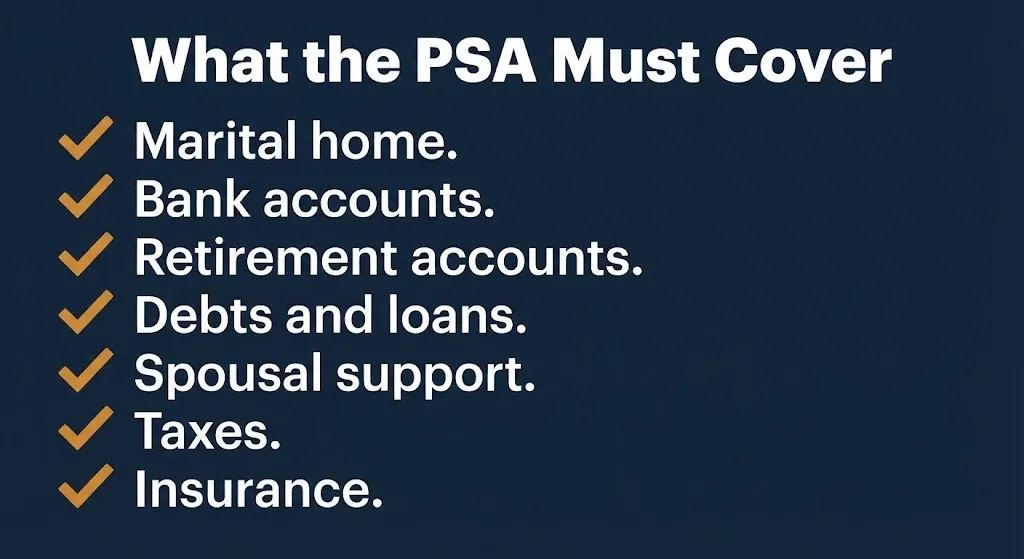
A complete property settlement agreement must name every asset and every debt the couple holds, with specific instructions for how each one is divided. The agreement can only divide what it names.
The core components include:
| Category | What the PSA Must Address |
|---|---|
| Marital home | Whether it is sold, or one spouse buys the other out and refinances |
| Bank and investment accounts | Each account named, with who receives what |
| Retirement accounts | 401(k)s, pensions, IRAs, with the specific order needed to divide each |
| Real estate | Family residence, vacation homes, investment properties |
| Vehicles | Cars, boats, recreational vehicles |
| Personal property | Furniture, electronics, jewelry, art |
| Debts | Mortgages, car loans, credit cards, student loans, medical debt |
| Support | Spousal support amount, duration, and termination conditions |
| Taxes | Filing status, who claims dependents, how refunds or liabilities split |
| Insurance | Life insurance obligations tied to support, health coverage |
| Attorney fees | Who pays whose fees, and whether prevailing party fees apply |
In California, all assets and debts acquired during the marriage are presumptively community property and subject to equal division unless the spouses agree otherwise . The MSA outlines exactly how that division happens for each category.
A Virginia guide put it plainly: the agreements that come back to court are the vague ones . “Split the retirement fairly” is not a plan. Naming the account, stating the share or dollar figure, and saying who does what by when is a plan.
How does a Marital Settlement Agreement work in California?
In California, the Marital Settlement Agreement is the standard document for resolving all divorce issues by agreement. Once both spouses agree on the terms, the MSA is filed with the court and incorporated into the final judgment .
California courts use specific Judicial Council forms for MSAs. Form FL-11 is the Marital Settlement Agreement form approved for optional use . The form directs parties to attach additional Judicial Council forms for specific issues:
- FL-341: Child Custody and Visitation Order Attachment
- FL-342: Child Support Information and Order Attachment
- FL-343: Spousal, Partner, or Family Support Order Attachment
- FL-345: Property Order Attachment to Judgment
The FL-11 form requires each party to declare that they have completed and served a Preliminary Declaration of Disclosure under Family Code section 2104 . Service of the Final Declaration of Disclosure can be waived under Family Code section 2105(d), but only if both parties agree and sign the waiver .
The MSA form also includes a notarization section. If the respondent did not file a response and default was taken, the respondent’s signature must be notarized . If a response was filed, additional forms are required, including an Appearance, Stipulations and Waivers form and a Stipulation and Waiver of Final Declaration of Disclosure .
California law also requires equalization payments if the division of community property is not equal. Form FL-11 and the related templates include a section for calculating and specifying any equalization payment owed from one spouse to the other .
How do you get a marital settlement agreement PDF in California?
The most reliable way to get a California MSA PDF is through the official California Courts website or the Judicial Council forms page. Form FL-11 is available as a fillable PDF through the California Courts self-help center.
County-specific versions exist as well. Justia hosts a Marital Settlement Agreement form for Imperial County and a Marital Settlement Agreement Judgment Attachment form for Stanislaus County . These local versions follow the same Judicial Council structure but include county-specific filing instructions.
Third-party legal template sites offer MSA templates as well. The Ezel.ai California divorce settlement template, updated May 2026, includes sections on equalization payments, omitted assets under California Family Code § 1101(h), and the tax treatment of transfers under Internal Revenue Code § 1041 . It also addresses California Proposition 19 property tax reassessment rules .
Important: A downloaded template is a starting point, not a finished agreement. California law requires full financial disclosure from both parties. A template cannot verify that you have disclosed every account, every debt, and every retirement benefit. Missing an asset in the agreement can leave it subject to later division by the court .
What is the difference between a property settlement agreement and a QDRO?
A property settlement agreement is the contract that says how you will divide retirement accounts. A Qualified Domestic Relations Order, or QDRO, is the separate court order that actually divides a specific retirement plan.
You need both if you are splitting a 401(k), pension, or other employer-sponsored retirement account. The PSA names the account and states the share each spouse receives. The QDRO is sent to the plan administrator and tells them exactly how to process the division.
Without a QDRO, the plan administrator will not move the money. A PSA that just says “divide the pension” can stall at the agency because the plan needs its own order . Military pensions, federal civilian pensions, and Thrift Savings Plans each require different order language.
The Continuing Education of the Bar California guide dedicates an entire chapter to QDROs and other retirement benefits orders, reflecting how central this step is to making a retirement division actually happen . A well-drafted PSA identifies which accounts need QDROs and sets a deadline for submitting them.
The same principle applies to the family home. If one spouse is buying out the other and refinancing the mortgage, the PSA must set a deadline for the refinance and a deadline for the deed transfer. Without dates, the buyout can drag on for years.
What happens if a property settlement agreement is incomplete or vague?
An incomplete or vague property settlement agreement becomes a future court fight. The property division terms in a final judgment generally cannot be changed afterward, so the time to fix gaps is before you sign.
Virginia attorney Corrie Sirkin put it directly: “A property settlement agreement is not the place to be polite and vague. Every line you leave fuzzy is a line someone can fight about later” .
California law adds a specific consequence for undisclosed assets. Under Family Code § 1101(h), if a party deliberately misrepresents or fails to disclose a community asset, the court may award the entire asset to the other party, plus attorney fees . That is a harsh penalty for a deliberate omission.
An American Bar Association case update from July 2025 illustrated how strict courts can be about deadlines in settlement negotiations. In that case, a wife’s offer to settle required the husband to sign by a specific date. The husband signed three days late. The court held that “no reasonable person would perceive any flexibility in that deadline,” and there was no agreement .
The lesson cuts both ways. Deadlines in settlement negotiations are real. And once an agreement is signed and incorporated, the terms are locked in.
Key Takeaway: A property settlement agreement is only as strong as its specificity. Name the account, state the amount, set the deadline, and specify who does what by when.
What are the most common mistakes in a property settlement agreement?
The most common mistakes in a property settlement agreement are vague language, missing accounts, and failure to address tax consequences. Each one can cost you money or send you back to court.
Here are the pitfalls that come up most often:
- Naming an account without a dollar figure or share. “Husband keeps the 401(k)” leaves open whether the wife gets an equalization payment.
- Forgetting a retirement account. Every 401(k), 403(b), IRA, pension, and TSP must be listed, even small ones.
- Ignoring the QDRO deadline. The PSA must say who will prepare the QDRO and by when.
- Leaving the house in limbo. The agreement must specify whether it sells, who lists it, at what price, and how proceeds split.
- Not addressing debt liability. Saying “Wife pays the credit card” does not remove the husband’s name from the account. The creditor can still pursue him.
- Skipping tax consequences. The IRS treats transfers between spouses incident to divorce as nontaxable under Section 1041 , but the tax basis of assets carries over. Selling a house later can trigger capital gains.
- No health or life insurance provisions. If spousal support is ordered, the PSA should address life insurance to secure the obligation.
California’s Family Code § 3800 et seq. allows a court to order a deferred sale of the family residence to minimize the impact on minor children . If you have children and one spouse wants to stay in the home, the PSA should address whether that option applies, who pays the mortgage during the deferred period, and what triggering events force a sale.
When does a property settlement agreement take effect?
A property settlement agreement takes effect when both spouses sign it. It becomes enforceable as a court order when the judge incorporates it into the divorce judgment.
In California, the MSA is filed with the court and incorporated into the final judgment of dissolution . In Virginia, the court affirms, ratifies, and incorporates the agreement into the decree under § 20-109.1 .
Before the agreement is incorporated, it is a contract between the spouses. Either party can potentially challenge it if they can show fraud, duress, or lack of disclosure. After incorporation, the property terms are generally final and cannot be modified.
The disclosure requirement is the key protection. California requires a Preliminary Declaration of Disclosure under Family Code section 2104 . Each spouse must list all assets, debts, and income. The Final Declaration of Disclosure can be waived if both parties agree, but the preliminary disclosure cannot be skipped without a court order.
If you are signing an MSA, read the disclosure documents carefully. If an account or debt is missing, ask about it before you sign. After the judge signs the judgment, your options narrow considerably.
What happens next after signing a property settlement agreement?
After you and your spouse sign the property settlement agreement, the next steps are filing the agreement with the court, completing any required disclosure waivers, and obtaining the final judgment.
Here is the expected sequence in California:
Step 1: Both parties sign the MSA and any attached Judicial Council forms.
Step 2: If a response was filed, complete the Appearance, Stipulations and Waivers form and the Stipulation and Waiver of Final Declaration of Disclosure .
Step 3: File the MSA and supporting documents with the court.
Step 4: The court reviews the agreement and incorporates it into the judgment of dissolution.
Step 5: Obtain certified copies of the judgment for any transfers requiring proof, such as real estate deeds or retirement plan QDROs.
Step 6: Submit QDROs to plan administrators for any retirement accounts being divided.
Expected 2026-2027: Deadlines in the agreement begin running, including refinance deadlines, deed transfer dates, equalization payment schedules, and QDRO submission dates.
The permanent nature of the incorporated agreement is why the time to get every figure right is before you sign. A delayed tax refund eventually arrives. A property settlement agreement that misses an asset may never be corrected.
Frequently Asked Questions
What is the difference between a property settlement agreement and a marital settlement agreement?
A property settlement agreement and a marital settlement agreement are the same document with different names. California and many other states use “Marital Settlement Agreement.” Virginia and several East Coast states use “Property Settlement Agreement.” Both divide assets, debts, and support.
Is a property settlement agreement legally binding in California?
Yes, a California MSA is legally binding once both spouses sign it and the court incorporates it into the final judgment. The agreement is enforceable as both a contract and a court order after incorporation.
Do I need a lawyer to draft a property settlement agreement?
You are not required to have a lawyer, but California requires full financial disclosure from both parties. A template cannot verify that you have disclosed every asset and debt. An attorney can also identify which retirement accounts need QDROs.
What happens if my spouse hides an asset during the divorce?
In California, if a party deliberately misrepresents or fails to disclose a community asset, the court may award the entire asset to the other party plus attorney fees under Family Code § 1101(h). The penalty is designed to punish concealment.
Can a property settlement agreement be modified after it is signed?
Property division terms generally cannot be modified after the court incorporates the agreement into the judgment. Spousal support may be modifiable depending on the agreement’s language and state law. Child support is always modifiable.
What is a QDRO and do I need one?
A Qualified Domestic Relations Order is a separate court order that directs a retirement plan administrator to divide an account. You need a QDRO for any 401(k), pension, or employer-sponsored retirement account being split.
How long does it take to finalize a marital settlement agreement in California?
The timeline depends on the court’s calendar and whether both parties have completed disclosure. California has a mandatory six-month waiting period from the date the respondent is served before a divorce can be finalized. The MSA must be filed before the judgment can be entered.
What should I do if my spouse won’t sign a property settlement agreement?
If your spouse won’t sign, the case goes to trial or to a contested hearing. You can still present your own proposed division to the judge. Mediation is often required before a contested hearing in California family court.
The Bottom Line for Anyone Facing a Property Settlement Agreement
A property settlement agreement is the document that decides your financial future after divorce. It is enforceable, permanent, and unforgiving of vague language. In California, form FL-11 and its attachments are the standard tools, and the court must incorporate the agreement into the judgment before it becomes binding.
If you are negotiating an agreement right now, the most important action is verifying that every asset and debt is listed with a specific dollar figure or percentage. The second is confirming which retirement accounts need a QDRO and setting a deadline for submission. The single most important date is the one the court sets for filing the agreement, because missing it can delay your divorce indefinitely.