PG&E Lawsuit 2026: $100M Securities Settlement Deadline and Fire Victim Trust Final Payments
Quick Answer
- Is it legit? Yes. PG&E agreed to a $100 million settlement for investors and funded a $13.5 billion Fire Victim Trust.
- How much? Securities settlement averages $0.09 per common share. Fire victims received about 70% of approved claims.
- Deadline? The securities claim deadline was July 6, 2026. Fire Victim Trust final payment is expected by December 2026.
If you bought PG&E stock between April 2015 and November 2018 and lost money when the wildfires hit, the $100 million securities settlement was built for you. But the claim window closed on July 6, 2026, and payments have not yet been distributed.
For wildfire survivors, a different pool of money is still moving. The Fire Victim Trust, funded with $13.5 billion from PG&E’s bankruptcy, has paid out $13.72 billion to 66,530 eligible claimants. A final distribution expected by December 2026 will add roughly 1% more to each approved claim.
This article covers what is confirmed as of September 2026: the securities settlement payout formula, the Fire Victim Trust’s remaining shortfall, the status of Assembly Bill 2700, and what PG&E’s recent $2 billion spending cut means for the utility’s legal exposure.
Is the PG&E lawsuit settlement legit or a scam?
The PG&E settlements are real, court-supervised, and documented in federal bankruptcy and district court records. But the claim windows are closing or closed, and that gap is where scams operate.
The $100 million securities settlement was reached on December 31, 2025, and filed in the U.S. District Court for the Northern District of California. The case is In re PG&E Corporation Securities Litigation, No. 18-cv-03509 . The settlement resolves claims that PG&E misled investors about safety practices before the 2017 and 2018 wildfires .
The Fire Victim Trust is a separate entity created in 2020 from PG&E’s bankruptcy. It was funded with $13.5 billion, half in cash and half in PG&E stock . The trust has processed 71,787 determination notices and awarded $19.57 billion to 66,530 eligible claimants .
Those are verified, court-approved processes. The scam risk comes from third-party websites still advertising “file your PG&E claim” for settlements that have closed. If a site asks for your Social Security number or a fee to process a PG&E wildfire claim, that is a red flag.
Reality Check: No legitimate settlement administrator texts you first or charges a fee to submit a claim. The Fire Victim Trust and the securities settlement administrator only contact you through official court-approved notices.
How much is the PG&E settlement payout per person?
Payout amounts depend entirely on which settlement you are part of and what type of claim you filed. There is no single per-person figure for PG&E cases.
For the $100 million securities settlement, the court-approved plan of allocation sets estimated recoveries by security type. The fund is split with at least 83.85% for equity claims and up to 16.15% for debt claims .
| Security Type | Estimated Gross Recovery | Estimated Net Recovery |
|---|---|---|
| Common stock | $0.13 per share | $0.09 per share |
| Preferred stock | $0.03 per share | $0.02 per share |
| Securities Act notes | $2.95 per note | $2.04 per note |
| Exchange Act notes | $0.22 per note | $0.15 per note |
Actual payments may be higher or lower depending on how many valid claims were filed and the total recognized losses .
For wildfire victims, the numbers are much larger but incomplete. The Fire Victim Trust awarded $19.57 billion in total claims but has paid only $13.72 billion . That leaves a shortfall of roughly $5.85 billion, or about 30% of what claimants were initially told to expect.
Key Takeaway: Securities settlement payments are calculated per share or note, not as a flat amount. Wildfire victim payments depend on the approved claim value, and the trust is still short of full funding.
What was the claim deadline for the PG&E settlement?
The claim deadline for the $100 million PG&E securities settlement was July 6, 2026 . That window is now closed.
Class members had from April 2026 through early July 2026 to submit claims. The settlement class includes anyone who purchased or acquired PG&E common stock, preferred stock, exchange-traded call and put options, or certain PG&E notes between April 29, 2015, and November 15, 2018 .
Investors who held PG&E securities only through a mutual fund are not class members. The mutual fund itself may be a class member, but individual fundholders cannot file separate claims .
For the Fire Victim Trust, there is no new claim deadline because the trust is in its final distribution phase. Claims were filed and evaluated between 2020 and 2025. The trust stopped accepting new claims and is now calculating the final payment .
If you missed the July 6 securities deadline, you cannot file now. Late claims are rejected under the settlement’s terms.
How do you file a PG&E settlement claim?
You cannot file a claim for either PG&E settlement right now because both claim windows are closed. But understanding how the process worked shows what to expect if a new settlement opens.
Here is how the securities settlement claims process worked:
- Receive the class notice. Eligible investors were mailed or emailed a notice with a Class Member ID.
- Go to the official settlement website. The notice named the administrator and provided the claim portal.
- Gather your transaction records. You needed brokerage statements showing PG&E purchases and sales during the class period.
- Complete the claim form. The form asked for your Class Member ID, contact information, and transaction details.
- Calculate your recognized loss. The administrator used artificial inflation tables to determine recognized loss amounts.
- Submit before July 6, 2026. Online claims had to be submitted by the deadline. Mail claims had to be postmarked.
- Wait for the final approval hearing. The court must approve the settlement before payments distribute.
For the Fire Victim Trust, the process was different. Claimants filed detailed proofs of claim with documentation of property damage, personal injury, or wrongful death. The trust’s claims administrator evaluated each claim and issued a determination notice .
If a new PG&E settlement opens in the future, watch for postcards or emails from a court-appointed administrator. They are easy to mistake for junk mail.
When will PG&E settlement checks mail?
Securities settlement payments have not yet mailed as of September 2026. The final approval process is still underway. Based on the settlement timeline, payments typically issue 30 to 60 days after final court approval.
For the Fire Victim Trust, the final payment is expected by December 2026 . Paradise Mayor Steve Crowder confirmed the timeline after speaking with Trustee Cathy Yanni. The trust was waiting for a settlement with Davey Tree to add more than $111 million before calculating the final distribution .
That final payment will add roughly 1% to each survivor’s approved award, bringing total payments to about 70% of what was originally approved . The trust awarded $19.57 billion but had only $14.7 billion available, leaving a 30% gap .
The shortfall exists because PG&E’s stock price dropped after bankruptcy. The trust was funded half in stock, and when the share price fell, the trust’s total value shrank. A $13.5 billion commitment became $14.7 billion in actual funds, but approved claims reached nearly $20 billion .
What is the PG&E Fire Victim Trust and who qualifies?
The Fire Victim Trust is the entity created from PG&E’s 2020 bankruptcy to compensate victims of the 2015 Butte Fire, 2017 North Bay Fires, and 2018 Camp Fire . It is separate from the securities settlement and covers personal injury, wrongful death, and property damage claims.
You may qualify for the Fire Victim Trust if you:
- Lived in or owned property in areas affected by the Butte, North Bay, or Camp Fires
- Suffered personal injury, wrongful death, or property damage from those fires
- Filed a claim with the trust before its filing deadline
- Received a determination notice approving your claim
The trust processed 71,787 determination notices and found 66,530 claimants eligible for awards . The Camp Fire alone killed 85 people and destroyed the town of Paradise .
The trust is now in its wind-down phase. Trustee Cathy Yanni said the trust and its claims administrator met in August 2026 to begin calculating the final payment . No new claims can be filed.
What is Assembly Bill 2700 and will it cover the PG&E shortfall?
Assembly Bill 2700 is a California bill that aims to force PG&E to cover the 30% shortfall facing Fire Victim Trust claimants. The bill passed both the State Senate and Assembly and is awaiting Governor Newsom’s signature as of September 2026 .
The bill’s intent is to make wildfire survivors whole after the trust ran out of money. But major questions remain unanswered. Local leaders say it is unclear where the money would come from or how it would work legally after PG&E’s bankruptcy .
PG&E emerged from bankruptcy in July 2020. The bankruptcy discharge typically protects a company from most pre-bankruptcy liabilities. Whether AB 2700 can force PG&E to pay more despite that discharge is an open legal question.
The bill also faces political headwinds. PG&E has warned that wildfire liability costs are unsustainable and has already announced $2 billion in spending cuts for 2027 . The utility’s CEO said the current liability framework is “too expensive for our customers” .
What does PG&E’s $2 billion spending cut mean for wildfire victims?
PG&E’s decision to defer $2 billion in capital spending for 2027 is a direct response to California lawmakers failing to pass wildfire liability reform. The utility announced the cut after Senate Bill 492, a liability overhaul measure, failed to clear the Legislature .
The deferred spending includes connections for new housing projects, renewable energy interconnections, and large loads beyond 1.8 gigawatts. PG&E said it will preserve critical safety programs and meet wildfire mitigation requirements .
Consumer Watchdog called the move a “capital strike” and accused PG&E of withholding paid-for services to force a political result. Jamie Court, president of Consumer Watchdog, said the Legislature should not respond to “blackmail” .
The political fight matters for wildfire victims because PG&E’s financial health affects its ability to pay claims. If PG&E’s credit rating drops below investment grade, its borrowing costs rise and its ability to fund settlements shrinks. The company’s stock closed at $13.33 on September 2, 2026, a 52-week low .
What happens next in the PG&E litigation landscape?
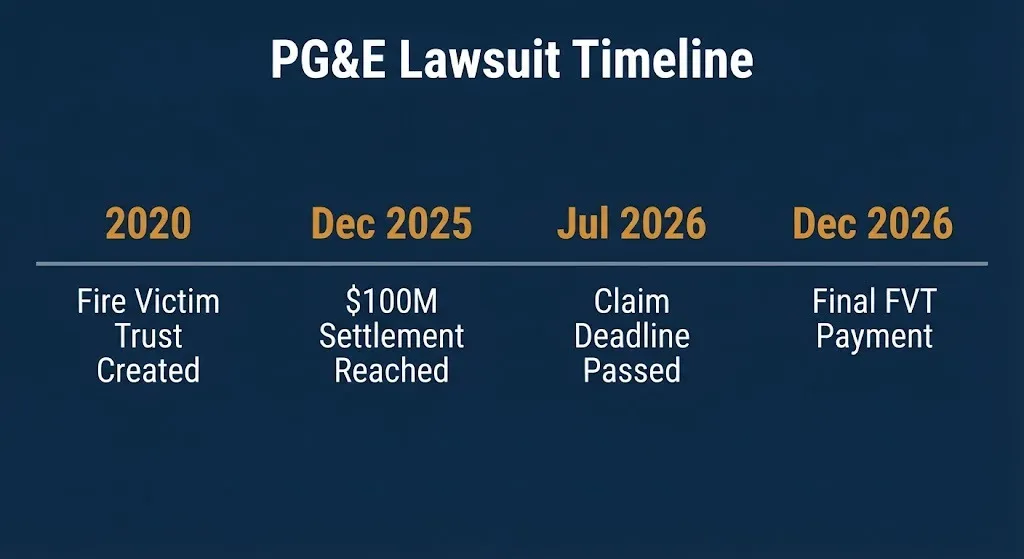
The next major developments are the Fire Victim Trust’s final payment and the fate of Assembly Bill 2700. Here is the expected timeline.
December 2026: Fire Victim Trust final payment distributes, bringing total payments to roughly 70% of approved claims.
Pending: Governor Newsom signs or vetoes Assembly Bill 2700. The bill would force PG&E to cover the 30% shortfall, but funding and legal mechanisms remain unclear.
2027: PG&E’s $2 billion spending cut takes effect, potentially delaying housing and energy project connections.
Ongoing: California legislators may revisit wildfire liability reform in 2027 after Newsom leaves office due to term limits.
The Fire Victim Trust’s final payment is the only confirmed date. Everything else depends on political and legal developments that have not yet resolved.
Frequently Asked Questions
Is the PG&E $100 million settlement still open for claims?
No. The claim deadline was July 6, 2026. The settlement class included investors who bought PG&E securities between April 29, 2015, and November 15, 2018.
How much will I get from the PG&E securities settlement?
Payments depend on the type and number of securities you held. Estimated net recoveries are approximately $0.09 per common share, $0.02 per preferred share, $2.04 per Securities Act note, and $0.15 per Exchange Act note.
When will Fire Victim Trust final payments go out?
Final payments are expected by December 2026. The trust is calculating the final distribution after receiving a settlement with Davey Tree that added more than $111 million.
Why did Fire Victim Trust claimants only get 70% of their approved claims?
PG&E funded the trust with $13.5 billion, half in cash and half in stock. When PG&E’s stock price dropped, the trust’s total value fell to $14.7 billion. Approved claims reached nearly $20 billion, leaving a 30% shortfall.
Does Assembly Bill 2700 guarantee PG&E will pay the missing 30%?
No. The bill passed the Legislature and is awaiting Governor Newsom’s signature, but it is unclear where the money would come from or how it would work after PG&E’s bankruptcy discharge.
Can I still file a wildfire claim against PG&E?
The Fire Victim Trust stopped accepting new claims. If you suffered losses from a more recent wildfire, consult a California wildfire attorney about whether a new claim is possible.
What does PG&E’s $2 billion spending cut mean for me?
The cut defers spending on new housing connections, renewable energy projects, and large industrial loads. If you are building a home or developing a project in PG&E territory, your connection timeline could be delayed.
The Bottom Line for PG&E Lawsuit Claimants
The $100 million securities settlement claim window closed on July 6, 2026. If you filed a claim, payments will distribute after final court approval. If you missed the deadline, there is no late filing option.
Fire Victim Trust claimants should watch for a final payment by December 2026 that will add roughly 1% to their approved awards. The trust has paid $13.72 billion of $19.57 billion in approved claims, leaving a 30% shortfall that Assembly Bill 2700 aims to address.
The single most important date is December 2026 for the Fire Victim Trust final payment. For everything else, the legal and political process is still moving.