What Is Commercial Litigation? 2026 Update on Business Disputes, Lawsuits, and the Role of a Commercial Litigation Attorney
Quick Answer
- Commercial litigation is a subset of civil litigation involving business disputes: contracts, partnerships, fraud, and trade secrets .
- There is no standard settlement amount; outcomes range from thousands to billions depending on the claim .
- If you face a business dispute, check your contract for arbitration clauses or filing deadlines immediately.
You are searching for what commercial litigation means because a business deal went wrong. Maybe a partner stopped returning calls. A vendor delivered something different from what the contract promised. Or a former employee walked out with your client list.
This article explains exactly what commercial litigation is, how it differs from ordinary civil lawsuits, what a commercial litigation attorney actually does, and the practical steps you need to understand. The surprising part: most commercial disputes never reach a jury. They end in arbitration, mediation, or a settlement negotiated over email .
The Facts
| Definition | Legal disputes arising from business relationships or transactions |
| Common Claims | Breach of contract, fraud, shareholder disputes, trade secrets |
| Typical Forum | State circuit court, federal court, or arbitration |
| Typical Timeline | One to three years in court; faster in arbitration |
| Cost Range | Varies widely; commercial discovery is document-intensive |
| Settlement Rates | Most cases resolve before trial |
| Proof Needed | Contracts, financial records, communications, expert testimony |
What Is Commercial Litigation?
Commercial litigation is a type of civil lawsuit that involves disputes arising from business relationships, transactions, or commercial activity. It covers breach of contract claims, partnership disagreements, shareholder fights, fraud allegations, and trade secret theft .
Think of civil litigation as the umbrella. It covers everything from car accident claims to divorce to landlord-tenant disputes . Commercial litigation sits under that umbrella, but the defining feature is the source of the conflict: a business deal, a corporate agreement, or a commercial relationship.
The parties are usually companies. But an individual can be involved too, especially in disputes over a business they own or a contract they signed on behalf of a company .
What Is the Difference Between Commercial Litigation and Civil Litigation?
Civil litigation covers any non-criminal dispute between parties, while commercial litigation specifically involves business or commercial relationships . The distinction matters because commercial cases are often more complex, more document-heavy, and heard in different courts.
A car accident lawsuit is civil litigation. A fight between two business partners over how to split profits is commercial litigation. A personal injury claim from a slip and fall at a store is civil. A vendor suing a retailer over unpaid invoices is commercial.
Commercial cases often involve multiple parties, extensive written contracts, and expert witnesses like accountants or industry specialists . The discovery process alone can generate thousands of documents.
How Much Does Commercial Litigation Cost?
There is no standard cost, and anyone who quotes you a flat figure before reviewing your case is guessing. Commercial litigation is expensive because discovery is document-intensive and expert testimony is often required .
The cost depends on the size of the dispute, the number of parties, and whether the case settles early or goes to trial. A straightforward contract dispute between two small businesses might resolve in mediation for a few thousand dollars in legal fees. A shareholder fight involving multiple entities and forensic accounting can run into hundreds of thousands or more.
The U.S. Chamber Institute for Legal Reform identifies litigation costs as a top concern for mid-sized businesses . That is why early case assessment and alternative dispute resolution clauses in contracts matter so much.
What Types of Cases Does a Commercial Litigation Attorney Handle?
A commercial litigation attorney handles disputes that arise from business relationships, including breach of contract, partnership conflicts, fraud claims, intellectual property theft, and unfair competition .
The table below shows the most common commercial litigation matters and where they are typically heard.
| Dispute Type | Common Legal Claims | Typical Forum |
|---|---|---|
| Contract breach | Breach of contract, damages | State or federal court |
| Business fraud | Fraud, misrepresentation | State court |
| Shareholder disputes | Breach of fiduciary duty | State chancery court |
| Trade secrets | Misappropriation, injunction | Federal or state court |
| Partnership conflicts | Dissolution, accounting | State court |
| Real estate | Lease breach, title claims | State court |
| Non-compete enforcement | Restrictive covenant violation | State or federal court |
What Is a Commercial Litigation Attorney?
A commercial litigation attorney is a lawyer who represents businesses or individuals in disputes arising from commercial relationships and transactions . They handle the full lifecycle of a dispute: investigation, filing, discovery, negotiation, and trial.
These attorneys must understand contract law, corporate law, the Uniform Commercial Code, and often industry-specific regulations . A healthcare billing dispute requires knowledge of the False Claims Act. A securities fraud case requires familiarity with SEC rules.
Their role goes beyond courtroom advocacy. Commercial litigators negotiate settlements, manage document production, prepare witnesses for depositions, and advise clients on whether a dispute is worth pursuing in the first place .
How Do You Know If You Need a Commercial Litigation Attorney?
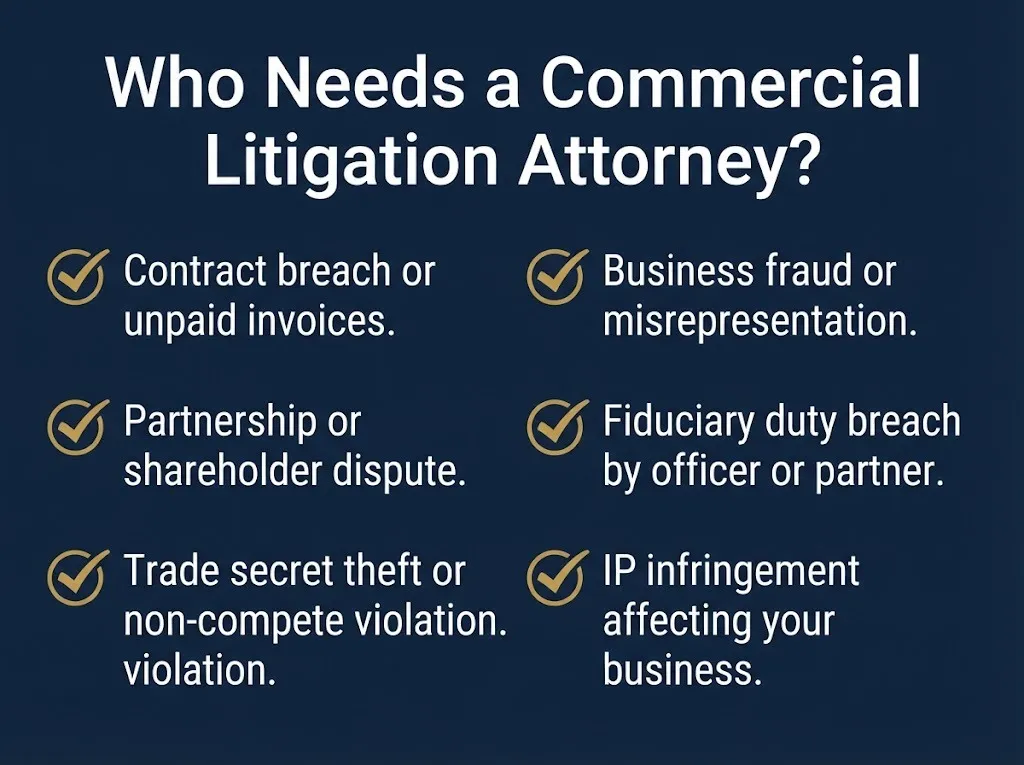
You likely need a commercial litigation attorney if you face a business dispute involving a contract breach, a partner who has acted against the company’s interests, or a competitor who stole your trade secrets .
The earlier you involve a lawyer, the more options you have. Attorney Benjamin I. Fink told Super Lawyers that getting a lawyer involved in a festering dispute early gives you advice on how to handle it before positions harden .
A simple test: If the other party is a business entity, the dispute arose from a business relationship, and the stakes exceed what small claims court handles, treat it as a commercial matter .
How Does the Commercial Litigation Process Work?
The commercial litigation process follows a predictable sequence, though timelines vary by jurisdiction and case complexity. Here are the major phases:
- Pre-suit investigation. Your attorney reviews evidence, researches applicable law, and may send a demand letter.
- Filing the complaint. The plaintiff files a lawsuit in the appropriate court.
- Service of process. The defendant is formally notified of the lawsuit.
- Defendant’s response. The defendant files an answer or a motion to dismiss.
- Discovery. Both sides exchange documents, answer written questions, and conduct depositions.
- Pre-trial motions. Attorneys file motions that can reshape or resolve the case.
- Mediation or settlement. Courts often require mediation before trial.
- Trial. If no settlement is reached, the case goes before a judge or jury.
What Are the Alternatives to Commercial Litigation?
Arbitration and mediation are the two main alternatives to going to court, and both are far more common than most people realize . Arbitration involves a neutral third party who hears evidence and issues a binding decision. Mediation involves a neutral party who helps the disputing parties reach their own agreement.
Arbitration offers privacy, which matters when sensitive business information is at stake. The Starbucks-Kraft dispute over coffee distribution ended in a $2.75 billion arbitration award, not a public trial . The arbitrator ruled Starbucks had improperly terminated a distribution agreement.
Mediation is cheaper and less adversarial. Many contracts now include clauses requiring mediation before either party can file a lawsuit.
What Happens If You Lose a Commercial Litigation Case?
If you lose, the court can enter a judgment against you for damages, and the winning party may also seek attorney’s fees if the contract or a statute allows it. You generally have the right to appeal, but appeals are expensive and the standard for overturning a trial outcome is high .
The bigger risk is often the business disruption. A commercial case can tie up resources, distract management, and damage relationships even if you win. That is why early settlement discussions are almost always worth exploring.
How Long Does Commercial Litigation Take?
A commercial case typically takes one to three years from filing to resolution if it goes through the full court process . Cases that settle in mediation can resolve in months. Cases that go to trial and then appeal can stretch to four or five years.
The median time to trial in U.S. courts has improved slightly, but business disputes still move slowly compared to consumer claims . Arbitration is generally faster, but not always by as much as people expect.
What Happens Next
If you are facing a commercial dispute, the timeline below shows the stages ahead.
Now: Preserve documents and communications. Do not delete anything related to the dispute.
Within 30 days: Review your contract for arbitration clauses, notice requirements, and filing deadlines.
Expected Q4 2026: Consult a commercial litigation attorney if the amount in dispute exceeds what you can afford to lose.
Expected early 2027: Attempt mediation or arbitration if your contract requires it.
If no resolution: File a complaint before the statute of limitations expires.
Frequently Asked Questions
Is commercial litigation the same as civil litigation?
No. Commercial litigation is a subset of civil litigation. All commercial cases are civil, but not all civil cases are commercial .
What is the most common type of commercial litigation?
Breach of contract is the most common commercial dispute. It covers unpaid invoices, failed deliveries, and agreements where one side did not perform as promised .
Can an individual be involved in commercial litigation?
Yes. An individual can sue or be sued in commercial litigation if the dispute arises from a business relationship, a contract they signed, or a business they own .
Do I need a lawyer for commercial litigation?
You are not legally required to hire a lawyer, but commercial cases involve complex procedural rules, strict deadlines, and document-heavy discovery. Missing a deadline can end your case permanently .
What is the difference between arbitration and litigation?
Arbitration is a private process with a neutral decision-maker, while litigation happens in public court before a judge or jury. Arbitration is often faster and more confidential .
How much does a commercial litigation attorney cost?
Fee structures vary. Some attorneys charge hourly, some offer flat fees for specific phases, and some take cases on contingency. Ask for a written fee agreement before hiring anyone.
What should I do if I receive a commercial litigation complaint?
Do not ignore it. You have a limited time to respond, usually 20 to 30 days. Missing that deadline can result in a default judgment against you.
Can commercial litigation be settled out of court?
Yes. Most commercial cases settle before trial, often during mediation or through direct negotiation between attorneys .
Key Takeaway: Commercial litigation is a business dispute that belongs in court or arbitration, and most cases resolve through settlement or mediation long before a jury hears the evidence.
Reality Check: No legitimate attorney or claims service will contact you out of nowhere promising a commercial litigation payout. If someone does, it is a scam. Filing a lawsuit requires specific facts, a real contract or legal harm, and a licensed attorney in your jurisdiction.