Montana Workers Compensation in 2026: Benefits, Filing Steps, Insurance Rules, and Claim Deadlines
Quick Answer
- Montana requires nearly all employers to carry workers comp insurance for their employees.
- Benefits include medical care and wage replacement, but stress claims are not compensable.
- Report your injury within 30 days and file a First Report of Injury within 12 months.
You are searching for Montana workers compensation because something happened at work. Maybe you got hurt on a job site in Billings. Or you run a small business in Missoula and need to understand your insurance obligations.
The system exists to get injured workers medical care and partial wage replacement without proving fault. That means you can still receive benefits even if the accident was your own mistake. But the rules are strict. Deadlines are unforgiving. One missed date can bar your entire claim.
This article walks you through exactly how Montana workers compensation works in 2026. You will learn who is covered, how to file, what benefits pay, and what changed in the law this year.
The Facts
| System Type | No-fault, employer-funded insurance |
| Coverage Required | All employers with employees |
| Injury Report Deadline | 30 days to employer |
| Claim Filing Deadline | 12 months from injury |
| Average Monthly Premium | $74 per month |
| Insurer Decision Time | 30 days to accept or deny |
| Stress Claims | Not compensable |
| State Fund | Montana State Fund (insurer of last resort) |
Is Montana Workers Compensation Legitimate and How Does It Work?
Yes, Montana workers compensation is a legitimate, state-mandated insurance system that provides medical and wage-loss benefits to injured workers without requiring proof of fault. The system has operated under Title 39, Chapter 71 of the Montana Code Annotated for decades.
The core principle is simple. If you get hurt doing your job, your employer’s insurance pays your medical bills and a portion of your lost wages. You do not sue your employer. Workers compensation is your exclusive remedy.
That trade-off benefits both sides. Employers get protection from personal injury lawsuits. Workers get faster benefits without proving negligence.
But the system has limits. Montana law explicitly states that stress claims, often called mental-mental claims, are not compensable. The Legislature decided these claims are too difficult to verify objectively.
How Much Does Workers Compensation Insurance Cost in Montana?
The average cost of workers compensation insurance in Montana is $74 per month for small businesses. Your actual premium depends on your payroll, industry risk, claims history, and location.
Insurance providers calculate premiums using a formula. They multiply your classification rate by your experience modification rate, then multiply by your annual payroll divided by $100. Office workers pay less. Carpenters and roofers pay more.
The table below shows what factors drive your premium.
| Factor | How It Affects Your Rate |
|---|---|
| Payroll size | Higher payroll means higher premium |
| Industry classification | Riskier jobs carry higher rates |
| Claims history | Past claims raise your experience modification rate |
| Location | Rates vary by city and region |
| Coverage limits | Higher limits cost more |
The experience modification rate only applies when your annual premium exceeds $5,000. Many small businesses fall below that threshold.
Who Is Exempt from Montana Workers Compensation Coverage?
Montana law exempts several categories of workers from mandatory coverage, including domestic workers, commission-only salespeople, newspaper carriers, and certain religious workers.
Sole proprietors, partners, LLC members, and corporate officers are also exempt. But they can choose to buy coverage. That is often a smart move. Your health insurance may deny a claim for a work-related injury.
Independent contractors occupy a special category. Montana requires employers to verify that any independent contractor has either a state-issued exemption certificate or their own workers comp policy. Without that documentation, you could be held financially responsible for their injuries.
The list below shows the main exempt categories:
- Household or domestic workers
- Real estate, securities, or insurance salespeople paid by commission
- Newspaper carriers
- Freelance writers paid by the article
- Licensed barbers or cosmetologists working under contract
- Ministers of a church or members of a religious order
- Sole proprietors, partners, LLC members, and corporate officers (unless they opt in)
How Do You File a Workers Compensation Claim in Montana?
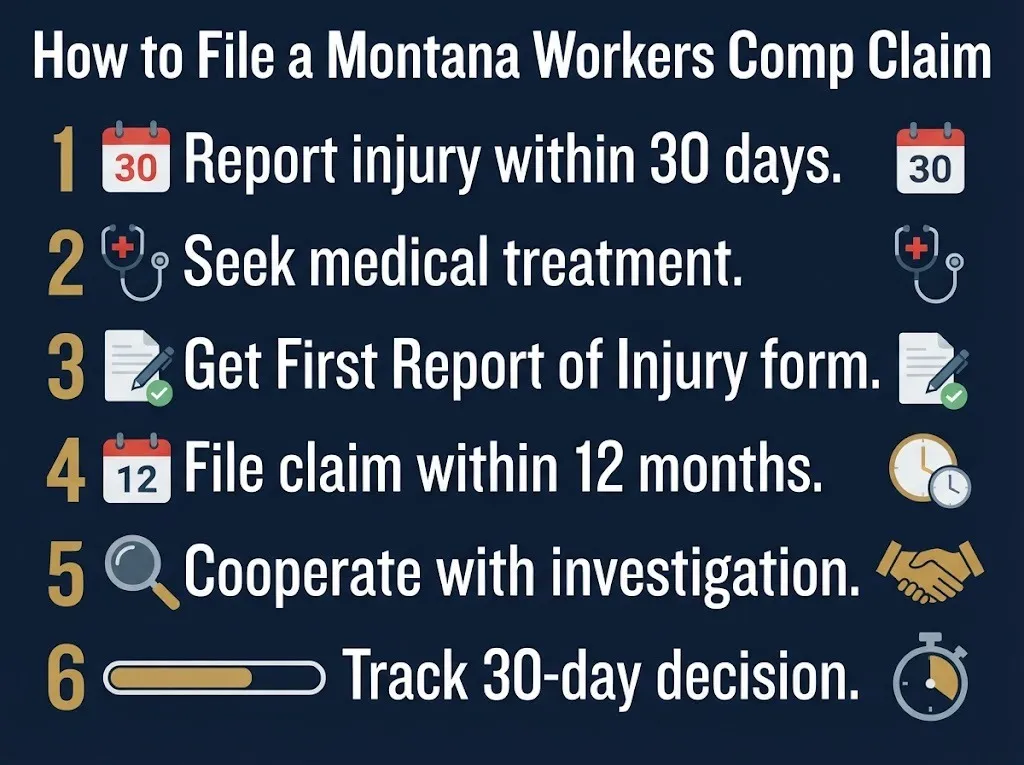
You must report your injury to your employer within 30 days and file a written First Report of Injury form within 12 months of the accident. Missing either deadline can bar your claim.
Here are the steps to file:
- Report the injury to your employer. Tell them the time, place, and nature of the injury. Do it in writing if possible.
- Seek medical treatment immediately. Tell your provider the injury happened at work.
- Get the First Report of Injury form. Ask your employer or download it from the Montana Department of Labor and Industry.
- Complete and submit the form. Send it to your employer, the insurer, or the Department of Labor within 12 months.
- Cooperate with the insurer’s investigation. Provide requested medical records and statements.
- Attend any independent medical examination. The insurer can schedule one, and you must attend.
- Track the 30-day decision window. The insurer must accept or deny your claim within 30 days of receiving it.
What Benefits Can You Receive Under Montana Workers Compensation?
Montana workers compensation pays for medical treatment, temporary wage replacement, permanent disability benefits, and vocational rehabilitation. The specific benefits depend on your injury and your ability to work.
Medical benefits cover all reasonable and necessary treatment related to your compensable injury. There is no deductible. Covered care includes exams, diagnostics, surgery, therapy, medications, and rehabilitation.
Temporary Total Disability benefits pay wage replacement if your injury prevents you from working at all. These benefits are calculated under MCA § 39-71-701. The amount depends on your pre-injury wages.
Permanent disability benefits apply if your injury leaves lasting impairment. The calculation considers your impairment rating and wage loss.
Key Takeaway: Montana workers compensation is a no-fault system that pays medical bills and partial wages, but you must report your injury within 30 days and file your claim within 12 months.
Reality Check: No one texts you workers comp money or asks for a fee to file your claim. Filing a First Report of Injury is free. Third-party “claim helpers” charging upfront fees are unnecessary. If someone contacts you promising a settlement for a fee, it is a scam.
What Changed in Montana Workers Compensation Law in 2026?
Two bills introduced in the 2025 session affected workers compensation, but only one passed. House Bill 367 changed how travel-related injuries are evaluated and took effect October 1, 2025.
HB 367 clarifies that the mere fact your employer furnishes transportation or reimburses travel costs does not automatically make an injury compensable. Coverage depends on whether the travel was required by the employer or was an integral part of your job.
Senate Bill 291 would have changed how lodging and housing are valued as wages for benefit calculations. It passed a committee vote 11-1 but ultimately died in process. The bill would have required annual updates to housing valuation rules.
For now, the existing wage definition framework remains in place. That includes how commissions, bonuses, tips, and board are treated.
How Long Does a Montana Workers Compensation Claim Take?
A straightforward claim can resolve in 30 to 90 days after the insurer receives your First Report of Injury. The insurer has 30 days to accept or deny liability.
Complex claims involving disputed causation, independent medical examinations, or permanent disability take longer. If your claim is denied, the appeals process adds months.
The timeline below shows typical stages.
| Stage | Typical Timeframe |
|---|---|
| Report injury to employer | Within 30 days |
| File First Report of Injury | Within 12 months |
| Insurer decision | 30 days after receiving claim |
| Appeal to mediation | 90 days from determination |
| Petition to Workers Comp Court | 60 days after mediator’s report |
What Happens If Your Employer Does Not Have Workers Compensation Insurance?
If your employer does not carry workers compensation coverage, you may still receive benefits through the Uninsured Employers’ Fund. This state fund exists specifically to cover workers whose employers failed to comply with insurance requirements.
The process differs from a standard claim. You file with the Uninsured Employers’ Fund rather than a private insurer. The Department of Labor and Industry investigates.
Appeals follow a specific timeline. You must appeal to mediation within 90 days of the department’s determination. If mediation fails, you must file a petition with the Workers Compensation Court within 60 days of the mediator’s report. If you miss either deadline, the determination becomes final.
How Do You Appeal a Denied Montana Workers Compensation Claim?
You must appeal a denied claim through mediation first, then to the Montana Workers Compensation Court if mediation fails. Deadlines are strict.
The appeals process works like this:
- Receive the denial notice. The insurer must send written notice with the reason for denial.
- Request mediation within the required timeframe. For uninsured employer fund disputes, that is 90 days from the determination.
- Attend mediation. A neutral mediator tries to help both sides reach a settlement.
- Receive the mediator’s report. This document summarizes what happened.
- File a petition with the Workers Compensation Court. You have 60 days from the mailing of the mediator’s report unless both sides agree in writing to more time.
- Present your case. The court hears evidence and issues a ruling.
Many attorneys handle workers compensation cases on a contingency basis. You pay nothing unless you receive benefits.
What Happens Next
If you were injured at work in Montana, here is the timeline ahead.
Now: Report your injury to your employer in writing. Include the time, place, and nature of the injury.
Within 30 days: Confirm your employer filed a First Report of Injury or file it yourself.
Within 12 months: Ensure your written claim reaches your employer, the insurer, or the Department of Labor.
If denied: Request mediation within the required timeframe.
Expected Q4 2026: Watch for any legislative interim committee activity on workers compensation rules.
Frequently Asked Questions
Is Montana workers compensation a no-fault system?
Yes. You can receive benefits even if the accident was your own mistake, as long as it happened during your job duties.
How long do I have to report a work injury in Montana?
You must tell your employer within 30 days of the accident. Missing that deadline can bar your claim unless a narrow exception applies.
Can I choose my own doctor for a Montana workers comp claim?
You may choose your treating physician for initial treatment. After the insurer accepts liability, it may designate a different physician or approve your choice.
What is the average workers compensation insurance cost in Montana?
The average is $74 per month for small businesses. Your actual rate depends on payroll, industry, and claims history.
Are stress claims covered under Montana workers compensation?
No. Montana law explicitly states that mental-mental and mental-physical stress claims are not compensable.
Can I be fired for filing a workers compensation claim in Montana?
No. An employer may not use the filing of a claim as grounds for terminating a worker under MCA § 39-71-317.
What is the Montana State Fund?
The Montana State Fund is the state’s insurer of last resort. Employers who cannot qualify for private coverage can purchase workers compensation from the State Fund.
Do I need a lawyer to file a Montana workers compensation claim?
You are not required to hire a lawyer. But if your claim is denied or disputed, an attorney can help you navigate the appeals process. Many work on contingency.