Estate Settlement in 2026: Costs, Services, Timelines, and What Executors Must Know
Quick Answer
- Estate settlement is the administrative work of closing a deceased person’s financial and legal affairs.
- Full-service companies charge roughly 1% of gross estate value or flat fees starting at $500.
- Most beneficiaries receive inheritances 12 to 18 months after probate begins.
You are searching for estate settlement because someone you love died and you are the executor. Or you are helping a family member through probate and you just realized how much paperwork is involved.
The process has a reputation for being slow, expensive, and confusing. That reputation is partly earned. But the confusion often comes from not knowing what the job actually requires.
This article explains what estate settlement means, what services cost in 2026, how long the process takes, and where the real risks hide. One number stands out: most estates take 12 to 18 months to close, and many run much longer.
The Facts
| What It Is | Administrative process of closing a deceased person’s estate |
| Typical Timeline | 12 to 18 months after probate begins |
| National Average | About 20 months for full settlement |
| Service Costs | $500 to $6,000 flat, or 1% of estate with $9,000 minimum |
| DIY Option | Free guides plus workspace tools from $39 |
| Proof Needed | Death certificate, will, asset documents, court filings |
| When to Hire Attorney | Contested estates, disputes, complex tax issues |
Is Estate Settlement Legitimate and What Does It Actually Mean?
Estate settlement is legitimate and necessary. It is the administrative process of resolving a deceased person’s financial and legal affairs after death.
The work includes gathering documents, identifying assets, paying debts, filing taxes, and distributing what remains to the people named in the will or determined by state law.
Some estates settle in months. Others take years. The difference usually comes down to complexity. A single bank account with a named beneficiary moves fast. A house, multiple accounts, business interests, and a disputed will do not.
A trust can bypass probate entirely for assets placed inside it. But many people rely on a simple will, and that means court involvement.
How Much Do Estate Settlement Services Cost in 2026?
Estate settlement costs range from free do-it-yourself guides to 1% of the estate value with a $9,000 minimum for full concierge service.
Published pricing in August 2026 splits into three shapes. Elayne charges flat tiers of $500, $3,000, or $6,000 depending on scope. Alix charges 1% of the estate value with that $9,000 floor.
The minimum matters more than the percentage for smaller estates. At a $9,000 minimum, a 1% fee stops being 1% the moment the estate falls under $900,000.
| Estate Value | Fee at 1% with $9,000 Minimum | Effective Rate |
|---|---|---|
| $100,000 | $9,000 | 9.0% |
| $300,000 | $9,000 | 3.0% |
| $500,000 | $9,000 | 1.8% |
| $900,000 | $9,000 | 1.0% |
Court filing fees are separate under every model. So are attorney fees if the company does not include one.
Key Takeaway: Estate settlement services can make sense for larger or complex estates, but a $9,000 minimum can make them expensive for modest estates.
Reality Check: No legitimate estate settlement company asks you to pay upfront from your own pocket. Fees come from the estate, not from you personally. If someone demands cash before doing any work, walk away.
What Is Included in Estate Settlement Services?
A full-service estate settlement company handles probate filings, asset discovery, debt resolution, tax preparation, and beneficiary distributions.
The work is broader than most people expect. It is not just legal filings. It is hours on hold with banks. It is securing a vacant house. It is stopping subscriptions nobody remembered.
Here is what a comprehensive service typically covers:
- Legal work including probate attorney support
- Asset inventory and valuation
- Account closures and creditor notifications
- Property maintenance and sale coordination
- Tax return preparation for the estate and decedent
- Beneficiary communication and distribution
Some services include a licensed attorney in the fee. Others bill legal work separately.
What Is the Difference Between an Estate Settlement Company and a Probate Attorney?
A probate attorney handles legal advice, court representation, and filings. An estate settlement company handles the broader operational workload.
This distinction matters when something goes wrong. A settlement company is not a law firm. It cannot give legal advice. If a dispute arises, you hire a lawyer separately.
The table below shows how they compare.
| Factor | Settlement Service | Probate Attorney |
|---|---|---|
| Legal advice | Not provided | Core service |
| Court representation | Not typically included | Included |
| Administrative work | Full scope | Usually client’s job |
| Fee structure | Percentage or flat tiers | Hourly or statutory |
| Dispute handling | You hire separately | Already retained |
For a straightforward estate with no conflicts, a settlement service may handle everything. For a contested estate, you need an attorney first.
How Long Does Estate Settlement Take in 2026?
The national average for settling an estate runs about 20 months, but most beneficiaries receive inheritances 12 to 18 months after probate begins.
Timelines vary by state and complexity. California probate routinely runs 12 to 24 months or longer due to court backlogs. Florida estates typically close in 9 to 18 months with a mandatory 3-month creditor window.
Several factors push timelines longer:
- Real property that needs appraisal, maintenance, and sale
- Disputes among beneficiaries or creditor claims
- Missing or incomplete documentation
- Business interests requiring formal valuation
- Outstanding debts requiring creditor notice periods
A modest estate with a contested will can take far longer than a larger one where everything is clean.
What Are the Steps to Settle an Estate?
Estate settlement follows a predictable sequence. The executor must complete each step before moving to the next.
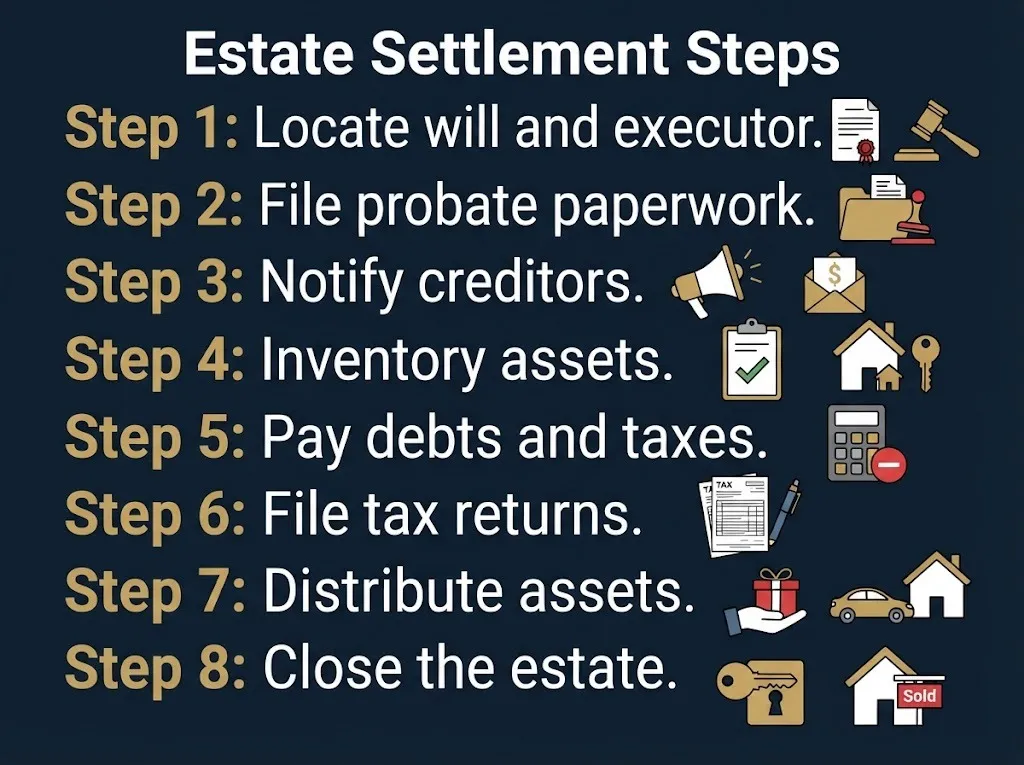
Here are the core tasks in order:
- Locate the will and identify the executor. The named person has legal authority to act.
- File probate paperwork with the court. This validates the will and appoints the executor formally.
- Notify creditors and publish legal notices. State law sets the notice period.
- Inventory and value all assets. Bank accounts, real estate, investments, and personal property.
- Pay valid debts and taxes. Only debts the estate legally owes.
- File final tax returns. Both the decedent’s final return and estate income tax returns.
- Distribute remaining assets. Transfer titles, deeds, and funds to beneficiaries.
- Close the estate. File a final accounting and obtain court approval.
The executor can be held personally liable for mistakes like paying the wrong creditor or distributing too early.
What Happens When There Is No Will?
When someone dies without a will, state intestacy laws determine who inherits. The process is called administration rather than probate.
Without a will, the court appoints an administrator. The distribution follows a formula set by state law. Spouses, children, and other relatives get shares in an order the legislature decided.
This often surprises blended families. A surviving spouse may not inherit everything. Children from a previous marriage may have claims. The outcome depends on state rules.
An heirship determination proceeding may be required. Two witnesses testify about the family history before the court can distribute anything.
How Do You Avoid Probate Entirely?
You avoid probate by using a trust, beneficiary designations, and payable-on-death accounts for major assets. These transfer directly to named people without court involvement.
Assets that bypass probate include life insurance policies, retirement accounts with named beneficiaries, and bank accounts set up as payable-on-death. A revocable living trust holds assets during life and distributes them after death without court oversight.
The will still matters for anything not placed in a trust. But the bulk of an estate can move without waiting for the probate calendar.
Key Takeaway: Estate settlement can be avoided for many assets through trusts and beneficiary designations, but a will alone does not skip probate.
What Is the Estate Settlement Process for Small Estates?
Small estates often qualify for simplified procedures that skip formal probate entirely. California allows affidavit collection for personal property estates worth $208,850 or less for deaths before April 1, 2026.
The threshold rises to $239,700 or less for deaths on or after April 1, 2026. These limits cover personal property only, not real estate.
Every state sets its own small-estate threshold. If the estate falls below it, the family can collect assets in weeks instead of waiting out the full probate calendar.
Families with modest estates should always check whether a simplified option is available before paying for full probate services.
What Are the Risks of Estate Settlement Fraud?
Estate settlement fraud is rising, with organized schemes targeting probate systems in multiple countries. Fraudulent wills and forged documents are being used to steal inheritances.
In the UK, investigators documented nearly a dozen cases with a consistent pattern. The wills were simple, one or two pages. Entire estates went to young individuals with no connection to the deceased. Witness signatures were untraceable. Properties sold within weeks of probate being granted.
The estimated value of these frauds ranged from £2 million to £10 million. Authorities were slow to respond.
In Australia, AI-powered scammers are exploiting property settlement processes. One Melbourne worker lost $90,000 when a hacker impersonated his conveyancer and switched bank account details. A Gold Coast couple lost $250,000 in a spear-phishing attack.
The common thread: scammers intercept communications and redirect funds. If someone emails you new bank details for a settlement payment, call to verify using a number you already have.
What Happens Next
If you are settling an estate, here is the timeline ahead.
Now: Locate the will and identify the executor. Gather death certificates and asset documents.
Within 30 days: File probate paperwork if required. Notify banks and financial institutions.
Expected Q1 2027: Complete asset inventory and begin creditor notification period.
Expected mid-2027: File tax returns and resolve any disputes.
Expected late 2027: Distribute assets and close the estate.
Frequently Asked Questions
Is estate settlement the same as probate?
No. Probate is the court process that validates a will and appoints an executor. Estate settlement is the broader work of closing the estate, which may include probate but also covers debts, taxes, and distributions.
How much does estate settlement cost in 2026?
Published pricing ranges from $500 flat tiers to 1% of estate value with a $9,000 minimum. Do-it-yourself options start around $39.
How long does it take to settle an estate?
Most beneficiaries receive inheritances 12 to 18 months after probate begins. The national average runs about 20 months. Complex or contested estates take longer.
Do I need a lawyer to settle an estate?
You are not legally required to hire a lawyer. But if the estate is contested, involves disputes, or has complex tax issues, an attorney is strongly recommended.
Can I settle an estate without probate?
Yes, if the estate qualifies for simplified procedures or if assets pass through a trust or beneficiary designations. Many states offer small-estate affidavit procedures.
What happens if I die without a will?
State intestacy laws determine who inherits. The court appoints an administrator. Distribution follows a formula set by the legislature, which may not match your wishes.
Are estate settlement companies worth the cost?
They can be for larger or complex estates. For modest estates, a local attorney may charge less than the $9,000 minimum. Run the numbers for your state.
What should I do if I suspect estate fraud?
Contact local law enforcement and the state attorney general’s office. If a fraudulent will is involved, report it to the probate court immediately.