TCPA Lawsuit 2026: $500 to $1,500 Per Call, Active Settlements, and How to File
Quick Answer
- The TCPA lets you sue for $500 per illegal call or text, or up to $1,500 if the violation was willful.
- Several active settlements are paying now, including O’Reilly Auto Parts ($18.8M) and Gen Digital ($9.95M).
- You have four years from each call or text to file a TCPA claim, and many attorneys work on contingency.
The TCPA lawsuit is your legal tool against robocallers, spam texters, and companies that won’t stop calling. The Telephone Consumer Protection Act gives you the right to sue for real money, and you don’t need a government agency to enforce it.
TCPA filings doubled in 2025, making it one of the most actively litigated consumer protection laws on the books . Companies have paid millions to settle class actions, and individual cases routinely resolve for four and five figures when the evidence is solid .
This guide covers what the TCPA prohibits, how much each violation is worth, which settlements are active in 2026, and the exact steps to document and file a claim. The most important number to remember: $500 per call, with the possibility of $1,500 if you can prove the company knew it was breaking the law.
The Facts
| Law | Telephone Consumer Protection Act (47 U.S.C. § 227) |
| Statutory Damages | $500 per violation, up to $1,500 for willful violations |
| Statute of Limitations | 4 years from each call or text |
| Active Settlements | O’Reilly Auto Parts ($18.8M), Gen Digital ($9.95M) |
| Attorney Fees | Most work on contingency, no upfront cost |
| Do Not Call Registry | donotcall.gov, free and permanent |
Is the TCPA lawsuit real and enforceable?
Yes. The TCPA is a federal law passed in 1991 that restricts automated calls, prerecorded messages, and texts to consumers without consent . It has real teeth, and courts enforce it.
The law carries statutory damages of $500 per violation under 47 U.S.C. § 227(b)(3) and § 227(c)(5). If the violation is willful or knowing, a court can treble that to $1,500 per violation .
A 2026 Nevada case, Edwards v. Tamez, shows both the power and the limits of the law. After five years of litigation over four marketing calls, the court awarded just $1,000, choosing to exercise discretion at $250 per call instead of the maximum . The case shows that individual TCPA cases can produce meaningful recoveries, but outcomes depend on the evidence and the judge.
For class actions, the numbers are much bigger. Companies settle for millions because the per-violation math adds up fast.
How much is a TCPA lawsuit worth per call?
A TCPA lawsuit is worth $500 per call or text at the base statutory rate, and up to $1,500 per violation if the court finds the violation was willful or knowing .
Here is how the math works:
| Violation Type | Base Award | Willful Award |
|---|---|---|
| One illegal robocall | $500 | $1,500 |
| One illegal text | $500 | $1,500 |
| 25 illegal calls after revocation | $12,500 | $37,500 |
Each call and each text is a separate violation . If you received 25 unwanted texts over three months after you told the company to stop, that is 25 violations. Even without trebling, the exposure is $12,500.
A 2026 class action settlement with Comodo Group paid an average of $596.17 per claiming member, weighted by the number of unlawful calls received . That average reflects a mix of claimants who received one call and those who received many.
Which TCPA settlements are active in 2026?
Several TCPA class action settlements are active or recently approved in 2026. The largest is O’Reilly Auto Parts, which agreed to pay $18.8 million to settle claims over SMS messages to numbers on the Do Not Call list .
The O’Reilly settlement has approximately 525,000 class members. If all class members file claims, each would receive about $35. With a typical 5% claims rate, individual payouts could reach $500 or more . The settlement drew criticism because it was reached in the Seventh Circuit, where a recent ruling held that SMS messages may not constitute “telephone calls” under the TCPA .
Gen Digital, the company behind LifeLock and Norton, settled for $9.95 million over wrong-number prerecorded calls. The class covers calls from February 2021 to October 2025 .
Molina Healthcare settled for $1.93 million over wrong-number prerecorded calls. The settlement is non-reversionary, meaning all 18,794 class members receive a check, averaging $102.69 each .
The Money Source settled for $1.5 million over robocalls made after consumers said stop. Class members are estimated to receive about $285 each .
Who qualifies for a TCPA lawsuit or settlement?
You may qualify for a TCPA claim if you received calls or texts that violate the law. The most common qualifying situations include:
- Autodialed or prerecorded calls to your cell phone without your prior express written consent
- Calls to a number on the National Do Not Call Registry without your consent
- Calls after you revoked consent by saying stop, texting STOP, or telling the caller to remove you
- AI-generated voice calls that sound human but are artificial
- Calls outside permitted hours, before 8 a.m. or after 9 p.m. in your time zone
- Wrong-number calls where the caller used a prerecorded voice to a number not associated with their customer
For class action settlements, the class definition is set by the court. You may be automatically included if you fit the definition and did not opt out.
What does the TCPA prohibit?
The TCPA prohibits several specific practices related to telemarketing and automated calls. Unless you gave prior express consent, companies cannot make autodialed or prerecorded calls to your cell phone .
The law also prohibits:
- Calls before 8 a.m. or after 9 p.m. in your local time zone
- Calls to numbers on the National Do Not Call Registry without written consent
- Calls after you revoke consent, with companies required to honor stop requests within 10 business days under FCC rules effective April 2025
- AI-generated voice calls, which the FCC has ruled qualify as “artificial or prerecorded”
- Caller ID spoofing or blocking
- Unsolicited fax advertisements
The law does have exceptions. Manually dialed calls to numbers not on any DNC registry, emergency calls, and informational calls from businesses you have an existing relationship with are generally exempt .
How do you file a TCPA lawsuit?
You file a TCPA lawsuit by documenting the violations, identifying the caller, and consulting an attorney. Most TCPA attorneys work on contingency, meaning you pay nothing unless you recover .
Here are the steps in order:
- Document every call and text with screenshots of your call log and messages.
- Save voicemails because prerecorded messages are direct evidence.
- Keep your phone bills for the full four-year limitations period.
- Identify the caller by answering calls and asking for company details, or using reverse lookup tools .
- File a complaint with the FCC to create an official record.
- Consult a TCPA attorney who handles contingency cases.
- Preserve your phone through any litigation to avoid spoliation issues.
For class actions, you may not need to file anything yourself. If you are included in a class definition, you will receive notice and can file a claim or opt out.
Key Takeaway: The TCPA pays $500 to $1,500 per illegal call or text, and you have four years from each violation to act, so documenting every unwanted contact is the foundation of any claim.
What evidence do you need for a TCPA case?
You need a call log, screenshots of texts, saved voicemails, and a written log of any stop requests. TCPA cases are won on the consumer’s own records .
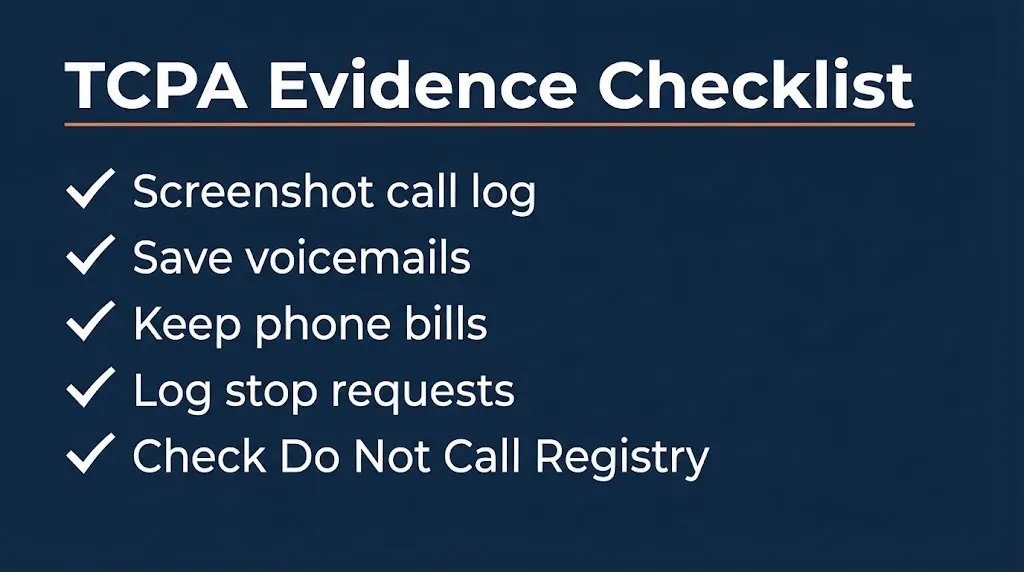
The evidence checklist includes:
- Screenshot your call log immediately showing date, time, and calling number
- Save every voicemail and back it up to cloud storage
- Screenshot spam texts in full, showing the sender number and timestamp
- Keep your carrier records because carriers produce 6 to 24 months of detailed logs on request
- Document consent revocation in writing by replying STOP and screenshotting the exchange
- Keep your Do Not Call Registry confirmation from donotcall.gov
Do not delete anything. Spoliation arguments can damage an otherwise strong case .
One caution: Florida is an all-party consent state for call recording. Recording a live call without the other party’s consent can itself be a crime. Screenshots of logs and texts carry no such risk .
Reality Check
If someone calls claiming you owe money to “process” a TCPA claim, that is a scam. TCPA attorneys work on contingency, and you never pay upfront. If a settlement administrator contacts you, they will not ask for your bank account or Social Security number to “release” funds. Filing a claim is always free. And if a company tells you they can “guarantee” a specific payout, they cannot. Every case depends on the evidence and the court.
What happens next in a TCPA lawsuit?
The path from unwanted call to recovery follows a predictable sequence.
Document the violations: Screenshot calls, save voicemails, and log every contact.
Identify the caller: Use reverse lookups, ask the live agent, or check the FCC database .
Consult an attorney: Most TCPA lawyers offer free consultations and work on contingency .
File the complaint: Your attorney handles this, and the case either settles or proceeds to trial.
Recovery: If you win or settle, you receive your share after attorney fees.
The statute of limitations is four years from each violation, so do not wait .
Frequently Asked Questions
How much can I sue for under the TCPA?
You can sue for $500 per call or text, or up to $1,500 if the violation was willful or knowing .
What is the statute of limitations for a TCPA lawsuit?
Four years from each call or text under 28 U.S.C. § 1658 .
Do I need to be on the Do Not Call Registry to sue?
No. Prerecorded-voice and autodialer claims do not require DNC registration. Only DNC-Registry claims under § 227(c)(5) require it .
Can I sue for text messages under the TCPA?
Yes, though a recent Seventh Circuit ruling held that SMS messages may not constitute “telephone calls” under the TCPA, creating uncertainty in that circuit . The law remains unsettled on this point.
What is the O’Reilly Auto Parts TCPA settlement?
O’Reilly agreed to pay $18.8 million to settle claims over SMS messages to numbers on the Do Not Call list, covering approximately 525,000 class members .
How do I revoke consent under the TCPA?
You can revoke consent “in any reasonable manner,” including texting STOP, saying “stop calling me,” or telling the caller to remove you. Companies must honor the request within 10 business days .
Do I need a lawyer to file a TCPA lawsuit?
Not necessarily, but most consumers use an attorney because TCPA cases are handled on contingency and the procedural rules are complex .
How long does a TCPA lawsuit take?
Timelines vary. A 2026 Nevada case took five years to reach trial . Class actions can take two to four years from filing to settlement approval.
Your next step
If you are receiving unwanted calls or texts, start documenting today. Screenshot your call log, save every voicemail, and write down when you told the caller to stop. The four-year statute of limitations runs from each violation, so delay costs you money.
Consult a TCPA attorney about your options. Most work on contingency, and the math on per-violation damages can turn a modest call log into a meaningful recovery. The most important number to remember: $500 per call, with up to $1,500 if the company knew it was breaking the law.