Compensation Analyst Jobs: What This Role Actually Is
Quick Answer
- What is it? A human resources role focused on designing and analyzing pay structures, market benchmarking, and compensation programs.
- What do they earn? The national median was $78,210 in May 2025, with tech and finance roles reaching $164,600+.
- Is it growing? Yes. The Bureau of Labor Statistics projects 6 percent employment growth from 2025 to 2035.
A compensation analyst is an HR professional who designs and analyzes pay structures to ensure they are fair, competitive, and aligned with market rates. You collect salary data, benchmark jobs against industry surveys, and make recommendations about base pay, bonuses, and equity programs.
This is not a recruiting role or a benefits administrator role, though the work overlaps with both. You sit in the total rewards function and report to compensation managers or HR leaders. Your daily output is spreadsheets, market pricing models, and pay range recommendations.
The work is data-heavy and detail-obsessed. If you like Excel, salary surveys, and translating numbers into business recommendations, this field fits.
How Much Do Compensation Analysts Make in 2026?
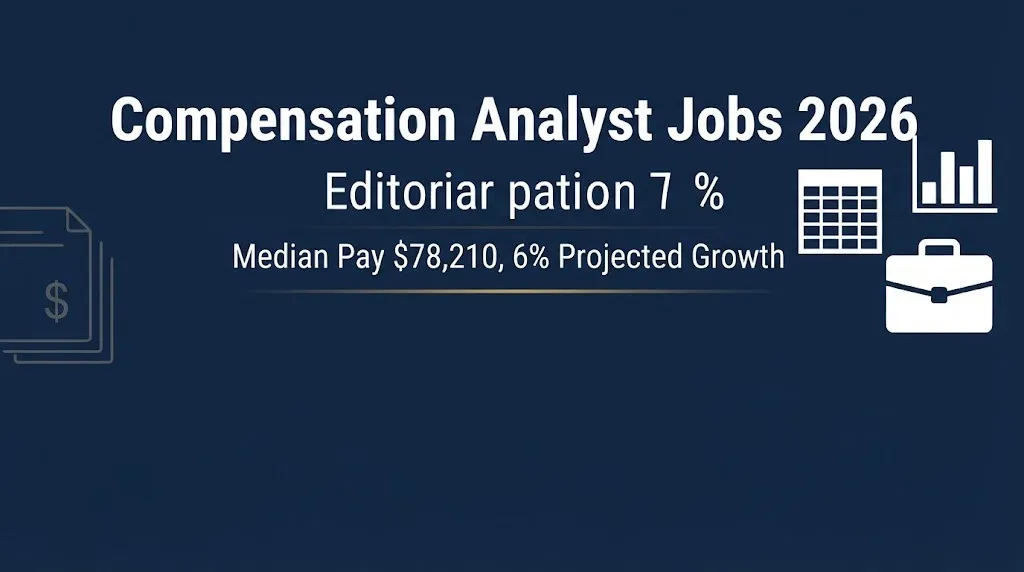
The national median annual wage for compensation, benefits, and job analysis specialists was $78,210 in May 2025, according to the Bureau of Labor Statistics. The lowest 10 percent earned under $49,480, and the highest 10 percent earned over $128,920.
Actual offers in 2026 vary widely by industry and location. Here are verified ranges from live job postings:
| Company | Role | Salary Range | Location |
|---|---|---|---|
| Stripe | Compensation Analyst | $109,800 – $164,600 | Remote (US) |
| Twilio | Senior Compensation Analyst | $92,800 – $136,500 | Remote (varies by state) |
| Wealth Enhancement Group | Compensation Analyst | $95,000 – $105,000 | Remote |
| PGIM (Prudential) | Compensation Analyst | $80,000 – $95,000 | Hybrid |
| Tines | Sales Compensation Analyst | $110,000 – $130,000 | Remote (East Coast) |
| Zeta Global | Global Compensation Analyst | $120,000 – $130,000 | Remote |
Apple’s compensation analyst postings list a range of $90,000 to $130,000, with the actual offer depending on experience and location. Reddit’s Lead Compensation Partner role, a more senior position, pays $180,200 to $252,300.
The BLS breaks down median wages by industry. Management of companies and enterprises paid the highest at $84,240, followed by professional, scientific, and technical services at $84,000.
Key Takeaway: Compensation analyst salaries range from roughly $49,000 at the low end to over $164,000 at tech companies, with the national median sitting at $78,210.
Is the Compensation Analyst Job Market Growing or Shrinking in 2026?
The Bureau of Labor Statistics projects 6 percent employment growth for compensation, benefits, and job analysis specialists from 2025 to 2035. That is faster than the average for all occupations.
About 9,000 openings are projected each year over that decade. Most of those openings come from replacing workers who transfer to other occupations or leave the labor force entirely.
The growth is driven by regulatory complexity, not just company expansion. New pay transparency laws in California, New York, Colorado, and the European Union require employers to disclose salary ranges and justify pay decisions. That work falls on compensation analysts.
One countervailing trend: AI tools are automating the data-crunching side of the job. Salary benchmarking, survey data normalization, and job matching now take minutes instead of weeks. But the strategic side of compensation, pay philosophy design, executive comp, equity structures, still requires human judgment.
Key Takeaway: The field is growing at 6 percent through 2035, but the job is shifting from data processing toward strategy and governance.
What Skills and Experience Do You Need for a Compensation Analyst Job?
Most employers require a bachelor’s degree in human resources, business, finance, or a related field, plus 2 to 5 years of relevant experience. The specific requirements depend on the seniority of the role.
From verified 2026 job postings, here is what employers are asking for:
Technical skills:
- Advanced Excel or Google Sheets (modeling, pivot tables, lookups, complex formulas)
- Experience with HRIS platforms, especially Workday
- Familiarity with market pricing tools and survey data from providers like Radford, Mercer, and WTW
- Data visualization tools like Tableau or Power BI
Core competencies:
- Market benchmarking and job evaluation
- Understanding of job architecture and leveling frameworks
- Knowledge of base pay, bonus, and equity program design
- Pay equity analysis and compliance with pay transparency laws
- Strong communication skills to explain complex data to HR partners and business leaders
Experience levels:
- Entry-level roles typically ask for 1 to 3 years of compensation or HR analytics experience
- Mid-level roles want 3 to 5 years
- Senior and lead roles require 5 to 10+ years, often with public company equity experience
Do You Need a Certification to Get a Compensation Analyst Job?
No certification is strictly required to get hired as a compensation analyst. But the Certified Compensation Professional credential from WorldatWork is the industry standard and appears in job postings as a preferred qualification.
The CCP credential requires passing eight exams covering total rewards strategy, base pay design, variable pay, market pricing, compensation analytics, and business communication. WorldatWork also offers a bundle option that saves 15 percent compared to buying courses individually.
ERI Economic Research Institute offers a Compensation Analyst Credential that teaches salary planning fundamentals through 12 online courses. Marian University offers a six-course certificate program that can be completed in as little as 21 weeks.
For remote roles specifically, the CCP designation signals seriousness to employers who cannot meet you in person.
Are Remote Compensation Analyst Jobs Available in 2026?
Yes. Remote compensation analyst roles are common and increasing. Stripe’s current posting offers a fully remote option for candidates 35+ miles from a Stripe office. Wealth Enhancement Group lists its compensation analyst position as fully remote with a $95,000 to $105,000 salary range.
Twilio’s senior role is remote but excludes candidates in California, Connecticut, New Jersey, New York, Pennsylvania, and Washington due to state employment regulations. Viasat’s EMEA compensation analyst role is remote but requires US, UK, or EU citizenship.
Remote roles tend to pay based on geographic location. Twilio’s range shifts from $92,800 to $116,000 for Colorado or DC candidates, up to $109,200 to $136,500 for the San Francisco Bay area. This mirrors how a store return might refund you the sale price, not the current price: your pay adjusts to the local market where you sit.
Key Takeaway: Remote compensation analyst jobs exist, but many adjust pay based on where you live and exclude certain states for regulatory reasons.
Reality Check: No legitimate employer or recruiter asks you to pay for a job lead, a certification they “require,” or a background check upfront. Real compensation analyst jobs list salary ranges in the posting, interview you without charging fees, and never ask for payment to “secure” the role. If someone promises a six-figure comp analyst job for a $200 training fee, it is a scam.
How Do You Become a Compensation Analyst in 2026?
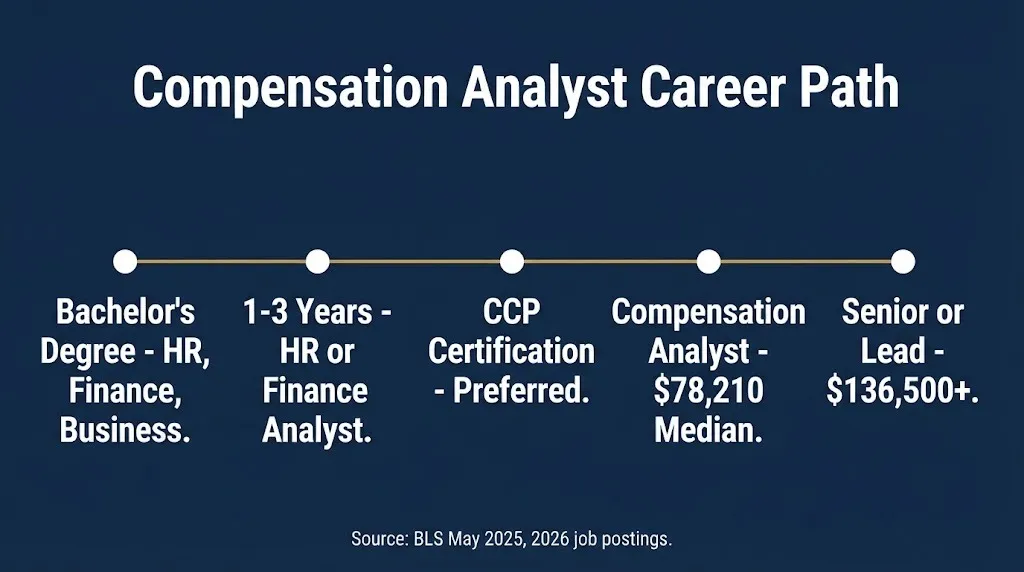
The most common path is a bachelor’s degree in HR, finance, or business, followed by 1 to 3 years in an HR generalist or analyst role, then a move into compensation. But there are faster routes.
Step 1: Get the foundational knowledge. A bachelor’s degree in HR, finance, or business is the standard entry requirement. Some roles accept equivalent experience.
Step 2: Build Excel and data skills. Every posting requires advanced spreadsheet work. If you cannot build a lookup formula or a pivot table, start there.
Step 3: Learn an HRIS platform. Workday experience appears in most postings. Free training resources exist, but hands-on experience matters more.
Step 4: Pursue a certification if you lack experience. The CCP or ERI credential can help you break in when your resume does not have compensation-specific roles.
Step 5: Target adjacent roles first. HR generalist, HR analyst, or finance analyst positions can lead to compensation internally. Many companies promote from within.
Step 6: Apply for entry-level comp analyst roles. Look for titles like “Compensation Analyst I” or “Associate Compensation Analyst.” Wealth Enhancement Group asks for just 2 years of experience for its remote role.
Will AI Replace Compensation Analysts?
AI is automating parts of the job, but not the whole role. Salary benchmarking and market data analysis have already reached high automation rates. Platforms like Payscale, Radford, and Mercer use machine learning to aggregate and normalize compensation data across millions of sources.
The tasks most exposed to automation include data aggregation, job title matching, benefits comparison reports, and standard compliance checks. The tasks least exposed include compensation philosophy design, executive pay decisions, pay equity judgment calls, and stakeholder communication.
What does that mean for you? If your comp analyst job is entirely spreadsheet processing, that work is shrinking. If you can interpret data, advise leaders, and design programs, you are safer. The job is shifting toward the strategic end.
One analysis places compensation analysts at 48 out of 100 on automation risk, with 61 percent AI exposure. That is high exposure but not replacement. The role evolves rather than disappears.
What Is the Difference Between a Compensation Analyst and a Compensation Manager?
A compensation analyst does the analysis and modeling. A compensation manager sets the strategy and manages the team. The analyst runs the numbers; the manager decides what to do with them.
The salary gap reflects that difference. Analysts earn a median of $78,210 nationally. Senior analysts and lead partners earn $180,000 to $252,000 at companies like Reddit. Managers typically sit between those ranges.
Job titles in this field are not standardized. You will see “Compensation Analyst,” “Senior Compensation Analyst,” “Lead Compensation Partner,” “Global Compensation Analyst,” and “Sales Compensation Analyst.” Read the responsibilities, not just the title.
What Happens Next for Compensation Analyst Hiring in 2026
The hiring market for compensation analysts remains active through the rest of 2026. Here is what to expect:
Ongoing: Pay transparency laws in more states will drive demand for analysts who can build compliant pay ranges and conduct equity audits.
Expected Q4 2026: Annual compensation planning cycles at most companies will create contract and full-time openings for analysts with Workday and market pricing experience.
Ongoing: AI tool adoption will continue shifting job descriptions toward strategic work and away from manual data processing.
Expected 2027: Growth in global compensation roles as multinational companies standardize pay frameworks across countries.
Frequently Asked Questions
How much do compensation analysts make in 2026?
The national median was $78,210 in May 2025, with tech and finance roles paying $109,800 to $164,600.
Do you need a degree to become a compensation analyst?
Most employers require a bachelor’s degree in HR, business, or finance, though equivalent experience is sometimes accepted.
Is the compensation analyst job market growing?
Yes. The BLS projects 6 percent employment growth from 2025 to 2035, faster than the average for all occupations.
Can you work remotely as a compensation analyst?
Yes. Many companies offer fully remote roles, though some adjust pay based on your location.
What is the CCP certification?
The Certified Compensation Professional credential from WorldatWork is the industry standard, requiring eight exams.
Will AI replace compensation analysts?
AI is automating data analysis but not strategic work like pay philosophy design and executive compensation decisions.
How do you get an entry-level compensation analyst job?
A bachelor’s degree, strong Excel skills, and 1 to 3 years of HR or finance experience is the common entry path.
What is the difference between a compensation analyst and an HR generalist?
Compensation analysts specialize in pay data and structures, while HR generalists handle broader employee relations and recruiting.
If you are searching for a compensation analyst job in 2026, the field is hiring and paying well. Check company career pages directly, target roles that match your experience level, and build the Excel and Workday skills employers actually list. The median salary is $78,210, but the right company can pay well over six figures.