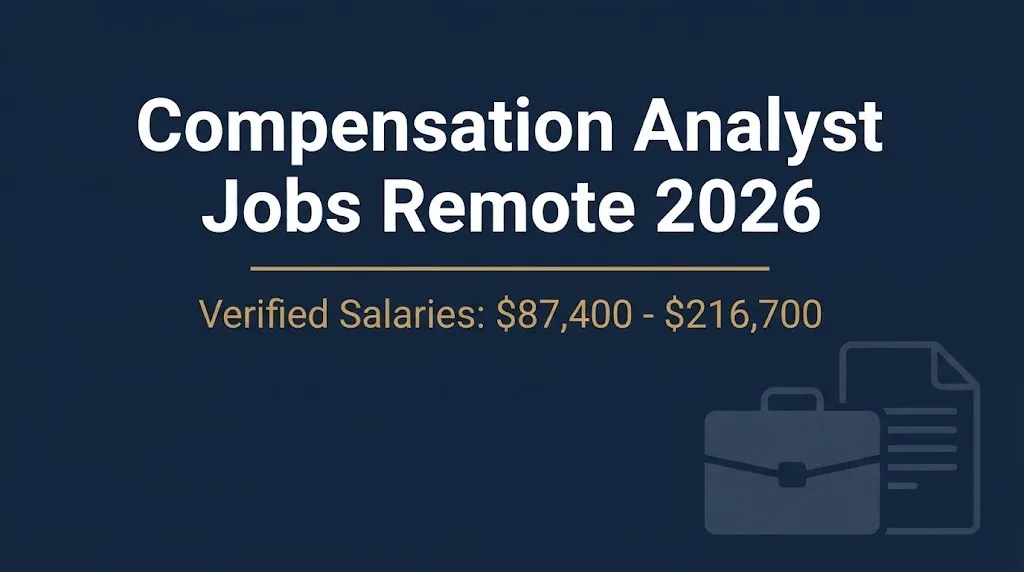
Compensation Analyst Jobs Remote 2026: Verified Salaries, Real Openings, and How to Spot the Scams
Quick Answer
- Real remote roles exist. Verified openings at Wealth Enhancement Group ($95k-$105k), Zeta Global ($120k-$130k), and Tailscale ($120k-$150k) are posted for 2026.
- Salary range spans $87,400 to $216,700 based on company pay transparency disclosures. Senior and principal roles command the highest bands.
- Scammers are impersonating recruiters. The FTC warns that fake remote job texts and WhatsApp messages are rising in 2026. Never pay for a job.
Are remote compensation analyst jobs legit or a scam?
Remote compensation analyst jobs are legitimate. Real companies post real openings with real salary ranges. But the remote job market has a scam problem that you need to understand before you apply anywhere.
The Federal Trade Commission issued a warning in April 2026 about fake recruiters sending text messages that offer remote positions . These scammers claim to represent legitimate companies and ask you to reply “YES” or “INTERESTED.” Once you engage, they find reasons for you to send money. Sometimes they mail a fake check and ask you to send part back. Other times they assign online tasks and eventually demand you deposit your own money.
The New Jersey Cybersecurity and Communications Integration Cell issued a similar alert in July 2026, reporting an increase in remote job scams targeting state employees and residents . The scammers impersonate HR departments, use generic greetings, and push conversations to Signal or WhatsApp.
Reality Check: No legitimate employer will ever ask you to pay for training, equipment, or background checks. No real recruiter will interview you entirely through text or WhatsApp. If someone promises high pay for little work and wants your bank details before you have met a hiring manager, it is a scam. The FTC says real employers never contact you that way .
How much do remote compensation analyst jobs pay in 2026?
Remote compensation analyst salaries in 2026 range from $87,400 to $216,700 per year, based on verified pay transparency disclosures from active job postings. Your actual offer depends on experience, location, and whether the role includes equity or bonus.
Here is a breakdown of verified salary ranges from 2026 job postings:
| Company | Role | Salary Range | Equity/Bonus |
|---|---|---|---|
| Wealth Enhancement Group | Compensation Analyst | $95,000 – $105,000 | Annual bonus eligible |
| EarnIn | Compensation Analyst II | $113,000 – $139,000 | Equity + benefits |
| Zeta Global | Global Compensation Analyst | $120,000 – $130,000 | Equity |
| Tailscale | Revenue Compensation Analyst | $120,000 – $150,000 | Equity |
| ZoomInfo | Principal Compensation Analyst | $137,900 – $216,700 | Bonus, commission, equity |
| Twilio | Senior Compensation Analyst | $92,800 – $136,500 | Equity + corporate bonus |
The variation is wide because these are different levels and specializations. A Global Compensation Analyst at Zeta Global handles job architecture and market pricing across regions . A Revenue Compensation Analyst at Tailscale focuses on sales commissions and incentive plans . A Principal role at ZoomInfo is a senior individual contributor with strategic advisory duties .
Location matters too. Twilio’s posting shows different ranges for Colorado, New York, Washington, and the San Francisco Bay area . Remote does not always mean one national pay scale.
What qualifications do you need for a remote compensation analyst job?
You need at least a bachelor’s degree and 2 to 6 years of relevant experience for most analyst roles. Senior and principal positions typically require 5 to 8+ years and demonstrated expertise in equity, sales compensation, or global pay structures.
Here is what employers consistently list as required in 2026 postings:
- Bachelor’s degree in HR, finance, business, economics, or a related analytical field
- 2 to 4 years of compensation, HR analytics, or finance experience for standard analyst roles
- 3 to 6+ years for senior or global roles
- Advanced Excel skills including pivot tables, lookups, and financial modeling
- Market pricing and survey experience with tools like Aon Radford, Mercer, or WTW
- HRIS familiarity, especially Workday
- Job architecture and leveling knowledge for roles at larger companies
Preferred qualifications often include experience with sales commissions, equity administration, public company compliance, and global pay practices. Certification as a Certified Compensation Professional is listed as an asset in some postings .
Key Takeaway: The remote compensation analyst market is real and paying well in 2026. The barrier to entry is experience and specific technical skills, not geography.
How do you find legitimate remote compensation analyst openings?
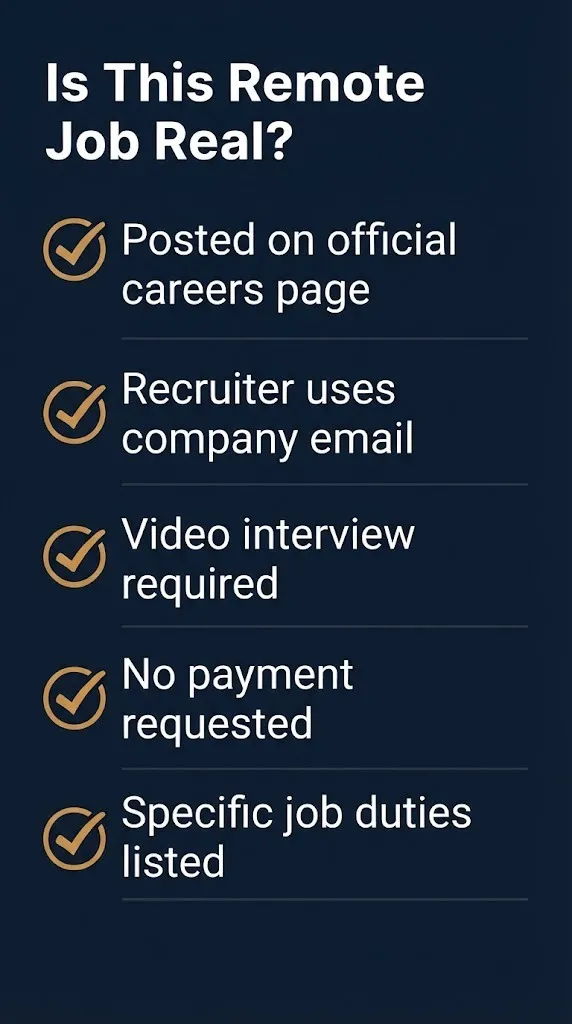
You find legitimate remote compensation analyst openings by checking company career pages directly and using established job boards. Scammers copy real job descriptions and post them on social media or send them via text. The official source is your best filter.
Here is a numbered process for finding and verifying openings:
- Search the company’s official careers page first. If the role is real, it appears there .
- Cross-check on reputable boards like LinkedIn, Glassdoor, or industry-specific job boards.
- Verify the recruiter’s email domain. Legitimate recruiters use company email addresses, not Gmail or Yahoo accounts .
- Look for a structured interview process. Real employers conduct phone or video interviews before making offers .
- Check the job description for specifics. Scam postings are vague about duties and requirements .
- Search the company name plus “scam” or “review” before applying .
- Never pay for anything. No training fee, no equipment deposit, no background check cost .
A plain-life comparison: verifying a job posting is like checking a contractor’s license before letting them work on your house. You look for the official record, not the business card they handed you.
What red flags should you watch for in remote job offers?
The biggest red flags in remote job offers are requests for payment, interviews conducted entirely through messaging apps, and offers made without a real interview. The FTC and the Identity Theft Resource Center have documented these patterns extensively in 2026.
Warning signs to watch for:
- You receive an offer before any interview
- All communication is by text, WhatsApp, or Telegram
- The recruiter asks you to move to Signal or another encrypted app
- You are asked to pay for training, software, or equipment
- The salary sounds unusually high for the role
- The recruiter sends a check and asks you to buy supplies
- The email domain is slightly altered from the real company (example: “Infosys Ltd.” changed to “InfoSys Global”)
- You are pressured to act immediately
The Identity Theft Resource Center notes that scammers sometimes ask for your Social Security number or driver’s license before any verified interview . Real employers do not request that level of personal information early in the hiring process.
What skills do compensation analysts actually use day to day?
Compensation analysts spend most of their time analyzing data, benchmarking pay against market surveys, and building models that inform salary decisions. The work is analytical and detail-heavy, not people-facing in the traditional HR sense.
Core daily tasks include:
- Market pricing: Matching internal jobs to external survey data to determine competitive pay
- Job evaluation: Assessing roles to assign them to the right level and salary band
- Data analysis: Building spreadsheets and models to identify pay equity issues, compression, and trends
- Survey participation: Submitting company data to compensation surveys and analyzing the results
- Incentive plan administration: Calculating bonuses, commissions, and equity grants
- Stakeholder communication: Explaining compensation decisions to HR partners and business leaders
A Global Compensation Analyst at Zeta Global uses Aon Radford as a primary survey source and partners with Finance and Sales Operations on commission plans . A Revenue Compensation Analyst at Tailscale manages commission processing in CaptivateIQ and audits calculations against Salesforce data . The specialization matters.
What is the difference between compensation analyst and total rewards analyst?
Compensation analysts focus on pay, including salary structures, market pricing, and incentive plans. Total rewards analysts cover a broader scope that includes benefits, retirement plans, and sometimes equity in addition to compensation .
In practice, the titles are often used interchangeably at smaller companies. At larger organizations, the distinction is clearer. A total rewards role might oversee health insurance plan design, 401(k) matching strategy, and paid time off policies alongside salary benchmarking .
If you see a posting for a “Total Rewards Analyst,” expect the job description to include benefits administration in addition to compensation analysis. If you prefer to specialize in pay alone, look for postings with “Compensation Analyst” in the title.
What happens next if you want a remote compensation analyst job?
Immediately: Update your resume to highlight any experience with market pricing, survey data, Excel modeling, and HRIS systems. Those are the skills employers verify first.
This month: Check the career pages of companies you want to work for. Verified 2026 openings exist at Wealth Enhancement Group, Zeta Global, Tailscale, and EarnIn .
Ongoing: Treat every unsolicited recruiter message as a potential scam until you verify it through the company’s official channels. The FTC’s job scam resources are your reference point .
Expected late 2026: Remote and hybrid compensation roles will remain competitive. Companies continue to list fully remote positions with transparent salary ranges, which makes comparison shopping easier for candidates.
Frequently Asked Questions
What is the average salary for a remote compensation analyst?
Verified 2026 salary ranges span $87,400 to $216,700 depending on level and company. Standard analyst roles cluster around $95,000 to $130,000, while principal and senior roles reach higher.
Do remote compensation analyst jobs require a degree?
Most postings require a bachelor’s degree in HR, finance, business, or a related field. Some employers accept equivalent experience in place of a degree .
Is it hard to get a remote compensation analyst job?
It is competitive but not impossible. Employers want 2 to 6 years of relevant experience plus specific skills in Excel, market pricing, and HRIS systems. Without that background, breaking in is harder.
What tools do compensation analysts use?
Common tools include Workday, Aon Radford, Mercer, CaptivateIQ, Salesforce, and advanced Excel or Google Sheets. Some roles use PayScale or Anaplan .
How can I tell if a remote job offer is a scam?
If the recruiter asks for payment, interviews only through text or WhatsApp, or sends a check for equipment, it is a scam. Real employers never do those things .
Do remote compensation analyst jobs offer benefits?
Yes. Verified postings include medical, dental, vision, 401(k), paid time off, and equity or bonus eligibility depending on the company .
Can I work remotely as a compensation analyst from any state?
Some roles are fully remote with no restrictions. Others exclude specific states for tax or legal reasons. Twilio’s posting, for example, excludes California, Connecticut, New Jersey, New York, Pennsylvania, and Washington .
What is the career path for a compensation analyst?
Typical progression runs from Compensation Analyst to Senior Analyst to Principal Analyst or Compensation Manager. Specializing in equity, sales compensation, or global rewards can accelerate advancement .
Closing
Bookmark the official career pages of companies you want to work for. Check them weekly. The verified roles are there, and the salaries are published.
The single most important rule for 2026: never pay for a job. Real employers pay you. If anyone asks for money first, walk away.