St. Louis Workers Compensation Attorneys 2026: Missouri Claim Deadlines, Settlements, and Benefit Rules Explained
Quick Answer
- Missouri workers’ comp is a no-fault system covering medical care and part of lost wages
- The standard filing deadline is two years from injury or last payment
- Settlement amounts depend on disability ratings, average weekly wage, and whether future medical care is included
St. Louis workers compensation attorneys handle claims filed with the Missouri Division of Workers’ Compensation, not through a civil lawsuit. The system covers medical bills and partial wage replacement for on-the-job injuries.
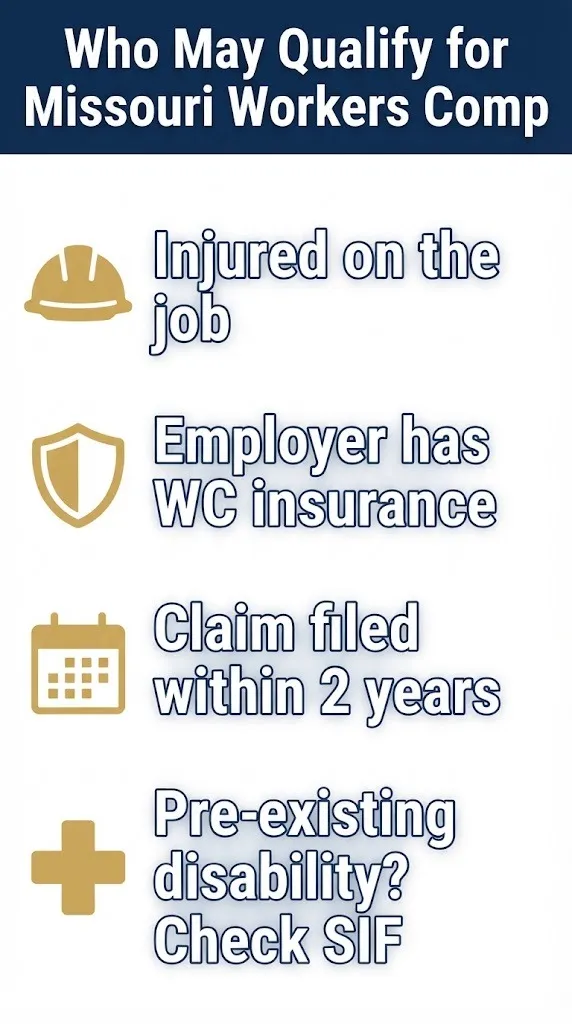
If you were hurt at work in the St. Louis area, the clock matters more than most people realize. Missouri gives you two years to file, though that window can extend to three in certain situations.
This guide covers the verified rules, deadlines, and settlement realities for Missouri workers’ compensation claims in 2026. It also explains why some workers walk away with $15,000 and others with $150,000 for similar injuries.
The Facts
| Item | Detail |
|---|---|
| System Type | State-mandated, no-fault workers’ compensation |
| Governing Agency | Missouri Division of Workers’ Compensation |
| Standard Filing Deadline | 2 years from injury or last payment |
| Extended Deadline | 3 years if employer fails to file timely report |
| Max Weekly Benefit Rate | Set annually by state law (check current DWC schedule) |
| Attorney Fee Cap | 25% of award (requires ALJ approval) |
| Settlement Approval | Required by administrative law judge |
| Second Injury Fund | Separate claim for qualifying pre-existing disabilities |
Is St. Louis Workers Compensation Legit or a Scam Risk?
Missouri workers’ compensation is a real, state-administered system, not a private settlement program. There is no “claim portal” that texts you money. No legitimate administrator cold-calls injured workers offering cash.

The actual process runs through the Missouri Division of Workers’ Compensation. You file a Claim for Compensation form (WC-21) directly with the state. Your employer’s insurance carrier responds. An administrative law judge oversees disputes and must approve any final settlement.
Scams do exist, but they usually come from third parties. Someone claims they can “expedite” your claim for an upfront fee. Or a “case manager” you never hired asks for your Social Security number. Missouri’s system does not work that way.
The state does not charge you to file. The division does not require you to pay anyone to process a claim. If you hire an attorney, their fee is capped at 25% and comes out of your award, not your pocket upfront.
How Much Can You Get from a Missouri Workers Comp Settlement?
There is no single payout figure for Missouri workers’ comp cases. Not yet determined for your situation, because settlement value depends on variables unique to your injury, your wage history, and your medical outcome.
The baseline formula uses your disability rating and your average weekly wage. Your compensation rate is typically 66 and two-thirds percent of your average weekly wage from the 13 weeks before the injury.
Here is how the math works for a permanent partial disability:
| Factor | Example Value |
|---|---|
| Average Weekly Wage | $900 |
| Compensation Rate (66⅔%) | $600/week |
| Disability Rating | 15% |
| Weeks for Body Part | 400 |
| Settlement Calculation | 400 × 15% × $600 = $36,000 |
That is the raw formula. Actual settlements often exceed this baseline when future medical care, disputed ratings, or Second Injury Fund claims are involved.
Your settlement amount depends on several factors that insurance companies do not volunteer:
- Disability rating disputes. The insurance company’s doctor may rate you at 10%. Your treating physician might say 25%. An independent evaluator could land at 20%. That gap can mean tens of thousands of dollars.
- Future medical needs. If you will need ongoing care, surgery, or prescriptions, that value gets negotiated into the lump sum or preserved as open medical benefits.
- Second Injury Fund eligibility. If you had a pre-existing disability before the work injury, you may qualify for an additional award from the state fund.
- Average weekly wage calculation. Overtime, bonuses, and second jobs should be included. Underreporting your AWW lowers every future payment.
Key Takeaway: Missouri workers’ comp settlements are calculated, not guessed. The disability rating and average weekly wage are the two biggest levers, and both can be challenged.
What Is the Filing Deadline for a St. Louis Workers Compensation Claim?
The standard filing deadline is two years from the date of your injury or the date of your last workers’ compensation payment. If your employer did not file a timely Report of Injury with the state, you get three years.
For occupational diseases, the clock starts when the condition becomes reasonably discoverable and you know it relates to work exposure.
Do not confuse the filing deadline with the reporting deadline to your employer. Missouri requires you to notify your employer within 30 days of the injury. Miss that window, and you may lose your right to benefits entirely.
The filing deadline with the Division is the hard stop. Once that date passes, the claim is typically barred. Missouri courts treat this deadline as “one of extinction,” meaning it is jurisdictional, not something that can be waived or excused.
How Do You File a Workers Compensation Claim in Missouri?
File a Claim for Compensation (Form WC-21) with the Missouri Division of Workers’ Compensation. You can submit it electronically, by mail, or in person at a division office. The division serves the employer and insurance carrier once your claim is received.
Here is the step-by-step process:
- Report the injury to your employer in writing within 30 days. Keep a copy.
- Get medical treatment. You may need to see a doctor chosen by your employer initially.
- Complete Form WC-21 (Claim for Compensation). Provide your injury date, body part affected, and employer information.
- File with the Division of Workers’ Compensation. Do not file with the court. Workers’ comp is administrative.
- Respond to requests from the insurance adjuster and the division.
- Attend any scheduled hearings if your claim is disputed.
- Negotiate settlement after reaching Maximum Medical Improvement.
- Get ALJ approval for any final settlement agreement.
The division does not require you to have an attorney to file. But the filing itself is just the first step. What happens after determines your payout.
What Does “Maximum Medical Improvement” Mean for Your Claim?
Maximum Medical Improvement (MMI) means your doctor believes you have recovered as much as you ever will from the injury. Once you hit MMI, the doctor assigns a permanent disability rating.
You cannot meaningfully settle a permanent disability claim before MMI. Settling early means you are agreeing to a disability percentage before anyone knows your final condition. The division and the judge approving the settlement will scrutinize that.
Think of MMI like a store return window. You cannot decide if the product is defective until you have used it long enough. Filing before MMI is like returning something while you are still opening the box.
What Does a Settlement Actually Close Out?
A Missouri workers’ comp settlement closes your case completely. The insurance company will not pay additional compensation. More importantly, they will not provide further medical treatment for that injury.
Do not assume your health insurance will pick up the tab after settlement. Your health insurer may refuse to pay for treatment that should have been the workers’ compensation carrier’s responsibility. That is a coverage gap that catches people off guard.
Some settlements preserve future medical benefits. This happens when the injury has documented ongoing needs and the parties agree to keep medical open. That is a negotiated term, not a default.
Reality Check: No one from the state calls you to “verify your settlement” and collect a fee. No legitimate administrator asks for your bank login. The Missouri Division of Workers’ Compensation does not charge injured workers to file. If someone demands payment upfront to “release your funds,” it is a scam.
What Is the Second Injury Fund and Do You Qualify?
The Second Injury Fund (SIF) provides additional compensation when a work injury combines with a pre-existing disability to create a greater overall impairment than the new injury alone would cause.
To qualify against the SIF, you generally need a prior disability that meets or exceeds 50 weeks of permanent partial disability compensation under Missouri law. That is a specific threshold, not a general “I had a bad back before” standard.
Occupational diseases have a complicated history with the SIF. Missouri courts have held that pre-existing occupational diseases do not count as qualifying prior disabilities for SIF purposes in most cases. This area of law has been actively litigated.
If you think you may have a SIF claim, that determination needs to be made before you settle your primary claim. Once you settle against the employer and carrier, the SIF claim may be affected.
What Happens After You Reach Maximum Medical Improvement?
After MMI, the treating doctor issues a disability rating. This rating drives the settlement calculation. You and the insurance company can then negotiate a compromise settlement under Section 287.390.
A settlement agreement must be approved by an administrative law judge. The judge reviews the agreement to confirm you understand your rights, the settlement is not the result of fraud or undue influence, and the terms are consistent with the law.
The judge does not rubber-stamp settlements. If the agreement looks inadequate or the employee does not appear to understand what they are signing, the judge can reject it.
How Long Does It Take to Get a Settlement Check?
Timelines vary widely. Not yet confirmed for any specific case because each claim follows its own path.
Disputed claims that require hearings take longer. Claims that settle by agreement after MMI move faster. Once an ALJ approves a compromise settlement, payment is typically issued within 30 days.
The real variable is how long it takes to reach MMI and negotiate terms. Some cases resolve in months. Others take a year or more if medical treatment is ongoing or the insurer disputes liability.
What Are the Common Mistakes Injured Workers Make?
The most expensive mistake is settling before you understand your full medical picture. Once a judge approves the settlement, you cannot reopen the case for more money or more treatment, with limited exceptions.
Other mistakes that cost workers money:
- Accepting the insurance company’s disability rating without a second opinion. Their doctor works for them, not you.
- Not documenting out-of-pocket expenses. Travel to appointments, prescriptions, and medical equipment can factor into settlement value.
- Missing the filing deadline. Two years sounds long until it is not.
- Underreporting average weekly wage. If you worked overtime or a second job, those earnings count.
- Signing a settlement without understanding what it closes. Future medical benefits are gone once you sign.
Key Takeaway: The settlement offer is a starting point, not a final number. Missouri law allows you to negotiate, and an ALJ must approve any agreement before it becomes binding.
How Much Do St. Louis Workers Compensation Attorneys Cost?
Missouri caps attorney fees at 25% of the award, and the fee must be approved by an administrative law judge. You do not pay hourly. The fee comes out of your settlement or award.
Most workers’ comp attorneys offer free initial consultations. That means you can get a professional review of your claim and your options before committing to anything.
The 25% cap applies to the combined fees if multiple attorneys work on the case. It is not 25% per lawyer.
If you recover nothing, the attorney typically recovers nothing. The fee is contingent on the outcome.
What Happens Next: Timeline for Your Missouri Workers Comp Claim
- Immediately after injury: Report to your employer in writing. Get medical attention. Document everything.
- Within 30 days: Employer must file a Report of Injury with the Division. If they do not, your filing deadline extends.
- Within 2 years: File your Claim for Compensation (Form WC-21) with the Division of Workers’ Compensation.
- During treatment: Attend appointments. Keep records of lost wages, expenses, and medical restrictions.
- At Maximum Medical Improvement: Doctor issues permanent disability rating. Settlement negotiation can begin.
- After settlement agreement: Submit to an administrative law judge for approval.
- After ALJ approval: Payment typically issued within 30 days.
Frequently Asked Questions
How long do you have to file a workers comp claim in Missouri?
Two years from the date of injury or last payment, or three years if your employer failed to file a timely report.
How much is a workers comp settlement in Missouri?
There is no set amount. It depends on your disability rating, average weekly wage, and whether future medical care is included.
Do you need a lawyer for a workers comp claim in Missouri?
No, but the insurance company has one. The system is designed to be navigable, but the settlement math is not obvious.
What is Maximum Medical Improvement?
It is the point where your doctor says you have recovered as much as you will. Settlement discussions typically begin after MMI.
Can you settle a Missouri workers comp claim before MMI?
Technically yes, but it is risky. You would be agreeing to a disability rating before knowing your final condition.
What is the Second Injury Fund in Missouri?
A state fund that pays additional benefits when a work injury combines with a qualifying pre-existing disability.
Does workers comp cover future medical treatment after settlement?
Only if the settlement agreement specifically preserves it. A full compromise settlement typically closes medical benefits.
How much do workers comp lawyers charge in Missouri?
Attorney fees are capped at 25% of the award and require ALJ approval. Initial consultations are usually free.
If you were injured at work in the St. Louis area, check the filing deadline first. Two years from the injury date is the standard. Then gather your medical records and wage documentation. The Missouri Division of Workers’ Compensation does not charge you to file, and you can review the process before deciding whether to hire an attorney.
The deadline is the one thing you cannot negotiate.