Tax Litigation Attorney 2026: When You Need One and What to Expect
Quick Answer
- A tax litigation attorney represents you in disputes with tax authorities like the FBR, from audit defense to court appeals.
- Legal fees vary widely; contingency arrangements are rare in tax cases, and hourly rates dominate.
- Most tax disputes can be resolved through appeals and ADR without going to trial.
If you’re searching for a tax litigation attorney, you’re likely facing a notice from the Federal Board of Revenue or a provincial tax authority. The question isn’t whether you need help, it’s what kind.
Tax litigation is not the same as tax filing. Filing is arithmetic. Litigation is arguing about whether the arithmetic was legal.
Pakistan’s tax adjudication structure involves multiple stages: from tax authorities to appellate commissioners, then tribunals, high courts, and ultimately the Supreme Court. Each layer adds delay, cost, and inconsistent interpretations.
This article explains what a tax litigation attorney does, when to hire one, how the appeal process works under the 2024 amendments, and what it actually costs.
The Facts
| Role | Representation in tax disputes before FBR, tribunals, and courts |
| Governing Framework | Income Tax Ordinance 2001, Tax Laws (Amendment) Act 2024 |
| Key Authorities | FBR, Commissioner Appeals, Appellate Tribunal Inland Revenue, High Courts |
| Appeal Decision Timeline | 90 days for Tribunal, 6 months for High Courts |
| ADR Threshold | Disputes up to PKR 50 million eligible |
| Stay Duration | 90 days at Tribunal, 6 months at High Court with 30% payment |
| Current Backlog | Rs5.4 trillion stuck in litigation |
What is a tax litigation attorney?
A tax litigation attorney is a lawyer who represents clients in disputes with tax authorities, including audits, assessments, appeals, and court proceedings. They interpret tax law, challenge improper assessments, and argue cases before appellate tribunals and superior courts.

The distinction matters. A tax consultant files your returns and handles compliance. A tax litigation attorney goes to war when the FBR disputes what you filed.
These attorneys handle cases before the Commissioner Appeals, the Appellate Tribunal Inland Revenue, High Courts, and the Supreme Court. They also represent clients in Alternative Dispute Resolution proceedings when both sides agree to mediate.
Some tax attorneys focus on planning and transactions, structuring deals to minimize tax exposure. Others focus purely on controversy, the fight after the notice arrives. If you’re reading this because you got a notice, you need the second type.
How does Pakistan’s tax appeal process work in 2026?
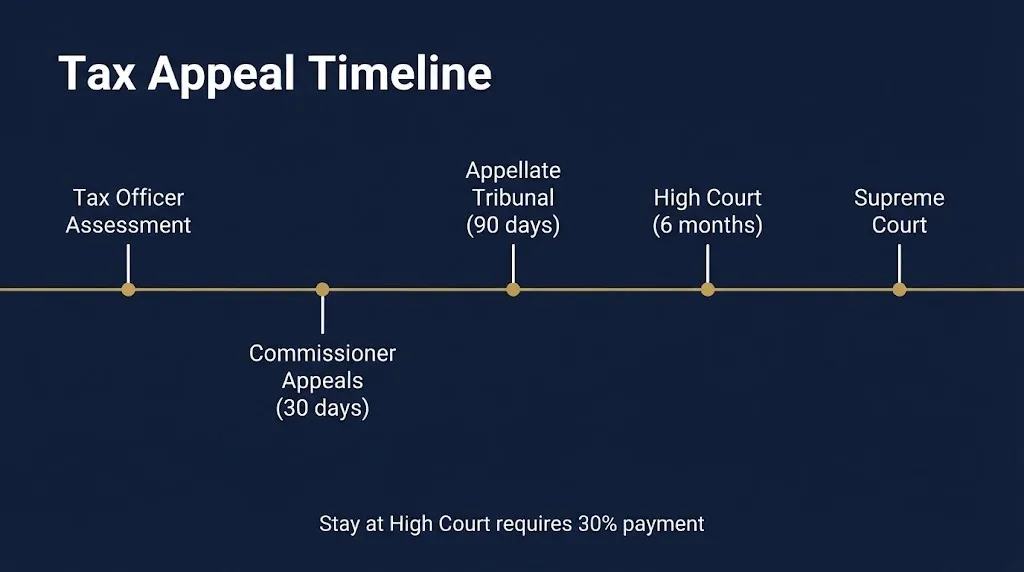
Pakistan’s tax appeal process involves multiple stages, and recent amendments have introduced stricter timelines to reduce delays. The Tax Laws (Amendment) Act 2024 mandates that the Appellate Tribunal decide appeals within 90 days and High Courts within six months.
Here’s how the ladder works:
| Stage | Authority | Timeline |
|---|---|---|
| 1 | Tax Officer assessment | Initial |
| 2 | Commissioner Appeals | Appeal within 30 days |
| 3 | Appellate Tribunal Inland Revenue | 90 days to decide |
| 4 | High Court | 6 months to decide |
| 5 | Supreme Court | Final appeal |
The amendments also lowered the ADR threshold to PKR 50 million, making mediation accessible for mid-sized disputes. If an ADR committee dissolves without resolution, the appellate forum must decide the pending appeal within 90 days.
Stay orders are critical. At the Tribunal level, a stay lasts 90 days. At the High Court, a stay requires payment of 30% of the assessed tax and expires after six months.
How much does a tax litigation attorney cost?
Tax litigation attorney fees vary significantly based on complexity and forum, and there is no standard rate published for Pakistan. Contingency arrangements are uncommon, so you should expect hourly or fixed-fee structures.
International benchmarks provide context. Court filings show partner-level attorneys billing at $400 to $675 per hour, with associates at $285 to $400. Pakistani tax lawyers often work on fixed retainers or per-appearance fees, but rates depend on the firm and the stakes.
The cost calculus depends on what’s at stake. If the FBR is demanding PKR 5 million and your attorney charges PKR 500,000 to fight it, the math may work. If the demand is PKR 200,000, the legal fees could exceed the tax at issue.
Legal professional privilege is another factor. A law firm offers confidentiality protections that standard consultancy firms cannot guarantee. If your dispute involves sensitive financial data or potential exposure, that protection has value.
Reality Check: No one calls you first and offers to settle your tax debt for pennies. The FBR does not negotiate through third-party “tax resolution” services. Any outfit demanding upfront fees to “reduce your tax liability” without reviewing your actual notice is selling hope, not representation.
What triggers the need for a tax litigation attorney?
You need a tax litigation attorney when the dispute shifts from compliance to controversy. That means notices, assessments, recovery actions, or penalties that require formal legal response.
Specific triggers include:
- Section 122 notices: Amendment of assessment proceedings
- Section 177 notices: Audit proceedings under the Income Tax Ordinance
- Recovery notices: FBR demands payment or threatens asset attachment
- Penalty proceedings: Fines for alleged non-compliance
- Show cause notices: Formal accusations requiring legal reply
- Assessment orders: Final determinations you believe are wrong
A qualified lawyer can represent you before the Appellate Tribunal Inland Revenue and High Courts. A standard tax practitioner cannot. When the FBR issues a notice under Section 122 or Section 177, a lawyer’s intervention can prevent arbitrary demands and protect your liquidity.
How do you prepare for an FBR appeal?
Preparing for an FBR appeal means assembling a complete record and filing within strict deadlines. Missing a deadline can forfeit your appeal rights entirely.
Here are the steps:
- Review the order and service date. Deadlines run from service, not from when you learned about it.
- Gather all relevant records. Returns, ledgers, prior replies, hearing records, and supporting documents.
- Identify the grounds. What legal or factual errors exist in the assessment?
- Draft the appeal. Formal grounds must be submitted to the Commissioner Appeals.
- File within 30 days. Late filing typically requires condonation, which is not guaranteed.
- Apply for stay if needed. Recovery can proceed during appeals unless a stay is granted.
- Attend hearings. Missing scheduled appearances can result in dismissal.
The FBR is the largest litigant in Pakistan’s tax system, and aggressive assessments push cases through every available stage. Your appeal record is your defense.
Key Takeaway: The deadline for filing an FBR appeal runs from the date of service, and missing it can forfeit your rights. Calendar the date the moment you receive the order.
What is Alternative Dispute Resolution in tax cases?
Alternative Dispute Resolution offers a faster path to resolution when both sides agree to mediate. The 2024 amendments lowered the threshold to PKR 50 million and shortened timelines for decisions after ADR committees dissolve.
ADR works differently from litigation. A neutral mediator or committee reviews the dispute and proposes a resolution. Both sides must agree to participate, and the outcome may involve compromise rather than a winner-take-all ruling.
The appeal is not automatically stayed by an ADR request. Recovery can continue unless you obtain separate relief. If the ADR committee dissolves without resolution, the appellate forum must decide the pending appeal within 90 days.
For taxpayers with solid records but a disputed interpretation, ADR can resolve matters in months rather than years. For cases involving fraud or clear legal violations, ADR may not be appropriate.
What happens next in your tax dispute?
Immediately: Review the notice or order. Note the date of service and any stated deadline.
Within 30 days: File your appeal with the Commissioner Appeals or apply for ADR if eligible.
Expected 90 days: Appellate Tribunal decides the appeal, unless extended by up to 90 additional days.
Expected 6 months: High Court decides the reference application if further appeal is filed.
Ongoing: Stay orders require 30% payment at the High Court stage and expire after six months.
Frequently Asked Questions
What does a tax litigation attorney do?
A tax litigation attorney represents clients in disputes with tax authorities, including audits, appeals, and court proceedings. They challenge improper assessments and argue cases before tribunals and high courts.
How much does a tax litigation attorney cost?
Fees vary by complexity and forum. International benchmarks show partner rates of $400 to $675 per hour, but Pakistani firms often use fixed retainers or per-appearance fees. Always confirm the fee structure in writing.
How long does a tax appeal take in Pakistan?
The Appellate Tribunal must decide appeals within 90 days, and High Courts within six months. Extensions are possible, and backlogs can stretch timelines far longer.
Can I represent myself in a tax appeal?
Yes, you can file pro se. However, the FBR has experienced legal teams, and procedural errors can forfeit your rights. Professional representation is recommended for anything beyond simple matters.
What is the deadline to file an FBR appeal?
Generally 30 days from the date of service of the order. Deadlines are strict, and late filing may require condonation that is not guaranteed.
Does filing an appeal stop tax recovery?
Not automatically. You must separately apply for a stay. At the Tribunal, stays last 90 days. At the High Court, a stay requires 30% payment and expires after six months.
Can I use ADR for my tax dispute?
You may qualify if the disputed liability is up to PKR 50 million. ADR is voluntary and requires both sides to participate.
Are tax litigation attorney fees tax deductible?
In many jurisdictions, legal fees related to tax disputes may be deductible as business expenses. Consult a tax professional about your specific situation.
Gather every notice, order, and supporting document. Write down the date of service on the most recent order. Then consult a tax litigation attorney before the appeal deadline passes. The 30-day window from service is the date that matters most.