Birthright Citizenship Lawsuit 2026: The Latest Court Rulings and What They Mean
Quick Answer
- The Supreme Court ruled on June 30, 2026, that children born in the U.S. to undocumented or temporary parents are citizens.
- A Maryland court has now blocked Trump’s second executive order targeting these same children.
- The government has filed a motion to dissolve the injunction, and appeals are expected.
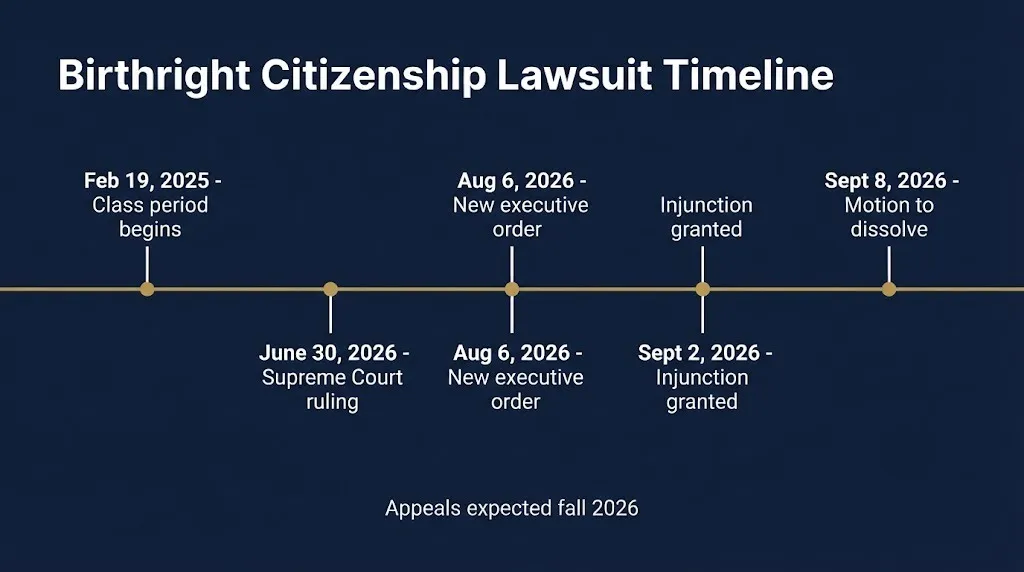
If you’re searching for information on the birthright citizenship lawsuit, the legal picture has shifted dramatically in 2026. The U.S. Supreme Court struck down Trump’s first executive order in June. Then the administration tried again in August with a narrower order. A federal judge just blocked that one too.
The fight isn’t over. The government filed a motion on September 8, 2026, seeking to dissolve the new injunction and stay its enforcement . Appeals are likely.
This article explains what the courts have actually decided, who is protected by the current injunction, and what the government might try next.
The Facts
| Lead Case | CASA, Inc. v. Trump, No. 8:25-cv-00201 (D. Maryland) |
| Supreme Court Decision | Trump v. Barbara, 146 S. Ct. 2438 (June 30, 2026) |
| August 2026 Executive Order | Executive Order 14418, signed August 6, 2026 |
| Preliminary Injunction | Granted September 2, 2026 by Judge Deborah Boardman |
| Class Definition | Children born after February 19, 2025, to non-citizen/non-LPR parents where mother was unlawfully or temporarily present |
| Government Response | Motion to dissolve injunction filed September 8, 2026 |
Is the birthright citizenship lawsuit real or just political theater?
The birthright citizenship lawsuit is a real constitutional challenge with actual court rulings, not political messaging. A federal judge in Maryland issued a formal preliminary injunction on September 2, 2026, blocking enforcement of Executive Order 14418 against a certified class of children .
The case is CASA, Inc. v. Trump, filed in the U.S. District Court for the District of Maryland. Judge Deborah Boardman wrote that the new order “is almost certainly unconstitutional” because the Supreme Court already decided that these children are citizens at birth .
This isn’t a symbolic lawsuit. The injunction legally bars federal agencies from denying citizenship documents to covered children. It also prohibits them from interfering with or failing to recognize those children’s citizenship .
The government has already signaled it will fight back. A motion to dissolve the injunction was filed on September 8, 2026, and appeals are expected to follow .
What did the Supreme Court decide in Trump v. Barbara?
The Supreme Court ruled 6-3 on June 30, 2026, that children born in the United States to parents who are unlawfully or temporarily present are citizens at birth under the Fourteenth Amendment .
Chief Justice John Roberts wrote the majority opinion. He stated that “citizenship, then and now, was the right to have rights, to freely participate in our political community” .
The Court’s decision affirmed the long-standing interpretation of the Citizenship Clause. The majority held that the Fourteenth Amendment, together with the 1898 case United States v. Wong Kim Ark, guarantees citizenship to nearly everyone born on U.S. soil .
The only recognized exceptions are children of foreign diplomats and members of certain 19th-century Indian tribes . The Court rejected the administration’s argument that undocumented or temporary residents are not “subject to the jurisdiction” of the United States .
Key Takeaway: The Supreme Court has definitively rejected the core legal theory behind both executive orders. Any future challenge must overcome that binding precedent.
What is Executive Order 14418 and why was it blocked?
Executive Order 14418 is President Trump’s second attempt to restrict birthright citizenship, signed August 6, 2026. It directs federal agencies not to recognize citizenship for certain U.S.-born children when neither parent is a citizen or lawful permanent resident .
The order lists five conditions that would trigger denial of citizenship recognition. These include birth tourism, surrogacy arrangements, fraudulent activity to obtain citizenship, being an “alien enemy,” or being a foreign government employee .
Judge Boardman blocked it because the Supreme Court already ruled on the same group of children. The certified class includes children born after February 19, 2025, whose father was not a citizen or LPR and whose mother was unlawfully or temporarily present .
The injunction does not bar the President personally. It applies to agency defendants and those acting in concert with them .
Reality Check: No one texts you about a birthright citizenship settlement. There is no money, no claim form, and no payout. This is a constitutional rights case, not a class action settlement. Anyone offering to “process” a birthright citizenship claim for a fee is running a scam.
Who is protected by the current injunction?
The injunction protects children who meet the certified class definition. It is defined by who the children are, not where they live .
Covered children are those born in the United States after February 19, 2025, who meet both conditions:
- Their father was not a U.S. citizen or lawful permanent resident at birth.
- Their mother was either unlawfully present or lawfully but only temporarily present in the United States.
The injunction bars agencies from enforcing the executive order against any class member. It also prohibits interference with, denial of, or failure to recognize that child’s U.S. citizenship .
Families whose children do not meet this definition should not assume the injunction protects them. The effect depends on each child’s date and place of birth and both parents’ immigration status at the time .
What does the injunction actually prohibit?
The injunction prohibits federal agencies from applying Executive Order 14418 to class members. It does not strike down the entire order or apply nationwide to everyone .
Here’s what the ruling provides:
| Provision | Status |
|---|---|
| Enforcement against class members | Blocked |
| Interference with class members’ citizenship | Blocked |
| Denial of citizenship documents to class members | Blocked |
| Agency guidance requirements | Remains in effect |
| Territorial birth provision | Remains in effect |
The court found that the territorial birth provision does not threaten class members, so it was not enjoined. The requirement that agencies issue implementation guidance also remains in force .
The government can seek to modify or dissolve the injunction after agency guidance is issued. But it must show a significant change in facts or law makes continued enforcement inequitable .
What is the DHS interim final rule for foreign government employees?
DHS published an interim final rule on September 9, 2026, addressing certain U.S.-born children of foreign government employees. The rule took effect September 4, 2026, and generally applies to children born on or after that date .
Under the rule, a covered child may voluntarily file Form I-485 to register as a lawful permanent resident. If USCIS approves, the child’s permanent residence is recorded as beginning on the date of birth .
A child who does not use this process may face other federal registration requirements, unless diplomatic or international-organization immunity applies .
DHS stated it will not implement the rule against class members or in a way that conflicts with the injunction, unless the government obtains relief from the court. The public comment period runs through October 5, 2026 .
How many children are affected by this case?
More than 250,000 children born in the United States each year would have been affected by the executive order, according to estimates from the Migration Policy Institute and Penn State’s Population Research Institute .
A separate Penn State study published in March 2026 projected that ending birthright citizenship could create 6.4 million U.S.-born children without legal status by 2050 .
The study found that Asian immigrants would experience the largest relative impact. There would be 41 “unauthorized” births per 1,000 Asians without legal status, compared to 17 per 1,000 Latinos .
Most of the Asian children affected would be born to parents on student or work visas. About half of temporary visa holders eventually obtain legal permanent residency, which puts them on a path to citizenship. Their children would have no such path under the executive order .
What happens next in the birthright citizenship lawsuit?
September 8, 2026: Government filed motion to dissolve the injunction and stay enforcement .
Expected fall 2026: District court rules on the motion to dissolve.
Expected late 2026 or early 2027: Appeals to the Fourth Circuit Court of Appeals.
Expected 2027: Potential Supreme Court review if the case returns.
October 5, 2026: Deadline for public comments on the DHS interim final rule .
Frequently Asked Questions
What did the Supreme Court decide about birthright citizenship?
The Supreme Court ruled 6-3 on June 30, 2026, that children born in the U.S. to undocumented or temporary parents are citizens at birth under the Fourteenth Amendment.
Is birthright citizenship still the law in 2026?
Yes. The Supreme Court upheld birthright citizenship in Trump v. Barbara. A federal court has also blocked the August 2026 executive order that tried to restrict it.
Who is protected by the Maryland injunction?
Children born after February 19, 2025, whose father was not a citizen or LPR and whose mother was unlawfully or temporarily present in the U.S.
Can the government still enforce the August 2026 executive order?
Not against class members covered by the injunction. The government has filed a motion to dissolve the injunction, but it remains in effect for now.
What is Executive Order 14418?
It is President Trump’s August 6, 2026 order directing agencies not to recognize citizenship for certain U.S.-born children. A federal judge blocked it on September 2, 2026.
What happens if the injunction is dissolved?
If the court grants the government’s motion, the executive order could be enforced against class members while appeals proceed. The government would need to show a significant change in law or facts.
Do I need a lawyer to protect my child’s citizenship?
If your child meets the class definition, the injunction currently protects them. Consult an immigration attorney if you have specific concerns about your child’s documentation.
Check your child’s birth date and both parents’ immigration status at the time of birth. If your child meets the class definition, the current injunction protects their citizenship recognition. The next key date is the court’s ruling on the government’s motion to dissolve, expected this fall.