Car Accident Lawsuit in 2026: Compensation, Process, and What to Expect
Quick Answer:
- Car accident lawsuits are individual claims, not class actions. You file against the at-fault driver or their insurer.
- Compensation averages range from $20,000 to $50,000 for moderate injuries, but severe cases can reach six or seven figures.
- The deadline to file varies by state. Most states require filing within two to three years of the accident date.
A car accident lawsuit is what you file when an insurance settlement offer does not cover your medical bills, lost wages, and other damages. It is not a class action where you join thousands of others for a small payout. It is your case against the person or company that caused the crash.
This article covers how car accident compensation works in 2026, the lawsuit process step by step, average payout ranges backed by insurance data, and the deadlines that can kill your case overnight. It is built for someone who just got a lowball offer or is wondering whether hiring a lawyer is worth it. Every number here comes from publicly available insurance and legal data, not firm marketing materials.
The Facts
| Detail | Value |
|---|---|
| Case Type | Individual personal injury lawsuit (not a class action) |
| Typical Defendant | At-fault driver, employer, or vehicle manufacturer |
| Statute of Limitations | Varies by state (1 to 3 years typical, some up to 6) |
| Average Settlement | $20,000 to $50,000 for moderate injury claims |
| Settlement Timeline | 3 to 18 months for most cases that settle before trial |
| Trial Timeline | 18 months to 3 years if case goes to court |
| Attorney Fees | 25% to 40% of recovery, typically contingency basis |
| Required Proof | Medical records, accident report, wage statements, photos |
What Is a Car Accident Lawsuit?
A car accident lawsuit is a civil claim filed in court by an injured person against the driver, business, or entity responsible for the crash. The lawsuit seeks monetary compensation for losses the insurance settlement did not cover.
It is not a group case. Unlike product recall or data breach class actions, car accident lawsuits are individual. Each case turns on its own facts: who caused the crash, how badly you were hurt, what the insurance policy limits are, and whether the defendant has assets beyond insurance.
Most car accident lawsuits settle before a trial happens. The Insurance Research Council reports that roughly 95% of personal injury claims settle before a jury ever sees the case. Filing the lawsuit is often the step that forces a serious settlement offer, not the step that leads to a courtroom. Think of it like a tax audit notice. The filing itself changes the conversation, even if you never walk into court.
How Much Compensation Can You Get From a Car Accident?
Compensation in a car accident lawsuit falls into two broad buckets: economic and non-economic damages. Economic damages cover things with a receipt: medical bills, lost income, property damage, and future care costs. Non-economic damages cover pain, suffering, emotional distress, and loss of enjoyment of life.
Average settlement amounts vary heavily by injury severity. Based on 2025 and 2026 data from insurance industry reports and legal analytics firms, here is what the ranges look like:
| Injury Severity | Typical Settlement Range | What It Covers |
|---|---|---|
| Minor (whiplash, soft tissue) | $3,000 to $15,000 | ER visit, chiropractor, 1-2 weeks lost wages |
| Moderate (fractures, herniated discs) | $20,000 to $75,000 | Surgery, physical therapy, 1-3 months lost income |
| Severe (spinal injury, TBI, permanent damage) | $100,000 to $500,000+ | Long-term care, lost earning capacity, pain and suffering |
These are not guarantees. The actual amount you may receive depends on the insurance policy limits of the at-fault driver, the strength of your evidence, whether you share any fault, and how well your attorney negotiates. If the at-fault driver carries only a $25,000 state minimum policy, that is the ceiling unless they have personal assets to pursue. That ceiling is real. Many people discover it only after the bills pile up.
Lost wages and reduced earning capacity often make up the largest portion of a serious accident claim. A 35-year-old with a back injury that prevents return to physical work might claim decades of lost income. Those calculations require vocational expert reports and economic projections, which is why severe injury cases take longer and require more expert involvement.
Key Takeaway: Compensation depends on injury severity, insurance limits, and fault. Most moderate-injury cases settle between $20,000 and $50,000, but severe cases can reach six figures.
What Does Car Accident Compensation Cover?
Car accident compensation is meant to make you whole, or as close to whole as money can. The legal term is “compensatory damages.” Courts break these into categories, and insurance adjusters use the same framework when valuing your claim.
Economic damages are the ones you can document with bills and pay stubs. They include:
- Emergency room visits, hospital stays, and surgeries.
- Physical therapy, chiropractic care, and rehabilitation.
- Prescription medications and medical equipment.
- Lost wages from missed work during recovery.
- Reduced earning capacity if you cannot return to the same job.
- Vehicle repair or replacement costs.
- Transportation to medical appointments.
Non-economic damages cover what the injury did to your life beyond the receipts. They include:
- Physical pain and suffering.
- Emotional distress and anxiety.
- Loss of enjoyment of life.
- Loss of consortium (impact on your relationship with a spouse).
- Disfigurement or permanent scarring.
A third category, punitive damages, is rare in car accident cases. Courts award punitive damages only when the defendant’s conduct was reckless or intentional. A drunk driver who caused a fatal crash might face punitive damages. A distracted driver who ran a red light probably will not.
Reality Check: Insurance companies calculate your pain and suffering using a multiplier method. They take your total medical bills and multiply by 1.5 to 5, depending on injury severity. A $10,000 ER bill with no ongoing treatment might get a 1.5 multiplier for a $15,000 total offer. A $50,000 surgery with permanent complications might get a 4x multiplier for a $200,000 demand. Knowing this math helps you spot a lowball offer.
How Does the Car Accident Lawsuit Process Work?
The car accident lawsuit process follows a predictable path. Most cases never reach the final stage. Understanding each step helps you know where your case stands and why things take time.
- Medical treatment and documentation. Get treated immediately. Follow every doctor recommendation. Gaps in treatment are the number one thing insurers use to reduce your claim value.
- Insurance claim filing. Your attorney notifies the at-fault driver’s insurer and submits a demand letter with your medical records, wage statements, and a settlement demand amount.
- Negotiation. The insurance adjuster responds, usually with a low offer. Your attorney counters. This back-and-forth can take weeks or months.
- Filing the complaint. If the insurer will not offer a fair amount, your attorney files a complaint in civil court. This document lays out your allegations and the damages you seek.
- Discovery. Both sides exchange evidence. You may sit for a deposition. Expert witnesses are retained. This phase typically lasts 6 to 12 months.
- Mediation. Many courts require mediation before trial. A neutral third party tries to help both sides reach a settlement. Most cases settle here.
- Trial. If mediation fails, the case goes to a jury. Trials take days or weeks. The jury decides fault and damages.
- Appeal. The losing side may appeal. Appeals can add 12 to 24 months before you see any money.
The entire process, from accident to settlement check, typically takes 3 to 18 months for cases that settle early. Cases that go to trial can take 2 to 3 years. Cases with appeals can stretch beyond 3 years. This is not a quick-pay scenario. It is more like a long home renovation where the final result is worth the wait, but the timeline is never what you hope.
How Long Does a Car Accident Lawsuit Take?
Most car accident lawsuits settle in 3 to 18 months from the date you hire an attorney. Cases involving severe injuries, disputed liability, or multiple defendants take longer. Cases that go to trial can take 18 months to 3 years.
The single biggest variable is how long your medical treatment lasts. Attorneys typically wait until you reach “maximum medical improvement” before sending a demand letter. That means your doctors have determined you are as healed as you are going to get. Sending a demand while you are still in treatment means guessing at future medical costs. Guessing wrong leaves you holding bills the settlement did not cover.
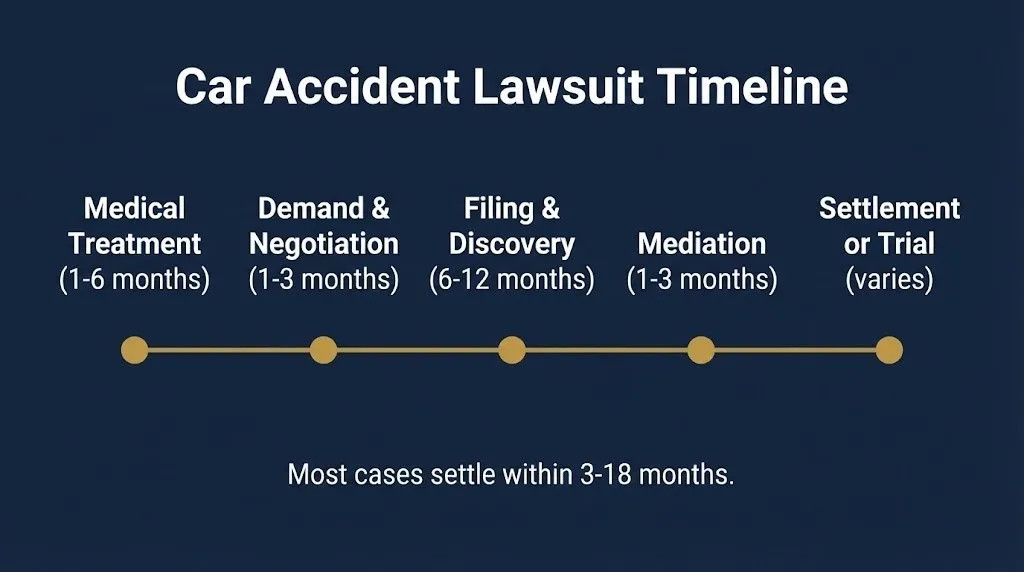
Here is a realistic timeline for a moderate-injury case that settles before trial:
| Stage | Typical Duration |
|---|---|
| Medical treatment to MMI | 1 to 6 months |
| Demand letter and negotiation | 1 to 3 months |
| Filing and discovery | 6 to 12 months |
| Mediation and settlement | 1 to 3 months |
| Settlement check delivery | 2 to 6 weeks after signing |
Delays happen. Insurance companies have no incentive to move fast. Court backlogs in some jurisdictions add months. If the at-fault driver’s insurer disputes liability, expect the timeline to stretch by 6 to 12 months while evidence is gathered and depositions are taken.
Key Takeaway: A straightforward car accident case can settle in under a year. Serious injuries, disputed fault, or trial-bound cases can take 2 to 3 years or longer.
When Should You File a Car Accident Lawsuit?
You should consider filing a car accident lawsuit when the insurance settlement offer does not cover your damages. There are specific thresholds where filing makes financial sense.
File if your medical bills and lost wages exceed the insurance policy limit and you have evidence the at-fault driver was negligent. File if the insurer denies your claim outright. File if the adjuster’s offer is less than 60% to 70% of what your attorney calculates your claim is worth. Do not file over a minor fender bender with a $500 repair bill. The legal costs will eat your recovery.
The strongest cases share these characteristics:
- Clear liability. The other driver was cited, or there is video evidence.
- Significant damages. Medical bills over $10,000, surgery, or permanent injury.
- Adequate insurance. The at-fault driver has high policy limits or personal assets.
- No shared fault or minimal shared fault. States with pure contributory negligence rules bar recovery if you are even 1% at fault.
If you were partially at fault, you can still recover in most states under comparative negligence rules. Your compensation is reduced by your percentage of fault. If a jury finds you 20% responsible for the crash, your $100,000 award becomes $80,000. Four states, Alabama, Maryland, North Carolina, Virginia, and Washington D.C., use pure contributory negligence. In those jurisdictions, any fault on your part means zero recovery.
What Evidence Do You Need for a Car Accident Lawsuit?
Evidence makes or breaks a car accident lawsuit. The insurance company starts building its case the day the claim is filed. You need to do the same.
The strongest car accident claims are built on these pieces of evidence:
- Police accident report. This is often the single most important document. It identifies the drivers, notes citations issued, and may include an officer’s opinion on fault.
- Photographs and video. Crash scene photos, vehicle damage photos, traffic camera footage, dashcam video, and surveillance footage from nearby businesses.
- Medical records. Every doctor visit, every diagnostic test, every prescription. The records must connect your injuries to the crash.
- Wage and income statements. Pay stubs, tax returns, and a letter from your employer confirming time missed and wages lost.
- Eyewitness statements. Contact information and written accounts from anyone who saw the crash.
- Expert reports. Accident reconstruction experts, medical experts, and vocational experts in severe injury cases.
Start gathering this evidence immediately after the crash. Memories fade. Surveillance footage gets overwritten. Witnesses move. Waiting even a few weeks can mean losing the best evidence you have.
How Much Does It Cost to File a Car Accident Lawsuit?
Most car accident attorneys work on a contingency fee basis. You pay nothing upfront. The attorney receives a percentage of your settlement or verdict, typically 25% to 40%, depending on when the case resolves and the complexity involved.
The standard contingency fee is 33% of the recovery if the case settles before filing a lawsuit. If a lawsuit is filed, the fee often increases to 40% because the attorney takes on more work and risk. Some firms use a sliding scale. Always read the fee agreement before signing. Ask what percentage applies at each stage.
Case costs are separate from attorney fees. These include filing fees, deposition costs, expert witness fees, and medical record retrieval charges. Costs typically run $1,000 to $5,000 for a case that settles early. Cases that go to trial can run $10,000 to $50,000 in costs. Most firms advance these costs and deduct them from your settlement. If you lose, you generally do not owe costs, but confirm this in the retainer agreement.
What Is the Statute of Limitations for a Car Accident Lawsuit?
The statute of limitations is the legal deadline to file your lawsuit. Missing this deadline means losing your right to sue, permanently. The deadline varies by state.
Most states set the deadline at two or three years from the date of the accident. A few states allow more time. Here are the 2026 deadlines for the most populous states:
| State | Statute of Limitations |
|---|---|
| California | 2 years |
| Texas | 2 years |
| Florida | 2 years |
| New York | 3 years |
| Pennsylvania | 2 years |
| Illinois | 2 years |
| Ohio | 2 years |
| Georgia | 2 years |
| North Carolina | 3 years |
| Michigan | 3 years |
Some exceptions can extend the deadline. If the injured person was a minor at the time of the crash, the clock may not start until they turn 18. If the at-fault driver left the state, the clock may pause. If a government vehicle was involved, special notice deadlines apply, often as short as 30 to 90 days. Government claims require immediate action. Do not wait.
Key Takeaway: The statute of limitations deadline is firm. In most states, you have two years from the accident date to file. Government claims have much shorter deadlines.
How Do Car Accident Settlements Get Paid Out?
Once you accept a settlement offer or a jury returns a verdict, the money does not arrive the next day. There is a payment process that takes several weeks.
The at-fault driver’s insurance company issues a check made payable to your attorney’s trust account. Your attorney deposits the check, waits for it to clear, then distributes the funds. The distribution order is typically:
- Attorney fees are deducted.
- Case costs are reimbursed.
- Medical liens are paid. Hospitals, health insurers, and government programs like Medicare may have lien rights.
- Any outstanding child support or tax liens are satisfied.
- The remaining balance goes to you.
The entire process from settlement signing to check in hand takes 2 to 6 weeks. Settlement checks are not taxable for physical injury claims under federal law. Compensation for lost wages is generally not taxable either. Punitive damages and interest on the award are taxable. Confirm with a tax professional.
What Happens Next After You File a Car Accident Lawsuit?
The timeline after filing is predictable but slow. Here is what to expect from the day the complaint is filed.
- Days 1 to 30: The defendant is served with the complaint and has 20 to 30 days to file an answer.
- Months 1 to 6: Initial disclosures are exchanged. Both sides share witness lists and document the evidence they plan to use.
- Months 6 to 12: Discovery proceeds. Depositions are taken. Written questions, called interrogatories, are exchanged. Expert witnesses are retained and produce reports.
- Months 12 to 18: Summary judgment motions may be filed. One or both sides ask the judge to rule on the case without a trial. Most are denied in car accident cases because facts are disputed.
- Months 12 to 24: Mediation occurs. A settlement is reached in most cases at this stage.
- Months 18 to 36: If no settlement, trial begins. The jury deliberates and returns a verdict.
- Post-trial: Appeals may follow. Payment is delayed until all appeals are resolved.
Frequently Asked Questions
Can I file a car accident lawsuit without a lawyer?
Yes, you can file without a lawyer. This is called proceeding pro se.
It is not recommended for anything beyond small claims court.
Insurance companies have attorneys. Going alone against them almost always results in a lower settlement.
How long after a car accident can you sue?
It depends on your state’s statute of limitations, typically two or three years.
The clock starts on the date of the accident.
Some exceptions apply for minors and cases where injuries were not discovered immediately.
What happens if the at-fault driver has no insurance?
You file a claim with your own uninsured motorist coverage if you have it.
If you do not, you can sue the driver personally, but collecting is difficult if they have no assets.
Your own health insurance may cover medical bills under those circumstances.
Do car accident lawsuits go to trial?
Rarely. About 95% of car accident cases settle before trial.
Filing the lawsuit often leads to a higher settlement offer, not a courtroom appearance.
Trials happen when liability is genuinely disputed or the insurer refuses to offer fair value.
How is pain and suffering calculated?
Insurance companies typically use a multiplier method based on your medical bills.
The multiplier ranges from 1.5 to 5 times your medical costs depending on injury severity.
Severe permanent injuries get higher multipliers. Minor soft tissue injuries get lower ones.
Can I sue for a car accident if I was a passenger?
Yes. Passengers are almost never at fault.
You can file a claim against the at-fault driver’s insurance, regardless of which vehicle you were in.
You may have claims against both drivers if fault is shared.
What if the insurance company says I am partially at fault?
In most states, you can still recover compensation under comparative negligence rules.
Your recovery is reduced by your percentage of fault.
In a few states with pure contributory negligence rules, any fault bars recovery entirely.
How do I find the right car accident attorney?
Look for an attorney who specializes in personal injury and car accident cases.
Check their trial experience. Insurers know which attorneys actually go to court.
Read client reviews focused on communication and case outcomes, not just settlement amounts.
If you were hurt in a crash, the single most important deadline is your state’s statute of limitations. In most places, that gives you two years from the accident date. The second most important move is getting medical treatment and following through on every referral. Gaps in treatment are what insurers exploit to pay you less. Get the police report. Take photos. Call an attorney before talking to the other driver’s insurance company. The early moves determine what your case is worth.