Compensation Programs 2026: Complete Guide to Design, Management, and Legal Compliance
Quick Answer
- What it is: A compensation program is the structured system employers use to pay and reward employees.
- Key components: Direct pay, benefits, incentives, and equity all count toward total compensation.
- Legal watch: Pay transparency laws and equal pay regulations expanded significantly across states in 2026.
When you hear the phrase “compensation programs,” it usually means the entire framework a company uses to pay its people. That includes salary, bonuses, health insurance, retirement matching, and equity grants. It is not one number. It is a system.
For employees, understanding that system helps you negotiate better and compare offers fairly. For employers, getting it wrong invites lawsuits, turnover, and compliance headaches. The stakes are high on both sides.
This guide breaks down how compensation programs work, the laws governing them, and the real numbers behind total compensation in 2026.
The Facts
| Topic | What You Need to Know |
|---|---|
| Definition | Structured system for pay, benefits, and incentives |
| Core Types | Direct pay, indirect benefits, incentive compensation, equity |
| Average US Salary | $74,736 per year (gross) |
| Median US Salary | $44,225 per year, meaning half earn less |
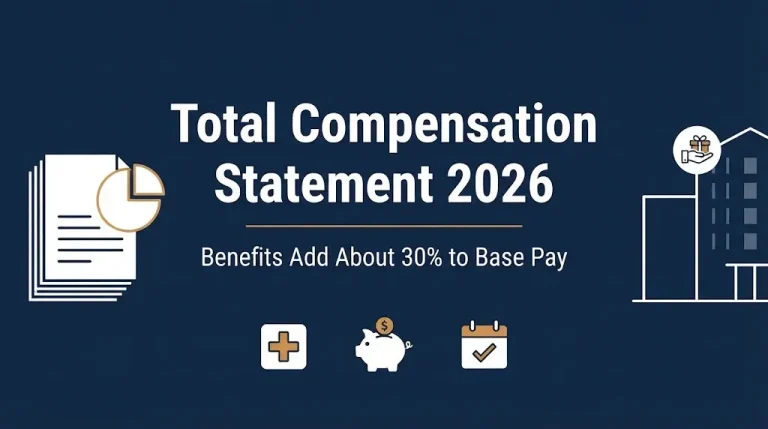
| Typical Benefit Load | 20% to 40% on top of base salary |
| Federal Minimum Wage | $7.25 per hour, unchanged for 45 years |
| Top Software | Oracle HCM Cloud (40.51% market share), Workday (19.55%) |
What Are Compensation Programs?
A compensation program is the complete system an employer uses to determine, distribute, and manage pay and benefits for its workforce. It covers everything from base salary to stock options .
The term gets used interchangeably with “compensation management” and “total rewards.” At its core, it describes how a company decides what to pay, who gets what, and why. That includes the rules, the budgets, the market benchmarks, and the approval chains.
SAP defines compensation management as ensuring labor is “remunerated according to employee performance, the requirements of the enterprise, and current market values” . Both employee motivation and company costs depend on how well that system functions.
For you as an employee, the program determines what shows up in your offer letter and your paycheck. For employers, it determines whether they can attract talent without blowing the budget.
What Are the Main Types of Compensation Programs?
There are four main types: direct pay, indirect benefits, incentive compensation, and equity-based awards. Most companies combine all four into a single package .
Direct pay is the cash you receive for showing up. That means salary, hourly wages, overtime, and commissions. It is the foundation of every compensation program.
Indirect benefits carry monetary value but do not appear as cash. Health insurance premiums, retirement matching, life insurance, and paid time off all fall into this bucket. A 6% 401(k) match on a $60,000 salary adds $3,600 per year.
Incentive compensation rewards specific outcomes. Bonuses, profit-sharing, and sales commissions are common examples. These rewards tie pay to performance.
Equity-based awards give employees ownership stakes. Stock options, restricted stock units (RSUs), and employee stock purchase plans (ESPPs) are the most common forms .
Here is how they break down:
| Type | Examples | Cash Now? |
|---|---|---|
| Direct pay | Salary, hourly wage, overtime | Yes |
| Indirect benefits | Health insurance, 401(k), PTO | No |
| Incentive pay | Bonuses, commissions, profit-sharing | Usually |
| Equity | Stock options, RSUs, ESPPs | No, vests later |
Compensation Management Program: How Employers Build the System
A compensation management program is the operational backbone that turns pay philosophy into actual numbers. It covers job architecture, market benchmarking, pay structures, and approval workflows .
KPMG’s reward framework identifies five pillars for effective compensation programs. These include an effective underpinning structure, strong governance, understanding of current position, good communication, and effective use of technology .
In practice, that means employers must first define job levels and pay bands. They then benchmark against market data to ensure competitiveness. Governance processes determine who approves exceptions and how often pay gets reviewed.
Technology plays a growing role. More than 38,000 companies use dedicated compensation management software as of 2026. Oracle HCM Cloud leads with 40.51% market share, followed by Workday at 19.55% and Anaplan at 13.54% .
The software handles salary planning, bonus calculations, equity tracking, and compliance reporting. Without it, large employers struggle to maintain consistency across departments and geographies.
Key Takeaway: Compensation programs are not just about salary. They combine cash, benefits, incentives, and equity into a structured system that requires governance, market data, and technology to run effectively.
Employee Compensation Management: What It Means for You
Employee compensation management is the process of planning, examining, and providing monetary and non-monetary benefits fairly. It directly affects your paycheck, your benefits, and your career trajectory .
Paychex defines it as managing base pay, employee benefits, and incentives while analyzing internal and external pay data. The goal is to ensure pay is “fair, equitable, and competitive” .
That sounds corporate. But it matters for you. When a company manages compensation poorly, high performers leave, pay gaps widen, and morale drops. When it manages well, employees trust that their pay reflects their contribution.
Several factors drive what you actually earn. Education level is a strong predictor. The ASM 2025 Compensation and Benefits Study found that professionals with a doctoral degree earned an average base salary of $144,600, compared to $94,500 for those with a bachelor’s degree .
Certification and licensure also matter. Respondents with any certification earned a median salary of $163,500, compared to $111,600 for those without .
Gender gaps persist. Men reported an average base salary of $154,800, while women reported $135,200 in the same study .
Compensation Program Examples: Real Numbers from 2026 Filings
Public company proxy statements reveal exactly how executive compensation programs are structured. These filings are public records, and they show the real numbers.
One 2026 proxy statement for a government contractor detailed a “pay for performance” approach. The program uses annual cash incentives tied to financial and safety metrics, plus long-term restricted performance stock rights that vest over multiple years .
The company emphasized several best practices. It benchmarks against peer companies, uses an independent compensation consultant, and maintains stock ownership guidelines for executives. It also prohibits hedging and pledging of company stock by officers and directors .
Another 2026 filing from Murphy USA described a peer group of 17 companies used for compensation benchmarking. The group included AutoZone, Dollar General, and Chipotle Mexican Grill. The compensation committee compared base salaries and total target direct compensation to the median of market data .
For ordinary employees, these disclosures matter less for the specific dollar amounts and more for the structure. The same principles apply at every level: benchmark against the market, tie pay to performance, and govern the process with clear rules.
What Laws Govern Compensation Programs in 2026?
Federal law sets minimum standards, but state and local laws increasingly dictate pay transparency and equity requirements. Compliance is now a major driver of compensation program design .
The federal minimum wage has remained at $7.25 per hour for 45 years . Many states and cities set higher floors, with hourly rates ranging from $10 to $20 depending on location .
The Equal Pay Act and Title VII prohibit pay discrimination based on sex, race, and other protected characteristics. The Dodd-Frank Act added compensation recovery provisions, requiring companies to claw back erroneously awarded incentive pay .
Pay transparency laws have expanded rapidly. Several states now require employers to disclose salary ranges in job postings. Others mandate pay data reporting by gender and race. These laws force companies to audit their compensation programs for internal equity .
The practical result is that compensation management has become a legal compliance function, not just an HR task. Companies that ignore pay equity data risk enforcement actions and private lawsuits.
Reality Check: No legitimate employer will ask you to pay a fee to receive your compensation or benefits. If a company requests payment for “processing” your pay, it is a scam. Real compensation programs pay you, not the other way around.
How to Evaluate a Compensation Program Before You Accept an Offer
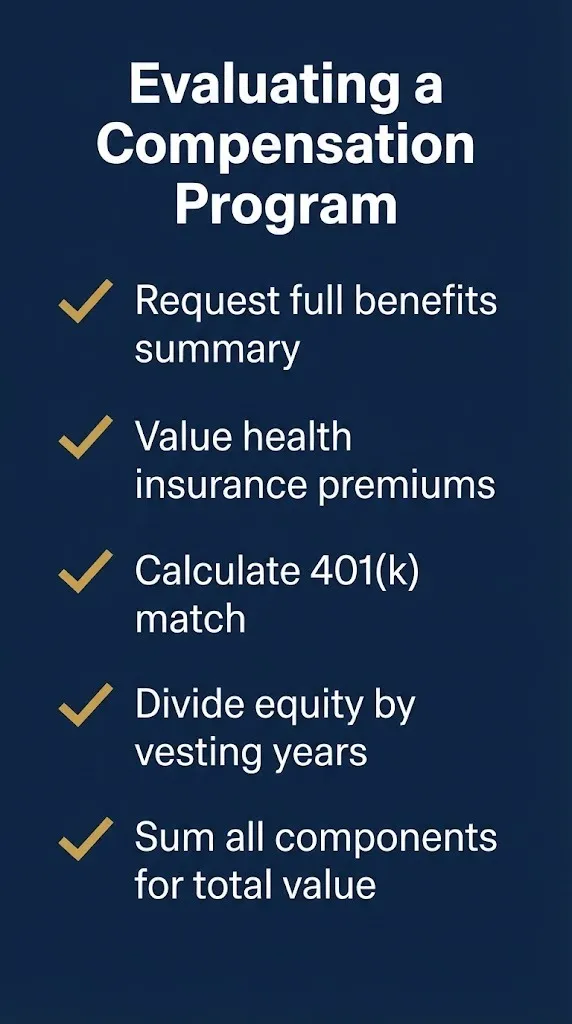
Evaluating a compensation program means calculating the total value of every component, not just the salary line. Here is the step-by-step process:
- Request the full benefits summary in writing.
- Calculate the value of health insurance premiums paid by the employer.
- Multiply your salary by the 401(k) match percentage.
- Value paid time off by dividing salary by workdays and multiplying by PTO days.
- Divide total equity grant value by the vesting period to get annual value.
- Add any signing bonus, relocation assistance, or tuition reimbursement.
- Sum all components to get total compensation value.
A plain-life comparison: think of it like buying a house. The listing price gets your attention. But property taxes, insurance, and maintenance determine what you actually pay every month. Salary is the listing price. Benefits are the carrying costs.
What Happens Next in Compensation Program Trends
The next 12 to 18 months will bring continued pressure on pay transparency and equity auditing. Here are the expected developments:
Expected Q4 2026: More states implement pay range disclosure requirements for job postings.
Expected 2027: Federal agencies finalize rules on compensation data reporting for large employers.
Expected 2027: AI-driven compensation analytics tools become standard in mid-size companies.
Ongoing: Remote work pay policies continue to evolve, with location-based adjustments becoming more common.
Frequently Asked Questions
What is a compensation program?
A compensation program is the structured system an employer uses to pay and reward employees. It includes salary, benefits, incentives, and equity, along with the rules for how those elements are determined and distributed.
What is compensation management?
Compensation management is the process of planning, analyzing, and providing employee pay and benefits. It ensures pay is fair, competitive, and compliant with laws .
What are the 4 types of compensation?
The four types are direct pay, indirect benefits, incentive compensation, and equity-based awards. Direct pay covers salary and wages. Indirect benefits include insurance and retirement plans .
What is the difference between compensation and benefits?
Compensation is direct pay like salary and bonuses. Benefits are indirect rewards like health insurance and retirement matching.
How do companies design compensation programs?
Companies design programs by benchmarking against market data, defining job levels, setting pay bands, and establishing governance rules. They use compensation software to manage the process .
What is the average salary in the United States in 2026?
The average gross annual salary is $74,736. However, half of all workers earn less than $44,225 per year .
What is a total compensation package?
A total compensation package includes salary, bonuses, health insurance, retirement matching, equity, and paid time off. The benefits portion can add 20% to 40% on top of base salary.
Are compensation programs required by law?
Employers must comply with minimum wage, overtime, and anti-discrimination laws. Pay transparency and equity reporting requirements vary by state and locality.
Closing
Your action is simple: never evaluate a job offer on salary alone. Request the full benefits summary, calculate the total value of every component, and compare offers on that basis. The difference between two packages with the same salary can exceed $15,000 per year once retirement matching, equity, and paid leave are counted.