How Long After Workers’ Comp Settlement Do I Get Paid? 2026 State-by-State Timelines
Quick Answer
- Is it legit? Yes. Workers’ comp settlements are court-approved and legally binding.
- How long? Most states require payment within 14 to 30 days of judge approval.
- Key factor: Medicare Set-Asides and unresolved liens can add weeks or months to the wait.
You settled your workers’ compensation case. The judge signed off. So where is the money? If you are staring at an empty bank account and wondering whether something went wrong, you are not alone.
The time between “settled” and “paid” depends almost entirely on one thing: when the judge or state agency officially approves the agreement. Once that approval order issues, most states give the insurance carrier a hard deadline, typically 14 to 30 days, to cut the check . But that deadline does not always translate to cash in your hand.
This guide breaks down the real timelines by state, the specific rules that trigger penalties for late payment, and the delays that can silently stretch your wait past the legal deadline.
The Facts
| Topic | What You Need to Know |
|---|---|
| Typical Wait After Approval | 2 to 6 weeks for most states |
| Fastest State Deadlines | Florida (14 days), North Carolina (24 days with grace period) |
| Common Delay Cause | Medicare Set-Aside approval, unresolved medical liens |
| Penalty for Late Payment | 10% automatic penalty in many states |
| Check Clearing Time | 5 to 10 business days for checks over $50,000 |
| Total Timeline from Injury | 4 to 24+ months depending on dispute level |
How Long After Workers’ Comp Settlement Do I Get Paid?
The short answer is 2 to 6 weeks after a judge or state agency approves your settlement agreement. That is the window most injured workers experience .
The clock does not start when you sign the papers. It starts when the approval order issues. In North Carolina, for example, the settlement proceeds are due within 10 days of the Industrial Commission’s order approving the compromise settlement agreement . But the statute also gives the carrier an additional 14-day grace period. If payment is not made within that combined 24-day window, a mandatory 10% penalty applies to the total amount owed .
Florida operates on a tighter clock. Under Florida law, the insurance company generally has 14 days from the date the settlement agreement is signed to issue the check .
Other states fall somewhere in between. Missouri settlements typically pay within 14 days to a few weeks after an Administrative Law Judge approves the deal . Illinois workers’ comp settlements pay within 2 to 4 weeks from signing, including the time for the Illinois Workers’ Compensation Commission to review and approve .
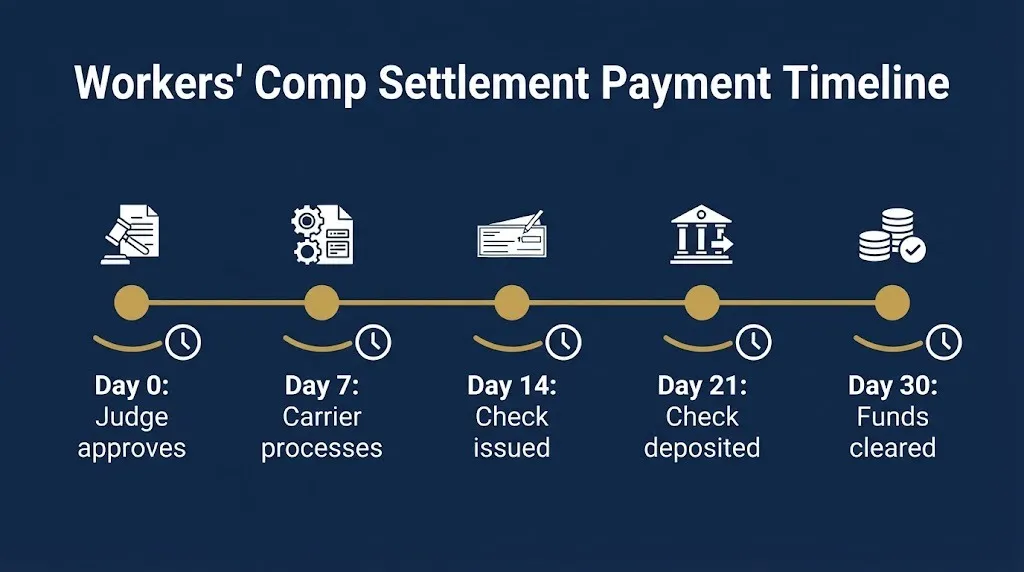
Here is how the typical post-approval timeline breaks down:
| Stage | Typical Time |
|---|---|
| Judge signs approval order | Day 0 |
| Carrier processes payment request | 2 to 7 business days |
| Check issued and mailed | 3 to 10 business days |
| Check clears your bank | 5 to 10 business days |
| Total from approval to cash | 2 to 6 weeks |
State-by-State Workers’ Comp Settlement Payment Deadlines
Payment deadlines vary significantly by state, ranging from 10 days to 30 days after approval. Knowing your state’s rule gives you a concrete date to hold the carrier accountable.
North Carolina has the most precise statutory framework. Settlement compensation is due within 10 days of the order approving the compromise settlement agreement, with a 14-day grace period that extends the effective deadline to 24 days . The 10% penalty is mandatory if payment is late, and the only excuse is circumstances entirely outside the carrier’s control .
Florida law sets the deadline at 14 days from signing the settlement agreement . California’s system operates differently. Most California settlements require approval by a workers’ compensation judge, and the approval process itself takes 1 to 4 weeks after negotiations conclude .
Missouri settlements pay within 14 days to a few weeks after ALJ approval . Michigan settlements involve a 15-day appeal period after the redemption hearing before the settlement becomes final, and then the check is mailed about two weeks later . The appeal period can be waived by mutual agreement, which speeds payment significantly .
A plain-life comparison: think of the approval order like the green light at an intersection. The carrier can see it, but whether they accelerate immediately or coast through depends on their internal processes and whether any obstacles remain in the intersection.
Key Takeaway: Most states give the insurance carrier 14 to 30 days after judge approval to issue your settlement check. North Carolina’s 24-day combined deadline with a mandatory 10% penalty is one of the strictest enforcement frameworks in the country.
What Delays a Workers’ Comp Settlement Check?
The most common delay is a Medicare Set-Aside (MSA), which can add months to an otherwise finished settlement. If you are on Medicare or close to eligibility, federal law requires that your settlement protect Medicare’s future interests .
An MSA sets aside part of your settlement money for future injury-related medical care. Medicare must review and approve the set-aside amount before the settlement can be finalized. In larger settlements, getting CMS approval can take several months by itself . That is the single biggest reason a “done” comp settlement sits in limbo.
Unresolved medical liens are the second major delay. Hospitals, doctors, and health insurers may have claims against your settlement proceeds. Your attorney cannot disburse funds to you until those liens are negotiated or resolved .
Other delay triggers include:
- Disputed disability ratings: If you and the carrier disagree on your impairment percentage, the case goes back to the agency.
- Missing medical records: Incomplete documentation stalls the rating process.
- Second Injury Fund involvement: Missouri’s SIF cases take longer because the Attorney General’s office has up to 30 days to respond .
- Check mailing issues: Lost checks or incorrect addresses add weeks to the timeline.
- Bank clearing holds: Large settlement checks over $50,000 can take 7 to 10+ business days to clear .
If your settlement involves an MSA, add 2 to 6 months to the standard timeline. Plan accordingly.
What Happens If Your Workers’ Comp Settlement Check Is Late?
Most states impose automatic penalties on carriers that miss payment deadlines. You do not have to prove intent or harm. The clock runs out, and the penalty applies.
In North Carolina, the penalty is 10% of the total settlement amount, assessed by the Industrial Commission . California imposes a 10% increase on any indemnity payment not made within the statutory timeframe, and that penalty is automatic under Labor Code section 4650 .
The penalty structure is designed to make late payment expensive enough that carriers prioritize compliance. For a $50,000 settlement, a 10% penalty is $5,000. For a $200,000 settlement, it is $20,000.
If your check is late, the first step is to notify your attorney. Your attorney can file a motion with the workers’ compensation board or commission requesting the penalty. In many states, the commission assesses penalties on its own motion when it sees a missed deadline in the record.
Documentation matters. Keep track of the approval date, the date you expected payment, and the date payment actually arrived. If you need to prove a late payment, those dates are your evidence.
Reality Check: No legitimate workers’ comp carrier will text you asking for a fee to release your settlement funds. If someone outside the legal process demands payment to “unlock” your check, it is a scam. Settlement funds flow through your attorney’s trust account or directly from the carrier at no cost to you.
How Long Does It Take to Get a Workers’ Comp Settlement in Total?
From injury to settlement check, the total timeline ranges from 4 months to over 2 years. The biggest variable is whether your claim is disputed.
An accepted claim with a minor injury can resolve in 4 to 9 months from the injury date . The insurer accepts liability, you reach Maximum Medical Improvement (MMI) quickly, and settlement negotiations proceed smoothly.
A serious injury with an accepted claim typically takes 12 to 24 months, mostly because reaching MMI takes longer . A shoulder reconstruction might take 18 months to plateau. A back injury with ongoing treatment can take even longer.
A denied or disputed claim adds months to the timeline. Disputes go before an administrative law judge, and agency calendars move slowly. Getting a hearing date commonly takes several months. If either side appeals, add more time .
Here is the full picture:
| Claim Type | Total Timeline |
|---|---|
| Accepted, minor injury | 4 to 9 months |
| Accepted, serious injury | 12 to 24 months |
| Denied or disputed | 12 to 24+ months |
| Any case with Medicare Set-Aside | Add 2 to 6 months |
The settlement check itself is the final step. Most of the wait happens before you ever sign a settlement agreement.
How Long Does It Take for a Settlement Check to Clear?
Large settlement checks can take 5 to 10 business days to clear, and checks over $50,000 may take 7 to 10+ business days. That clearing time is separate from the carrier’s payment deadline .
When your attorney receives the settlement check, they deposit it into a trust account. The bank then verifies the funds. Federal banking rules allow holds on large deposits to protect against fraud and insufficient funds. Until the check clears, your attorney cannot disburse money to you.
This is a fiduciary rule, not a delay tactic. If your attorney wrote you a check before the settlement check cleared and the settlement check bounced, the firm could face an overdraft and ethics violations. The clearing period protects everyone.
Once the check clears, your attorney must resolve any outstanding liens and deduct their fee and costs. Then they issue your check. That final step typically takes 1 to 5 business days after clearing.
Frequently Asked Questions
How long after workers’ comp settlement do I get paid?
Most settlement checks arrive within 2 to 6 weeks after a judge approves the agreement. Some states require payment within 14 days of approval, while others allow 30 days or more.
How long does it take to get a workers comp settlement check after signing?
The clock starts when the judge signs the approval order, not when you sign. From that approval date, most states give carriers 14 to 30 days to issue payment.
What state pays workers comp settlements the fastest?
Florida requires payment within 14 days of signing. North Carolina requires payment within 10 days of approval, with a 14-day grace period before penalties apply.
What happens if my workers comp settlement check is late?
A 10% penalty typically applies automatically. In North Carolina and California, the penalty is mandatory when payment exceeds the statutory deadline.
Can a workers comp settlement check be direct deposited?
In some states, yes. Pennsylvania now requires insurers to offer direct deposit under Act 126, effective December 2025. Other states allow electronic payment by agreement.
Why is my workers comp settlement taking so long?
Medicare Set-Aside approval and unresolved medical liens are the most common delays. An MSA review can add 2 to 6 months to the timeline.
Do I have to pay taxes on a workers comp settlement?
Workers’ compensation settlements are generally not taxable at the federal level. However, the portion allocated to attorney fees may be deductible. Consult a tax professional for your specific situation.
How do I check the status of my workers comp settlement check?
Contact your attorney’s office first. They can confirm whether the approval order has issued and whether the carrier has processed payment. You can also check your state’s workers’ compensation board online portal.
What Happens Next: Expected Timeline After Approval
Day 0: Judge or agency issues approval order.
Days 1 to 7: Carrier processes the payment request internally.
Days 7 to 14: Check issued and mailed or electronically transferred.
Days 14 to 21: Check arrives at your attorney’s office and is deposited.
Days 21 to 30: Bank clears the funds and your attorney disburses your share.
Your action is simple: confirm the date the judge approved your settlement. That is Day 0. If you have not received payment within the timeframe your state allows, contact your attorney. Penalties exist to protect you, but they only apply if someone enforces them.