What Is a Viatical Settlement in 2026? The Complete Legal Process Explained
Quick Answer
- Is it legit: Yes. Viatical settlements are legal in most U.S. states and regulated under insurance laws.
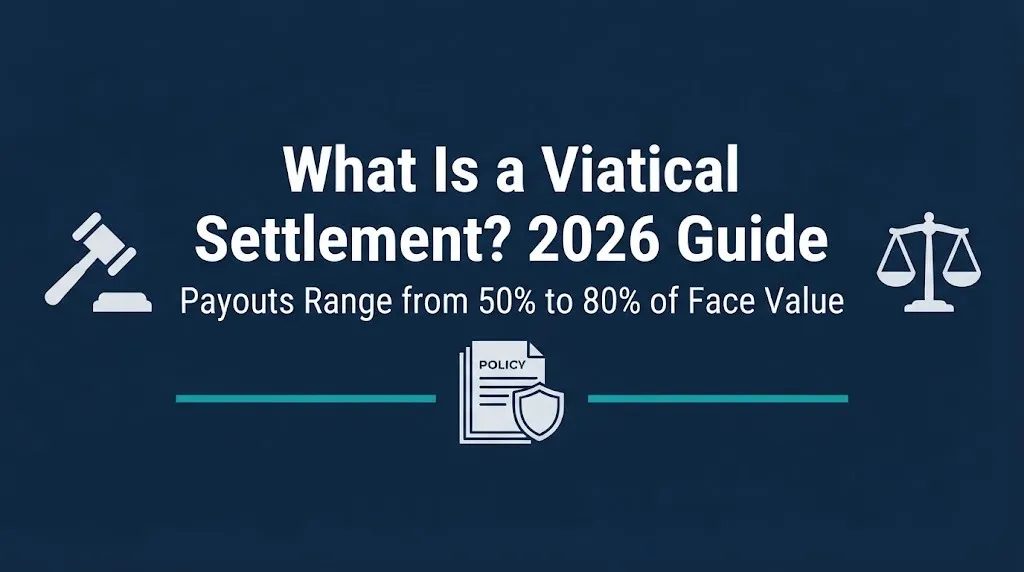
- How much: Payouts typically range from 50% to 80% of the policy’s face value based on life expectancy.
- Key deadline: Rescission rights vary by state, commonly 15 to 30 days after receiving proceeds.
A viatical settlement is the sale of a life insurance policy by someone facing a terminal or chronic illness. The seller, called the viator, receives a lump sum cash payment that’s less than the policy’s death benefit but more than what the insurance company would pay for a surrender.
The buyer becomes the new policy owner, takes over premium payments, and collects the full death benefit when the insured person dies. This arrangement gives you immediate cash when you need it most, often when medical bills and living expenses are mounting.
This article explains how viatical settlements work, who qualifies, how much you can expect, the tax implications, state regulations, and the red flags to watch for. One detail stands out: the term comes from the Latin word “viaticum,” meaning “supplies for a journey,” a fitting name for money meant to fund a difficult passage.
The Facts
| What It Is | Sale of a life insurance policy by a terminally or chronically ill person |
| Typical Payout | 50% to 80% of face value, depending on life expectancy |
| Who Qualifies | Policyholders with life expectancy of 24 months or less |
| Federal Tax Status | Generally tax-free if IRS criteria are met |
| State Regulation | Regulated at the state level; requirements vary |
| Rescission Period | Varies by state (commonly 15 to 30 days) |
Is a Viatical Settlement Legitimate?
Yes, a viatical settlement is a legitimate legal transaction, but it operates in a highly regulated space with significant potential for abuse. The National Association of Insurance Commissioners (NAIC) created the Viatical Settlements Model Act to set standards for how providers and brokers operate.
Every U.S. state except a few have enacted some form of viatical settlement regulation. The industry emerged in the 1980s, largely to help AIDS patients access cash from their life insurance policies when they needed funds for treatment and living expenses.
Regulators have long acknowledged the legitimate purpose of these settlements while also warning about fraud. The North American Securities Administrators Association has documented cases where viatical investments were marketed with fraudulent life expectancy evaluations, inadequate premium reserves, and unfounded claims of guaranteed profits.
The FTC has also cautioned that viatical arrangements involve complex legal, financial, and tax consequences that should be reviewed by professional advisors before proceeding.
How Much Can You Get from a Viatical Settlement?
You can expect a payout ranging from 50% to 80% of your policy’s face value, depending on your life expectancy and the policy’s terms. The shorter your life expectancy, the higher the percentage you’ll typically receive.
Virginia’s regulations provide a concrete example of how these ranges work in practice:
| Life Expectancy | Minimum Percentage of Face Value |
|---|---|
| Less than 6 months | 80% |
| 6 to less than 12 months | 70% |
| 12 to less than 18 months | 65% |
| 18 to less than 24 months | 60% |
| 24 months or more | 50% |
The actual offer you receive depends on several factors. Premium costs, the insurance company’s financial strength, and the specific policy type all affect the final number. A $600,000 policy with a short life expectancy could fetch far more than the cash surrender value the insurance company offers.
Key Takeaway: Viatical settlements generally pay between 50% and 80% of face value, significantly more than a policy surrender but less than the full death benefit.
Who Qualifies for a Viatical Settlement?
You may qualify for a viatical settlement if you have a terminal or chronic illness with a life expectancy of 24 months or less. Medical documentation from a licensed physician is required to verify your diagnosis and prognosis.
A terminal illness is generally defined as a condition expected to result in death within two years. A chronic illness may involve the inability to perform at least two activities of daily living, such as dressing, feeding, or bathing yourself.
State regulations may impose additional requirements. Some states require that the policy be beyond its contestability period, typically two years from the issue date. Virginia law requires a doctor’s written statement that the viator is “of sound mind and under no constraint or undue influence” before completing a transaction.
You must also be the owner of the policy to sell it. If you’re the insured but not the owner, your consent may still be required if the sale involves examining your medical records.
What Is the Difference Between a Viatical Settlement and a Life Settlement?
A viatical settlement is for someone with a terminal or chronic illness and a life expectancy of two years or less. A life settlement is for someone who does not have a terminal or chronic illness but wants to sell their policy, typically because they’re 65 or older and no longer need the coverage.
The tax treatment differs significantly. Viatical settlement proceeds are generally tax-free if federal criteria are met. Life settlement proceeds are typically subject to income and capital gains taxes.
| Feature | Viatical Settlement | Life Settlement |
|---|---|---|
| Health status | Terminal or chronic illness | No terminal diagnosis required |
| Life expectancy | 24 months or less | Often longer |
| Typical age | Any age | 65 or older |
| Tax treatment | Generally tax-free | Typically taxable |
| Payout range | 50% to 80% of face value | 10% to 25% of face value |
An accelerated death benefit is a third option. That’s a feature of your policy that lets you receive some or all of the death benefit early directly from the insurance company, without selling to a third party. It may be a better option if your policy includes it.
Reality Check: No legitimate viatical settlement provider will ask you to pay a fee upfront to receive an offer. The provider pays you, not the other way around. If anyone asks for money before you receive your settlement, walk away and report them to your state insurance department.
Step-by-Step: How Does the Viatical Settlement Process Work?
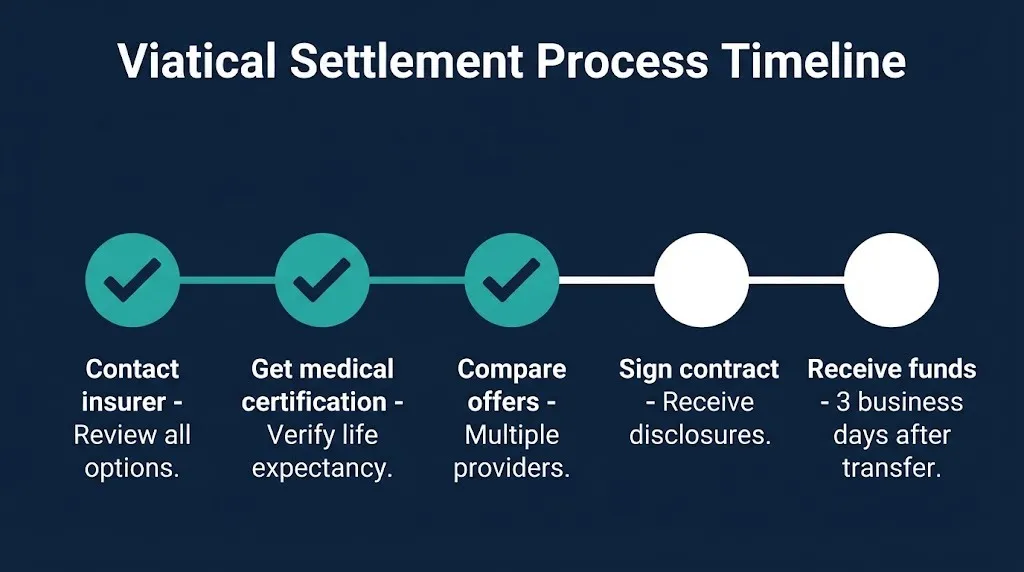
The viatical settlement process involves several stages, from initial application to receiving your funds. Here’s how it works:
- Contact your life insurer first. Ask about all options under your policy, including accelerated death benefits and policy loans.
- Request offers from multiple providers. Comparison shopping can help you get the best value for your policy.
- Submit medical records. A licensed physician will verify your diagnosis and life expectancy.
- Receive and review offers. You don’t have to accept any offer you receive.
- Sign the settlement contract. Disclosures about taxes, creditor claims, and public benefits must be provided before signing.
- Exercise your rescission right if needed. Most states allow you to cancel within 15 to 30 days of receiving proceeds.
- Receive your lump sum payment. Funds are typically sent within three business days after the insurer confirms the ownership transfer.
The entire process can take several weeks to a couple of months, depending on how quickly medical records are obtained and offers are evaluated.
What Are the Tax Implications of a Viatical Settlement?
Viatical settlement proceeds are generally tax-free under federal law if specific IRS criteria are met. The insured must be certified by a physician as terminally or chronically ill, and the buyer must qualify as a licensed viatical settlement provider.
The tax exclusion is unlimited for terminally ill individuals. For chronically ill individuals, the exclusion is limited under Section 101(g)(3) of the Internal Revenue Code.
State tax treatment may differ. Some states impose their own income or franchise taxes on settlement proceeds. You should consult a professional tax advisor before completing a transaction.
There’s another financial consideration that catches some sellers off guard. Receiving a large lump sum could affect your eligibility for Medicaid, food stamps, or other public assistance programs. The proceeds could also be subject to claims by your creditors.
How Are Viatical Settlements Regulated by State Insurance Departments?
Viatical settlements are regulated at the state level, not by a single federal agency. Most states require viatical settlement providers and brokers to be licensed.
Ohio’s Department of Insurance, for example, recently completed a five-year review of its viatical settlement rules in 2026. The state charges initial licensure fees of $1,000 for providers and $200 for brokers, with renewal fees and continuing education requirements.
Virginia’s regulations set minimum payout percentages based on life expectancy, require comprehensive disclosures about alternatives, taxes, creditor claims, and public benefits, and mandate a 30-day rescission right. Violations are treated as unfair trade practices with fines up to $5,000 for knowing violations.
Kansas law requires disclosures about the fiduciary duty brokers owe to viators, the potential tax consequences, and the right to rescind within 15 days. The law also limits how often the insured can be contacted for health status checks, capping it at once every three months for those with life expectancy over one year.
What Are the Risks and Red Flags in Viatical Settlements?
The biggest risks in viatical settlements involve privacy loss, tax consequences, and the possibility of getting less than your policy is worth. You’ll need to provide extensive medical and personal information to the buyer, who may share it with others.
Your identity and medical details could be disclosed as necessary to complete the transaction. Buyers may learn your address, life expectancy, and health status. That information can be passed along if the policy is resold.
High-pressure sales tactics are a known problem in this industry. The FTC advises consumers to resist them, contact multiple companies, and verify that the company has the payout money on hand rather than “shopping” the policy to a third party after you’ve signed.
Regulators have documented significant fraud in the broader life settlement investment market. The NASAA has reported cases involving fraudulent life expectancy evaluations, inadequate premium reserves, and misrepresentations about risks and returns.
What Happens Next in the Viatical Settlement Industry?
The viatical settlement market continues to evolve as the population ages and more policyholders seek ways to access the value of their life insurance policies.
Ongoing: State insurance departments continue five-year reviews of their viatical settlement regulations. Ohio completed its review in April 2026 with only technical changes.
Ongoing: Institutional investors are playing a larger role in the life settlement market, which may lead to higher standards and more professionalized operations.
Expected: Continued state-level scrutiny of stranger-originated life insurance (STOLI) arrangements, where policies are purchased with the intent to settle them from the start.
TBD: Any federal regulatory changes. The SEC’s attempt to regulate viatical investments as securities was rejected by the D.C. Circuit in SEC v. Life Partners, leaving primary oversight to the states.
Frequently Asked Questions
Is a viatical settlement the same as a life settlement?
No. A viatical settlement is for someone with a terminal or chronic illness. A life settlement is for someone without a terminal diagnosis who wants to sell their policy.
How much can I get from a viatical settlement?
Payouts typically range from 50% to 80% of your policy’s face value, depending on your life expectancy and policy terms.
Are viatical settlements taxable?
Generally tax-free under federal law if the insured is certified as terminally ill and the buyer is a licensed viatical settlement provider.
Who qualifies for a viatical settlement?
You may qualify if you have a terminal or chronic illness with a life expectancy of 24 months or less and own a life insurance policy beyond its contestability period.
Can I cancel a viatical settlement after signing?
Yes. Most states give you a rescission right, commonly 15 to 30 days after receiving proceeds. You must return the money if you cancel.
What are the alternatives to a viatical settlement?
Accelerated death benefits, policy loans, cash surrender, or borrowing against the policy’s cash value. Contact your insurer to learn what’s available.
What is a viatical settlement broker?
A broker represents you, the viator, and comparison shops offers from multiple providers. The broker owes you a fiduciary duty in many states.
What happens to my policy after I sell it?
The buyer becomes the new owner and beneficiary, pays all future premiums, and collects the death benefit when you die.
What Should You Do Before Selling Your Policy?
Contact your life insurance company first to learn about all your options, including accelerated death benefits that may let you access funds without selling. Comparison shop by contacting multiple licensed providers or working with a broker who represents your interests.
Consult a tax professional about the consequences, especially if you receive public benefits like Medicaid or food stamps. A lump sum could affect your eligibility. Talk to a financial advisor who knows your situation before making a decision.
The most important fact to remember: a viatical settlement is a one-time transaction with permanent consequences. Your beneficiaries will not receive the death benefit after you sell the policy. The buyer will.