Negligence Lawsuit 2026: Elements, Damages & How to File a Claim
Quick Answer
- Is it legit: Yes. Negligence is the most common legal theory in personal injury lawsuits across the U.S.
- How much: Damages depend on injury severity. Economic losses plus non-economic multipliers typically range from 1.5x to 5x medical costs.
- Key deadline: Statutes of limitations vary by state, typically 2 to 4 years from the injury date.
A negligence lawsuit is how you hold someone legally accountable when their carelessness causes you harm. It’s the foundation of most personal injury cases, from car accidents to slip-and-falls to medical malpractice.
The lawsuit requires proof of four things: the defendant owed you a duty of care, they breached that duty, the breach caused your injury, and you suffered actual damages. Miss any one element, and the case fails.
This guide breaks down what negligence actually means in legal terms, the different types, how damages are calculated, the deadlines you can’t miss, and the defenses you’ll face. One detail stands out: comparative negligence rules in most states reduce your recovery by your own percentage of fault, meaning even a small mistake on your part can cost you thousands.
The Facts
| Legal Theory | Negligence (duty, breach, causation, damages) |
| Typical Deadline | 2 to 4 years from injury (varies by state) |
| Damages Range | Economic losses plus 1.5x to 5x multiplier |
| Fault Rules | Comparative or contributory negligence varies by state |
| Attorney Fees | Contingency, typically 25% to 40% |
| Proof Standard | Preponderance of the evidence (more likely than not) |
What Is a Negligence Lawsuit in Simple Terms?
A negligence lawsuit is a civil claim that says someone failed to act with reasonable care and that failure caused you harm. You’re not accusing them of intentional wrongdoing, just carelessness.
Think of it like this: if a store leaves a slippery floor without warning and you fall, that’s negligence. The store didn’t mean to hurt you, but they failed to meet a basic standard of care that any reasonable business would follow.
The legal system uses a “reasonable person” standard. Would a reasonable person in the same situation have acted differently? If yes, the defendant may be negligent.
This isn’t about perfection. People make mistakes. Negligence law asks whether the mistake was one a careful person would have avoided, and whether that mistake caused real harm.
What Are the 4 Elements of a Negligence Lawsuit?
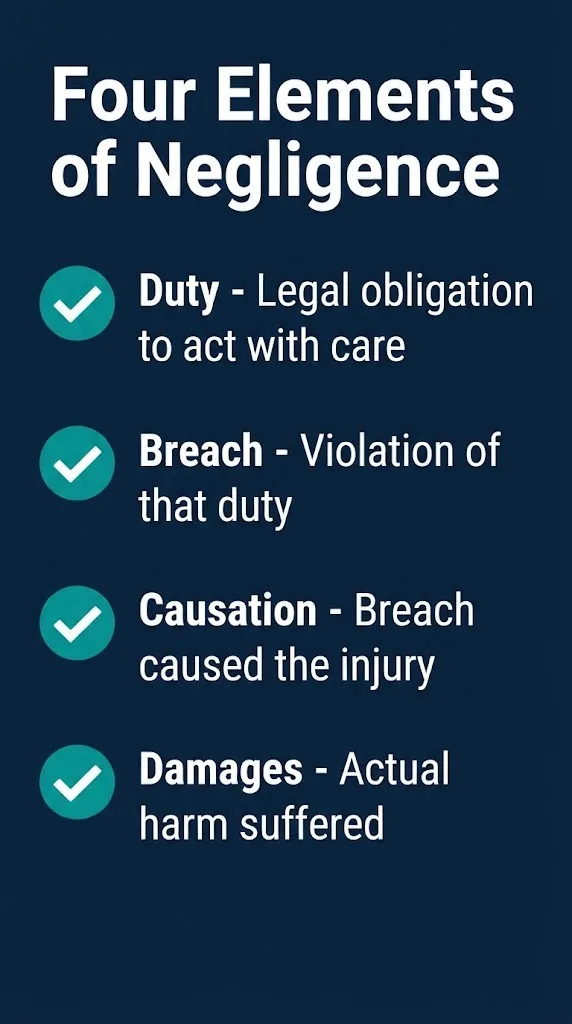
The four elements of negligence are duty, breach, causation, and damages. You must prove all four to win. Missing any single element means the lawsuit fails.
Duty: The defendant owed you a legal obligation to act with reasonable care. Drivers owe other drivers a duty. Property owners owe visitors a duty. Doctors owe patients a duty.
Breach: The defendant violated that duty. They did something a reasonable person wouldn’t have done, or failed to do something they should have.
Causation: The breach directly caused your injury. This has two parts: actual cause (the injury wouldn’t have happened without the breach) and proximate cause (the injury was a foreseeable result).
Damages: You suffered actual harm, whether physical, financial, or emotional. No damages, no lawsuit, even if duty and breach are obvious.
Here’s how the elements work in a car accident case:
| Element | Example |
|---|---|
| Duty | Driver owes others a duty to follow traffic laws |
| Breach | Driver runs a red light |
| Causation | The red-light running causes a collision |
| Damages | You suffer a broken arm and $15,000 in medical bills |
Key Takeaway: All four negligence elements must be proven by a preponderance of the evidence, meaning it’s more likely than not that the defendant’s carelessness caused your harm.
What Is the Difference Between Negligence and Gross Negligence?
Negligence is a failure to exercise reasonable care. Gross negligence is a conscious and voluntary disregard for the safety of others, representing a much higher level of carelessness.
The distinction matters for damages. Some states allow punitive damages only in gross negligence cases. Insurance companies may also pay more to settle gross negligence claims because the exposure is greater.
Examples help clarify the difference:
Ordinary negligence: A driver briefly looks down to adjust the radio and rear-ends the car ahead.
Gross negligence: A driver who is intoxicated, speeding in a school zone, and running red lights.
Both are negligence. One is far more serious and carries higher legal consequences.
What Types of Negligence Lawsuits Exist?
Negligence lawsuits span nearly every area of personal injury law. The legal theory is the same, but the specific duty and breach analysis differs by context.
| Type | Common Examples |
|---|---|
| Car accidents | Distracted driving, speeding, DUI |
| Slip and fall | Wet floors, uneven pavement, poor lighting |
| Medical malpractice | Surgical errors, misdiagnosis, medication mistakes |
| Product liability | Defective design, manufacturing flaws, inadequate warnings |
| Premises liability | Inadequate security, dog bites, pool accidents |
| Truck accidents | Fatigue, improper loading, maintenance failures |
Each type has its own standards for what constitutes reasonable care. A doctor’s duty is defined by medical standards. A property owner’s duty depends on whether you’re an invitee, licensee, or trespasser.
How Is Fault Determined in a Negligence Lawsuit?
Fault in a negligence lawsuit is determined by comparing the defendant’s conduct to what a reasonable person would have done in the same situation. Courts use different systems depending on the state.
Pure comparative negligence: You recover damages minus your percentage of fault, no matter how high your fault is. If you’re 80% at fault and the defendant is 20%, you recover 20% of your damages.
Modified comparative negligence: You recover only if your fault is below a threshold, typically 50% or 51%. If you’re 50% or more at fault in a 50% bar state, you recover nothing.
Contributory negligence: A few states still follow this strict rule. If you’re even 1% at fault, you recover nothing. This is rare and widely criticized.
Most states use some form of comparative negligence. The specific rule in your state can make or break your case, so checking the law early matters.
What Damages Can You Recover in a Negligence Lawsuit?
You can recover economic damages, non-economic damages, and in rare cases punitive damages. Each category has different documentation requirements and caps.
Economic damages are easy to calculate. They include medical bills, lost wages, property damage, and future care costs. Receipts and records prove these.
Non-economic damages are subjective. They include pain and suffering, emotional distress, loss of enjoyment of life, and loss of consortium. Insurance companies often use a multiplier method: economic damages times 1.5 to 5, based on injury severity.
Punitive damages are rare and reserved for gross negligence or intentional misconduct. They’re designed to punish, not compensate.
| Damage Type | Examples | How Proved |
|---|---|---|
| Economic | Medical bills, lost wages, future care | Receipts, records, expert testimony |
| Non-economic | Pain, suffering, emotional distress | Medical records, testimony, multiplier |
| Punitive | Punishment for egregious conduct | Clear and convincing evidence (varies) |
Some states cap non-economic damages in certain cases, particularly medical malpractice. Caps vary widely and change with legislation.
Reality Check: No one texts you about a negligence settlement you didn’t file. If someone contacts you claiming you’re owed money from a lawsuit you never filed, it’s a scam. Filing a negligence claim is always free to initiate, and legitimate attorneys work on contingency.
What Is the Deadline to File a Negligence Lawsuit?
The deadline to file a negligence lawsuit depends on your state’s statute of limitations, typically 2 to 4 years from the injury date. Missing it can end your case entirely.
Some examples of how strict these deadlines are:
- Nebraska: 4-year statute of limitations. A claimant filed one day before expiration but named a deceased person as defendant, and the case was dismissed as a nullity.
- Ontario, Canada: 2-year limitation period, but the clock starts when the claimant discovers the injury meets the “permanent serious impairment” threshold, not necessarily the accident date.
Some states toll the deadline for minors or incapacitated claimants. Others have shorter deadlines for claims against government entities, often 6 months to 1 year.
Step-by-Step: How to File a Negligence Lawsuit
Filing a negligence lawsuit involves several stages. Here’s the sequence:
- Seek medical care immediately. Document your injuries from the start.
- Preserve evidence. Photos, witness statements, incident reports, and surveillance footage.
- Notify the responsible party. In writing, if applicable. Do not admit fault.
- Consult an attorney. Most offer free consultations for negligence claims.
- Send a demand letter. Your attorney outlines facts, injuries, and the requested amount.
- Negotiate or file suit. Most cases settle before trial.
- Complete discovery. Depositions, medical exams, and document exchange.
- Settle or go to trial. The final stage if no agreement is reached.
What Defenses Are Used in Negligence Lawsuits?
Defendants in negligence lawsuits use several common defenses to reduce or eliminate liability. Understanding these helps you prepare.
Comparative fault: You were partly responsible for your own injury. This reduces your recovery.
Assumption of risk: You knowingly and voluntarily accepted a known danger. Common in sports injuries and some recreational activities.
Lack of causation: The defendant admits fault but argues their actions didn’t cause your specific injury.
Statute of limitations: The deadline passed. This is a complete bar to recovery.
No duty: The defendant argues they owed you no legal duty of care in the specific situation.
What Happens Next in a Negligence Lawsuit?
The path forward depends on the strength of your evidence and whether the defendant disputes liability.
Weeks 1-4: Evidence gathering, medical documentation, attorney consultation.
Month 2-6: Demand letter sent, negotiations begin. Most cases settle here.
If disputed: Lawsuit filed. Discovery phase. Depositions, expert reports.
Month 12-24: Mediation or trial. Most cases resolve before a verdict.
After settlement: Payment arrives after liens and fees are deducted.
Frequently Asked Questions
What is a negligence lawsuit?
A civil claim alleging someone failed to exercise reasonable care, causing you harm. It requires proving duty, breach, causation, and damages.
What are the 4 elements of negligence?
Duty (legal obligation), breach (violation of that duty), causation (the breach caused the injury), and damages (actual harm suffered).
How long do you have to file a negligence lawsuit?
Statutes of limitations vary by state, typically 2 to 4 years from the injury date. Some claims against government entities have much shorter deadlines.
What is the difference between negligence and gross negligence?
Negligence is ordinary carelessness. Gross negligence is a conscious disregard for safety, often allowing punitive damages.
How is fault determined in a negligence case?
By comparing the defendant’s conduct to what a reasonable person would have done. Comparative negligence rules reduce recovery based on your own fault percentage.
What damages can you recover in a negligence lawsuit?
Economic damages (medical bills, lost wages), non-economic damages (pain and suffering), and in rare cases punitive damages.
Do you need a lawyer for a negligence lawsuit?
You can file without one, but liability disputes, insurance negotiations, and trial procedures are complex. Most negligence attorneys work on contingency.
What is comparative negligence?
A system that reduces your recovery by your percentage of fault. In modified comparative states, you recover nothing if you’re 50% or 51% at fault.
What Should You Do After Suffering a Negligence Injury?
Seek medical care immediately, even if you feel fine. Document everything: photos, witness contacts, incident reports, and all medical records. Report the incident to the responsible party in writing.
Contact a negligence attorney for a free consultation. The consultation costs nothing and could protect thousands in compensation. The most important deadline is your state’s statute of limitations, typically 2 to 4 years. Don’t wait.