Mass Tort vs Class Action 2026: Key Differences, Payouts & Which Path Fits Your Claim
Quick Answer
- Key difference: Class actions share one outcome for everyone. Mass torts let each plaintiff prove individual harm and damages.
- How much: Class action payouts are often equal or formula-based. Mass tort payouts vary widely by injury severity.
- Key deadline: No general deadline. Timelines differ by case, and class actions typically resolve faster than mass torts.
When a large group of people suffers harm from the same product, drug, or corporate conduct, the legal system offers two distinct paths: a class action or a mass tort. The terms get used interchangeably in headlines, but they operate very differently, and the path chosen affects your control, your timeline, and your compensation.
The choice isn’t yours to make alone. Courts decide whether claims qualify for class certification based on how similar the injuries are. If individual issues like causation or damages vary too much, the case likely proceeds as a mass tort.
This guide explains what separates these two legal mechanisms, how each handles compensation, why pharmaceutical and medical device cases usually become mass torts, and what you should know if you’re considering joining either type of litigation. One detail stands out: mass tort plaintiffs often recover more because their damages aren’t averaged across a class.
The Facts
| Class Action Structure | Single lawsuit, one outcome for all class members |
| Mass Tort Structure | Individual lawsuits coordinated for pretrial efficiency |
| Class Certification | Required; court must approve the class |
| Mass Tort Certification | Not required; cases often consolidated in MDL |
| Compensation Model | Shared equally or by formula |
| Compensation Model (Mass Tort) | Individualized based on specific damages |
| Typical Use | Consumer fraud, data breaches, small claims |
| Typical Use (Mass Tort) | Defective drugs, medical devices, toxic exposure |
What Is the Main Difference Between a Mass Tort and a Class Action?
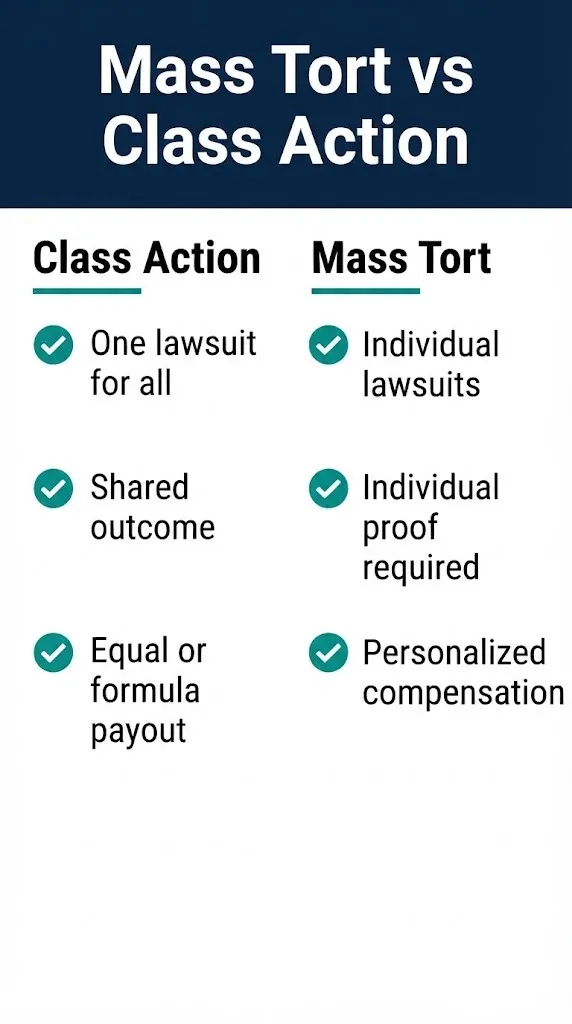
The main difference is that a class action consolidates everyone into one lawsuit with a shared outcome, while a mass tort keeps each plaintiff’s case separate and individually evaluated .
In a class action, one or a few “lead plaintiffs” represent the entire group. If the case settles or wins at trial, the money is divided among all class members, often equally or by a pre-set formula. Your individual story and specific damages carry less weight .
In a mass tort, every plaintiff files their own case. Those cases may be grouped together in a Multi-District Litigation (MDL) for pretrial efficiency, but each plaintiff still needs to prove their own injury, causation, and damages. Compensation reflects the actual harm each person suffered .
Think of it like a delayed tax refund versus a store return without a receipt. The class action is the refund: everyone gets the same calculation based on a formula. The mass tort is the return: you have to prove what you paid and what went wrong to get your specific money back.
How Do Class Action Payouts Work?
Class action payouts are typically shared equally or distributed by a formula, regardless of how severely each person was affected. That’s the trade-off for efficiency.
The court must certify the class before anything moves forward. To be certified, the claims must share common questions of law or fact, the group must be large enough that individual suits are impractical, and the lead plaintiff’s claims must be typical of the class .
Once certified, everyone in the class is bound by the outcome unless they opt out. If the case settles for $10 million and there are 100,000 valid claims, each person might receive $100 or less after fees and costs. Your actual losses don’t change that number .
This structure works best when individual damages are small and similar. Data breaches, false advertising, and hidden fee cases fit well because everyone lost roughly the same thing. A class action lets thousands of people pursue claims that wouldn’t be worth filing individually .
How Do Mass Tort Settlements Work?
Mass tort settlements are negotiated individually, and the amount each plaintiff receives depends on the specific harm they suffered. This allows for much wider variation in compensation.
In a mass tort, every plaintiff retains their own case. The court may consolidate pretrial proceedings, particularly in federal court through an MDL, but each claim remains distinct . Discovery is shared for efficiency, but each plaintiff still must prove their own causation and damages .
Settlement negotiations often happen on a global basis, but the allocation to each plaintiff is based on factors like injury severity, medical costs, lost wages, and long-term prognosis. A plaintiff who suffered permanent organ damage will receive far more than someone with a temporary reaction .
This individual approach is why mass torts dominate pharmaceutical and medical device litigation. When injuries range from mild to catastrophic, averaging them across a class would shortchange the most severely harmed plaintiffs .
Why Are Drug and Medical Device Cases Usually Mass Torts?
Drug and medical device cases are usually mass torts because individual injuries, medical histories, and causation issues vary too much for class certification. Courts consistently find that these claims lack the commonality required for a class .
Consider a defective drug case. One plaintiff took the medication for six months and suffered a minor reaction. Another took it for years and developed a life-threatening condition. Their medical histories differ. Their dosages differ. Their causation proof differs. A court can’t fairly resolve all those claims in one trial .
The Dalkon Shield litigation from the 1970s illustrates this. Courts refused to certify a class of women injured by the intrauterine device because injuries could have resulted from “individual physical characteristics, negligent conduct of the user, or negligent conduct of the prescribing physician” .
Modern mass torts follow the same logic. Zantac, opioid, and hernia mesh cases all proceed as mass torts because the individual issues predominate .
Key Takeaway: Mass torts preserve individual compensation for serious injuries, while class actions trade individual variation for efficiency in cases with small, similar damages.
Can You Opt Out of a Class Action?
Yes, you can opt out of a class action after the class is certified. Opting out means you give up your share of any class settlement but keep the right to file your own individual lawsuit .
The opt-out window is typically announced in the class notice. If you believe your damages are significantly higher than what the class settlement would provide, opting out may make sense. But you’ll need to pursue your own case, which means finding your own attorney and covering your own costs .
If you stay in the class, you’re bound by the outcome. You can’t file a separate lawsuit later for the same claims. The decision is final once the opt-out deadline passes.
Mass torts don’t have an opt-out mechanism because there’s nothing to opt out of. Every plaintiff already has their own case. No one is automatically included in someone else’s lawsuit .
How Are Attorneys Paid in Class Actions vs Mass Torts?
Attorneys in class actions are paid from the total settlement fund, with fees approved by the court. In mass torts, attorneys are paid based on each plaintiff’s individual retainer agreement .
Class action fees are set through a court process. The judge reviews the requested amount and awards what’s reasonable. This protects class members from excessive fees, but it also means the fee is deducted before anyone receives their share .
Mass tort fees are typically contingency-based, often 33% to 40% of each plaintiff’s recovery. Each plaintiff has their own fee agreement. Costs and liens are deducted from individual settlements, and attorneys’ fees are based on what you agreed to in your retainer .
What Happens Next in Large-Scale Litigation?
The path forward depends on whether the court certifies a class or allows mass tort coordination. Here’s what typically happens:
Filing: One class action complaint or hundreds of individual complaints filed.
Certification/Coordination: Court decides whether to certify a class or consolidate cases in an MDL.
Discovery: Common evidence gathered; in mass torts, individual discovery also proceeds.
Resolution: Class actions settle or go to trial as one. Mass torts negotiate global settlements or try individual cases.
Distribution: Class funds distributed by formula. Mass tort settlements paid based on individual damages.
Frequently Asked Questions
What is the difference between a mass tort and a class action?
A class action groups everyone into one lawsuit with a shared outcome. A mass tort keeps each plaintiff’s case individual with personalized damages.
Which pays more, a class action or mass tort?
Mass torts often pay more because compensation reflects your specific harm. Class action payouts are typically equal or formula-based.
Can I be in both a mass tort and a class action?
Sometimes. A defective drug might generate mass tort claims for injured people and a separate class action for refunds for those without physical injuries .
Why are drug cases mass torts instead of class actions?
Individual injuries, medical histories, and causation proof vary too much for class certification. Courts find these claims lack commonality.
Do I have to participate in a class action?
No. You can opt out after the class is certified and file your own lawsuit. But you give up your share of the class settlement.
What is an MDL?
Multi-District Litigation. It’s a procedure that consolidates federal cases for pretrial efficiency while preserving each plaintiff’s individual claim .
How long do mass torts take compared to class actions?
Class actions often resolve faster because they’re one proceeding. Mass torts take longer because each claim requires individual evaluation .
Do class action members get individual trials?
No. Only the lead plaintiff’s case is tried. Other class members are bound by the outcome unless they opt out .
What Should You Do If You’ve Been Harmed?
Determine whether your injury is similar to others affected by the same product or conduct. If your damages are small and identical to others, a class action may be the right path. If your injury is severe and unique, a mass tort likely serves you better.
Consult an attorney who handles large-scale litigation. They can explain whether a class has been certified, whether an MDL exists, and what your options are. The consultation typically costs nothing.
The most important fact: mass torts preserve your right to individual compensation, while class actions trade that individuality for efficiency. Understanding which path applies to your situation is the first step toward protecting your claim.