Agent Orange Lawsuit 2026: Current Status, VA Benefits, and What Veterans Can Still File
Quick Answer
- The original Agent Orange class action settled for $180 million in 1984, paying up to $12,800 per veteran before ending in 1994.
- No new U.S. class action settlement fund exists, but veterans can still file VA disability claims for Agent Orange presumptive conditions.
- The PACT Act of 2022 added hypertension, MGUS, and hypothyroidism to the presumptive conditions list.
Is the Agent Orange Lawsuit Still Active in 2026?
The original Agent Orange class action lawsuit is not active because it settled in 1984 and the payment fund closed on December 31, 1994. Vietnam veterans filed a class action against Dow, Monsanto, and five other chemical companies in 1978. The case settled for $180 million hours before trial in May 1984 .
That settlement did not admit wrongdoing by the chemical companies. The fund distributed approximately $196.5 million in cash payments to about 52,000 class members during its ten-year operation . The maximum payment was $12,800 for a totally disabled veteran and $3,400 for a survivor .
The fund ended in 1994. Veterans who manifested injuries after that cutoff were not covered by the original settlement. A federal appeals court later ruled that those post-1994 claimants were not adequately represented and could pursue their own lawsuits .
For most veterans today, the active path is VA disability benefits, not a class action settlement. VA recognizes Agent Orange exposure as a presumed cause of certain conditions, meaning you do not have to prove causation.
Key Takeaway: The 1984 Agent Orange settlement fund closed in 1994 and cannot be claimed. Current relief flows through VA disability benefits and the PACT Act presumptive conditions.
What Agent Orange Lawsuit Settlements Have Paid Out?
The original Agent Orange settlement paid a maximum of $12,800 to totally disabled veterans and $3,400 to survivors. That is the only class action settlement fund that ever paid Agent Orange claims in the United States.
Judge Jack Weinstein of the U.S. District Court for the Eastern District of New York approved the settlement. Aetna Life Insurance Company served as the claims administrator . Payments were based on how long you were disabled and your age at the time disability began .
Here is what the settlement fund paid:
| Payment Type | Maximum Amount | Who Qualified |
|---|---|---|
| Disabled veteran | $12,800 | Totally disabled Vietnam veterans |
| Survivor | $3,400 | Spouses or dependent children of deceased veterans |
| Total distributed | $196.5 million | Approximately 52,000 class members |
The fund also allocated $71.8 million to the Class Assistance Program for social services . Another $50 million was set aside for Vietnam veteran social services programs .
A parallel lawsuit filed by Vietnamese victims was thrown out by a Federal District Court in Brooklyn. Judge Weinstein ruled that supplying Agent Orange did not amount to a war crime .
Key Takeaway: The only U.S. settlement ever paid to Agent Orange claimants maxed out at $12,800 per disabled veteran and ended in 1994. No new class action fund has been established.
Reality Check
No one will text you about an Agent Orange settlement payment. The original fund closed in 1994, and no new settlement exists. If someone contacts you promising cash from an “Agent Orange lawsuit,” it’s a scam. The only legitimate path for veterans today is filing a VA disability claim, which is always free. VA-accredited attorneys and veterans service organizations can help you file at no upfront cost.
What VA Disability Benefits Can Agent Orange Veterans Still Claim?
VA disability compensation is available for Agent Orange presumptive conditions, and the PACT Act of 2022 expanded that list. If you served in Vietnam between January 9, 1962, and May 7, 1975, and have a condition on the presumptive list, VA presumes your exposure without requiring proof .
The Blue Water Navy Vietnam Veterans Act of 2019 extended the presumption to veterans who served aboard U.S. military vessels offshore of the Republic of Vietnam . That law reversed the “foot-on-land” requirement that had excluded Navy veterans for decades.
Agent Orange presumptive conditions include:
- Ischemic heart disease
- Type 2 diabetes
- Non-Hodgkin lymphoma
- Prostate cancer
- Respiratory cancers (lung, bronchus, larynx, trachea)
- Multiple myeloma
- Parkinson’s disease
- Peripheral neuropathy
- Soft tissue sarcomas
- Hodgkin disease
- Chronic B-cell leukemias
- AL amyloidosis
- Hypertension (added by PACT Act)
- MGUS (added by PACT Act)
- Hypothyroidism (added by PACT Act)
Veterans who served in Thailand at Royal Thai Air Force bases between 1962 and 1975 may qualify if their duties placed them near the base perimeter where herbicides were used. Korean DMZ veterans who served between April 1, 1968, and August 31, 1971, may also qualify .
Secondary conditions linked to these presumptive conditions can be separately rated. Type 2 diabetes commonly causes peripheral neuropathy, erectile dysfunction, and kidney issues that each carry their own disability rating .
What Is the Blue Water Navy Agent Orange Lawsuit About?
The Blue Water Navy lawsuit was about whether Navy veterans who served offshore of Vietnam qualified for the Agent Orange presumption. In 2019, the U.S. Court of Appeals for the Federal Circuit ruled in Procopio v. Wilkie that the VA must accept service in the waters surrounding Vietnam the same as boots-on-the-ground service .
Congress then passed the Blue Water Navy Vietnam Veterans Act of 2019, signed into law on June 25, 2019. The law provides that veterans aboard U.S. military vessels offshore of Vietnam between January 9, 1962, and May 7, 1975, are presumed exposed to herbicides and may be entitled to service connection .
The Supreme Court later considered whether the VA’s interpretation of the law was correct. The case addressed whether the BWN Act’s definition of “offshore” waters applies to veterans who flew high-altitude missions over Vietnam .
For eligible Blue Water Navy veterans, the practical result is that you can now file claims for Agent Orange presumptive conditions without proving you set foot on land. You only need to show your ship operated in the defined offshore waters during the covered period.
Key Takeaway: The Blue Water Navy Act of 2019 restored Agent Orange presumptive benefits to Navy veterans who served offshore, reversing decades of denial based on the “foot-on-land” rule.
How Do You File an Agent Orange VA Disability Claim in 2026?
Filing an Agent Orange VA disability claim requires documenting your service location and your current diagnosis. The process is free, and you can get help from a VA-accredited representative.
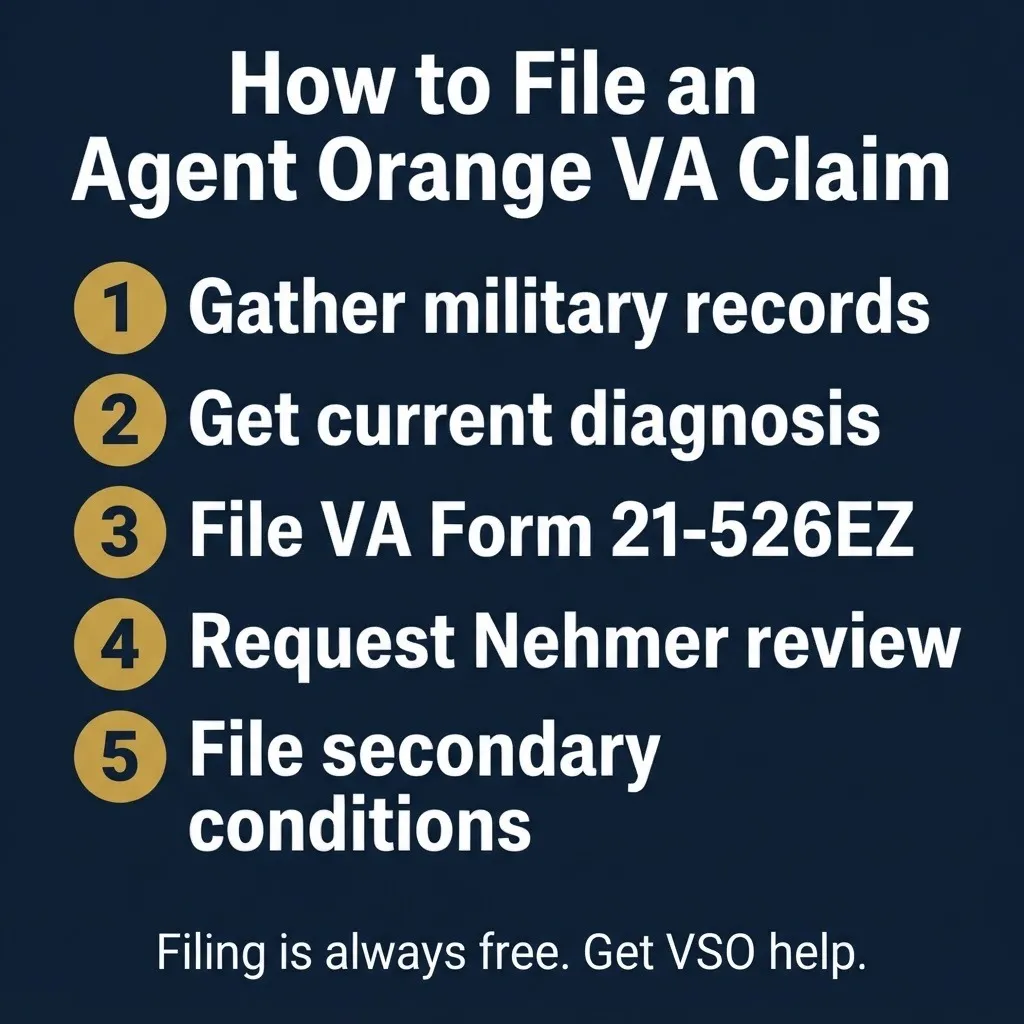
- Gather your military records. Request your DD-214 and service records showing your location and dates in Vietnam, Thailand, Korea, or offshore waters.
- Get a current diagnosis. See a VA or private doctor for the condition you’re claiming.
- File your claim with the VA using VA Form 21-526EZ.
- Claim the presumptive condition by name and reference your qualifying service location.
- Request a Nehmer review if you had a prior denied claim for the same condition.
- Appeal if denied within one year of the decision.
- File secondary conditions as they develop, each gets its own rating.
If you had a prior Agent Orange claim denied, the Nehmer class action requires VA to reconsider it using the original effective date. That can mean retroactive payments going back years .
The VA has recognized more than 650,000 veterans and survivors under the Agent Orange Act between 2002 and 2013 alone .
What Is the Tran To Nga Agent Orange Lawsuit?
Tran To Nga is a French-Vietnamese woman who has pursued a lawsuit against 14 U.S. chemical companies for over 17 years. Her case is active in the French court system, not the U.S.
Tran To Nga filed her lawsuit in 2009 in France. She claims the chemical companies that manufactured Agent Orange are liable for damage to her health and to Vietnamese victims. The Evry High Court dismissed the case in 2021 on jurisdictional grounds .
On June 16, 2026, the French Court of Cassation heard her appeal. After more than two hours of arguments, the court referred the case to its General Assembly instead of ruling immediately .
That referral is significant. It means the highest level of the French court system will consider whether private companies can claim jurisdictional immunity for supplying chemical weapons to a government . A ruling from the General Assembly could set a precedent for corporate liability in war-related environmental damage.
This case does not involve U.S. settlement money for American veterans. It is separate from VA benefits and from the closed 1984 class action fund.
Key Takeaway: Tran To Nga’s French lawsuit is the only active Agent Orange litigation, but it targets Vietnamese victims’ claims, not U.S. veteran compensation.
What Are the 2026 VA Disability Rates for Agent Orange Conditions?
VA disability rates increased by 2.8% for 2026, the annual cost-of-living adjustment. The rate you receive depends on your disability rating percentage, not the specific Agent Orange condition .
Here are the 2026 monthly rates for a single veteran:
| Disability Rating | Monthly Payment (Single) | Annual (Single) |
|---|---|---|
| 10% | $171.23 | $2,054.76 |
| 20% | $338.49 | $4,061.88 |
| 30% | $524.31 | $6,291.72 |
| 50% | $1,041.82 | $12,501.84 |
| 70% | $1,759.19 | $21,110.28 |
| 100% | $3,831.30 | $45,975.60 |
Veterans with dependents receive higher rates. The specific amount depends on the number of dependents and whether the veteran is rated 30% or higher.
The PACT Act also expanded eligibility for VA health care and benefits for toxic-exposed veterans beyond Agent Orange. If you served at certain locations during specific periods, you may qualify even if your exposure wasn’t herbicide-related.
What Happens Next
Expected late 2026: The French Court of Cassation’s General Assembly will issue a ruling on Tran To Nga’s case, potentially setting a precedent for corporate liability in Agent Orange litigation.
December 1, 2026: VA 2027 cost-of-living adjustment announcement, with rates effective January 1, 2027.
Ongoing: VA will continue processing PACT Act claims for Agent Orange presumptive conditions, including hypertension, MGUS, and hypothyroidism.
Ongoing: Veterans who had prior claims denied under the old “foot-on-land” rule should file supplemental claims or request Nehmer reviews.
Frequently Asked Questions
Can I still file an Agent Orange lawsuit in 2026?
No. The 1984 class action settlement fund closed in 1994. No new U.S. class action settlement exists. Veterans can file VA disability claims for presumptive conditions.
How much did veterans get from the Agent Orange settlement?
The maximum was $12,800 for a totally disabled veteran and $3,400 for a survivor. The fund distributed about $196.5 million to roughly 52,000 class members before closing.
Is the Blue Water Navy lawsuit still active?
No, the Blue Water Navy lawsuit resulted in the 2019 law extending the Agent Orange presumption to Navy veterans who served offshore. The law is now in effect.
What conditions qualify for Agent Orange VA benefits?
The presumptive list includes ischemic heart disease, Type 2 diabetes, prostate cancer, respiratory cancers, Parkinson’s disease, and several other conditions. The PACT Act added hypertension, MGUS, and hypothyroidism.
How do I file an Agent Orange VA claim?
File VA Form 21-526EZ with your service records and medical diagnosis. You can get free help from a VA-accredited representative or veterans service organization.
What is the Tran To Nga lawsuit about?
It’s a French lawsuit filed by a Vietnamese-French woman against 14 U.S. chemical companies. The French Court of Cassation referred it to its General Assembly in June 2026.
Can I claim Agent Orange benefits if I served in Thailand or Korea?
Possibly. Thailand veterans at specific Royal Thai Air Force bases and Korean DMZ veterans during certain periods may qualify. Documentation requirements are stricter than for Vietnam service.