Utah Workers Compensation 2026: Benefits, Settlements, and Deadlines
Quick Answer
- Utah pays 66.67% of your average weekly wage, capped at $1,039 per week for temporary disability.
- You must file a claim within 365 days of your injury. The 180-day employer notice runs strictly from the injury date.
- Permanent partial disability uses a scheduled-member system with weekly rates up to $1,306.
Utah workers’ compensation is a no-fault insurance system that covers medical bills and replaces lost wages for employees injured on the job. Every Utah employer with at least one employee must carry coverage.
If you were hurt at work, the clock starts immediately. Utah law requires you to report the injury within 180 days. The formal claim deadline is one year from the accident. Missing either deadline can bar your claim permanently.
This guide covers 2026 benefit rates, how settlements are calculated, the hearing process, and the recent court rulings that affect your rights.
The Facts
| Item | What to Know |
|---|---|
| Benefit Rate | 66.67% of average weekly wage |
| Maximum Weekly Benefit (TTD) | $1,039/week |
| Minimum Weekly Benefit | $208/week |
| Waiting Period | 3 days (retroactive after 14 days) |
| Employer Notice Deadline | 180 days from injury |
| Filing Deadline | 365 days from injury |
| Max TTD Duration | 312 weeks |
| PPD Max Weekly Rate | $1,306/week |
How Much Does Utah Workers’ Compensation Pay?
Utah workers’ compensation pays 66.67% of your average weekly wage for temporary total disability, up to a maximum of $1,039 per week . The minimum weekly benefit is $208.
The state average weekly wage for 2026 is $1,039. If your average weekly wage is below that, you receive two-thirds of your actual wage. If you earn above it, you hit the cap.
Utah has a 3-day waiting period before benefits begin. If your disability lasts more than 14 days, benefits become retroactive to the date of injury, and you are paid for the waiting period as well .
Medical benefits have no waiting period. They are available from the date of injury.
What Is the Average Utah Workers’ Comp Settlement?
There is no published average settlement for Utah workers’ comp cases. Settlement values depend on injury severity, impairment rating, and future medical needs.
Estimates for common injuries based on Utah’s 2026 rates:
| Injury Type | Avg Medical Cost | Avg Lost Wages | Typical Total |
|---|---|---|---|
| Back / Spine | $14,357 | $20,781 | $35,138 |
| Shoulder | $11,712 | $15,239 | $26,951 |
| Knee | $10,201 | $12,469 | $22,670 |
| Neck / Whiplash | $8,690 | $11,083 | $19,773 |
| Carpal Tunnel / Wrist | $5,289 | $7,620 | $12,909 |
| Fracture (Arm/Leg) | $6,990 | $9,698 | $16,688 |
| Head / Concussion | $13,035 | $16,625 | $29,660 |
These are estimates based on NCCI injury cost data and Utah’s 2026 benefit rate . Actual compensation varies by impairment rating, medical documentation, and disputed issues.
How Is a Utah Workers’ Comp Settlement Calculated?
Utah uses a scheduled-member system for permanent partial disability. Each body part has a set number of weeks of benefits.
The formula is: Scheduled Weeks × Impairment Percentage × Weekly Rate
Scheduled values include:
- Arm: 218 weeks
- Hand: 168 weeks
- Leg: 184 weeks
- Foot: 152 weeks
- Eye: 120 weeks (loss of vision)
Unscheduled injuries (back, neck, internal) are valued by whole-person impairment: % impairment × 312 weeks, paid at 66.67% of your average weekly wage up to the maximum .
A negotiated lump-sum settlement usually bundles the disability award with future medical care, then discounts it for present value. Workers’ comp does not pay pain and suffering.
Key Takeaway: Utah workers’ comp pays two-thirds of your wage, capped at $1,039 weekly for temporary disability. Settlements are calculated using a scheduled-member system for permanent injuries, with a negotiated lump sum that typically discounts the gross value.
What Is the Deadline to File a Utah Workers’ Comp Claim?
You must file an Application for Hearing within 365 days of your injury . The employer notice deadline is 180 days from the date of injury.
A 2026 Utah Court of Appeals decision clarified that the 180-day reporting deadline runs strictly from the date of injury, not from when you discover the injury is work-related . The court rejected the discovery rule for the Workers’ Compensation Act. The Occupational Disease Act does contain discovery language, but the standard injury statute does not.
For death benefits, the claim is barred unless an application is filed within one year of the date of death .
If you file within six years, the Commission retains continuing jurisdiction even if your initial claim is denied. That means you can reopen the case if your condition worsens .
How Do I File a Utah Workers’ Comp Claim?
You file a Utah workers’ comp claim by reporting the injury to your employer and then filing an Application for Hearing with the Labor Commission if benefits are disputed.
Here are the steps:
- Report the injury to your employer within 180 days, in writing.
- Seek medical treatment and tell the provider it is a work injury.
- File a First Report of Injury with your employer’s insurance carrier.
- If benefits are denied or disputed, file an Application for Hearing with the Division of Adjudication .
- Attend the evidentiary hearing before an Administrative Law Judge.
- If needed, appeal the ALJ’s decision to the Appeals Board within 30 days.
Most claims are settled without a formal hearing. Only disputed cases proceed to adjudication.
What Happens at a Utah Workers’ Comp Hearing?
The evidentiary hearing is a formal proceeding before an Administrative Law Judge. Testimony is taken under oath and evidence is presented .
The hearing may be held in Salt Lake City or St. George. The ALJ does not announce a decision at the hearing. A written decision is mailed later.
The ALJ may refer disputed medical issues to a Medical Panel for review. The Labor Commission pays for the panel. Objections to the panel report must be filed within 15 days.
If you disagree with the ALJ’s decision, you can file a Motion for Review within 30 days. The case then goes to the Labor Commissioner or Appeals Board.
What Are the 2026 Utah Workers’ Comp Court Rulings?
Two 2026 appellate decisions affect Utah workers’ comp cases.
Hooker v. Labor Commission (Utah Supreme Court, 2026) held that suspension, not dismissal, is the proper sanction when an employee obstructs an independent medical examination . The Board had dismissed Hooker’s claim with prejudice for a pattern of obstructive behavior. The Supreme Court ruled that Utah Code section 34A-2-602(2) specifically prescribes suspension as the sanction for IME obstruction, and that specific statute prevails over the general discovery sanctions in Rule 37 .
Auto Owners Insurance v. Labor Commission (Utah Supreme Court, 2026) addressed how attorney fees and subrogation offsets work when an injured worker settles with a third party. The court held that an employer’s proportionate share of legal expenses includes consideration of anticipated future benefits when the employer seeks both reimbursement and an offset .
What Are the Attorney Fees in Utah Workers’ Comp Cases?
Attorney fees in Utah workers’ comp are fixed by the Labor Commission and are contingent. You pay only if you win, and the fee is deducted from your award .
The fee schedule is:
- 25% of the first $25,000 in weekly benefits
- 20% of benefits from $25,000 to $50,000
- 10% of benefits above $50,000
- Maximum fee: $15,250 for services through final Commission action
For appeals, fees can reach $22,000 at the Court of Appeals and $27,000 at the Supreme Court .
For limited services like consultation or document review, an attorney may charge up to $125 per hour for up to four hours without Commission approval .
Reality Check: No one can promise a specific settlement amount before reviewing your medical records. Utah workers’ comp does not pay pain and suffering. An attorney who guarantees a number is not being honest with you.
What Happens Next?
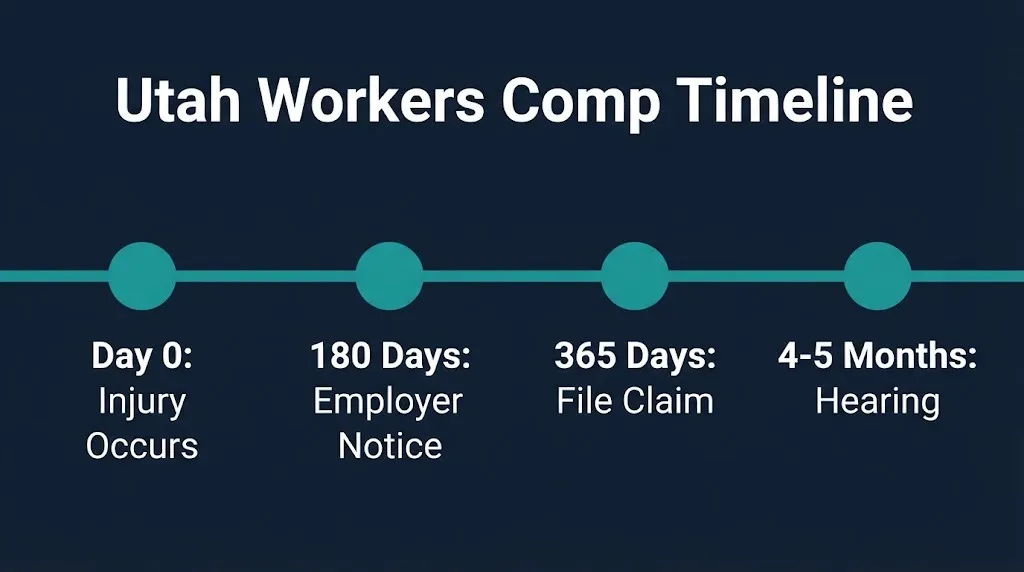
Immediately: Report your injury to your employer in writing.
Within 180 days: Ensure your employer has notice of the injury.
Within 365 days: File an Application for Hearing if benefits are disputed.
4 to 5 months after filing: Evidentiary hearing before an ALJ.
30 days after ALJ decision: Deadline to file a Motion for Review.
Frequently Asked Questions
How much does Utah workers’ comp pay?
Utah pays 66.67% of your average weekly wage, capped at $1,039 per week for temporary total disability. The minimum is $208.
What is the deadline to file a Utah workers’ comp claim?
You must file within 365 days of the injury. The employer notice deadline is 180 days from the injury date.
Can I choose my own doctor in Utah?
You can choose a chiropractor as your treating doctor. Changes to your treating physician may require Labor Commission approval.
How are Utah workers’ comp settlements calculated?
Utah uses a scheduled-member system for permanent partial disability. The formula is scheduled weeks times impairment percentage times the weekly rate.
Do I need a lawyer for a Utah workers’ comp claim?
You can file without one. But complex cases may benefit from representation. Attorney fees are fixed by the Commission and contingent on winning.
What happens if I miss the 180-day reporting deadline?
Your claim may be barred. A 2026 court ruling confirmed the deadline runs strictly from the injury date, not from discovery.
Can I receive unemployment and workers’ comp at the same time?
You cannot receive temporary total disability and unemployment at the same time. You can receive permanent partial disability and unemployment together.
What is the maximum weekly benefit in Utah for 2026?
The maximum for temporary total disability is $1,039 per week. The maximum for permanent partial disability is $1,306 per week.
Report your injury to your employer in writing today. Mark your 365-day filing deadline on your calendar. The most important number is $1,039, the maximum weekly benefit you may receive while unable to work.