Nonqualified Deferred Compensation Plan in 2026: How It Works and Who Qualifies
Quick Answer
- A nonqualified deferred compensation plan lets you defer part of your salary or bonus to a later year, often retirement, without the limits that apply to 401(k) plans.
- There is no fixed payout amount. Your benefit depends on what you defer and what your employer contributes.
- The key deadline is your deferral election. You must make it in the year before you earn the compensation, with narrow exceptions.
A nonqualified deferred compensation plan is a promise from your employer to pay you later. The money is not set aside in a trust for you. It stays on the company’s books and remains subject to its creditors. That is the tradeoff for the tax deferral and the ability to save far more than a 401(k) allows. This article breaks down how these plans work, who can use them, the tax rules under Section 409A, and what to watch for in 2026.
Is a Nonqualified Deferred Compensation Plan Legit?
Yes, nonqualified deferred compensation plans are legitimate and widely used. They are governed by federal tax law and regulated by the IRS under Internal Revenue Code Section 409A .

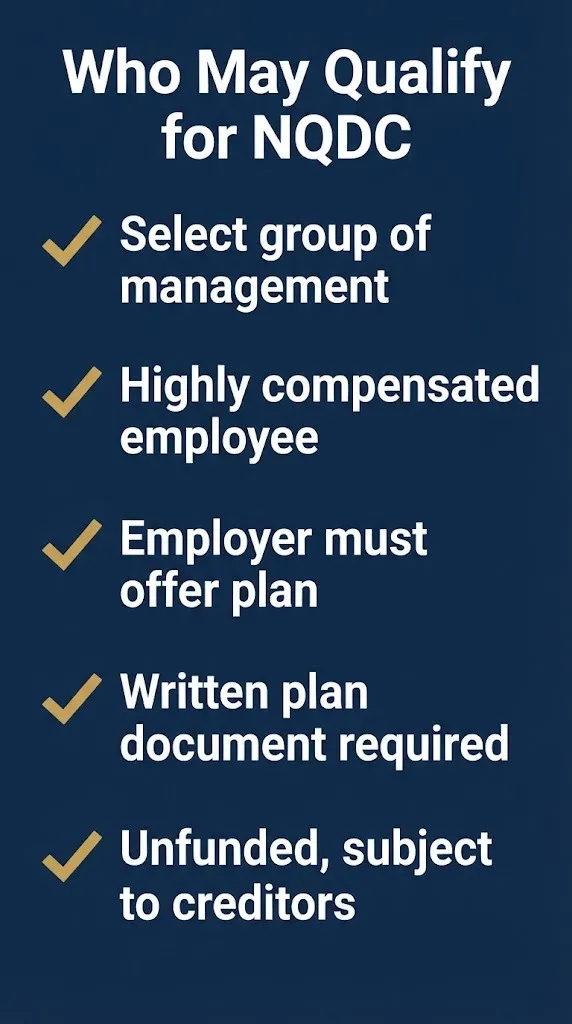
These plans are not scams. They are a standard executive benefit offered by thousands of employers. The key distinction is that they are unfunded and unsecured. Your employer does not put your deferred money into a trust that is protected from creditors. If the company goes bankrupt, you become a general unsecured creditor.
That is different from a 401(k), where your money sits in a trust and is legally yours. A nonqualified plan is a contract, not a trust account. The money you see in your “account” is a bookkeeping entry, not a segregated asset .
Despite that risk, these plans remain a core part of executive compensation. A 2026 survey found that 88% of plan sponsors say their nonqualified plans effectively create long-term financial wellness for participants .
Who May Qualify for a Nonqualified Deferred Compensation Plan?
You may qualify if your employer selects you as part of a “select group of management or highly compensated employees.” This is often called a top-hat plan under ERISA rules .
Employers cannot offer these plans to all workers. The law limits participation to a select group. Common eligibility triggers include:
- Base salary above a certain threshold
- Bonus eligibility at a specific level
- Officer or executive title
- A role the employer designates as key talent
The employer decides who is in the group. There is no legal right to participate, even if you meet a salary threshold. The plan document controls who gets in .
Not yet determined: Exact eligibility rules vary by employer. Check your plan document or ask your HR department if your company offers one.
How Much Money Can You Defer into a Nonqualified Plan?
There is no statutory limit on how much you can defer. Unlike a 401(k), which caps contributions at $23,500 for 2025, a nonqualified plan can let you defer as much of your salary or bonus as the plan allows .
That is the main selling point for high earners. If you max out your 401(k) and still want to reduce your current tax bill, a nonqualified plan gives you more room.
Here is how the two compare:
| Feature | 401(k) Plan | Nonqualified Deferred Comp Plan |
|---|---|---|
| Contribution limit | $23,500 (2025) | No statutory limit |
| Who can participate | Most employees | Select group only |
| Funding | Trust, protected from creditors | Unfunded, subject to employer creditors |
| Tax deduction for employer | When contributions are made | When benefits are paid |
| ERISA protection | Full | Limited (top-hat exemption) |
The employer can also make contributions to your account, with or without your own deferrals. Some plans offer matching credits or profit-sharing credits .
What Is the Primary Tax Rule for Nonqualified Deferred Compensation?
The primary tax rule is Section 409A, which requires you to elect deferrals in the year before you earn the money. If you want to defer part of your 2027 salary, you must make that election by December 31, 2026 .
Section 409A sets strict rules for:
- Deferral elections: Must be made in advance, generally in the prior tax year
- Distribution timing: Only six permitted triggers: death, disability, separation from service, change in control, unforeseeable emergency, or a specified date
- Subsequent deferrals: Changes to payment timing must push payments at least five years later
- Written plan document: The arrangement must be in writing
If a plan fails to comply with Section 409A, all compensation deferred under the plan for that year and all preceding years becomes immediately taxable. You also owe interest and a 20% additional tax on the amount included in income .
Key Takeaway: The deferral election deadline is the most important date in a nonqualified plan. Miss it, and you cannot defer that year’s compensation. No exceptions.
Reality Check
A nonqualified deferred compensation plan is not a savings account. Your employer does not hold your money in a separate trust for you. If the company files for bankruptcy, your deferred pay is at risk alongside other unsecured debts. That is exactly what happened in the Sleep Number bankruptcy case in 2026, where the company asked a court to return assets held in its deferred compensation trust to the estate . Your plan balance is a contractual promise, not a protected asset.
How Do Deferral Elections Work?
Deferral elections must be made before the compensation is earned, usually by December 31 of the prior year. Once you make the election, it is generally irrevocable for that year .
Here is the step-by-step process:
- Review your plan document. Find the election deadline and the available deferral percentage.
- Decide how much to defer. You can defer salary, bonus, or both, depending on the plan.
- Submit your election by the deadline. Most plans require this in the prior calendar year.
- Choose your distribution timing. Pick from the six permitted triggers under Section 409A.
- Select your investment crediting rate. These are notional investments, not real assets you own.
- Confirm your election. Keep a copy of your submission.
- Monitor your account. Review statements and track your vesting schedule.
For performance-based compensation, a special rule allows elections up to six months before the end of the performance period .
What Are the Distribution Triggers for a Nonqualified Plan?
Section 409A permits only six distribution triggers. You must choose from these when you make your deferral election .
- Death: Your beneficiary receives the balance
- Disability: As defined under the tax code
- Separation from service: Termination or retirement
- Change in control: Sale or merger of the company
- Unforeseeable emergency: Severe financial hardship
- Specified date or event: A fixed date you choose, such as age 65
You can usually choose different triggers for different buckets of money. For example, you might schedule one portion for a specific date and another for separation from service.
Changes to distribution timing after the fact are restricted. You generally must push payments at least five years later and cannot accelerate them.
What Happens to Your Plan in a Bankruptcy or Change of Control?
Your deferred compensation is at risk in bankruptcy because the plan is unfunded. The assets are not held in a trust for your benefit and remain subject to claims by the company’s creditors .
In a change of control, the plan document may require the company to distribute your balance. A 2026 SEC filing from a company with a nonqualified plan shows that upon a change in control, balances can be distributed in a lump sum if the participant elected that option .
But in bankruptcy, the treatment is different. The Sleep Number case from August 2026 shows a bankruptcy court granting a debtor’s motion to direct the trustee of its nonqualified deferred compensation plan trust to return assets to the estate . If that happens, participants become unsecured creditors.
This is the risk you accept when you defer. The upside is the tax deferral. The downside is credit risk on your employer.
How Do You Check Your Nonqualified Plan Balance?
You check your balance through your plan’s recordkeeper or the HR portal your employer provides. Most plans send quarterly statements showing your notional account value.
Here is what to look for:
- Vesting schedule: Are you fully vested or do you have unvested employer contributions?
- Deferral balance: Your own deferred salary and bonus
- Employer credits: Any matching or profit-sharing contributions
- Investment earnings: Gains or losses on your notional investments
- Distribution elections: What triggers and timing you selected
If your employer changes recordkeepers, verify that your balance transferred correctly. Keep your own records of what you deferred each year.
What Happens Next for Nonqualified Plan Rules in 2026?
The IRS has a second round of proposed Section 409A regulations on its regulatory agenda for May 2026. Here is what to expect :
- May 2026: Second proposed regulations scheduled for release
- After release: Comment period for employers and practitioners
- TBD: Final regulations and effective dates
- Ongoing: IRS compliance initiative targeting deferred compensation arrangements
The first proposed regulations came in June 2016 and were partially withdrawn later that year. The new round aims to clarify ambiguities in the existing rules .
Employers should review their plan documents against the new guidance when it arrives. Participants should watch for any changes that affect deferral elections or distribution timing.
Frequently Asked Questions
What is a nonqualified deferred compensation plan?
It is an employer-sponsored plan that lets a select group of highly paid employees defer salary or bonus to a later year, often retirement, without the contribution limits of a 401(k).
Who can participate in a nonqualified deferred compensation plan?
You may participate if your employer selects you as part of a select group of management or highly compensated employees. Employers decide who is in the group.
How much can I defer into a nonqualified plan?
There is no statutory limit. You can defer as much as your plan allows, though employers often cap it at a percentage of salary or bonus.
What is the deadline for deferral elections?
You must generally make your election by December 31 of the year before you earn the compensation. For performance bonuses, you may have up to six months before the end of the performance period.
What happens if I leave my job?
The plan document controls. If you elected separation from service as a distribution trigger, you receive your vested balance according to the payment schedule you chose.
Is my nonqualified deferred compensation safe if my employer goes bankrupt?
No. The plan is unfunded and unsecured. You become a general unsecured creditor if the company files for bankruptcy.
What is the 20% penalty for Section 409A violations?
If a plan fails to comply with Section 409A, the deferred amounts become immediately taxable, plus interest and a 20% additional tax on the amount included in income.
Are nonqualified deferred compensation plans subject to ERISA?
They are ERISA pension plans, but top-hat plans for select management employees are exempt from most substantive ERISA provisions, including vesting, funding, and fiduciary rules.
What You Should Do Now
If your employer offers a nonqualified deferred compensation plan, find your plan document and check the deferral election deadline. Most elections for 2027 compensation are due by December 31, 2026. Decide how much you can afford to lock up and understand the credit risk before you commit. The single most important date is your election deadline. Miss it and you lose the opportunity to defer for that year.