Lawyers Lawsuit in 2026: How to Sue a Lawyer, Deadlines and Options
Quick Answer
- A lawyers lawsuit usually means a legal malpractice claim: suing your attorney for negligence that cost you money.
- Payout: Not yet determined. You must prove you’d have won the original case, and published ranges conflict.
- Deadline: California allows one year from discovery or four years from the act, whichever comes first.
A lawyers lawsuit most often means a legal malpractice claim against your own attorney. You can sue, but you must prove the lawyer’s negligence caused measurable financial harm. Lawyers call that the case within a case.
This affects anyone whose case was lost, dismissed, or shrunk by a lawyer’s error. Deadlines run short. In California, it’s one year from discovery. Missing it can end a valid claim.
Below, you’ll find the proof, deadlines, bar complaint limits, and 2026 AI sanction trends. One surprise: a bar can discipline a lawyer but usually can’t order refunds.
| The Facts | |
|---|---|
| Case | General guide to suing a lawyer for malpractice (no single case or class action) |
| Status | Not applicable. This is an ongoing legal-process topic |
| Fund Size | Not applicable, no settlement fund exists |
| Est. Per Person | Not yet determined. Published payout ranges conflict |
| Claim Deadline | Your state’s statute of limitations. California: 1 year from discovery, 4 years from the act |
| Administrator | None. State bars run discipline, fee arbitration, and client protection funds |
| Proof Needed | Fee agreement, case file, correspondence, and often an expert opinion |
Can you sue a lawyer for malpractice?
Yes, you can sue your lawyer for legal malpractice when their negligence causes you financial harm.
Lawyers owe clients a duty of care. The standard is what a reasonably skilled attorney would do in similar circumstances. A malpractice plaintiff must prove four elements:
- An attorney-client relationship existed.
- The lawyer breached the duty of care.
- That breach caused your harm.
- You suffered quantifiable damages.
All four must be proven. Even clear negligence may not support a lawsuit without demonstrable financial harm.

Grounds listed in law firm guides include missed deadlines, conflicts of interest, mishandled client funds, inadequate preparation, failure to communicate, and negligent advice. Each ground still needs causation and damages.
Most claims are professional negligence claims. Some involve breach of fiduciary duty, which means the lawyer failed to act in your best interest.
What counts as legal malpractice, and what doesn’t?
Malpractice means a lawyer’s negligence caused you a loss. Losing, disliking the outcome, or feeling ignored isn’t enough.
Nolo’s guide sorts common situations. Some are clear. Others depend on facts.
| Situation | Malpractice? | Why |
|---|---|---|
| Lawyer settles without your authorization | Yes | You decide whether to settle |
| Lawyer neglects the case and it’s dismissed | Often yes | Neglect caused the loss |
| Lawyer never tells you about a settlement offer | Can be | You lost the chance to decide |
| Lawyer recommends a lower settlement than first estimated | Depends | Facts and reasons matter |
| Lawyer quits working on your case | Depends | Why and when they tell you matters |
| Lawyer socializes with opposing counsel | Almost certainly no | Contact alone causes no loss |
Poor communication can still matter. Failure to communicate appears on grounds lists, but you’ll need harm tied to it.
Keep notes with dates. A clear timeline helps any new lawyer judge whether your situation is a real claim.
What is a “case within a case” and why does it matter?
A case within a case means you must prove your original case would have succeeded without your lawyer’s error.
Some courts call it a trial within a trial. If your lawyer lost a civil case, you show it was lost and would have been won. Or you show you recovered less than you should have.
Think of a warranty claim on a failed repair. You must show the product would have worked if fixed properly. Saying you’re unhappy isn’t enough.
This is why malpractice suits can be costly and slow. You’re effectively litigating two cases.
Criminal defense claims add a hurdle. California’s Supreme Court noted 10 states already require proof of factual innocence, and it joined them. Iowa and Kansas treat innocence as a factor, not a separate element.
One 2026 guide says many plaintiffs’ lawyers decline these cases. Suing a fellow attorney is hard, and the proof burden is heavy.
Key Takeaway: You can sue a negligent lawyer, but you must prove the original case would have turned out better.
How much money can you recover when you sue your lawyer?
Not yet determined for any one person, because recovery depends on what the original case was worth.
The usual measure is the compensation you would have received but for the lawyer’s negligence. Some guides add legal fees you paid and other losses caused by the negligence.
Published payout ranges conflict. One 2026 guide lists $100,000 to $750,000 in one section and $150,000 to $500,000 in another. Treat such ranges as marketing, not data.
Firms report individual results. One Georgia firm reports a $500,000 policy-limits settlement and a $1 million judgment in two matters. Those are firm-reported, not independently verified.
| Possible damages | What it means |
|---|---|
| Lost recovery | The “but for” amount from the original case |
| Fees paid | Money paid to the negligent lawyer |
| Added costs | Extra losses caused by the error |
No reliable national payout database exists in the sources checked. Your number depends on proof, fault, and collectability.
Can you get a fee refund without suing your lawyer?
Sometimes. Fee arbitration and client protection funds can return money without a malpractice lawsuit, but each has narrow limits.
Most jurisdictions offer fee arbitration, according to a law review study. Many programs are voluntary for lawyers. Some are binding. Wisconsin’s State Bar describes its program as an informal, economical alternative to litigation.
Client protection funds reimburse losses from lawyer dishonesty, such as theft. They are discretionary, not a right. Oregon’s fund says it doesn’t cover negligence or fee-reasonableness disputes.
| Route | Can help with | Limits |
|---|---|---|
| Fee arbitration | Billing disputes | Often voluntary for lawyers |
| Client protection fund | Theft, dishonest conduct, some unearned fees | Discretionary, capped at your proven loss |
| Malpractice lawsuit | Losses from negligence | Needs proof and usually an expert |
Tennessee’s fund says you must file a complaint with its Board of Professional Responsibility first. It may also require a judgment for requests above $1,000. Rules differ by state.
Does a bar complaint get your money back?
No, a bar complaint usually can’t order your lawyer to pay you.
A bar can issue a warning, suspend, or disbar a lawyer. That’s discipline, not restitution. It’s like a health inspector who can close a restaurant but won’t refund your meal.
A bar finding can still help. LegalClarity notes it can give leverage in fee arbitration, a malpractice suit, or a fund claim. A complaint also doesn’t replace your right to sue, according to a Florida firm.
California’s State Bar lets you file a misconduct complaint online. Its Client Security Fund is discretionary and funded entirely by California lawyers.
Complaint and arbitration windows vary by state. Check them early, because they run separately from your lawsuit deadline.
Reality Check: Suing your lawyer isn’t a guaranteed payday, and no one should promise you a win. Be wary of anyone who contacts you first offering to “recover” your money for an upfront fee. Verify any new lawyer’s license with your state bar.
Key Takeaway: Fee arbitration and client protection funds can return money in narrow cases, but a bar complaint alone usually can’t.
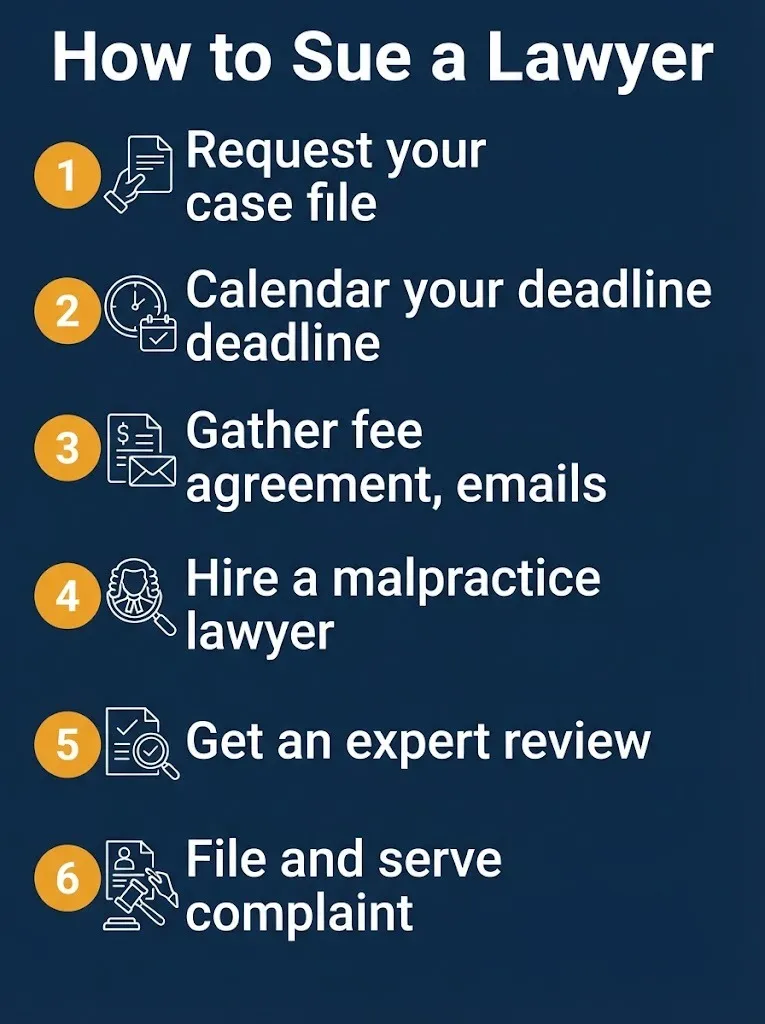
How do you sue a lawyer, step by step?
You sue a lawyer by hiring a different attorney, proving the case within a case, and filing before your deadline.
- Request your complete case file.
- Calendar your filing deadline.
- Gather the fee agreement and emails.
- Hire a malpractice lawyer.
- Get an expert review.
- File and serve the complaint.
The complaint names your former lawyer and describes the allegations. Service notifies them, and their response deadline begins.
Some states add hurdles. In Georgia, a Rule 9.1 affidavit from another attorney must show at least one act or omission constituting professional negligence. Filing without it can sink the case.
Don’t wait to find a new lawyer. Your old lawyer’s file may hold the proof, and your clock may already be running.
How long do you have to sue your lawyer?
You must sue within your state’s statute of limitations, and it can be as short as one year from discovery.
| State | Deadline | Note |
|---|---|---|
| California | 1 year from discovery or 4 years from the act, whichever comes first | Tolling can apply |
| New York | 3 years | Non-medical malpractice |
| Texas | 2 years | Legal malpractice |
| Florida | Typically 2 years | Per one firm summary |
| Louisiana | 1 year, no later than 3 years | Peremptive period |
California’s two timers run at once. It’s like a gift card with two expiry dates, where the earlier one wins. Tolling can pause the clock if you haven’t yet suffered actual injury, your lawyer still represents you on the matter, or you have a disability. Pending mandatory fee arbitration also tolls it. Willful concealment tolls only the four-year limit.
These rules are technical. Published summaries differ in detail, so confirm your state’s deadline with a lawyer or the court clerk.
What evidence do you need before suing a lawyer?
You need proof of the lawyer’s error, proof the error caused your loss, and proof of what the original case was worth.
Gather these items:
- The complete case file, requested in writing
- The fee agreement and billing statements
- Emails, letters, and texts with the lawyer
- Court filings and orders showing the deadline, error, or dismissal
- Records proving your original damages
- An expert opinion, usually from another lawyer, on the standard of care
Expert testimony helps establish that your attorney fell below professional standards. In Georgia, an affidavit is required before filing.
Save everything. Ask your new lawyer which documents matter most.
The ABA’s 2020 to 2023 data, summarized by ALPS, shows settlement-related claims at an all-time high. That includes “settle and sue” plaintiffs, who sign a settlement and later claim the lawyer erred. Those cases face extra proof problems, so don’t assume a signed settlement ends your options or guarantees them.
Key Takeaway: Start with your case file, your deadline, and an expert-backed review before you file.
What are courts doing about lawyers’ AI-fabricated citations in 2026?
Courts are sanctioning lawyers who file AI-invented case citations without checking them.
In March 2026, a Sixth Circuit panel sanctioned two Tennessee attorneys in Whiting v. City of Athens. Reports put the penalty at $15,000 each, plus fees and costs. The briefs contained more than two dozen fabricated citations.
The trend is accelerating. Researchers tracked at least $145,000 in AI-citation sanctions in the first quarter of 2026. One tracker lists an April 2026 indefinite suspension tied to a brief with 57 of 63 citations defective.
ABA Formal Opinion 512, issued in July 2024, says existing rules on competence, confidentiality, and supervision apply to AI tools. The ABA published more AI guidance in January 2026.
Does a sanction mean you can sue? Not automatically. A malpractice claim still needs harm to you. A sanction against your lawyer is evidence of a problem, not proof of your loss.
Ask any lawyer who checks AI-assisted drafts before filing.
What do the latest legal malpractice claim statistics show?
Legal malpractice claims cluster around substantive mistakes, with administrative errors close behind.
The ABA’s Profile of Legal Malpractice Claims 2020 to 2023, published in 2024, is the latest edition found. ALPS reports substantive errors slightly over 50% of claims and administrative errors nearly 25%. Conflict-of-interest and settlement-related claims hit all-time highs.
| Measure | Figure | Source |
|---|---|---|
| Substantive errors | Slightly over 50% | ABA profile, via ALPS |
| Administrative errors | Nearly 25% | ABA profile, via ALPS |
| Preparing, filing, transmitting documents | 35.66% of claims by activity | ALPS summary |
These figures come from insurer-reported claims, not court findings. A claim is an allegation, not a verdict.
That makes them useful but limited. Think of insurer claim data as a map of where trouble clusters, not a list of who’s guilty.
The same pattern appears in older data. Calendaring errors, missed filings, and failure to know the law keep showing up.
What’s the status of the law firm executive order lawsuits?
Four law firms won district court rulings against executive orders targeting them, and the appeal was argued May 14, 2026.
Perkins Coie, Jenner & Block, WilmerHale, and Susman Godfrey each sued over 2025 executive orders. District judges ruled for the firms. Perkins Coie’s ruling came May 2, 2025, and the government appealed.
On March 2, 2026, the Justice Department moved to dismiss its appeals. Within 24 hours, it reversed course and continued the defense. The D.C. Circuit consolidated the appeals and heard argument May 14, 2026.
I found no confirmed appellate ruling in the sources checked. A decision is not yet confirmed, so check the D.C. Circuit docket.
This is a constitutional dispute between firms and the government. It creates no client claim, no settlement fund, and nothing you can file.
Key Takeaway: AI sanctions and claim data show where lawyer risk is rising, but your own claim still turns on your own proof.
What does “lawyers lawsuit” mean?
A lawyers lawsuit can mean three different things, and the right answer depends on who is suing whom.
| Meaning | Who sues whom | Where this guide covers it |
|---|---|---|
| Malpractice or fee claim | You sue your lawyer | Most of this article |
| Lawsuit filed by your lawyer | Your lawyer sues on your behalf | A short note below |
| Law firms as parties | Firms sue the government, or courts sanction firms | The 2026 status sections |
If you need a lawyer to file your own case, the federal civil filing fee is $405. That’s a $350 fee plus a $55 administrative fee. State court fees vary.
Search results mix these meanings. A lawyer’s advertising page may talk about “lawyer lawsuits” when it means cases the firm files for clients.
This guide leads with the first meaning because it’s the most searched and the least explained. It’s also where deadlines are shortest.
Which lawyers get sued most for malpractice?
Solo and small-firm lawyers account for over half of malpractice claims by frequency, according to the ABA’s 2016 to 2019 profile.
That edition also found plaintiffs’ personal injury and family law were the most frequent sources of claims. Business and commercial matters have traditionally been riskier on severity, but the profile doesn’t correlate severity by practice area.
Frequency isn’t fault. Solos and small firms also make up a large share of the profession in many states. Practice areas with high stakes and tight deadlines produce more disputes.
Use the data to ask better questions before hiring:
- How do you calendar and double-check deadlines?
- Who else reviews my filings?
- Have you handled this exact type of case?
- Do you have written policies for new technology?
Administrative errors, such as failing to calendar properly, make up nearly a quarter of claims in the latest data. A firm that answers these questions clearly is showing you its process.
Can a lawyer sue you over unpaid fees?
Yes, fee disputes can end in court, but many bars offer fee arbitration as a faster alternative.
ABA Model Rule 1.5 bars unreasonable fees. If you think a bill is too high, start with the fee dispute program. Contact your state or local bar and ask for it.
Use this mini-checklist:
- Gather the fee agreement and every billing statement.
- Write down the specific charges you dispute.
- Ask your state bar for its fee arbitration program.
- Check whether the program is voluntary or binding.
- Calendar any filing window it sets.
California’s rules include mandatory fee arbitration, and a pending case there tolls the malpractice clock. Other states differ.
Arbitration is quicker and cheaper than a malpractice trial. It can’t resolve every claim, though. If negligence cost you your case, arbitration over the bill won’t recover that loss.
Key Takeaway: Before suing, check fee arbitration, because it can resolve billing fights without proving a case within a case.
What Happens Next
Your next steps depend on your deadline and what your lawyer’s error cost you.
- Today (October 3, 2026): Write down when you first learned of the error and calendar your state’s deadline.
- Expected within days: Request your complete case file and gather the fee agreement and emails.
- Expected within weeks: Get an independent attorney or expert review of the standard of care.
- Expected within weeks to months: Choose fee arbitration, a bar complaint, or a malpractice complaint filed before your deadline.
- Date not yet confirmed: The D.C. Circuit’s ruling in the law firm executive order appeals.
Frequently Asked Questions
Can I sue my lawyer for losing my case?
Not merely for losing.
You must show negligence caused harm and that you’d have done better.
What is the statute of limitations for suing a lawyer?
It varies by state.
California allows one year from discovery or four years from the act, whichever comes first.
New York allows three years, and Texas allows two.
How much can you get from suing a lawyer?
Not yet determined for any one person.
Recovery is usually the amount you would have received but for the negligence.
Published payout ranges conflict.
Will a bar complaint get my money back?
Usually no.
A bar can discipline a lawyer but typically can’t order payment.
A finding can help in arbitration, a lawsuit, or a client fund claim.
What is a case within a case?
It means proving your original case would have succeeded without the error.
You effectively litigate the old case inside the malpractice suit.
Do I need an expert to sue my lawyer?
Often yes.
Another lawyer typically testifies about the standard of care.
Georgia requires a Rule 9.1 affidavit before filing.
Can I get a fee refund without suing?
Sometimes.
Fee arbitration handles billing disputes, and client protection funds cover dishonest conduct.
Neither covers every negligence loss.
What happened in the law firm executive order lawsuits?
Four firms won in district court.
The government appealed, and the D.C. Circuit heard argument May 14, 2026.
A ruling is not yet confirmed in the sources checked.
Start with two things this week: request your complete case file and write down the date you discovered the problem. Then get an independent review before choosing between arbitration, a complaint, or a lawsuit.
The date that controls everything is your state’s deadline: in California, one year from discovery.