Workers Comp Attorney Settlement in 2026: How Settlements Work and What to Expect
Quick Answer
- Workers’ comp settlements are legally binding agreements that close your claim in exchange for a lump sum or structured payments.
- National average lump sums run about $29,750; California averages $67,400, with individual cases ranging from $2,000 to $500,000+.
- Most settlements require approval from a workers’ compensation judge before money moves.
The Facts
| Settlement Type | Compromise and Release (C&R) or Stipulated Award |
|---|---|
| National Average | Approximately $29,750 |
| California Average | Approximately $67,400 |
| Typical Range | $2,000 (minor injuries) to $500,000+ (severe permanent disability) |
| Attorney Fees | Typically 15% of settlement in California, paid from the award |
| Approval Required | Yes, a workers’ compensation judge must approve most settlements |
| Key Deadline | Varies by state; filing deadlines can be 30 days to 2 years from injury |
Is a Workers Comp Attorney Settlement Real? How to Verify Your Claim
A workers’ comp attorney settlement is real, and it’s a legally binding contract. Once you sign, you give up the right to reopen your claim for additional benefits. That makes verification and preparation critical.
The process starts when you and the insurance company agree on a dollar amount. That agreement doesn’t become final until a workers’ compensation judge reviews and approves it. The judge checks whether the settlement is adequate to protect you and the public interest.
California’s Workers’ Compensation Appeals Board (WCAB) enforces this. In a June 2026 en banc decision, the Board held that a judge must consider whether the agreement is valid and adequate before approving any settlement.
If the terms don’t add up or the settlement is too low, the judge can suspend action and set the matter for a hearing.
How Much Is a Workers Comp Settlement in 2026?
The amount depends on your injury, your wages, your state, and whether you have an attorney. There is no single number.
The national average lump sum settlement in 2026 is approximately $29,750, according to WorkCompCalc’s analysis. Individual settlements range from around $2,000 for minor injuries to more than $500,000 for severe permanent disabilities.
California leads all states with an average of $67,400. That’s because California’s statutory benefits are higher and the state enforces strict insurance regulations.
Here’s how settlement ranges break down by injury type in California:
| Injury Type | Typical Settlement Range |
|---|---|
| Back / Spine | $30,000 to $91,844 average |
| Minor strains / sprains | $2,000 to $15,000 |
| Moderate injuries with permanent restrictions | $25,000 to $75,000 |
| Severe permanent disability | $100,000 to $500,000+ |
Not yet determined applies to any case where you haven’t reached Maximum Medical Improvement (MMI). The full value of your claim depends on the final impairment rating, future medical needs, and lost earning capacity.
Key Takeaway
Key Takeaway: Settlement amounts vary widely by state and injury severity, so national averages are only a starting point, not a prediction of what you’ll receive.
Who May Qualify for a Workers Comp Settlement?
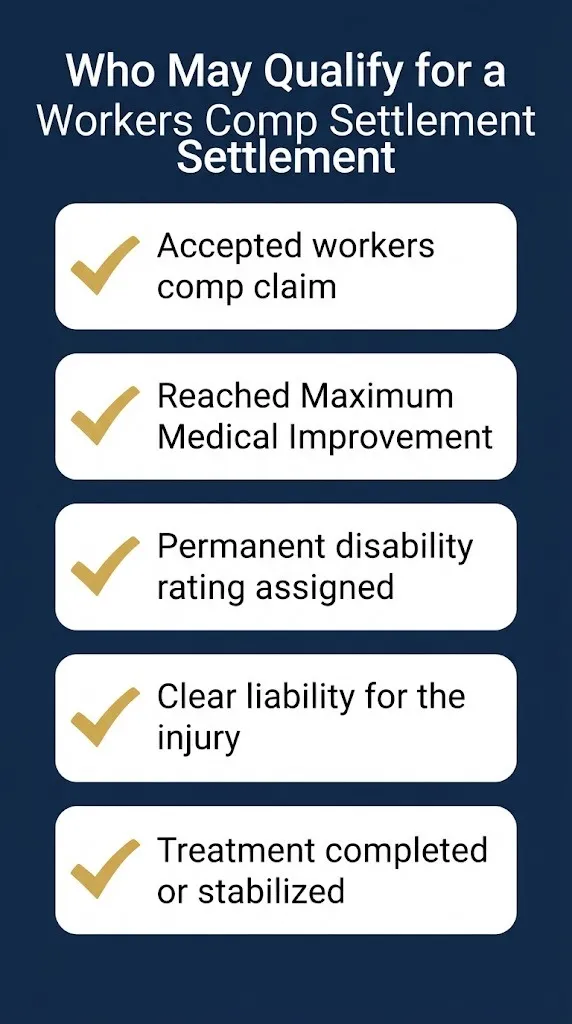
You may qualify for a workers’ comp settlement if you have an accepted workers’ compensation claim and your doctor has determined you’ve reached Maximum Medical Improvement (MMI). MMI means your condition has stabilized as much as it’s likely to.
Not every case settles. Some claims stay open for ongoing medical treatment. You may still settle the indemnity portion (lost wages) while keeping medical benefits open, but many settlements close the entire claim.
Factors that make settlement more likely:
- Your injury has resulted in a permanent disability rating
- The insurance company wants to close its exposure to future medical costs
- Liability is clear, meaning the employer’s responsibility isn’t disputed
- You’ve completed treatment and have a clear prognosis
Factors that may push against settlement:
- You still need ongoing medical care or surgery
- Your condition could worsen over time
- The disability rating hasn’t been finalized
Reality Check: No one calls you out of the blue and offers settlement money without paperwork. If someone promises a fast settlement for an upfront fee, it’s a scam. Filing is free, and legitimate settlements go through a claims administrator and judge approval.
What Is the Difference Between Compromise and Release and Stipulated Award?
A Compromise and Release (C&R) closes your entire claim for a single lump sum. A Stipulated Award keeps your medical benefits open and pays permanent disability in installments.
The C&R is the most common settlement type. You get one check, and the case ends. You’re responsible for any future medical costs out of that money. That’s the tradeoff for certainty.
A Stipulated Award is different. The judge orders the insurance company to pay permanent disability benefits over time. Your future medical care stays open. You can request treatment when needed without negotiating a new settlement.
Here’s how they compare:
| Feature | Compromise & Release | Stipulated Award |
|---|---|---|
| Payment Type | Lump sum | Periodic payments |
| Future Medical | Closed; you pay | Open; insurer pays |
| Finality | Case ends | Case stays open |
| Best For | Stable condition, clear prognosis | Ongoing treatment needs |
Think of it like a warranty on a used car. The C&R is selling the car as-is. The Stipulated Award is keeping the warranty active.
How Do You Calculate a Workers Comp Settlement?
You calculate a workers’ comp settlement by multiplying your permanent disability (PD) rate by the number of weeks assigned to your disability rating. Then you add future medical costs and any unpaid benefits.
In California, the formula uses two numbers:
- Your weekly PD rate: Two-thirds of your average weekly wage, capped by statute. For 2026 injuries, the range runs from $160 to $290 per week for ratings under 70%, and $240 to $435 per week for ratings of 70% or higher, plus a life pension.
- Your number of PD weeks: Set by California Labor Code § 4658 based on your disability rating. The weeks-per-point scale is non-linear, meaning a 30% disability is worth far more than three times a 10% disability.
Add future medical care and any unpaid temporary disability, and you get a settlement range.
A California workers’ comp judge must approve the final settlement, and they can suspend action if the numbers don’t add up.
Key Takeaway
Key Takeaway: Your settlement is built from your weekly PD rate multiplied by your disability weeks, plus future medical and unpaid benefits, and a judge must approve the final number.
How to Hire the Right Workers Comp Attorney
Hiring the right workers’ comp attorney means looking for one who is certified in workers’ compensation law and willing to take your case to hearing if needed.
The State Bar of California certifies workers’ compensation specialists. A certified specialist has passed a written exam, demonstrated extensive experience, completed ongoing education, and been favorably evaluated by other attorneys and judges.
Here’s what to look for:
- Certification. Check if the attorney is a State Bar certified specialist in workers’ compensation law.
- Experience with your type of injury. Ask if they’ve handled cases involving your specific body part or condition.
- Willingness to litigate. A lawyer who only settles cases may not fight for you at a hearing.
- Fee structure. In California, attorney fees are typically set at 15% of the settlement and are paid from the award, not upfront.
- Communication. Ask who will handle your case day-to-day and how often you’ll get updates.
The Reddit community’s advice is blunt: if you’re not being provided the benefits you deserve, hiring a lawyer is almost a given. One user advised looking at your state’s official workers’ comp site, pulling up recent cases in your area, and seeing which lawyers’ names appear most often.
What Happens If You Settle Before Reaching Maximum Medical Improvement?
Settling before Maximum Medical Improvement (MMI) is the single biggest mistake injured workers make. MMI is the point at which your condition has stabilized and further recovery is unlikely.
If you settle before MMI, you don’t know the full extent of your injuries. You might accept a settlement that doesn’t cover the care you’ll actually need. Insurance companies sometimes offer early settlements to close claims before the full cost is known.
The Reddit community echoes this. One user put it plainly: “If you are worried about future medical, don’t settle. You don’t have to. You can leave the claim open in the event that you need treatment in the future”.
Waiting for MMI gives you a clearer picture of your permanent disability rating, your future medical needs, and your lost earning capacity. That translates to a more accurate settlement value.
Key Takeaway
Key Takeaway: Never settle before reaching Maximum Medical Improvement, because you cannot know the full value of your claim until your condition stabilizes.
What Happens Next in the Workers Comp Settlement Process?
Here is the expected sequence once you and the insurance company agree on a number:
Immediately: Your attorney prepares the Compromise and Release or Stipulated Award documents.
Within 30 days: The documents are filed with the Workers’ Compensation Appeals Board for approval.
Expected 30 to 90 days: A judge reviews the settlement for adequacy. If approved, the case closes.
Expected 30 days after approval: Payment is issued. California law requires payment within 30 days of the settlement becoming final.
If disputed: The judge may suspend action and set the matter for an evidentiary hearing to build a record.
Frequently Asked Questions
Do I need a lawyer to settle a workers’ comp claim?
No, you can settle without a lawyer. But the insurance company has professional negotiators, and you do not. An attorney can help ensure your settlement reflects the full value of your claim.
How much does a workers’ comp attorney cost?
In California, attorney fees are typically set at 15% of the settlement and are paid from the award, not upfront. You do not pay out of pocket. Other states may have different caps.
Can I settle my workers’ comp claim and keep my medical benefits open?
Yes, in some cases. A Stipulated Award keeps future medical benefits open while settling the indemnity portion. A Compromise and Release closes everything.
How long does it take to get a workers’ comp settlement check?
After a judge approves the settlement, California law requires payment within 30 days. If the insurer delays, penalties may apply.
Can I reopen my workers’ comp claim after settling?
Generally, no. A Compromise and Release closes the claim permanently. That is why waiting until MMI is critical before settling.
What is a fair workers’ comp settlement?
A fair settlement covers your permanent disability, future medical costs, and lost earning capacity. The national average is around $29,750, but California averages $67,400.
Does filing for workers’ comp affect my job?
Your employer cannot legally fire you for filing a workers’ comp claim. Retaliation is prohibited under California law.
How long do I have to file a workers’ comp claim?
Deadlines vary by state. In California, you generally have 30 days to report a work injury to your employer and one year to file a claim with the Division of Workers’ Compensation.
Your Next Step
Gather your medical records, pay stubs, and any settlement offer paperwork. Write down your questions before you call a workers’ compensation attorney.
If you’re in California, check the State Bar’s certified specialist search to find an attorney who has demonstrated proficiency in workers’ comp law. Most offer free consultations. The call costs you nothing, and the information you get could be worth thousands.